Live game rules · South Island guide
Lightning Sic Bo: dice rules, marked spots and the fee
 Best casinos available in New ZealandUpdated 7 November 2026

Lightning Sic Bo uses three standard dice and a betting grid with markets such as Small/Big and Even/Odd. Evolution describes a 20% Lightning fee added to the total bet, followed by four or more randomly struck betting spots with multipliers from 5x to 2,000x. A selected spot must also be a winning outcome for that multiplier to matter. The public overview does not give a complete current operator payout grid, stake range or NZ access confirmation, so this guide explains the sequence and leaves those values to exact table help.
The short answer
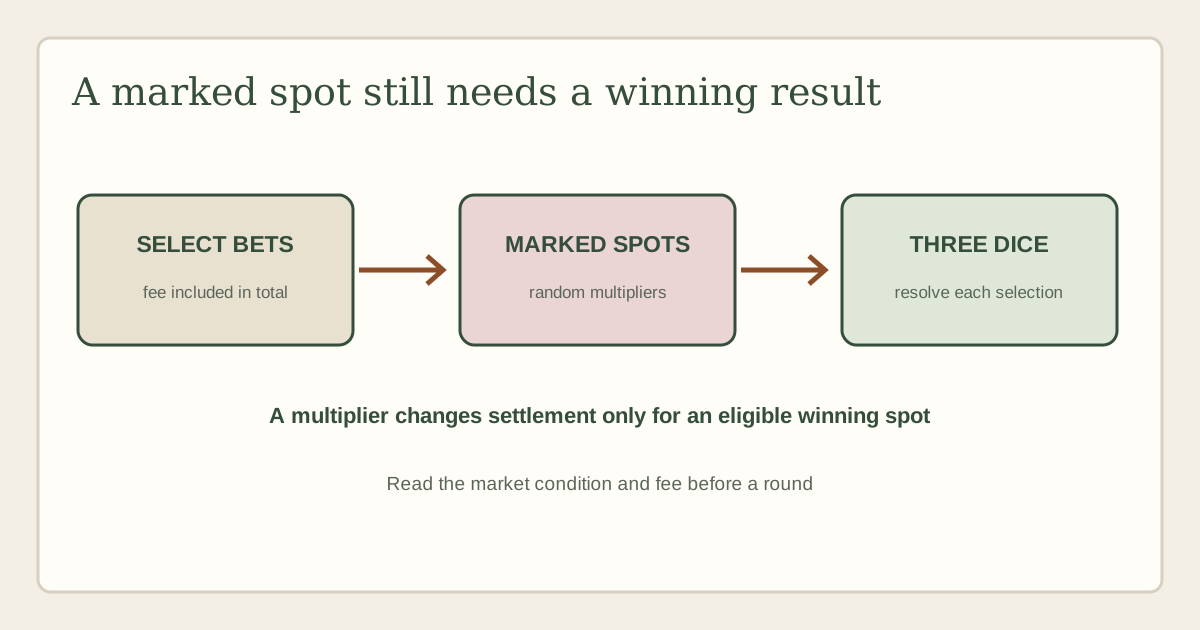
Lightning Sic Bo is Evolution’s three-dice game with a separate Lightning feature. Before the shake, a player selects one or more positions on the betting grid. The supplier describes a 20% Lightning fee on the total bet. After betting closes, at least four random positions on the grid receive multipliers between five and two thousand times while the dice are being shaken. The dice result then determines which selections win. A Lightning mark can enhance a matching winning position; a mark by itself does not change the dice result.
Evolution’s public overview identifies Small/Big, Even/Odd and other bet types. It says the game uses three standard dice, each showing one through six, and that the betting spots each have their own payout rate. The supplier description does not publish a complete current operator paytable, every market’s exact ratio, the live table’s stake range or New Zealand availability. This article does not transfer numbers from a different Sic Bo table or third-party casino.
The game can look busy because the grid, dice, Lightning strikes and multiplier values arrive close together. Follow the order: choose a spot, see which positions receive a Lightning value, read the three dice, identify any winning selection, then apply the multiplier only if the exact rules say it qualifies. That sequence is more reliable than focusing on the largest value shown on screen.
Confirm the title and rules panel
Begin with the title displayed in the game lobby and the matching heading inside the help panel. Lightning Sic Bo is not the same product as another Lightning title or a conventional Sic Bo table. Similar games may use three dice but differ in whether multipliers are attached to selected totals, what fee is charged, when the feature is applied, or which bets are eligible.
Use the supplier source to identify the broad product mechanic and the operator’s own table help to establish the exact active setup. The supplier describes the Lightning fee, number of dice, feature timing and multiplier range. A specific casino may show its own currency, limits, settlement wording and grid. Those settings should be recorded from the table actually being considered, not assumed from the catalogue.
If the help panel is dated or names a version, retain that information. If no version is shown, note the title and date checked. A page that says “Sic Bo” without identifying the Lightning variant is not enough to support a claim about this game’s fee or multiplier feature.
Three dice and the result
The supplier says the game uses three standard dice, each with faces from one to six. After the betting window closes and the dice are shaken, the three values form the result used to settle the selected grid positions. Depending on the market, a prediction can concern the individual faces, a combination, the total or a broad category such as odd/even.
The order in which dice land is not necessarily the same as an ordered bet. Check the market definition in the help. A total selection asks for a sum; a specific-dice or combination market can ask for a different relationship among the faces. The name of a position alone may not reveal whether order matters or whether repeated values count separately.
For a simple arithmetic illustration, if the dice show two, four and six, their total is twelve. That example only demonstrates addition. It does not establish whether twelve is classified as Big, what payout it carries, or which combination markets qualify. Those are grid rules, and the active table’s labels and help control.
The result screen should show the individual dice and identify winning positions. If you selected more than one spot, check each separately. A winning total bet can be a different event from a winning Small/Big bet. Likewise, a pair on the dice does not automatically settle as a pair bet unless that exact market was selected and its conditions were met.
Read the betting grid as separate markets
Evolution’s public overview names Small/Big and Even/Odd among the available choices and says the grid can contain other bet types. Sic Bo layouts commonly present broad totals and specific combinations, but the exact set and wording should be read from the active game help. This page does not copy a complete market list from a third-party screenshot.
Each marked position is a distinct wager. Before placing a selection, identify what event would make it win. A broad market may concern a category of results; a total market may require an exact sum; a specific combination can require exact dice faces or counts. The same three dice settle all positions, but the qualifying condition differs by market.
If you place several chips, the total amount is the sum across those positions plus the Lightning fee described by the supplier. Do not read each chip amount in isolation. The confirmation screen should show the combined stake and charge. If you cannot tell whether the displayed figure already includes the fee, stop and open the rules or amount summary before submitting.
Small, Big, Odd and Even
Small/Big and Even/Odd are broad categories named on Evolution’s public page. A result can satisfy one of the two options within each pair according to the table’s definitions. The table help should specify the exact totals included, what happens with a triple or special result, and whether a category bet is eligible for a Lightning multiplier.
Do not infer the limits of Small and Big merely from a standard Sic Bo memory or another operator’s game sheet. Some table variations treat edge totals, triples or particular combinations specially. Read the visible market tooltip or rules list and record the exact inclusion. A button label is a shorthand, not the full settlement rule.
Likewise, Even/Odd refers to a defined dice result under the table rules. It may be based on the sum or another displayed condition. Confirm how triples are treated and whether the game includes them in the broad result. The public overview does not answer every such exception, so the exact active help is necessary.
Totals and combination selections
A total market requires the dice sum to equal the selected number or range. A combination market may refer to a pair, triple, exact faces or a particular count. These market types often differ substantially in how many outcomes qualify and in their paytable, so a reader should not group them under a single “dice bet” description.
When two dice share a face, that fact is visible in the result. It matters only to markets whose rules include repeated faces. A triple is three matching values; a double is two matching values. A total-only selection can still win or lose independently of whether the dice contain a pair. The grid defines the market, not the animation label.
The supplier overview says each type has its own payout rate. It does not provide a complete table in the public text available for this review. If a position’s exact qualifying combinations or payout are not visible, avoid placing or describing that market as if its rule were obvious. Ask the operator or use the game help rather than extrapolating from a classic Sic Bo chart.
What the Lightning fee means
Evolution’s public overview says a Lightning fee of 20% is added to the total bet. This is a charge tied to the Lightning version, not an outcome multiplier, an RTP percentage or a promised return. It is important to account for the fee before evaluating the total amount exposed in a round.
For arithmetic only, a hypothetical set of selections totalling 100 units would produce a 20-unit fee at the described rate, for a combined total of 120 units if the fee is calculated on that base. This is not a New Zealand dollar stake example or a claim about rounding in any operator interface. Confirm whether the active help defines the percentage on each individual market, the combined amount or another stated base.
Check whether the table shows the fee as a separate line or folds it into the displayed total. If you place more than one selection, do not assume the fee appears once per market or once per round without reading the exact wording. The product overview uses “total bet”; operator help should answer how it is calculated for a particular interface.
A fee also changes the comparison with a conventional Sic Bo table. A payout ratio shown for the underlying dice bet may not include the Lightning charge. To compare like-for-like, identify the base market return, the Lightning multiplier treatment and the extra charge separately. Do not call the fee a “commission” unless the rules use that term, because commission conventions can differ.
When Lightning marks are assigned
The supplier says that after betting time expires, four or more random bet spots are struck while the dice are being shaken. Each selected spot receives a random multiplier in the stated five-to-two-thousand range. The values are assigned to positions on the grid; they are not assigned to every player’s wager individually.
A player benefits from a marker only when the selected spot is one of the winning outcomes and the active rules say the multiplier applies to that market. If a position is struck but the dice do not satisfy it, the marker does not change the prediction into a win. If a selection wins but has no Lightning marker, its base settlement follows the ordinary table rule.
The public description says four or more positions receive a value each round. That is a supplier-level feature statement, not evidence that the same spot will be selected regularly, that a chosen bet will be struck, or that every player receives a multiplier. The assignment is random per round in the description; prior history should not be treated as a schedule.
Worked sequence without a payout claim
Suppose a hypothetical player selects one exact total and one broad category. The betting window closes. Lightning markers appear on several positions, including the exact total but not the broad category. Then the dice are shaken. If the dice total matches the chosen exact total, the player’s first selection meets its base outcome condition and can receive the multiplier if that market is eligible. The broad selection is evaluated separately.
If the exact total was marked but does not match the dice, it is still a losing prediction under the base result. The multiplier cannot make a different dice total equal the selected one. This is the key distinction between a modifier and a winning condition. The result follows the selected bet’s rules before any eligible multiplier is applied.
No money amount is calculated in this example because the public overview does not provide the full base payout table or payout convention. The active game help must show what the selected market pays, whether the stake is returned and how the multiplier changes a qualifying award.
Payout tables, caps and unknowns
The Evolution product page says each bet type has its own payout rate and describes the Lightning feature range. It does not provide every rate for the full grid in a current, operator-specific table. Accordingly, this guide does not publish a universal payout table, RTP, house edge, minimum or maximum stake, or per-round monetary cap.
An exact paytable should identify each selection, the outcome that qualifies, the payout notation and whether the original stake is included in the displayed return. For Lightning bets it should also say whether the multiplier replaces or multiplies the base payout, and which markets are eligible. If an operator table is silent on one of these points, do not rely on an affiliate article to fill the gap.
The supplier’s maximum multiplier is a ceiling for a feature value, not a cash cap and not an expected result. The cash amount depends on the accepted bet and settlement calculation. A third-party chart may describe a named market in one jurisdiction, but it should not be used as the current value for a New Zealand player without the matching operator help.
If a payout appears inconsistent, retain the round number, chosen positions, fee, Lightning markers, dice result and result panel. That allows a reviewer to check whether the issue concerned the bet condition, multiplier eligibility, stake-return convention or a display total.
History and the temptation to predict
History can show prior dice results, winning positions or multipliers. This can help reconstruct a round or understand how the interface presents a settled result. It does not establish that a particular total or spot is due. A long run of low totals does not force the next total upward, and a large multiplier appearing once does not make a similar value more likely next time.
A recent-results board is descriptive. Do not use it as a strategy engine or a substitute for the paytable. If a page publishes long-run frequencies, determine whether they are theoretical, measured over a sample, or calculated from a specific set of rules. A percentage derived from a different fee, eligible market set or payout table may not apply to the active table.
The Lightning feature adds another random display layer to the dice prediction. It does not remove the need to meet the selected market’s outcome. Betting several spots may create more possible ways to match a result, but it also increases the combined amount at risk and may incur the fee. More selections do not guarantee a net-positive round.
Mobile interface and responsible use
On a phone, the betting grid may occupy most of the screen while the live video and result history use smaller panels. Verify the exact position label before placing a chip. A table can scroll within the game area, so confirm whether a panel is hidden below the grid before concluding that a rule is missing.
Check the total amount after every selection. A separate fee can make the final value larger than the sum of the chips you first noticed. If a lightning marker or payout label is too small to read, zoom or open the help before making a decision. Do not let a fast countdown turn an unclear screen into a guess.
Decide in advance how much time and money you are willing to spend, and stop at that limit. A multiplier ceiling is not a reason to increase a stake or chase a prior loss. If gambling is causing concern, use New Zealand’s support resources rather than continuing because a particular dice result seems close.
New Zealand access and advertising context
An Evolution listing does not prove that a named casino currently offers Lightning Sic Bo to a New Zealand account. Supplier presence, a local operator’s product catalogue, account eligibility and the legality of an advertisement are separate facts. This page makes no NZ availability claim and does not recommend an operator.
The DIA pages checked on 6 October 2026 say online-casino advertising is prohibited during the transition, and the advertiser guidance addresses parties that publish or arrange advertisements. The customer page says providers must not advertise to New Zealand people during this period. This is why the article remains informational and contains no affiliate button. Recheck the official rules before public distribution; the statement is an editorial compliance boundary, not legal advice.
A table-help checklist
- Confirm that the title is Lightning Sic Bo and that its own help panel is open.
- Check the definition and exact range of each Small/Big and Even/Odd selection.
- Read the total and combination market definitions; note whether order matters.
- Verify how a triple or other exceptional result affects broad bets.
- Confirm how the 20% fee is calculated and how it appears in the total wager.
- Check that at least four positions receive Lightning markers under the current rules.
- Record the published multiplier range and which markets are eligible for it.
- Confirm whether the multiplier replaces or multiplies the base payout.
- Check the ratio convention, table currency, stake limits and any operator cap.
- Save the round identifier if the markers, dice and settlement summary appear inconsistent.
Questions readers commonly ask
How many dice are used?
Evolution says Lightning Sic Bo uses three standard dice, each with faces from one to six. The exact market conditions are still determined by the table’s help. Do not assume that every familiar Sic Bo bet is present or has the same settlement wording.
What is the Lightning fee?
The supplier’s public description states that a 20% Lightning fee is added to the total bet. Check the active operator help to see how it calculates and displays the fee across multiple selected positions and in the chosen currency.
How are the multipliers assigned?
Evolution says four or more random bet spots are struck while the dice are being shaken, with multipliers between five and two thousand times in the public overview checked for this guide. A marked spot still needs to be a winning selection.
Does a Lightning mark turn a losing prediction into a win?
No. The dice must first satisfy the selected bet’s result condition. A multiplier modifies the settlement of an eligible winning position; it does not change which faces appeared or the market you selected.
Is the complete payout table available here?
No. The public supplier overview names broad markets and mechanic details but does not provide a full current operator-specific grid. Use the active game help for exact ratios, fee treatment, stake limits and payout convention.
Is this game available in New Zealand?
This guide cannot confirm a specific operator’s product catalogue or account eligibility. A supplier page does not establish local access. Check current official New Zealand government information and the operator’s terms; this page contains no casino referral.
Sources and verification boundary
- Evolution: Lightning Sic Bo — three-dice description, named market examples, supplier-stated fee and Lightning feature; checked 6 October 2026. No NZ operator help was accessed.
- Evolution Games catalogue — title listing; checked 6 October 2026.
- DIA: advertiser guidance and DIA: customer guidance — New Zealand advertising transition; checked 6 October 2026.
Competitor pages reviewed: https://www.casinos.com/games/lightning-sic-bo ; https://www.casinochick.com/live-dealer/lightning-sic-bo/ ; https://lightningsicbo.com/how-to-play/ ; https://evolutionarena.com/asian/lightning-sic-bo/ (cache miss); https://assets.lotoquebec.com/ressources/assets/v3/assets/blt8296e79a7001648c/blta9abb1dbfee4fef7/697a72f4d6c601679432d676/Lightning_Sic_Bo_EN.pdf . The independent pages and non-NZ operator rule sheet include market-specific numbers, so this article does not present them as universal or NZ-specific settings.
