Live game rules · South Island guide
Bet Stacker Blackjack: Bonus Element, Fees and Rules
 Best casinos available in New ZealandUpdated 7 November 2026

Classic Bet Stacker Blackjack combines a seven-seat blackjack table with a pre-deal Bonus Element. Evolution says a random card rank is selected with a value of 25%, 50%, 75% or 100% of the main bet; each matching initial card adds that amount. A 10% Bet Stacker fee applies to the main bet, not to later doubles or splits.
The short answer
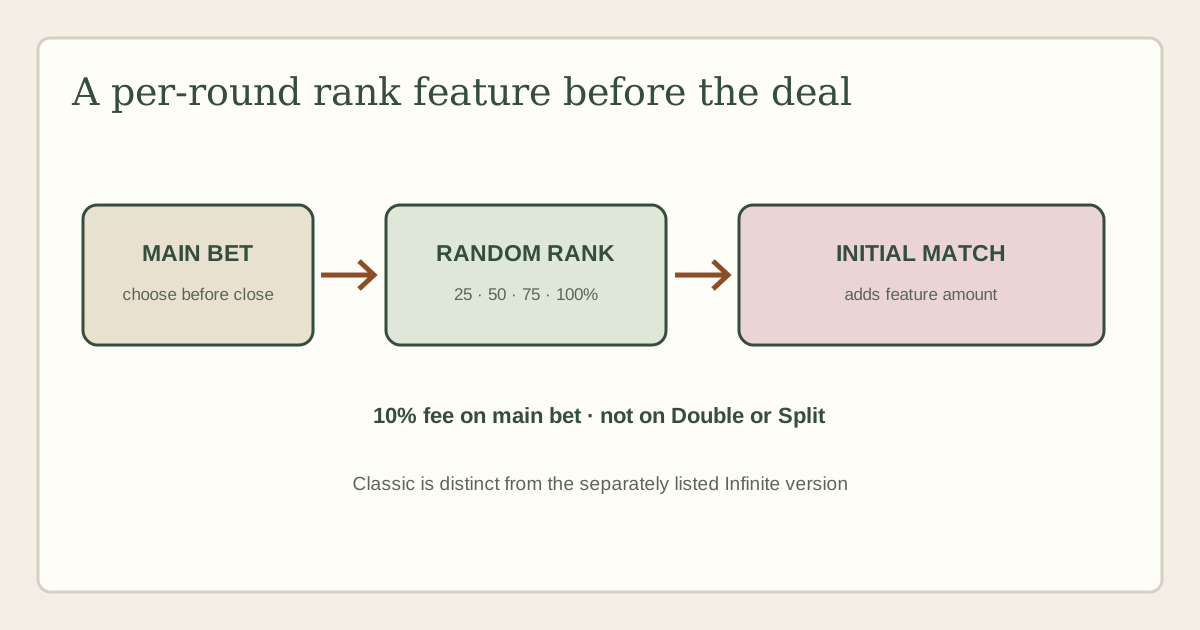
Evolution’s Classic Bet Stacker Blackjack is a seven-seat blackjack variant. The player’s aim remains to make a higher card count than the dealer without exceeding 21, but the game adds a separate Bet Stacker phase after betting closes and before the initial deal. A random Bonus Element rank is selected from card ranks A through K, together with a monetary value based on 25%, 50%, 75% or 100% of the main bet. Evolution says each of the player’s initial two cards that matches that rank adds the Bonus Element amount to the main bet.
The supplier says a 10% Bet Stacker fee is added to the main bet and that the fee does not apply to Double or Split. The Bonus Element value is included in the wager calculations for those actions: each new split hand includes the original wager plus the Bonus Element value, and a Double increases a new bet that consists of the wager acquired in the Bet Stacker phase. The public summary does not define every base blackjack rule, complete paytable, minimum or maximum stake, RTP or New Zealand operator setting. Check the exact table help. This guide covers Classic, not the separate Infinite version.
Identify the Classic version first
Evolution’s catalogue distinguishes Bet Stacker Blackjack and Infinite Bet Stacker Blackjack. The Classic product page describes a seven-seat table. Evolution says the Infinite version allows an unlimited number of players to join and links it separately. The title assigned to this page is Classic Bet Stacker Blackjack; the separate Infinite game has its own rules page and should not be merged into this guide.
This distinction matters because features can differ between the two titles. The Classic page names Perfect Pairs and 21+3 as available side bets, and says Bet Behind allows a player to stay involved if all seats are taken. The Infinite page is described elsewhere as having its own side-bet set and Six Card Charlie feature. Do not transfer the Infinite side-bet or hand rules into Classic, and do not assume that a rule seen in a standard blackjack game applies to either version.
Before using any description, compare the lobby name, page title and game-help heading. A casino may abbreviate the product or place both versions in a single category. The word “Infinite” is a meaningful product identifier, not a decorative synonym for a larger table. If the active interface does not clearly identify the version, open its help panel and confirm the title before relying on this page.
What remains blackjack and what changes
The official overview says the aim is to achieve a higher card count than the dealer without exceeding 21. That is the familiar objective. The changed element is the Bonus Element phase. It takes place after the betting time ends but before the initial cards are dealt. It uses a randomly generated card rank and a value linked to the main bet. The result can change the wager associated with the initial hand before the player makes standard blackjack decisions.
Do not infer the complete underlying blackjack rules from the short product summary. It does not specify all card values, dealer drawing rules, soft totals, natural blackjack settlement, split restrictions, doubling conditions, insurance availability, shoe composition or what happens on an equal final total. Many readers will recognise common blackjack conventions, but a familiar convention is not a substitute for the active table’s rules. Check each item in the help for the exact version and operator instance.
The Bonus Element changes the wager calculation; it does not change the target total of 21 in the supplier’s short explanation. It is not described as a card that is dealt to the player, a bonus hand, a multiplier applied after a win or a progressive pot. Treat it as a randomly chosen rank and an amount added to the main wager for each matching initial card.
Bet Stacker phase in sequence
The sequence begins with the betting period. A player selects the main blackjack wager and any available optional side bets. After the betting time concludes, the Bet Stacker phase starts. Evolution says the game generates a random Bonus Element whose value is a rank like one of the playing-card ranks from Ace to King and a monetary value associated with the main bet at 25%, 50%, 75% or 100%.
Once the rank and value are shown, the dealer deals initial cards to the players and the dealer. The player’s initial two cards are checked against the selected Bonus Element rank. Each matching rank adds the Bonus Element amount to the main bet. After this phase, the game resumes as regular blackjack under the table’s base rules. The exact interface should make visible the selected rank, the percentage, the relevant matches and how the amount was added before the player acts.
The timing is important. The Bonus Element is generated after betting closes, so it is not an input a player can choose when deciding the original wager. A player should not assume they can select a favourable rank or percentage. The official summary calls the rank random and lists the possible values; it does not provide the probability of each rank or each percentage. Therefore this guide does not calculate a chance of a particular stack amount.
When a matching card appears, confirm whether one or both initial cards match. If neither matches, the Bet Stacker phase may not add an amount under the supplier’s described condition. If one matches, the Bonus Element value is added once. If both match, the source wording says the value of each match is added. The exact cash accounting and fee display should be confirmed in the active rules and wager summary.
The Bonus Element rank
The rank can be any of the card ranks listed by Evolution: Ace, 2 through 10, Jack, Queen or King. The feature is rank-based in the supplier description. It is not described as suit-based. If a player receives a card of the selected rank, the card is a match regardless of suit unless the table help says otherwise. Do not add a suit condition merely because the interface displays full card faces.
The Bonus Element is selected for the round and then compared with the player’s initial cards. The public page does not say that the dealer’s card or later hit cards earn a Bet Stacker addition. It specifically refers to the player’s initial two cards matching the Bonus Element. That boundary avoids a common misreading: this is not described as a growing amount for every card drawn later in the hand.
The initial two cards are also the point at which a pair can permit a Split decision under the table rules. If a pair matches the Bonus Element rank, the stack amount may matter to the later split calculations. Evolution explicitly says each new hand after a split includes the original wager plus the Bonus Element value. The active help should explain how that amount appears for one or two matching cards and how any split limit or additional stake works.
No exact chance is stated for the Bonus Element landing on a player’s card rank, or for both initial cards matching. A generic deck calculation would require knowing the table’s shoe composition, dealing process and randomisation assumptions. The supplier page does not provide those inputs. Avoid presenting a percentage based on a presumed number of decks as if it were an Evolution-certified probability.
The 25%, 50%, 75% and 100% values
Evolution names four possible Bonus Element value levels: 25%, 50%, 75% and 100% of the main bet. These percentages describe the feature amount relative to the main bet. They are not stated as the probability of the event, a return percentage, an RTP, or an amount guaranteed to be added on every round. The feature amount applies when the initial card rank matches the Bonus Element, according to the supplier description.
A simple arithmetic illustration can help explain the relationship without claiming a payout. If a hypothetical main bet were 20 NZD and the feature value displayed 50%, half of that base amount would be 10 NZD per qualifying initial-card match under the stated percentage convention. That illustration does not quote a real operator minimum, a table payout or the final amount at risk. The exact interface must show how many matches were recognised and which wager amount was used.
If both initial cards match, the supplier says the value of each match is added. Using the same hypothetical arithmetic, two matching cards would represent two additions of the stated feature value before applying the table’s subsequent hand rules. Do not assume a particular account credit from that sentence alone: the rules panel should clarify whether the added amounts are treated as the main wager, how the fee is displayed and what happens if the player doubles or splits.
Do not describe the largest 100% level as a guaranteed doubling of a winning payout. The percentage is related to the wager amount; it does not by itself define the outcome of the blackjack hand. A player can receive an added amount and still lose under the underlying game rules. Conversely, a 25% feature value does not mean that a hand is likely to win one quarter of the time. It is a wager component, not an outcome probability.
The 10% Bet Stacker fee
Evolution says a Bet Stacker fee of 10% is added to the main bet. The supplier also explicitly says this fee does not apply to Double and Split. That distinction should be stated clearly whenever a guide explains the feature. The fee is not the same as a blackjack payout ratio, a side-bet fee or an RTP. It is an additional charge identified by the supplier as part of this product’s main-bet structure.
The short official summary does not provide a worked cash example or an exact rounding convention. It also does not define every screen label that an operator may use to display the fee. Therefore, check how the table calculates the fee for its displayed currency and stake. If a player is comparing the total debit with the main stake, confirm whether the screen lists the base wager and fee as separate lines or combines them.
For a purely illustrative calculation, 10% of a hypothetical 20 NZD main bet is 2 NZD. That arithmetic says nothing about whether an operator’s minimum stake is 20 NZD, whether its fee rounds to cents, or whether the interface’s base value includes any additional stack amount. Use the example only to understand the percentage. The current help and accepted bet record determine actual treatment.
Do not carry the fee into a Double or Split as if it were charged again on those actions: the supplier says it does not apply to Double and Split. At the same time, do not conclude that those actions require no added amount. Evolution says the new Double wager includes the Bet Stacker amount, and each new Split hand includes the original wager plus the Bonus Element value. Fee treatment and bet composition are separate calculations.
Doubles and the added stack amount
After the Bet Stacker phase, regular blackjack play resumes. Evolution says that if the player chooses Double, the new bet consists of the new bet acquired during the Bet Stacker phase. The page’s concise wording does not show the full formula for every possible starting hand and amount, so read the exact help for the active table. The key verified point is that the stack amount is part of the amount considered when doubling; the player should not assume the Double calculation uses only the original stake.
Before choosing a Double action, inspect the prompt and the total additional amount. Confirm which part represents the original base wager, which part represents the Bet Stacker addition and whether a fee line is present. A familiar blackjack interface may label the control simply “Double,” while this variant has a wager overlay. Use the game’s calculation rather than mentally applying a standard blackjack rule to an altered amount.
The supplier says the 10% Bet Stacker fee does not apply to the Double action. That means a reader should not multiply the Double amount by an additional 10% based on a mistaken assumption that every action carries the initial fee. It does not, by itself, resolve every possible debit or return convention; the table help and accepted action screen remain the evidence for a particular operator.
There is no need to take a Double because a Bonus Element increased the wager. The feature creates a larger amount tied to a matching rank, but it does not establish that doubling is safer, more profitable or mathematically preferred. Any strategy conclusion would require complete rules, card probabilities and payout calculations that are not provided in the short supplier overview.
Splits and separate hands
Evolution says that when the player’s initial two cards form a pair and the player chooses Split, each new hand includes the original wager plus the Bonus Element value from the Bet Stacker phase. This is an important distinction from treating the Bonus Element as a one-time prize detached from later hands. The amount is included in the composition of each resulting hand as described by the supplier.
The source summary does not enumerate all split rules: which pairs may be split, how many times a hand may be split, whether aces are treated differently, whether one card is dealt to each new hand, or whether a split hand can later be doubled. Those details are often table-specific and must be checked in the current help. Do not fill the gap from standard blackjack convention without confirmation.
If both initial cards match the Bonus Element rank and form a pair, the feature amount may be added per matching initial card before split calculations. The exact interface should show the resulting amount for each new hand. Confirm that each hand’s wager summary is legible and that the total debit is understood before selecting Split. The supplier’s overview states the composition concept but not a universal account-credit example.
The 10% fee exception also applies to Split, according to Evolution. Do not interpret this as the split being free: the player is making a further wager under the game’s rules. It only means the supplier says the named fee is not applied to the Split action. The new stake amounts and any table limit still need to be verified.
Optional side bets and Bet Behind
The Classic product page names Perfect Pairs and 21+3 as available side bets. It does not give their complete paytables in the short description reviewed. A side bet usually has its own conditions, but the exact version’s help must establish which combinations count and how they settle. Do not borrow a paytable from another blackjack table, another supplier or the Infinite Bet Stacker title.
Keep the side bet separate from the Bonus Element. The supplier describes the Bonus Element as affecting the main bet based on the rank of the initial two cards. It does not say that the Bonus Element adds to Perfect Pairs or 21+3. The side bets have separate names and need their own rule and payout sections. Check the bet slip to see the amount placed on each market and the amount exposed for the hand.
Bet Behind is a participation option identified by Evolution: it allows a player to stay in the game when all seats are taken. It does not mean the player occupies a normal seat or controls another player’s actions. The public overview does not state all decision or limit rules for Bet Behind, so consult table help for what choices the behind player can make and how their wager follows the hand.
If the seven seats are occupied, confirm whether the interface presents Bet Behind and how the stake is recorded. Do not assume the option exists at every operator or in every version. The page confirms it as a feature of the Classic product description, but the exact session’s controls remain the source for availability.
Reading the payout table and RTP carefully
The Evolution overview identifies the main mechanic and names two side bets, but it does not publish a complete universal payout table or RTP in the material reviewed. A useful table-level review should identify natural blackjack treatment, dealer rules, ties, side-bet rows, the Bonus Element calculation, splits, doubles, fee treatment and stake boundaries. If any of these are absent, the guide should say the value is not confirmed instead of inventing a conventional value.
RTP is a theoretical aggregate measure under defined assumptions, not the payout of one hand and not a promise about a session. To verify an RTP, you need the exact table version, applicable bet structure, full paytable, probabilities and calculation scope. A number copied from a general blackjack article may assume a different deck count, dealer rule, side bet or fee and so would not describe Bet Stacker Blackjack.
Likewise, a multiplier or bonus amount should not be reported as a payout. The 25%–100% values describe the Bonus Element amount against the main bet. They do not say what the winning hand returns. A returned stake, a net win and an account credit are different things. Read the operator’s payout notation before turning a published percentage into a cash result.
If a third-party guide claims that the game uses a win-streak accumulator or a progressive stacking mechanic, compare that against Evolution’s public rules. The official description reviewed here says a random rank and percentage are generated in a Bet Stacker phase and matching initial cards add that amount; it does not describe a cumulative progression based on previous wins. Do not repeat a conflicting mechanic without a primary source.
A step-by-step settings check
First confirm the exact Classic title. Check whether the table is seven-seat and whether the screen identifies it as Bet Stacker Blackjack rather than Infinite. Read the operator name, game help version and date. Then inspect the baseline blackjack rules: card values, dealer action, natural hand, push, hit, stand, double, split and any insurance decision. The supplier’s short overview does not settle all of these.
Next inspect the Bet Stacker section. Find the rank set, possible percentages, how each initial match adds an amount, and the fee base and display. Confirm how the fee relates to the main stake and how the added amount is treated in a win, loss or push. Check the Double and Split examples in the table’s own wording. If the help gives a worked example, compare it with the accepted bet summary rather than replacing it with an assumption.
Then review Perfect Pairs and 21+3 individually. Note the exact conditions, payout rows, qualifying card timing and stake range. Check whether Bet Behind is visible and what action it allows. Finally, record the table’s currency, minimum and maximum stakes and any RTP if actually shown. Include the title, version, operator and jurisdiction in any note so a later reader can tell the figure’s scope.
During a hand, reconcile the main bet, any fee, the Bonus Element rank and percentage, each matching initial card, and any amount added to a Double or Split. A clear screen should let a player understand the arithmetic before confirming the action. If a line is not explained, pause and open the rules panel. A support question should include the round ID and exact displayed amounts.
Mobile readability and control checks
The Bonus Element phase introduces more information than a basic blackjack table: rank, percentage, matching initial cards, base wager, fee and possible extra amounts for later actions. On a mobile screen, check that these are visible at the same time or can be opened without losing the hand state. A banner that shows only “100%” without its reference amount is incomplete for a player trying to understand the wager.
The initial cards and Bonus Element should be distinguishable through text or an accessible label, not colour alone. Before tapping Hit, Stand, Double or Split, verify that the displayed stake corresponds to the action. If the controls move after the dealing animation or the decision timer is hard to see, avoid acting until the interface is clear. The mobile layout and action controls are operator-level implementation details; this guide does not claim to have tested every live table.
For Bet Behind, make sure the seat/behind status and accepted amount are visible. A table that is full may display several players, chips and hand totals. The player should be able to identify which decision belongs to them. If the interface does not make that clear, do not infer that another player’s action is the behind player’s action.
New Zealand market and advertising boundary
Evolution’s catalogue does not prove that Classic Bet Stacker Blackjack is enabled at an operator in New Zealand, or that any account can access a particular version. Its own games site says freeplay mode and individual game features can be subject to jurisdiction. This page makes no real-money availability, demo, licensing or eligibility claim. Check current government guidance and the operator’s current terms for market information.
The Department of Internal Affairs states that online casino providers must not advertise to people in New Zealand during the current transition. Its advertiser page says the advertising prohibition is in effect and covers third parties that publish or arrange to publish advertisements. Accordingly, this guide has no casino offer, affiliate route or sponsored CTA. It explains game mechanics without steering the reader to an operator.
The Bonus Element does not change the fact that a blackjack wager can be lost. A larger amount attached to a matching rank should not be described as free money or guaranteed upside. Set limits before a session and do not increase a stake to recover a loss. If gambling is affecting someone’s wellbeing or essential spending, pause and use the support links on the site’s safer gambling page.
Questions readers commonly ask
What is the Bonus Element?
Evolution says a random card rank from Ace through King is generated after betting closes, alongside a value equal to 25%, 50%, 75% or 100% of the main bet. Each matching initial player card adds that amount to the main bet.
Is the Bonus Element a progressive stack from previous wins?
The official description reviewed does not describe a previous-win progression. It describes a rank and value generated for the round. A competing description should not be applied unless it matches the exact product and current official rules.
What fee applies?
Evolution says a 10% Bet Stacker fee is added to the main bet. It says the fee does not apply to Double or Split. Check the live help for how the operator displays and calculates it.
Does the added stack amount matter when splitting?
Evolution says each new split hand includes the original wager plus the Bonus Element value. The exact pair rules, split limits and amount display are table-specific details to confirm in help.
Does the fee apply again to a Double or Split?
The supplier says the 10% fee does not apply to Double or Split. That does not make those actions wager-free; inspect the amount the active table asks you to add.
Which side bets are named for Classic Bet Stacker?
The official product page names Perfect Pairs and 21+3. It does not provide their complete universal payout schedules in the overview reviewed here.
Is Bet Stacker Blackjack the same as Infinite Bet Stacker Blackjack?
No. Evolution lists Infinite separately and describes it as allowing an unlimited number of players. This guide covers the Classic seven-seat title. Check the exact title before using a rule.
What is the RTP or the minimum stake?
The public supplier overview does not establish one universal RTP or stake range. Verify these values in the precise operator table’s help and terms, with the date and version.
Sources and verification boundary
Evolution’s official Classic Bet Stacker Blackjack page was checked on 6 October 2026. It confirms the seven-seat format; the blackjack objective stated in the overview; optional Perfect Pairs and 21+3 side bets; Bet Behind; the pre-deal random rank and 25%, 50%, 75% or 100% amount; additions for matching initial cards; the stated Double and Split composition; and the 10% fee with its exception for Double and Split. The page separately identifies an Infinite version. The public overview does not supply a complete base-game rulebook, universal paytable, RTP, table limits or New Zealand operator access. Third-party pages reviewed 6 October 2026 included a material mechanics conflict; Evolution’s official description controls the statements here. DIA guidance was checked the same day.
