Live game rules · South Island guide
Lightning Ball: tickets, two draws and Lightning rules
 Best casinos available in New ZealandUpdated 7 November 2026

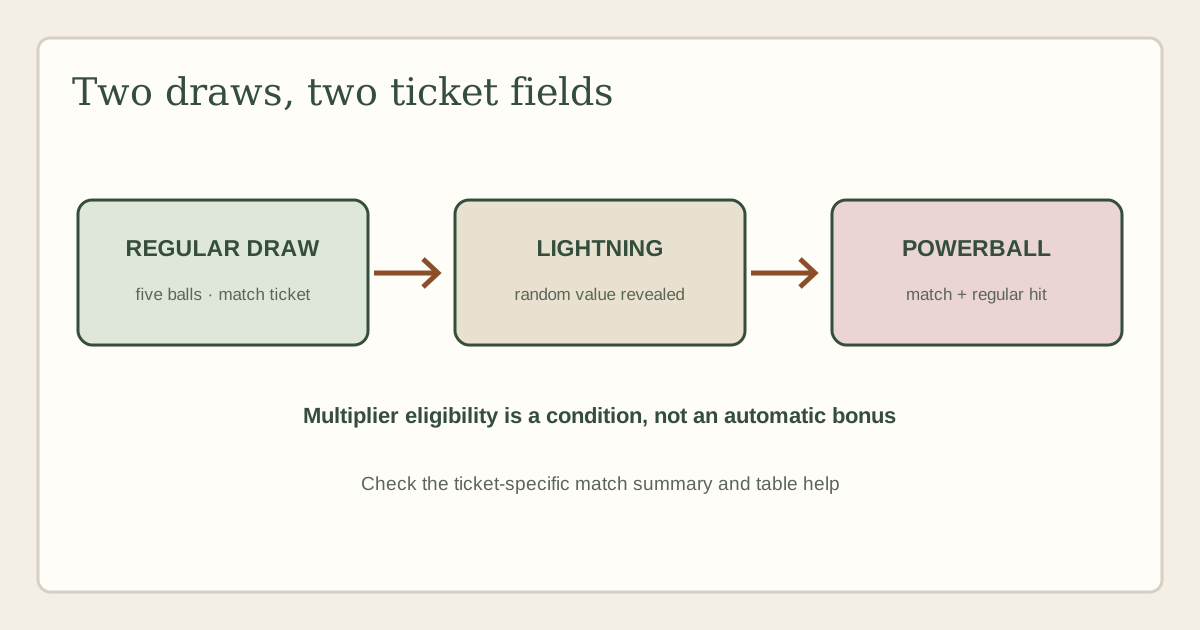
Lightning Ball is Evolution’s live ball-drawing game with two machines. A ticket has five regular numbers from one to thirty and a Powerball number from one to ten; the supplier says up to two hundred tickets may be bought in a round. Five regular balls are drawn, then a Powerball. A random Lightning multiplier is generated between those stages, and Evolution says it applies when the Powerball matches a ticket that also has at least one regular-number match. The full payout table and operator limits still require current table help.
The short answer
Lightning Ball is a live lottery-style game from Evolution that uses two ball machines and a ticket-based selection. A ticket contains five regular numbers from a pool of one to thirty and a separate Powerball number from one to ten. After the main draw, a Powerball is drawn from the second machine. The supplier says a ticket can win after matching at least two numbers, and a Powerball match combined with at least one regular match is the condition for applying the Lightning multiplier.
That distinction matters: a ticket’s ordinary matches and its multiplier eligibility are separate checks. The title page describes a random multiplier in the two-to-fifty range, generated after the five regular balls and before the Powerball is drawn. It does not provide a complete, current operator payout grid in the public overview. This guide therefore explains the stages and withholds a universal payout table, RTP, ticket price or New Zealand stake range.
The supplier also says a player may buy up to two hundred tickets in a round. That is a listed product limit, not a suggestion to buy more tickets or an operator-specific promise for every session. Check the exact table help for ticket bundles, permitted ticket amounts, per-ticket stake, currency and total limits. No operator was accessed for this guide, so local availability is not claimed.
What makes it a two-machine game
The first machine contains the regular-number pool. It draws five numbers after the betting window closes. A ticket’s matching regular numbers are marked on screen. The second machine draws one Powerball from a separate pool. The two steps matter because the game does not describe the Powerball as simply another one of the five regular balls.
The lightning feature is timed between those draws. Evolution says that after the five regular numbers are drawn, a random Lightning multiplier is generated. Then the game switches to the Powerball machine. If the Powerball matches the number printed on a ticket that also has at least one regular match, the Lightning multiplier is applied to that ticket’s payout. That is the supplier-described condition, not a general multiplier on every ticket.
When watching the presentation, identify which machine is active and which number pool it represents. The host and animations can make the feature feel like one continuous draw, but the ticket has two distinct number fields. If a help panel or result screen abbreviates the regular and Powerball matches, open the full result before concluding that a multiplier should have applied.
Read a ticket correctly
Each ticket has a regular set and one separate Powerball number. Keep those fields visually distinct when reviewing a ticket. A red mark on one of the regular numbers indicates a main-draw match in the supplier’s description; a Powerball mark is checked against the second machine. The game’s final result should make clear how many regular matches occurred and whether the Powerball condition was met.
Evolution’s public description says each ticket includes five regular numbers between one and thirty and one Powerball number between one and ten. It does not, in the accessible title overview, explain every ticket-selection control or whether a specific operator’s table automatically generates numbers. Do not assume that you can pick, edit or save combinations unless the active interface shows that function and the help describes it.
If several tickets are purchased, verify the ticket count and the value assigned to each before betting closes. The total at risk depends on both the ticket price and the number selected. A count of two hundred is the supplier-described maximum for the product page checked; it does not tell you the cost of a bundle, the operator’s maximum account exposure or whether all ticket combinations are unique.
The main number draw
Once betting has closed, the regular machine draws five numbered balls from the pool. Compare each called number with each ticket’s regular field. A single ticket can contain none, one or several matching regular numbers. The Evolution overview describes a reduced winning threshold of two matching numbers. It also says the payout depends on how many numbers are matched.
The public copy should be read with the table help because the separate Powerball condition can interact with the word “match.” The supplier’s multiplier explanation specifically says a Powerball must match and the ticket must also have at least one regular match for the multiplier to apply. The concise public page does not reproduce every row of the base payout table or clarify every settlement branch in a single matrix.
The safest approach is to inspect the result summary for both counts rather than trying to reconstruct the payout from an animation. If the table help distinguishes regular match count from total matching fields, use its exact terms. This article does not infer whether the Powerball is included in a headline threshold where the current title help does not say so explicitly.
A made-up ticket example
Imagine a ticket with regular numbers 3, 9, 17, 22 and 28, plus Powerball 6. Suppose the five regular balls include 9 and 22. That gives the ticket regular-number matches. If the separate Powerball is also 6, the supplier-described multiplier condition is satisfied because the Powerball matched and there was at least one regular match.
If the Powerball is a different number, the ticket can still have its regular matches, but the stated multiplier condition is not met. The exact base payout for that outcome must come from the current paytable. The example does not assert a money amount, a win amount, or the chance of the numbers appearing.
A different scenario would be a matching Powerball with no regular matches. The product overview says the multiplier requires at least one regular match as well. Do not treat the Powerball alone as a promise of the Lightning enhancement. The current game help should define whether that ticket has any base result and how it settles.
When the multiplier is generated
The supplier’s sequence places the Lightning multiplier after the five regular balls are drawn and before the Powerball is drawn. It describes a random multiplier between two times and fifty times. This timing can make the feature easy to misread: the multiplier is known before the final number is revealed, but its existence does not determine whether a ticket qualifies.
For any ticket, ask two separate questions after the result. First, did the regular number field meet a payout condition? Second, did the Powerball match and meet the supplier’s additional regular-match condition for the multiplier? The answer can differ by ticket, even when several tickets were submitted in the same round.
The product page’s range describes the possible multiplier values in the supplier overview. It is not a probability distribution, and it does not show how often a particular value is selected. It also does not mean every winning ticket receives the highest value. Avoid writing that a specific multiplier is likely, overdue or attached to each ticket unless the current rules make that exact claim.
“Up to” is a ceiling, not the payout table
A multiplier scales a qualifying payout; it does not independently state what the underlying payout is. To calculate a returned amount, a reader would need the exact match category, base payout, stake amount, rule for whether the stake is returned, applicable multiplier, and any operator cap. The public Evolution page checked here does not present the full table needed to calculate every branch.
That is why this guide does not repeat third-party payout ratios, an RTP or a theoretical top prize from an affiliate review. A number might be right for one table, one ticket value or a dated ruleset and still be misleading as a universal claim. A payout grid is current evidence only when its title, version, jurisdiction, operator and date can be identified.
If the active help displays a ratio, determine whether it states net profit or total return. Look for footnotes about matching the Powerball, minimum regular matches, multiple tickets and maximum round wins. The ticket’s potential result is not a simple multiplication of the visible Lightning number unless the rules say exactly which base amount it multiplies.
How to check ticket bundles and limits
The public product page says a player can purchase up to two hundred tickets per round. That gives readers a useful supplier-level capacity boundary. It does not establish the number of tickets in every pre-set bundle, the value of one ticket, or the permitted range of an operator’s currency. Those details can vary in the table interface.
Before buying a bundle, read the per-ticket value and the total. If the interface lets you add more than one pack, check whether the total updates after each addition. A selected number of tickets can increase total exposure quickly even if the amount per ticket looks small. Confirm that the round is still open before changing the amount and that the confirmation screen shows the final selection.
If a ticket value changes after an initial selection, verify which tickets it applies to. The product overview or game rules may describe a round-wide ticket value, but the active interface should show the exact total accepted for this account. Do not infer a New Zealand dollar range from a screenshot that uses euros, dollars or another currency.
Draw history and probability language
The history panel can show called numbers and settled results. It can help confirm whether a ticket was marked or which machine produced a particular number. It is not a mechanism for predicting the next draw. Seeing a number appear frequently in the recent window does not make it “hot” in a way that changes the next round under the public rule description.
Likewise, a rare combination is not made more likely by the fact that it has not occurred for several rounds. A graph, streak or tracker describes a selected historical sample. Without a documented dependence between rounds, it cannot justify a confident forecast. This page makes no number-selection strategy claim and does not calculate odds from assumptions that are absent from the rules source.
Several tickets can cover more combinations than one ticket if the combinations differ, but the total amount risked also increases. That simple relation is not a guarantee of profit. If an operator or tracker states the probability of an outcome, check the ticket generation rules, number pool, match definition and whether it models the multiplier condition. Different definitions can produce different figures.
Mobile view and result checking
Lightning Ball uses two machines, so a narrow screen may present the ticket list, main draw, multiplier and Powerball at different times. Before the round, make sure the regular numbers and Powerball field are legible. During settlement, view the full ticket result if the main summary shows only a total amount or a highlighted prize.
If you purchased multiple tickets, use the ticket identifier or expand each row rather than relying on an aggregate round result. A single Powerball match can apply to one ticket’s power field but not another’s. Likewise, two tickets may have different regular matches even though they share the same draw. The screen should connect each result to the ticket that qualifies.
If the game stream pauses or the result screen appears incomplete, do not repeat a wager because you are unsure what happened. Record the round identifier and use the operator’s history or support channel to obtain the accepted ticket and result. The animation is useful context; a settled record is stronger evidence for a disputed ticket.
Release, demo and New Zealand access
Evolution’s catalogue page shows Lightning Ball as a listed product and provides a public description of the mechanics. That does not establish a launch date for every market, current distribution by a particular operator, or the availability of a demo. A video or play button on a supplier page can be subject to jurisdiction and browser conditions.
No real-money game was opened for this article, and no claim is made that Lightning Ball is available to an account in New Zealand. The supplier’s global product information and the operator’s local offering answer different questions. Check a named operator’s current terms and the appropriate regulator rather than relying on a search snippet or a competitor’s casino list.
The Department of Internal Affairs says, on its New Zealand pages checked 6 October 2026, that online-casino advertising is prohibited during the present transition and that third parties can have advertising obligations. DIA customer information says providers must not advertise to New Zealand people during this period. Accordingly, this guide contains no referral buttons or casino invitation. Recheck government guidance before public distribution; this is an editorial status note, not legal advice.
A ticket review checklist
- Confirm the exact Lightning Ball title and open the rules from the active table.
- Separate the five regular-number fields from the individual Powerball field on every ticket.
- Verify the pool sizes and the number of balls drawn in the current supplier help.
- Check the product’s stated minimum-match condition and how it treats the Powerball.
- Confirm the order in which the Lightning multiplier is generated and the Powerball appears.
- Verify that multiplier eligibility requires a Powerball match and at least one regular match.
- Read the full payout row for each match category; do not infer it from the multiplier alone.
- Check the allowed number of tickets and the interface’s per-ticket and total amounts.
- Confirm any currency, bundle size, max stake or round cap from the operator’s current screen.
- Save the ticket and round identifiers if a result does not match the history display.
Questions readers commonly ask
How many numbers are on a Lightning Ball ticket?
Evolution’s public page describes five regular numbers and one Powerball number on each ticket. The regular field and the Powerball come from separate pools and are drawn by separate machines. Check the title’s current help for the exact ticket entry controls.
When can the Lightning multiplier apply?
The public supplier description says the Powerball must match and the ticket must have at least one regular-number match. It places the multiplier generation after the five regular balls and before the Powerball draw. The exact base payout still comes from the active paytable.
How many tickets can a player buy?
Evolution’s current public overview checked for this article says up to two hundred tickets can be bought in a round. The operator may display bundles, ticket values or limits that are specific to its own table. Confirm the total before betting closes.
Does the maximum multiplier guarantee a top prize?
No. The multiplier range is a ceiling on one feature value, not a guarantee of eligibility or a payout amount. A qualifying ticket and a base result are still required, and the current help must explain how the multiplier is applied.
What is the full payout table or RTP?
The public Evolution page checked here does not expose a complete current operator payout matrix or a New Zealand-specific RTP. This guide does not repeat figures from unrelated operator pages as universal. Use the current table help and preserve its title, date and market context.
Is Lightning Ball available in New Zealand?
This page cannot confirm a named operator’s distribution or account eligibility. The supplier catalogue lists the product, but that is not a local-access or licensing confirmation. Check official New Zealand sources and the operator’s terms; no casino link is included here.
Sources and verification boundary
- Evolution: Lightning Ball — ticket fields, two-machine process, matching condition, supplier-described multiplier range and stated ticket count; checked 6 October 2026. Current operator paytable and limits were not accessed.
- Evolution Games catalogue — catalogue title; checked 6 October 2026.
- DIA: advertiser guidance and DIA: customer guidance — NZ transition and advertising information; checked 6 October 2026.
Competitor pages reviewed: https://www.livedealer.org/lightning-ball-live-from-evolution/ ; https://pickpub.com/casino/live-game-shows/complete-guide-to-lightning-ball-by-evolution-gaming (search result inspected; destination was unavailable from the browser cache); https://8black.com/games/evolution-lightning-ball (cache miss); https://www.casinos.com/games/lightning-ball (not surfaced as a stable product page in the search set); https://clientzone.betconstruct.com/media/download/63dy05/lightning_ball_factsheet_eng_2024_07.pdf . The exact query had fewer accessible independent reviews than the other assigned topics. Secondary pages contain table-specific payout or stake claims that are not adopted here.
