Live game rules · South Island guide
Crazy Balls: round rules, card choices and bonus stages
 Best casinos available in New ZealandUpdated 7 November 2026

Crazy Balls combines a numbered-ball draw with card-based selections and four bonus formats: Coin Flip, Cash Hunt, Pachinko and Crazy Time. Evolution describes twenty random numbers drawn from one to sixty, with regular and bonus cards, Free Spaces, and Standard, Line or Global multipliers. This guide explains how to follow that sequence without treating a headline maximum, a bonus animation or a third-party RTP estimate as a guaranteed outcome or current operator setting.
The short answer
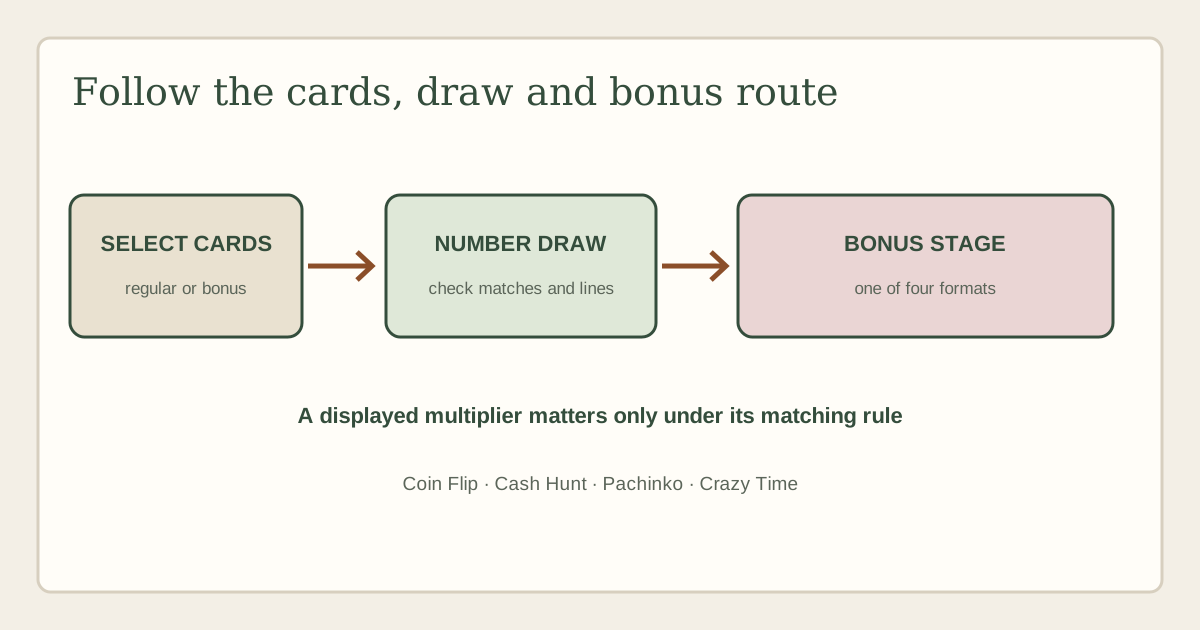
Crazy Balls is an Evolution live game show built around a numbered-ball draw. Before the draw, a player selects one or more regular cards or bonus cards. The game then draws numbers, marks relevant matches, checks whether a regular card has completed a qualifying line or whether a bonus card has met its condition, and may continue into one of four bonus formats. Those are Coin Flip, Cash Hunt, Pachinko and Crazy Time.
The official Evolution overview describes twenty random numbers from one to sixty, Free Spaces, multipliers and the four bonus games. It also names three multiplier types: Standard, Line and Global. A highlighted maximum on a supplier page describes an upper multiplier within part of the feature design. It does not mean that a player will receive that multiplier, that a particular stake pays a fixed sum, or that every bonus has the same cap.
The public supplier page is a mechanic overview, not a complete current operator paytable. It does not establish every stake limit, the return for every card, a universal RTP, or access for a particular New Zealand account. The active table help is needed for those details. This page keeps the product’s rule task in one URL rather than creating separate bonus, RTP or demo pages.
Identify the game and the cards
Start by checking that the active title says Crazy Balls and that the corresponding help refers to Evolution. The name is close to ordinary bingo language, but the game sequence is more specific: numbered balls are drawn, the numbers relate to selected cards, and bonus routes can add separate stages. A different title can use numbered balls without sharing this game’s card rules or paytable.
Evolution says a player can place bets on regular cards and on bonus-game cards. Its overview describes up to four regular cards and allows a choice of bonus cards associated with the named mini-games. A card is a selection surface; buying or selecting one does not guarantee that it will complete a line or trigger a bonus. The game help should define exactly how many markets are offered in a live operator interface.
If the screen shows a lobby tile plus a rules icon, open the help from inside the exact game. Verify that the content refers to Crazy Balls rather than a general game-show introduction. Preserve the displayed title, any table code and the date you reviewed it. This is especially useful if an operator’s lobby abbreviates a name or places several game shows in one menu.
How a round moves from betting to result
The first phase is selection. While betting remains open, choose which regular card or cards to back and whether to select any available bonus-game card. Check the stake shown next to each selection; the total exposure can be the sum of multiple positions. Once the betting period closes, Evolution describes Free Spaces and multipliers appearing on the cards before the draw.
The next phase is the ball draw. The supplier overview says the machine chooses twenty random numbers from a pool of one to sixty. Numbers that match a selected card are marked. The main game checks the result against the relevant card pattern and its rule wording. A bonus card can lead to a bonus game when its condition is met. The animation shows the sequence, while the help explains how the selection is evaluated.
The final phase depends on what the selections matched. A regular card can settle based on its qualifying line or other defined outcome. A bonus card can lead into Coin Flip, Cash Hunt, Pachinko or Crazy Time, each with its own displayed process. The round is not one single event: an ordinary card result and a bonus outcome are related parts of the same title but have distinct conditions.
Keep that phase sequence in mind when following a stream. The screen may present the multiplier allocation, the drawn balls, a line check and then a bonus animation in rapid order. If you look only at the largest visual element, it is easy to miss the earlier condition that determined whether your particular card had qualified.
Regular cards, Free Spaces and multipliers
Evolution describes Free Spaces on regular cards and three kinds of multipliers: Standard, Line and Global. Those labels indicate that multiplier placement can interact with a number, a completed line or more broadly with card outcomes. The public overview does not provide a complete operator-specific schedule for every card and multiplier combination, so this guide explains the categories without inventing their exact value table.
A Free Space is a designated cell that the supplier says acts as a drawn number. In a line-based format, a cell that is already counted can help a particular row, column or diagonal satisfy its rule. Do not assume that every card has the same configuration or that a visible open cell always qualifies; use the exact screen legend and game help to learn which lines and patterns count.
A multiplier is not automatically applied merely because it appears somewhere on the screen. The card, line, drawn number and multiplier type must satisfy the game’s rule. Check which card received the marker, whether its number was part of the draw, and what the result panel says about the affected selection. An attractive multiplier shown elsewhere on the board may have no effect on a different card.
When reading an individual settlement, separate three questions: did the card complete a qualifying result, was a multiplier allocated to that result, and what payout value did the operator’s paytable assign? The answer to one does not prove the other two. A completed line can settle without a special multiplier; a multiplier display can fail to qualify for your card; and a multiplier amount does not reveal the base payout by itself.
A hypothetical card check
Imagine a regular card whose rule says a completed horizontal row qualifies. After the draw, compare each cell in that row with the called numbers and any Free Space. If one or more required cells remain unmatched, the line is incomplete under that hypothetical condition. Do not use a special multiplier from another row to fill the missing match unless the active rules expressly say it can.
Now suppose a multiplier is shown on a position that is included in a completed line. The next check is whether the game labels it Standard, Line or Global and how the rule applies that label. The supplier identifies those three types but the operator’s full table may be needed to establish the exact settlement calculation. The example is a method for reading the screen, not a claim about a universal payout.
Bonus cards and their role
The four named bonus routes are part of Crazy Balls: Coin Flip, Cash Hunt, Pachinko and Crazy Time. The regular game uses number matches and card patterns; a bonus card is tied to a particular later feature. The interface and game help should show the specific condition that carries a selection into that bonus stage. A player should not assume that a regular-card line automatically triggers a bonus.
Evolution’s public page calls the title a mash-up of bingo-style play and those four bonus games. Each is a separate mini-format with its own presentation. The public game page provides more detail about some features than others; an independent full rulebook may contain further stages, but its language must be checked for title, date and market before using it as current operator help.
A useful pre-round question is “Which card am I backing and what event settles it?” If the answer is “regular line” or “a named bonus card,” write that down. Then check whether the selected card is independently wagered and whether the bonus outcome is tied to the main card or its own bet. The current table help should answer the relationship rather than the game’s visual theme.
Coin Flip in the Crazy Balls sequence
The supplier describes Coin Flip as a bonus game in which a two-sided coin determines which of the displayed multipliers applies. The public explanation says the sides are red and blue, that multiplier values are revealed, and that the winning side is determined by the coin’s final face. The result is a bonus-stage outcome connected to Crazy Balls, not a prediction of the numbered-ball draw.
When following the sequence, note when the multiplier values become visible and which card or selection triggered the stage. The coin’s colour and the selected outcome need to match the rules panel. A prior Coin Flip result, a run of one colour, or the visual size of a multiplier is not evidence that the next result is more likely to be one side.
The public supplier page is not a complete current payout document for every operator. It does not by itself settle whether the displayed value is net profit or total return, how a specific card stake is carried into the feature, or whether an operator applies a cap. Use the in-game help for the exact wager connection and settlement language.
Cash Hunt in the Crazy Balls sequence
Evolution describes Cash Hunt as a grid of concealed multipliers from which a player selects a target. The selected symbol is revealed when the feature resolves. That makes the stage visually different from the numbered-ball draw: the player chooses a target, then the game reveals the value associated with it. The available description does not support a claim that one symbol is more favourable or that a hidden location can be read from animation clues.
For a careful record, capture the bonus card or condition that qualified the selection, the chosen target if the interface provides one, the revealed multiplier and the final settlement label. Those are separate facts. Do not combine a promotional top multiplier from the overall game page with the payout for a specific Cash Hunt result unless the rules explicitly connect them.
If the target selection has a timer, decide only after the interface presents the actual choice and enough time to read it. The page does not establish the value of any unrevealed symbol in advance. A choice cannot be made reliably from a screenshot of a prior round because the grid contents are randomised for the current feature.
Pachinko in the Crazy Balls sequence
Evolution’s public description shows Pachinko as a pegboard-style feature with drop positions and landing zones. A puck or disc travels down the board; a zone can carry a multiplier or a Double result, after which the game applies its stated repeat or multiplier treatment. The presentation resembles a physical skill game, but the presence of a visible board does not establish that the player controls the random landing path.
Read the rules for how the starting position is chosen, which landing values are available and whether a Double causes another stage. The supplier overview says that the process can repeat and that the relevant multiplier values can be doubled, up to a named game cap. That upper limit applies to the described feature mechanics; it is not a prediction of the likely result or a promise for each operator’s maximum monetary payout.
Use the settlement display to distinguish the landing zone from any later doubling. A first landing, a repeated drop and the final payout are separate events. If the interface shows a cap or round limit, preserve its exact wording and scope. Do not infer that every bonus result can reach the same top value just because the game’s main promotional material contains a large headline multiplier.
Crazy Time in the Crazy Balls sequence
The Crazy Time feature uses a large wheel and selected flapper positions. Evolution’s public description explains that a player chooses among the displayed flappers, the wheel turns and the selected flapper points to a segment. A Double segment can cause the wheel to be spun again for the affected selection, with multiplier values doubled according to the game rule.
That wheel is a mini-game nested inside Crazy Balls. It is not the main Crazy Balls number draw and it does not replace the card-selection phase. Keep the original bonus card, the selected flapper, each spin and the final segment in the record. If an operator interface abbreviates a segment label, expand the result or help to see how it settles.
The supplier overview describes a maximum multiplier in relation to the feature, but it does not prove that a chosen player receives the maximum, that all wheel segments have the same likelihood or that any particular round is due to reach a Double. A repeat spin increases the duration of the bonus sequence; it does not turn a maximum into a normal expectation.
Payouts, maximum multipliers and RTP
An upper multiplier is only one term in a payout calculation. The base card result, selection amount, trigger condition, multiplier allocation and stake-return convention all matter. If a screen says “up to” a value, that phrase marks a ceiling, not the average, probability or minimum. It cannot be converted into an expected return without a complete rules table and a supported probability model.
The Evolution overview checked for this guide lists a high top multiplier for the Crazy Time feature and describes lower feature-specific handling, but it does not provide a complete operator-specific paytable or one verified New Zealand RTP. This article therefore does not publish a universal return percentage or exact payout grid. Numbers from an affiliate review or a live tracker can be useful leads, but they require confirmation against a current primary rules document.
When a paytable is available, confirm whether it applies to a regular card, a bonus card or one of the mini-games. Check the title, jurisdiction, operator, date and whether the ratio means net profit or total return. If the paytable is behind a table session and not publicly accessible, record the limit honestly rather than copying a value from another product.
What previous results can and cannot tell you
A visible history panel can help reconstruct what happened in earlier rounds. It may list called numbers, completed card patterns, bonus triggers or past results. That is useful for checking a specific settlement or learning where an interface puts the result data. It does not establish which numbers will be drawn next or where a future multiplier will appear.
Do not treat the number pool as a pattern that owes a particular result. A series of low numbers does not make a high number due in the next round. A long gap without one of the bonuses does not prove the feature is approaching. Unless a source describes a dependency, use each round’s stated random draw as a separate event rather than treating history as a predictive signal.
Third-party trackers may show observed counts, average gaps or historical maximums. Their data are observations over a chosen time range, not a guarantee for the next session, and their collection method may not match a player’s table. A theoretical return and an observed tracker value also answer different questions. Neither supplies the current operator’s paytable if the rules differ.
Mobile screen and round control
Crazy Balls can show several cards, the draw, a host and an active bonus at once. On a phone, some card details may require horizontal scrolling or a compact view. Before the betting window closes, verify the card label, chip amount and total. After it closes, follow which card is being evaluated rather than assuming all highlighted cards have the same stake or feature.
Use the table’s own history or help control when you need to check a rule. Avoid reading tiny promotional text in an animation as if it were a paytable. If a line marker, Free Space or multiplier label is difficult to distinguish, enlarge the relevant panel or wait until the result is fully displayed before forming a conclusion.
Fast animation is not a reason to click more quickly. If the timer is too short to identify the card or amount, skip the round rather than guess. Changing screen size affects readability and where controls are located; it does not change the underlying game rule. A captured mobile screenshot should include enough of the title or round identifier to be useful later.
Demo, release and New Zealand access
Evolution’s public game showcase lists Crazy Balls and may offer media or play features subject to jurisdiction. A visible catalogue tile confirms only that the product page is listed in that showcase when checked. It does not prove that an operator has deployed it, that a demo works in a particular location or that a New Zealand account can access real-money play.
No operator instance was opened for this guide, and no country-specific availability claim is made. If a demo is offered, its rules may help a reader identify the controls, but it should not be assumed to match an operator’s stakes, paytable or account terms. If a demo cannot load, note the access limitation; do not label the product discontinued on that basis alone.
New Zealand’s Department of Internal Affairs, on the pages checked 6 October 2026, says online-casino advertising is prohibited during the transition and that advertiser obligations can extend to third parties. The DIA customer page says providers must not advertise to people in New Zealand during this period. This guide is therefore factual and non-promotional: it includes no casino referral button or substitute operator link. Check current official guidance before public distribution; this statement is not legal advice.
A card and bonus verification checklist
- Confirm the exact title and supplier in the lobby and in the game’s own help panel.
- Note how many regular cards and which bonus cards are available in that operator’s interface.
- Check the betting-window end and the amount placed on every selected position.
- Read whether Free Spaces count as drawn numbers and which line patterns qualify.
- Identify whether a multiplier is Standard, Line or Global and which card it attaches to.
- Confirm the number pool and draw description from the current supplier or operator rules.
- Verify the trigger condition for each selected Coin Flip, Cash Hunt, Pachinko or Crazy Time card.
- Follow each bonus as its own sequence instead of conflating it with the main number result.
- Check payout notation, stake return and maximum payout in the exact table help.
- Save the round identifier if the card or feature settles in a way the help does not explain.
Questions readers commonly ask
How many balls does the supplier say are drawn?
Evolution’s public Crazy Balls page says twenty random numbers are selected from a pool of one to sixty. Confirm the same description in the current title help if a particular operator’s rules or display appear to use different wording.
Which bonus games are included?
The supplier lists Coin Flip, Cash Hunt, Pachinko and Crazy Time as Crazy Balls bonus formats. A bonus card and its trigger are separate from a regular card’s line result. Use the current help for the exact qualification and wager relationship.
What are Standard, Line and Global multipliers?
Evolution uses those labels for three multiplier types in the main card game. The public overview does not provide every operator-specific value or settlement combination. Check which card, line or result each marker affects rather than assuming a displayed multiplier applies to every selection.
Does the game guarantee a large multiplier?
No. A supplier’s “up to” figure describes a possible maximum within a feature description. It does not establish the chance of that outcome or a guaranteed return. The exact base result and the applicable operator paytable still determine settlement.
Is one bonus more likely because it has not appeared recently?
No such inference is supported by the supplier description. A history panel records prior events; it does not show that a bonus is due. Treat any tracker frequency as a past observation and do not use it as a promise about the next round.
Does the Evolution page prove NZ availability?
No. A supplier catalogue listing is not proof of an operator’s distribution, a player’s eligibility or New Zealand legal status. This guide makes no local access claim and directs readers to current official government information for regulatory questions.
Sources and verification boundary
- Evolution: Crazy Balls — public product sequence, numbered-ball description, multiplier categories and named bonus games; checked 6 October 2026. Operator paytable and NZ access were not verified.
- Evolution Games catalogue — catalogue title; checked 6 October 2026.
- DIA: advertiser guidance and DIA: customer guidance — New Zealand advertising transition; checked 6 October 2026.
Competitor pages reviewed: https://livecasinodata.com/games/crazy-balls/guide ; https://igamingfuture.com/live-dealer/crazy-balls/ ; https://www.livedealer.org/crazy-balls-live-evolution/ ; https://www.casinos.com/games/crazy-balls (redirected to a generic page during review); https://casinoscore.mobi/crazy-balls/how-to-play/ . The competing pages provide useful feature orientation but vary in RTP, cap and trigger claims; this guide follows the supplier description and does not repeat unsupported or tracker-derived figures as current settings.
If you arrived from the game-show wheel, our Crazy Time bonus round comparison and strategy and myths notes cover the four features and what tracking cannot do.
