Live game rules · South Island guide
Race Track: Rules, Racers, Modes and Changing Odds
 Best casinos available in New ZealandUpdated 7 November 2026

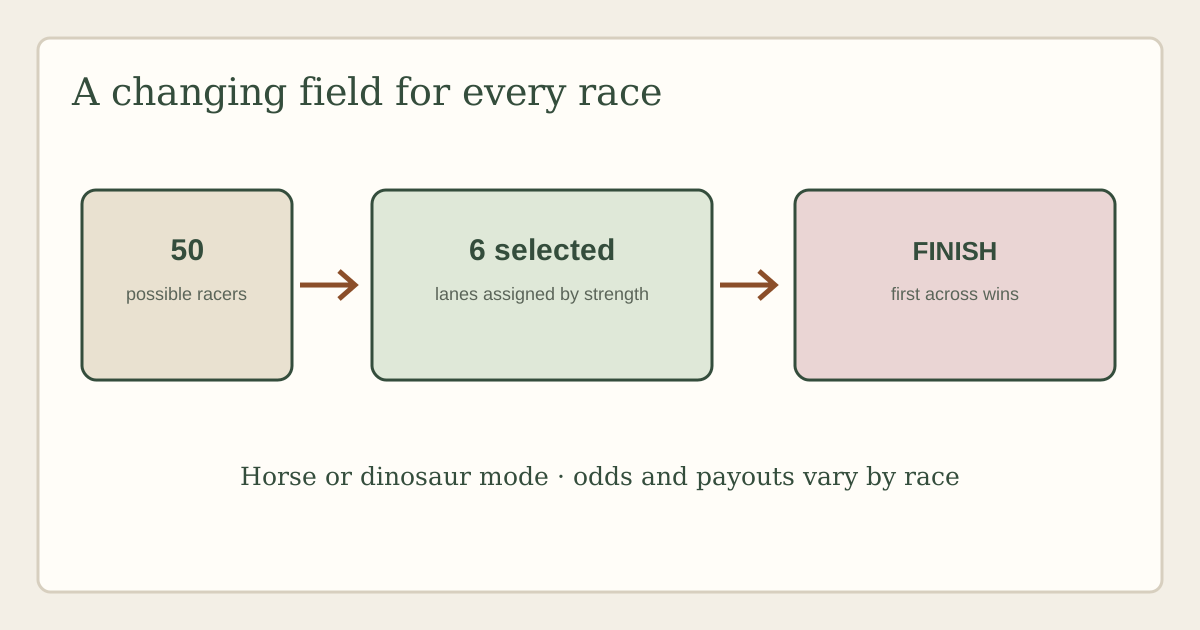
Evolution Race Track selects six racers from a pool of 50 and assigns them to lanes in descending strength order. The chosen horse or dinosaur that finishes first is the winner. The supplier says odds and payouts vary by race and describes two history-display modes; neither mode is a promise about a future result.
The short answer
Evolution Race Track is a race-based game show in which six racers are selected from a pool of 50. They are assigned to lanes in descending order of strength: the supplier says the strongest horse, or strongest dinosaur when Dinosaur Mode is selected, is placed in lane one, while the weakest of the selected field is placed in lane six. A player chooses the racer they think will finish first; the winner is the racer that crosses the finish line first. Evolution says winning odds and payouts vary for each race.
The supplier also describes an All Horses/All Dinos statistics mode that displays the racers’ performance in the last 100 races compared with theoretical winning probabilities, and a Tipster’s Choice mode that emphasises the racer with historically better performance than others. These displays are historical context, not a guarantee that the highlighted participant will win. The public page does not establish a universal payout table, RTP, stake range or New Zealand operator access. It also lists horse and dinosaur modes with host-stream and no-host variants, depending on jurisdiction. Verify the actual table and its help before relying on a setting.
Confirm the exact game and mode
This page covers the Evolution product named Race Track. The supplier presents it in horse and dinosaur modes and describes, for each mode, a variant with a live host video and one without that stream. The available version depends on jurisdiction, according to the page. A reader should therefore start by checking the table title and mode actually displayed rather than assuming a particular theme or presenter is available in every account.
The word “race track” is generic and may appear on unrelated games, sports products or third-party pages. Confirm the Evolution brand and the supplier’s exact product title. If an operator uses a shorter label, open its game help and compare the described field selection, 50-racer pool, lane assignment and statistics modes. A similar visual theme is not enough to identify the same product.
The supplier page explains the broad mechanic. It does not confirm an operator’s table ID, region, currency, wager range, rules revision or account eligibility. Keep those questions separate. The supplier can describe its product; only the exact game instance and operator terms can show the values and conditions presented to a particular player.
The pool of 50 and six-racer field
Evolution says each race has six randomly selected racers chosen from a possible 50. It groups the pool into strong, average and outsider racers. The six selected racers do not represent the entire pool in every race. The field for a particular event is assembled from that larger set, and the supplier says the six are assigned to lanes in descending order of strength.
That description provides a way to read the field, but it does not publish every selection probability, racer identity distribution or strength rating. Do not assume that each of 50 racers has an equal chance of appearing or that a named racer’s exact winning probability can be derived from its lane. The official summary does not provide the numerical table needed for those calculations. Read any probability shown by the actual game interface and record its scope.
The lane order is also not the finishing order. Lane one is described as the strongest racer in the selected field, and lane six the weakest, but the race still happens after betting closes and the finishing result is determined by who crosses first. A lane number can inform how the supplier labels the selected strength order; it is not a result guarantee. The official page presents the task as choosing the competitor expected to win, not as selecting the lane that must finish first.
If an interface presents horse names, colours, icons or lane numbers, match the chosen bet to the race card rather than remembering a previous race’s label. A racer drawn for one race is not automatically in the next. The selected field and displayed data should be checked anew before every round.
Race sequence from selection to result
The player first sees the available selection and associated odds or payouts for the current race. Evolution says a player may choose one or several racers. When betting closes, the race begins. The competitor that crosses the finish line first is the winner. The result appears on the screen. The supplier’s overview does not state a universal betting timer, minimum stake or exact layout; those should be confirmed in the active table’s help and betting panel.
Because the odds vary by race, a selection is linked to the current field and its current displayed terms. Do not carry a payout value from the previous race into the next. Before a bet is accepted, confirm the chosen racer, current displayed payout, amount and currency. If multiple racers are selected, check the interface’s total amount and settlement explanation. The supplier allows selection of “one or several,” but the exact betting-grid interaction and whether selections are independent should be read in the game help.
After the finish, compare the official winning label with the accepted wager. A race animation can make the leader at an intermediate point look like the likely result, but the supplier defines the winner as whoever crosses the line first. Wait for the official result. If the game records a photo finish or interruption, use the table’s settlement rules, not a paused video frame or commentator’s remark.
To preserve evidence for a question, note the race or round identifier, the mode, selected racer, amount, displayed odds, result and date. That record separates a rule misunderstanding from a table-specific value and from a possible account-support issue.
Horse Mode and Dinosaur Mode
The Evolution page describes Horse Mode and Dinosaur Mode as the two thematic modes. Both use a six-racer field selected from the larger pool and use lane assignment by strength order in the supplier’s description. In each mode, one variant has live host video and another does not. Which variants a player can access depends on jurisdiction, according to Evolution. The source does not state that the two visual modes necessarily share every operator setting or identical display.
Theme is a presentation choice, not evidence that the underlying market or payout is different. Conversely, a shared basic mechanic does not prove all values are identical. Compare the exact rules and payout panel if an operator lists both modes. The title, host configuration, current table and displayed market should all be recorded. Do not transfer a specific stake limit or payout from a horse table to a dinosaur table without confirming it.
The host-video version and no-host version should also be treated as interface variants, not as two different prediction methods. A stream can change the presentation or studio context; the public description does not say that a host’s commentary alters the race odds. Do not infer outcome influence from a live presenter, broadcast timing, camera angle or voiceover unless an official rule explicitly says otherwise.
If only one variant appears in an operator lobby, that does not show the other has been permanently withdrawn. Availability can depend on the market and operator integration. The supplier page explicitly qualifies the alternatives by jurisdiction, so this guide does not tell a New Zealand reader that a particular mode or stream is available.
The odds and payout panel changes by race
Evolution explicitly says winning odds and payouts vary for each race. This is a key instruction: use the number shown for the current field, not a remembered value or static third-party table. A dynamic panel may display different odds for different racers after the six have been selected. Read the current panel before selecting and confirm that the value remains attached to your chosen racer in the accepted bet record.
“Odds” and “payout” may be used in different ways across interfaces. A displayed number could be a multiplier, decimal odds, a total-return figure or another notation. The supplier overview does not define a single universal display convention for every operator. Check help for whether the figure includes the original stake. A payout shown as a total return should not be treated as net winnings; a net figure should not have the stake added twice.
A changed payout from one round to the next is not, by itself, evidence of an error. The field changes and the supplier says values vary. To determine whether a value was displayed incorrectly or a ticket was accepted under a different amount, compare the current betting panel, accepted bet record and settlement history. Record the display close to the time of selection if the question depends on that value.
The public page does not publish one fixed payout grid or every possible odds number. Third-party game reviews may report examples or an observed range for one table, but an example cannot be generalized without its table, market and date. This guide does not state a universal minimum, maximum, house edge or RTP for Race Track.
Understanding the two statistics modes
All Horses or All Dinos
Evolution says All Horses/All Dinos mode shows each racer’s performance in the last 100 races compared with the racers’ theoretical winning probabilities. The display can be read as a way of placing recent history beside a theoretical reference. It does not mean the last 100 outcomes form a forecast for the next race. The source does not say the stats mode changes the field, alters a racer or guarantees that an underperformer will catch up.
When reading this screen, ask what is being compared: the observed performance over the stated sample and a theoretical probability. Those are different kinds of quantities. Recent frequency is retrospective. The theoretical winning probability is a model-based reference. The public description does not disclose every numerical assumption or the full method behind the calculation, so avoid reverse-engineering a precise probability from a screenshot without the game’s explanatory help.
The sample is limited to the last 100 races in the mode description. It is not described as the game’s complete historical archive, and a rolling sample can change as new events are added. If a figure changes after a new race, that does not necessarily mean an earlier record was edited; the window itself may have moved. Record the date and the mode when documenting an observation.
Tipster’s Choice
Tipster’s Choice emphasises the racer that has historically performed better than the others, according to Evolution. The word “historically” is the key boundary. It describes past performance; it does not say that the highlighted racer must win the current event or that the display is an independent expert forecast. It is a presentation of historical comparison, not a claim of certainty.
Before relying on a highlight, look for the mode’s explanation in the active table. Is the highlight based on the same group of selected racers, what time window does it use, and which performance measure does it compare? The public description is brief and does not define those details. Do not invent a weighting method, confidence percentage or prediction accuracy when none is published.
A highlighted racer may also have a different current payout from another racer. A history label and a current payout are separate pieces of information. One summarizes prior performance as defined by the mode; the other states the current bet terms. Check both, and do not treat the former as a guarantee that overrides the latter.
Historical data, probability and prediction limits
Race Track’s statistics can help a reader understand how the interface summarizes past performance. They do not make an outcome controllable. A record of 100 races is a sample window; it may show a deviation from a theoretical probability, but it does not prove that the next outcome will compensate for the difference. If a competitor appeared less often than expected over a sample, “due” is not a rule the supplier states.
Avoid treating the lane strength order as if it were a finishing order. Lane one has the strongest selected racer and lane six the weakest according to the supplier’s stated sorting. The game still resolves through an actual race. The ranking and race result answer different questions: one is a supplier-described strength assignment, the other is the observed winner. A guide should explain both without promising that one determines the other.
Do not calculate a theoretical return from a single current payout and an incomplete probability display. Expected value depends on the probability of each result and the payout convention for each selection, including any other relevant rules. If a source gives theoretical winning probability for racers but not the complete market and settlement details, the necessary inputs remain incomplete. This is why the public source does not allow a universal RTP claim in this guide.
The same caution applies to third-party claims of a best strategy, fixed edge or stable race outcome. A strategy may be an author’s opinion based on a sample, not an official rule. If the page does not state sample size, date, market, operator and methodology, the claim is not a verified setting. This guide describes the game’s published information and offers no betting system.
A table-specific checklist
Open the game help from the exact Race Track table. Confirm the current mode, horse or dinosaur variant, host/no-host presentation, and the current race’s field. Find how the selected racers are named, how the lane numbers map to strength order and which odds or payout applies to each selection. Check the betting window, stake range, currency and whether one or several racers can be selected together in the way the interface shows.
Then inspect All Horses/All Dinos and Tipster’s Choice definitions, if the table has them. Confirm the stated sample and how the comparison is labelled. Do not assume the panel contains a probability for every outcome or that a historical highlight predicts a winner. If the game help does not explain a chart, treat its interpretation as uncertain rather than making a statistical claim.
After selection, verify the bet receipt. It should identify the race, racer, amount and payout terms. Since values vary by race, a saved screenshot or round record should capture the current display rather than an old example. After the finish, compare the official winner with the accepted selection and account settlement. If the result is disputed, collect the round ID and contact the operator through its support process.
Mobile display and result legibility
The game combines a moving race with fields, labels and potentially historical data. On a phone, a compact screen can conceal part of the racer name or make lane labels hard to associate with the current field. Before using a selection, make sure the selected name and displayed odds remain visible in the bet confirmation. A chosen racer should not be identified solely by a colour or screen position that could shift after the next race.
If statistics are shown in a chart, check that the legend and the sample label remain readable at the screen width being used. A bar, arrow or highlight may be decorative if its meaning is not clear. Open the help before interpreting it. If the animation fills the screen, locate the settled result or history function and make sure it can be opened without accidentally placing another selection.
A host stream can be absent in one version and present in another. That interface difference may be relevant to a user’s accessibility or preference, but the supplier’s page makes availability jurisdiction-dependent. Do not assume a local operator can offer both. This guide also does not claim hands-on mobile testing of a live casino table; its visual checklist is a set of questions to ask at the actual interface.
How to compare third-party coverage
A competitor page can be useful for a quick explanation of the six-from-50 concept, the two modes or the history display. Several reviews also publish RTPs, payout ranges, stake examples and betting tactics. Those additional values are not automatically invalid, but they need scope: named table, market, version, operator, source and date. If any of those are absent, do not repeat a value as a product-wide fact.
The pages reviewed for this guide often mixed the supplier mechanic with promotional casino content. Some described the statistics panel in a predictive tone or reported a fixed RTP and stake limit without showing whether it belonged to a particular configuration. The useful part is the quick explanation of how to enter a race and read a six-racer field. The gap is separating the supplier’s changing odds from a table-specific number and explaining what a 100-race history display can and cannot establish.
When using any competitor explanation, compare each factual clause against the official Race Track page or game help. If the competitor says “always live,” check the mode because Evolution lists versions without a live host video. If it says the odds are fixed, compare with the supplier’s explicit statement that they vary per race. If it recommends chasing historical underperformers, recognise that as strategy language, not a supplier rule.
New Zealand availability and responsible use
The official Evolution page lists modes and explains that their variants depend on jurisdiction. It does not confirm that Race Track is available from any particular New Zealand operator or that a player can access the horse or dinosaur version. Evolution’s catalogue also says freeplay mode and individual features can be jurisdiction-dependent. This page does not claim local operator access, demo access, regulatory approval or account eligibility.
The Department of Internal Affairs says online casino providers must not advertise to people in New Zealand during the current transition. Its advertiser information says the prohibition is in effect and that rules cover third parties publishing or arranging advertisements. This guide therefore contains no operator recommendation, CPA route or sponsored call to action. It is an informational description of supplier-published game mechanics.
A changing odds display and a dramatic race should not be presented as a source of reliable income. A past winner, strongest lane, recent underperformer or Tipster’s Choice highlight does not guarantee a future result. Set personal limits away from the excitement of the game and stop if you feel pressure to recover a loss. The site’s safer gambling information links to New Zealand support resources.
Questions readers commonly ask
How many racers appear in one Race Track round?
Evolution says six racers are selected for each race from a possible pool of 50. The supplier says the selected participants are assigned to lanes in descending order of strength.
What decides the winner?
The Evolution page says the racer that crosses the finish line first is the winner. A mid-race lead is not the final result; use the completed result display.
Why do the odds change between races?
Evolution states that odds and payouts vary for each race. Read the current field’s values rather than applying a remembered number from another race or review.
Does lane one always win?
No such guarantee is stated. Lane one is described as the strongest selected racer, but the winner is the one that crosses the finish line first. Strength order and final result are distinct.
What does All Horses/All Dinos show?
Evolution says it compares performance in the last 100 races with theoretical winning probabilities. It is a historical/statistical display, not a guaranteed prediction of the next event.
What does Tipster’s Choice mean?
The supplier says it emphasises the racer with historically better performance than the others. Its public overview does not define every underlying calculation; check the game help and do not treat a highlight as certainty.
Are horse and dinosaur modes both available in New Zealand?
Evolution says variants depend on jurisdiction but does not establish New Zealand operator access. This guide makes no local availability claim.
What RTP, minimum and maximum stake apply?
The public overview does not establish a universal value for these settings. Verify the exact table’s help and operator terms, recording the table and date.
Sources and verification boundary
Evolution’s official Race Track page was checked on 6 October 2026. It confirms the six-from-50 field, strength-ordered lane assignment, first-to-finish winner, per-race odds and payout variation, two statistics modes with the stated 100-race comparison and historical emphasis, and horse/dinosaur variants with and without host video depending on jurisdiction. The public page does not establish a universal paytable, RTP, stake limits or New Zealand availability. Secondary pages reviewed on 6 October 2026 provided some useful quick-start explanations but also made fixed-value and strategy claims without universal scope; those claims are not repeated here. DIA advertiser/customer guidance was checked the same day.
