Live game rules · South Island guide
War: Rules, Tie Decisions and Repeated Bets
 Best casinos available in New ZealandUpdated 7 November 2026

Evolution War compares one face-up card for the player with one for the dealer. A tie opens a Surrender or Go To War choice; a timed-out choice defaults to surrender. The supplier says a side bet can be selected without the main bet, and repeated ties continue under a defined doubled-bet process.
The short answer
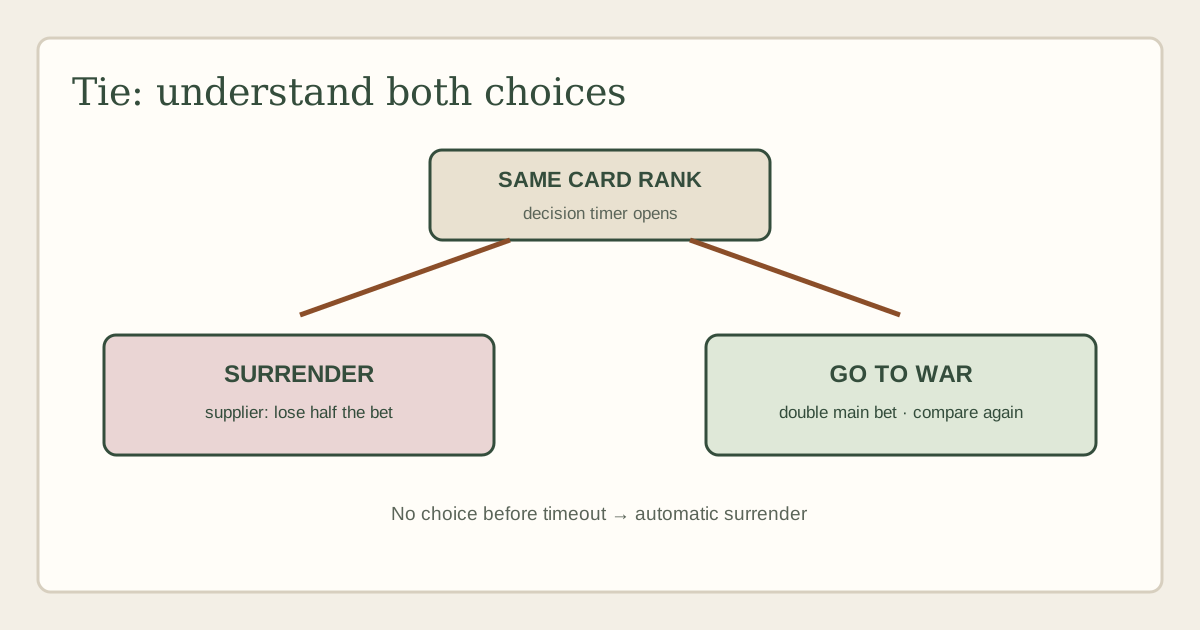
Evolution War is a live card game show based on comparing a player’s face-up card with the dealer’s face-up card. The higher-ranking card wins the main round. If both cards have the same rank, the player sees a choice between Surrender and Go To War. Evolution says that if the decision timer expires without a choice, the game automatically surrenders. Surrender means losing half of the player’s bet and ending that player’s round. Going to War doubles the main bet and continues with a further card comparison after the dealer discards three cards face down.
The supplier also says a player may select the main bet, a side bet, or both, and the side bet can be placed by itself. A further tie during War repeats the comparison with the existing doubled bet, without another decision or extra bet; the game allows up to four consecutive ties in a round. The exact side-bet payout, card ranking details, table limits, RTP and operator configuration are not fully established by the supplier summary. Check the current table help before using any figure. This guide does not recommend a decision as a way to improve expected results.
What this guide covers
This page explains the specific Evolution-branded game called War. It follows the sequence described on Evolution’s own product page: selection, initial card comparison, tie choice, surrender or war, and any additional tie. It does not claim every casino uses identical settings. It does not cover every traditional casino war variant, land-based house rules or other card games with a War label.
That boundary matters because “casino war” is a general game family, while a supplier’s table can have its own side bet, tie process or timeout rule. A printed brochure for a land-based venue may explain a similarly named game but cannot establish how the online Evolution table behaves. Use the supplier’s current game help for its mechanics, then the operator’s terms for account-specific information. If the two descriptions do not match, preserve the discrepancy instead of blending them into a generic rule.
The public product page provides more detail on the tie decision and continued War sequence than on a universal payout schedule. This guide gives the verified rule order and labels unknown settings clearly. It does not quote an RTP, stake range or side-bet ratio from a review without exact table, market and date context.
The opening selection phase
At the beginning of a round, Evolution says the player can put a chip on the main bet, the side bet, or both. The ability to choose the side bet alone is unusual enough to call out: the public rules do not say a main bet must accompany it. That does not establish what every operator interface will show or whether a table-specific condition applies, so verify the actual grid and help before selecting anything.
Treat each selected position as its own decision. If a player places one chip on the main market and another on a side market, the interface should identify both accepted stakes. A visually highlighted position can be difficult to distinguish from a selected or hovered control. Check the bet summary, amount and any currency symbol before betting closes. If the side bet alone is selected, confirm that the ticket records the side market and does not silently add a main wager.
The supplier page does not give the side bet’s complete name, conditions or payout in the summary reviewed for this guide. It is therefore not safe to infer that it is a familiar “tie” bet, a pair bet or an insurance wager based only on the word side bet. Read the name and qualifying event in the active table help. A side market can have a different card comparison or settlement rule from the main game.
The information needed before a round includes the selection timer, available stakes, currency, number of side options, and whether the interface confirms a wager. The game overview establishes the main structure, not these configurable details. If they are missing, pause rather than inferring them from another casino’s screenshot.
The first card comparison
After the selection period ends, Evolution says the player and dealer each receive one face-up card. The game compares rank. The higher-ranking card wins the round. A same-rank result is not a win for either side; it is the Tie outcome that opens the player’s next decision. The available summary does not spell out every rank order, how ace is treated, or the treatment of a rare deck-specific condition. Check the exact table help for those details rather than assuming every online implementation uses the same ranking language.
The card shown is the main evidence for the comparison. If a result is difficult to read in the video, use the game’s history or settlement display. A card’s suit is not said to decide the main round; the supplier describes the comparison by rank. Do not add a suit-based interpretation to the main result unless the exact market being considered explicitly includes suit.
When one card outranks the other, the game resolves the main comparison. The source summary’s detailed extra steps apply after a tie. It does not provide enough information to create a complete account of every possible winning payout, push or side bet. The account result and the table’s payout rules should be read together. A general explanation of who has the higher card cannot replace the table’s financial settlement table.
What happens on a tie
A tie occurs when player and dealer cards have the same rank, according to Evolution’s description. At that point, the player is asked to choose Surrender or Go To War. The choice is time-limited. If the player does not choose before the decision window ends, the supplier says the round automatically surrenders. A reader should understand this default before entering a round; the timer is part of the rule, not merely an interface detail.
The decision screen should identify the current stake and what each button does. If the screen is small, the wording may wrap or a timer may draw attention away from the amounts. Read the control labels and game help before betting. Do not tap a button just to dismiss a dialog. If the player is not prepared to make the tie decision in time, the supplier-stated timeout outcome is surrender, which loses half the player’s bet in this game.
A tie is not the same as an automatic push in this product’s described sequence. The player has a decision, and the available choice changes how the round continues. That makes generic descriptions of “casino war ties push” unreliable for this Evolution table. The exact table help should determine how the initial stake and any additions settle in the two paths.
Surrender: what the supplier says
Evolution defines Surrender as losing half of the player’s bet. The player’s game round then ends, although other players at the table may continue. That distinction helps explain why the table may display multiple seats with different round states. A player who surrenders is no longer participating in the continuing card comparisons for that hand.
“Half the bet” needs to be interpreted against the amount and bet type shown in the active table. The supplier’s summary does not provide a detailed example of how a side-only wager, an additional stake or an operator-specific bet denomination is treated. Do not calculate a cash deduction until the help says which wager the wording refers to. If the bet slip shows a main wager plus a side wager, the table should explain whether surrender affects only the main part and how the side market settles.
Surrender is also the automatic outcome when the choice period expires. A player should not assume inactivity means the game will wait indefinitely or preserve a decision. If a mobile connection slows, a tab loses focus or a prompt is obscured, the timeout can matter. Avoid starting a decision-sensitive round when the screen is unstable. If the account record appears inconsistent with the stated half-loss, save the round identifier and refer to the operator’s dispute procedure.
The purpose of this section is to define the published procedure, not to recommend surrender. Whether either available choice is favourable cannot be determined from the short rules summary alone; it would require the full applicable payout schedule, card probabilities and the precise treatment of additional wagers. No universal expected-value comparison is claimed here.
Go To War: the second comparison
If the player chooses Go To War, Evolution says the main bet must be doubled and the round continues. The dealer discards three cards face down, then both the player and dealer receive another face-up card. The new cards are compared. A higher player card wins according to the supplier’s description; the original wager is a push in that case, and the doubled bet wins. If the dealer card is higher, the player loses.
That wording distinguishes the original wager from the amount added to continue. It is important not to describe the sequence as simply “double or nothing” without checking the table’s exact settlement statement. The supplier says the original wager is a push when the player’s card beats the dealer in the war comparison, while the doubled bet wins. For a tie at this stage, another rule applies: the same process repeats with the existing doubled bet. The exact account credit convention should be verified in game help.
The three discarded cards are face down. The public summary does not describe them as a clue available to the player or explain a card-counting interface. They are part of the supplier’s stated deal sequence. Do not claim they can be tracked, identified, or used to improve a later decision from the product page alone.
Once the player has selected Go To War at the first tie, Evolution says that choice can be made only once. If another tie occurs, the player cannot newly choose surrender; the round immediately goes to War with the doubled bet. No extra bet is allowed during these repeated ties. This is different from a fresh choice at every tie and should be made clear before a player enters the game.
Repeated ties and the four-tie cap
The supplier says if a tie occurs again during War, the comparison process repeats until there is a winner, with four consecutive ties as the limit for each round. The same existing doubled bet remains in play; no additional bets are allowed at the repeated tie stage. The player does not receive another Surrender-versus-War choice after the first tie. The process resolves automatically under the defined rule.
The limit should not be paraphrased as four extra decisions or four new opportunities to increase the wager. It is a maximum count of consecutive ties in one round, according to Evolution’s public wording. The page does not explain in detail what exact terminal settlement occurs if the sequence reaches the cap without a higher card. That is a table-help question. Do not invent a final push or loss rule if the active help does not state it.
This also explains why a simple opening-card summary is incomplete. A reader needs to know that a tie creates a decision, that a timeout defaults to surrender, that going to war doubles the main bet, that additional ties repeat under the same doubled amount, and that the player cannot reselect after the initial choice. Each item can affect how a round appears in the history.
If an operator’s screen or rules use different terminology, copy the exact wording and compare it with the supplier page. There may be a version or configuration difference, or the help may be updated. Record the title and date checked. Do not assume a review written for a traditional physical card game resolves the online table’s repeated-tie limit.
Main bet and side bet are separate questions
Evolution allows a main bet, side bet or both, and explicitly says the side bet may be selected on its own. This tells the reader how the selection phase can work, but it does not disclose the side bet’s full condition or payout in the page reviewed. The main game outcome and side bet should be tracked as separate entries. A main loss does not automatically explain whether a side market wins or loses; the side market has its own qualifying rules.
Before choosing any side market, find its exact title in the table. Read whether it depends on rank, suit, a tie, a card combination or another event. Then locate its full settlement row. The term “side bet” is a category, not a sufficient rule. If an operator offers more than one side selection, do not transfer the terms for one to another.
A side-only ticket can also have a separate lower stake or limits from the main position. The supplier overview does not say whether that is so, so verify each bet’s range in the table. Check whether the interface’s total amount represents one selected ticket or the sum of main and side amounts. The display should distinguish these values before closure.
When reviewing a completed round, compare the official event with each bet’s own result. A player may have surrendered the main game but still need the separate side-market result. The account history may group these entries together or list them independently. Do not assume the main decision controls every other wager without a rule that says so.
A careful pre-round checklist
Before a round, identify the exact title and supplier. Confirm the main and side markets currently visible, their names and each stake amount. Read the table help for card ranking, the tie option, timeout behaviour, half-loss wording, doubled stake calculation, repeated-tie process and terminal limit. Make sure you know whether the side bet can stand alone on the actual table, rather than relying solely on a general overview.
Check the bet confirmation after placing a selection. Ensure the main bet is not present if you intended a side-only choice, and verify both positions if you chose both. Add their amounts. Do not assume that a chip moved visually or a button was tapped means the wager was accepted. The confirmation should reflect the currency, table limit and accepted amount.
Before any choice screen, notice the timer and know the button labels. An automatic surrender on timeout is the source-stated default. If a decision screen arrives but you cannot read or respond reliably, the safest operational action is to stop using that unstable interface and review the help before another round. This is about understanding the controls; it is not an advantage strategy.
After settlement, compare the round’s card sequence with the rule path. A first-card tie should lead to the choice screen. A Go To War selection should show the doubled main bet and second comparison. Any further tie should continue with no new bet, subject to the stated limit. If an account record differs, capture the round ID, table name and help version and use the operator’s formal support route.
How to read payout wording responsibly
The phrase “wins” in a short overview tells you who wins the comparison, not necessarily the exact cash credited. A table should distinguish stake returned, net winnings, pushes and losses. This is particularly important in the Go To War path because Evolution describes both the original wager and the doubled bet. Read each component separately. If the displayed amount appears to include the original stake, do not add that stake again when estimating a return.
For a side bet, record its own payout row and conditions. A high ratio alone does not establish the chance of the side event or expected return. A complete theoretical-return calculation would require the precise chance of each card outcome, deck or randomisation assumptions, market rules and all payout rows. The public overview reviewed does not provide the data needed for a universal calculation.
This guide therefore does not repeat the RTP figures that some third-party reviews attach to Evolution War. The pages reviewed include different tables and sometimes inconsistent values. A number that is accurate for one named table may still be false when presented as universal. For a setting you need, inspect the precise game help, keep its jurisdiction and date, and say if a source does not display the value.
Common misunderstandings
One error is to assume a tie automatically returns the initial wager. Evolution’s described game instead presents a decision and defines separate surrender and war procedures. Another is to assume the decision timer waits indefinitely; the supplier says it defaults to surrender. A third is to treat every repeated tie as a new choice; after the initial Go To War selection, further ties proceed under the existing doubled bet without another selection.
Another misunderstanding is to assume that the main bet must accompany the side bet. Evolution explicitly says the side bet can be placed alone. A table could still have version-specific presentation, so inspect the exact help. And do not infer the side-bet outcome from the main comparison without reading the side rule.
Finally, avoid importing the rules from a land-based Casino War brochure. The comparison theme may be familiar, but Evolution’s own online description includes timing, default behaviour, a doubling step and a maximum repeated-tie sequence. These specific details take precedence for this product. If a physical venue uses a similar name, it may have a different rulebook and is outside this page’s scope.
New Zealand availability and advertising boundary
Evolution’s catalogue is international and says that freeplay mode and individual features may depend on jurisdiction. Its game page does not confirm that War is available at a New Zealand operator or that any particular local account is eligible. No such availability claim is made here. Use current New Zealand Department of Internal Affairs guidance and the operator’s current terms when researching market and account conditions.
The DIA states that online casino providers must not advertise to people in New Zealand during the current transition. Its advertiser guidance says the advertising prohibition is in effect and that rules also cover third parties which publish or arrange publication. This page is therefore a rules reference with no offer, sponsored button or affiliate referral link. The existence of a supplier game page does not change that local advertising context.
The game explanation is also not a recommendation to wager. A decision between surrender and war should not be framed as a guaranteed way to avoid loss or create profit. If you or someone you know wants support, the site’s New Zealand safer gambling page lists available help routes. The point of this guide is to help a reader understand the published procedure before relying on any table-specific value.
Questions readers commonly ask
What happens when the first cards have the same rank?
Evolution says a Tie opens a Surrender or Go To War choice. If the decision timer expires, the game automatically surrenders. The active table help should be checked for any displayed version detail.
What does Surrender mean in this game?
The supplier says surrender loses half of the player’s bet and ends that player’s round, although other players may continue. The exact wager component should be checked in the table’s own settlement wording.
What does Go To War require?
Evolution says the main bet must be doubled. The dealer discards three cards face down, then both sides receive another face-up card. The supplier describes the original wager as a push if the player’s card beats the dealer’s, with the doubled bet winning.
Can I place the side bet without a main bet?
Evolution’s overview says yes: the player can place the side bet alone. Confirm the exact option and rules in the live table help because the overview does not state its full payout schedule.
Can I choose again after another tie?
Evolution says the player can choose Go To War only once, at the first tie. Further consecutive ties continue under the existing doubled bet without another decision or additional bet.
How many consecutive ties can one round have?
The supplier says four consecutive ties is the limit for a round. Its public summary does not explain every terminal settlement detail at that cap, so inspect the current table help for the exact final rule.
What is the RTP or minimum stake?
The Evolution overview reviewed for this guide does not establish one universal RTP or stake range. These are table-specific settings to verify in the exact operator’s help and terms.
Is Evolution War available to New Zealand players?
The supplier catalogue does not establish operator availability or local account eligibility. This page makes no such claim. Check current DIA guidance and the relevant operator terms.
Sources and verification boundary
Evolution’s official War page was checked on 6 October 2026. It confirms that the player may select the main bet, side bet or both, and that the side bet can stand alone; the initial card comparison; the Surrender or Go To War decision after a tie; automatic surrender on timeout; surrender’s stated half-bet loss; the doubled main bet and three-card discard during War; the supplier’s described push/win language; and a maximum of four consecutive ties with no further choice or added stake. The page does not provide the universal side-bet table, RTP, stake limits or New Zealand access. Secondary reviews and land-based rules were not treated as authority for this specific online product. DIA advertiser and customer guidance checked 6 October 2026.
