Crypto account guide · South Island guide
Crypto casino dormant accounts: inactivity fees, access and balances
 Best casinos available in New ZealandUpdated 7 November 2026

A dormant crypto casino account is defined by the operator’s current contract, not by a universal industry timer. Cloudbet’s Terms and Conditions, last updated 30 September 2026, define dormancy by twelve continuous months without login, bet, deposit or withdrawal activity, describe prior contact attempts, and permit a stated monthly administration fee after classification. That is a single operator’s clause. Other services can use different triggers, notice steps, fee currencies, access controls or remaining-fund rules.
The short answer
There is no universal period after which a crypto casino account becomes dormant, and there is no standard inactivity charge that can safely be assumed across operators. The answer comes from the current contract for the particular account. Read its definition of activity, the length of the measurement period, any notice or grace step, the exact fee and currency, how the balance is treated, and what the operator requires to restore access. Save a copy of the terms and the date you checked them, because account language can change.
Cloudbet provides a useful example of why the details matter. Its public Terms and Conditions page displayed a last-updated date of 30 September 2026 when checked for this guide. Clause 7.1.11 defines a dormant account by twelve continuous months without login, bet, deposit or withdrawal activity, says the operator will make reasonable attempts to contact the customer before classification, and allows suspension if the person does not respond or resume activity within a reasonable period. A later clause allows an administration fee of USD5, or the cryptocurrency equivalent, per month after classification, subject to stated limits. These are Cloudbet’s published terms, not a forecast for another casino and not a statement that Cloudbet is available to people in New Zealand.
The practical question is therefore not simply, “How long was I away?” It is, “Which version of the contract applies to this account, what event counts as activity, and what did the operator actually do?” This article sets out a careful way to answer that question without relying on a generic claim or on a remembered screen.
Dormancy is a contract label, not a single industry status
An operator may use words such as dormant, inactive, abandoned, suspended, restricted or closed. They can describe different states. A dormant flag might be an administrative classification while the account still exists. A suspension may prevent login or play. A closure may end normal access, while the operator still keeps records or owes an amount under its terms. The label alone does not say whether funds remain withdrawable or whether a fee has started.
Read the definitions section and the clauses around it. Look for the account name used in the contract, the start point for counting inactivity, and whether the operator treats several kinds of activity as equivalent. One service may count successful logins; another may require a completed transaction or wager. A failed login, an email click, a support conversation, or opening a mobile app might not be listed at all. Do not assume that activity in a separate sportsbook or another product counts for a casino wallet unless the terms explicitly say so.
The distinction also matters when a service uses crypto balances. A wallet address receiving a network transfer is not automatically the same thing as an account deposit being credited. A bet can appear in game history before or after a separate ledger entry. A display-currency estimate can change without any account activity. The dormancy clause determines which events reset its timer; a blockchain record or exchange price movement should not be treated as an operator-defined reset unless the contract says it is.
How to read the current Cloudbet clause
The public Cloudbet Terms and Conditions page identifies a continuous twelve-month period and names four kinds of activity: login, bet, deposit and withdrawal. The clause then describes contact attempts before classification, a chance to resume activity within a reasonable period following notice, and possible suspension if there is no response. This order matters. The fee clause applies after the account has been classified as dormant; it does not say that a fee begins automatically on the day twelve months elapse.
The same text states USD5 per month, or an equivalent in cryptocurrency, for as long as the account remains dormant. It gives two stopping points: reactivation or the Account Balance reaching zero, whichever happens first. It also says the fee will not take the Account Balance below zero and will not be charged for time before classification. The terms say that dormant-account funds remain the customer’s property, except for a fee charged under the stated clause, and that the operator may close the account under a separate clause after an extended inability to contact the customer.
Those pieces should be read together rather than compressed into a headline like “Cloudbet takes your balance after one year.” The text does not say the entire balance is forfeited at the twelve-month mark. It does allow a defined monthly fee after classification and says the remaining funds remain the customer’s property subject to that fee. A real account question still depends on the terms in force for that customer, the event history, any later amendment and applicable account verification. This guide does not determine contractual rights or provide a legal conclusion.
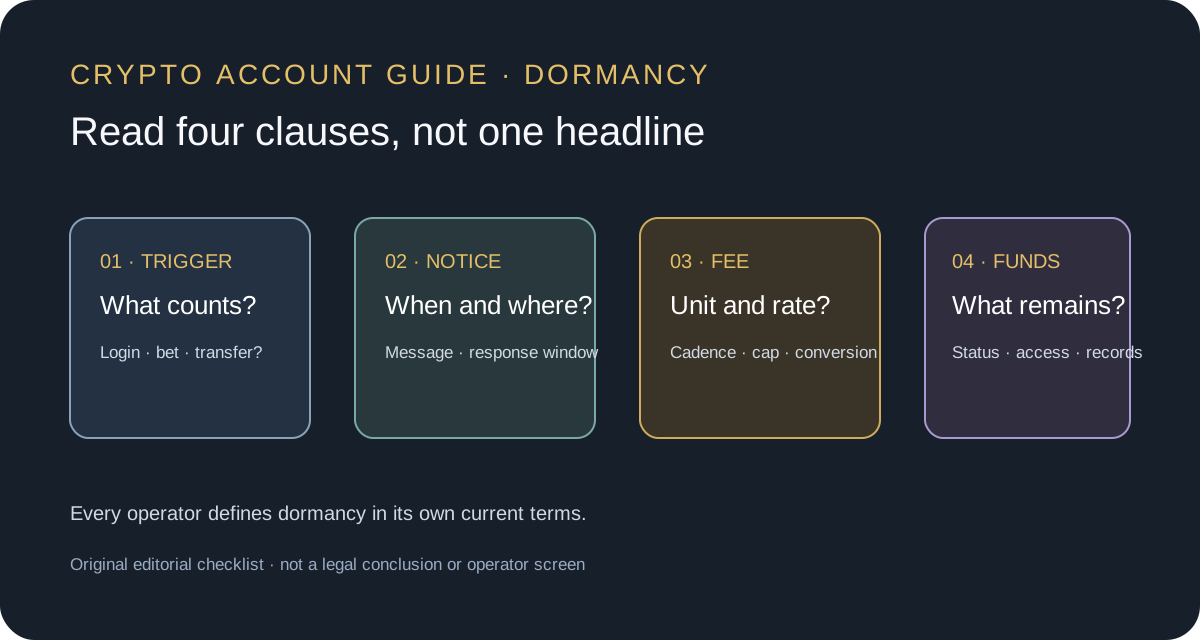
A four-part test for any operator’s inactivity rule
1. Find the trigger
Copy the exact sentence defining inactivity. Note the period, whether it is continuous, and the events that count. Record whether it says “no login”, “no transaction”, “no wagering activity”, or a combination. If the operator has separate wallet, casino and sportsbook products, see whether the clause applies to one product or the whole account. A table can help: event, counted or not stated, and where the contract says so.
Do not translate “no activity” into your own broader meaning. A login may preserve access but not reset a transaction-based timer. A bet may count even if the result is a loss, but only if the terms say so. A pending withdrawal may not be a completed withdrawal. If the contract is vague, label that ambiguity and ask support for the operator’s interpretation in writing rather than treating a guess as settled.
2. Find notice and the decision point
Look for whether notice is required, where it will be sent, and what happens if the email address is outdated or the message is filtered. Note any stated notice period or response window. “We may attempt to contact you” is not necessarily the same promise as “we will give you thirty days.” Preserve the wording and distinguish a promised step from a discretionary one.
Then identify when the status changes. Some terms may separate the inactivity threshold, notice, formal dormant classification, account suspension and the first fee date. Put each step in its own row. This prevents an old review or a support message from being mistaken for the current contractual trigger. If the site sends an account notice, save the message with full headers where available, date, subject and account reference.
3. Find the fee basis
Record the amount, currency, conversion wording, cadence and balance ceiling. Is the amount fixed in fiat, set in a named crypto asset, or converted at a rate selected by the operator? Does the fee apply monthly, once, or only after a grace period? Is it charged to any positive balance or only a real-money ledger? Do bonus funds, pending withdrawals, locked amounts or reserved bets count? The clause may not answer every question, so list what is missing.
Keep an operator’s dormancy charge separate from blockchain network fees, payment processing fees, withdrawal fees, currency conversion and a deposit handling charge. Those are different possible entries with different contractual bases. A statement showing a deduction should be matched to the clause the operator says authorises it. Do not assume that the word “administration” tells you how a crypto equivalent was calculated.
4. Find what remains after the change
Check whether the terms describe funds as retained, forfeited, transferred, subject to fees, or withdrawable on request. Look for separate rules on account closure, verification, open bets, bonus funds, chargebacks and legal holds. “Your balance remains yours” does not tell you the exact withdrawal path, supported asset, minimum, network or processing time. Conversely, a suspension clause does not prove that funds have been forfeited.
Make two lists: what the contract clearly states and what still needs an answer. Ask the operator to identify the balance components and current status, then explain any fee or hold by clause and transaction record. Keep the reply with the terms version. The goal is a specific record trail, not an assumption that every dormant account follows the same outcome.
Cryptocurrencies make fee language harder to compare
When a fee is named in fiat but payable in cryptocurrency, the contract may refer to an “equivalent” amount without presenting the conversion details in the same clause. Ask which rate source, timestamp, asset precision and rounding method are used. Ask whether the operator posts a separate ledger debit and whether the fee is valued when it accrues or when the account is later reactivated. If it uses more than one supported token, confirm which balance bears the charge and in what order.
The ticker matters. USDT, BTC and a platform’s internal accounting unit are not interchangeable merely because the interface shows a NZD estimate. A display estimate can move when the exchange rate changes, even if no fee or casino transaction occurred. Capture the unit shown next to the actual balance and the unit used in the fee clause. For a broader explanation of account units versus currency displays, use the existing crypto balance denomination guide.
Rounding can produce apparent differences. If a fee is converted to eight decimal places, the displayed line might be rounded again for a smaller screen. Compare the full ledger precision, if available, rather than subtracting two rounded values. Record the time zone and rate timestamp. If the operator cannot tell you how the crypto equivalent is calculated, report the fee as unexplained rather than silently converting it using a public market quote from another time.
Activity, login and proof
If the contract counts logins, preserve the account’s own security or access history if the service exposes it. A browser history record can show that a page opened on a device; it may not prove that the operator logged the account in. If the contract counts a bet, the transaction or game history should identify the account, game, date, stake unit and round or transaction reference. For a deposit or withdrawal, retain the casino ledger entry separately from the exchange record and network transaction.
Do not create activity solely to test whether a timer resets. A deliberate transfer or wager can introduce fees, risk or bonus conditions, and the terms may define a specific event as qualifying. Instead, ask support what exact event resets the inactivity period and whether it is already recorded. Request the last qualifying date and the current dormant status in writing. Do not send private keys, seed phrases or a full wallet credential to prove that a transaction occurred; those are not ordinary account-history evidence.
The operator may ask for identity verification before allowing account access or a withdrawal. That is a separate check from the dormancy definition. Read the privacy notice and only use the official account or support channel named by the operator. Do not send identity documents to an address copied from an unsolicited email. If you are unsure whether the request is genuine, access the company’s published help centre independently rather than using a link in the message.
A practical record pack
Create a small folder with a neutral label and a date. It can hold: the exact terms PDF or saved page; its last-updated date; the dormant-account clause; the notice email; the account status screen; a balance snapshot with asset ticker; transaction history; relevant deposit or withdrawal references; and the support conversation. Keep the materials read-only where practical so a later edit does not replace the version you first saw.
Use a simple timeline rather than a long narrative. For example: last qualifying activity shown by the account, date the operator says notice was sent, date dormant status began, each fee posting, date access changed, identity request, and support response. Mark uncertain dates as uncertain. If the support reply uses a different time zone, preserve the original text and add a separate converted time instead of altering the source record.
Avoid storing excessive personal data in screenshots. Hide unrelated balances, email addresses, wallet addresses, authentication codes and identity numbers before sharing a copy. Keep an untouched original in a secure location, but send only the information the operator needs. Never store a seed phrase or private key in the same evidence folder. The aim is to make the account question reproducible without creating a new security problem.
Questions to send to support
Use short, account-specific questions. Ask: “Which exact terms version and clause are you applying?” “What event and date started the inactivity period?” “Has the account been formally classified as dormant, and on what date?” “Was notice sent, to which registered channel, and what response period was provided?” “What is the account status now: active, restricted, suspended, dormant or closed?” These questions separate the contract from a generic help article.
Then ask for the balance breakdown by asset and category, including real-money balance, bonus balance if any, pending withdrawal, reserved amount and any fee debit. Ask for the date, currency, rate source and calculation used for a crypto-equivalent fee. Ask what identity information is required for reactivation or a permitted withdrawal and how to submit it securely. Request a ledger extract or a support-generated transaction list if the normal interface does not show the relevant period.
Keep the tone factual. Give the account ID through a verified support channel, but do not paste passwords or authenticator codes into an email. If a reply refers to a clause, compare the number and exact text with the saved terms. If the operator sends a newer version, save both versions and ask which effective date applies to the account event in question. Do not treat a support summary as a contract amendment unless the operator says it is.
Reactivation is not always the same as account access
A terms page can say that support is the reactivation path, yet an account may still require a password reset, identity check, security review or confirmation of ownership. Find out whether the operator is restoring login, lifting a suspension, enabling gameplay, or processing a withdrawal. Those are different outcomes. A customer who wants only to obtain a permitted remaining balance should say so clearly and ask whether the terms allow a withdrawal without resuming gambling activity.
Do not open a second account to get around a restriction. Multiple-account rules can create a separate dispute or freeze, and an account closure or self-exclusion may have its own safeguards. If you need a pause or closure rather than routine reactivation, the existing crypto account break and closure guide covers how to distinguish those states. It does not replace the operator’s current account-specific terms.
If access is restored, verify the balance before doing anything else. Save the status screen, statement and current terms. Compare each fee with the sequence the operator described. If an amount is in a different currency, preserve both the original unit and the displayed estimate. Avoid making a deposit or wager just to see whether controls work; confirm that support has completed the requested action and that the account state matches the written response.
Common misreadings
“Twelve months means every operator charges a fee at month twelve” is false as a general claim. The period, activity list, notice, classification and fee all vary by contract. Cloudbet’s current page gives a concrete example, but it cannot stand in for another brand’s terms. A review written before a terms update may describe an older clause. Compare the live operator wording and its date, not the date of a third-party article.
“A dormant account is automatically confiscated” also overstates what a clause may say. Some terms describe a fee, suspension or closure while preserving a stated balance treatment; others may have different language. Read the separate funds and closure provisions. A balance shown on screen is not proof of the precise legal status, but a suspension is not proof that the operator has taken ownership either.
“A public blockchain record resets the casino timer” confuses ledgers. A deposit has to be received and credited according to the account’s rules; the operator’s inactivity clause then decides what counts. “The interface shows NZD, so the fee is NZD” confuses a display estimate with the contractual debit unit. “Support said it should be fine” is not an adequate substitute for a date, clause, amount and written account status when a balance is involved.
A careful checklist before relying on an old account
- Find the operator’s current terms and save the version date.
- Copy the precise dormant or inactive definition.
- Mark each qualifying event and the period it measures.
- Identify notice steps, contact channels and any response window.
- Separate the trigger date, classification date and first fee date.
- Record fee amount, unit, cadence, conversion method and balance ceiling.
- Read the clauses for suspension, closure, bonus funds and remaining balances.
- Capture the account status and ledger before contacting support.
- Ask support for the clause, event date, balance breakdown and verification steps.
- Keep a private record without sharing credentials or unnecessary personal data.
If the terms are unclear, preserve the uncertainty. Do not convert a service-specific example into a promise about another account, and do not assume that a public currency estimate, login screen or old review changes the contract.
Sources and verification boundary
Primary source checked 8 October 2026: Cloudbet Terms and Conditions, displayed as last updated 30 September 2026, clauses 7.1.11–7.1.11.2. The article attributes the stated period, contact step and USD5 monthly example only to that published Cloudbet document. It does not establish access or legal eligibility for New Zealand residents, another operator’s terms, an individual account’s status, or an outcome for any customer. Competitor search results included older or inconsistent summaries; they were not used to replace the current primary terms. This is general information, not legal, financial or accounting advice.
