Crypto account guides · South Island guide
Crypto casino self-exclusion and account closure: funds and records
 Best casinos available in New ZealandUpdated 7 November 2026

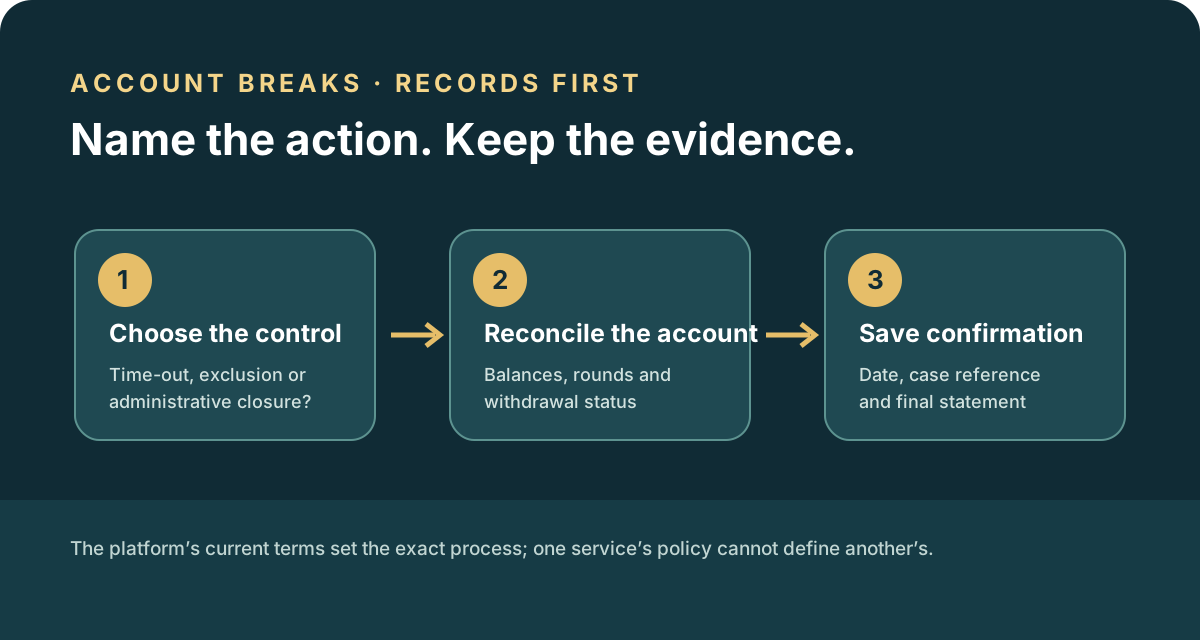
A logout, a cooling-off period, self-exclusion and permanent account closure are different actions. Before choosing one, identify the platform, the requested restriction, the duration, its product scope, the status of open rounds and the way any remaining balance is handled. Keep dated records of the request and response. Crypto-specific transaction details can help reconcile an account, but no universal withdrawal or refund rule can be inferred across operators.
Start with the action you actually want
The phrase “close my crypto casino account” can mean several things. A person might want to leave the current session, stop access for a defined period, ask for a self-exclusion, disable one product, or end the customer relationship and request closure. These actions can have different effects on log-in access, deposits, unsettled rounds, promotional funds, personal records and any remaining balance. The first useful step is to name the outcome precisely before pressing a button or sending a support message.
This guide gives a records-first way to compare those options. It does not assume every crypto casino provides every control, follows the same duration, pays funds in the same asset, or applies New Zealand’s regulated-platform requirements. A platform’s own current account terms and written support response matter. In New Zealand, the Department of Internal Affairs’ minimum standards apply to operators under the Online Casino Gambling Act; they are not evidence that an unverified offshore site is licensed or subject to those requirements. If a gambling break is needed because play feels difficult to control, contact independent support rather than treating account administration as a substitute for help.
Logout, time-out, self-exclusion and closure are not synonyms
Logging out ends access to the active screen. It does not, by itself, set a future restriction, cancel an account, change a deposit method, or create evidence that an operator has accepted a closure request. Closing an app or browser tab is even less conclusive: a session may remain active elsewhere, and a transaction already submitted may still be processing. Use the explicit account control or a written support request when the goal is to restrict future access.
A time-out or cooling-off tool usually describes a temporary, platform-level break. Its duration, whether the user can sign in to view account records, and whether it blocks all gambling products must be checked in that platform’s help. A self-exclusion is a more serious request to prevent participation for a specified or indefinite period. The operator may maintain an exclusion record and limit account access. An ordinary account closure is an administrative request to end an account; it may not automatically have the same harm-prevention scope or duration as self-exclusion.
The labels alone do not settle the issue. One service may use “deactivation” for reversible access suspension, while another uses “closure” for a final administrative state. “Responsible gambling break” could refer to a time-out, not a self-exclusion. Ask support to state the control’s exact name, effective time, duration, scope, account status and process for any remaining funds. Do not infer an account-wide restriction from a feature that applies only to a casino tab, a sportsbook, a single brand or one device.
A comparison table for the four common requests
| Request | Intended effect | Questions to resolve | What it does not prove by itself |
|---|---|---|---|
| Logout | Ends the current signed-in session | Are other devices still signed in? Are pending transactions complete? | That future access is blocked or the account is closed |
| Time-out | Pauses participation for a period | Start/end time, products covered, ability to cancel, treatment of open rounds | That funds are withdrawn or the customer relationship ended |
| Self-exclusion | Requests a gambling restriction for a defined or indefinite period | Duration, scope, covered accounts/products, confirmation and after-period process | That all related brands or unrelated operators are included |
| Account closure | Requests administrative termination or deactivation | Reversibility, records, final statement, balance and withdrawal handling | That the service treated the request as self-exclusion |
This table is a question framework, not a promise about any operator’s interface. If a platform offers both self-exclusion and account closure, choose based on the intended restriction and ask whether both steps are needed. If you are not sure, describe the outcome in plain language: “I want to stop gambling on this platform for the foreseeable future; please explain and apply the strongest available exclusion control.” A support agent can clarify its terminology. Avoid language that could be understood as a routine logout if you intend a sustained restriction.
Check the platform and scope before requesting a break
Record the exact website or app name, account username or email, and the product in which you played. Some services operate several products, brands or skins; a control might cover only one. The customer should ask whether the restriction applies to casino games, live games, sportsbook features, rewards, mobile applications and any related account under the same operator. Do not assume a group-wide block based on a company logo or common sign-in.
Check whether the request has to be made through an account setting, a particular responsible-gambling form, support chat or email. If there are several channels, use the one the current terms identify and retain its confirmation. Ask for the exact timestamp and time zone at which the restriction begins. A button labelled “start break” may take effect immediately, at the end of a current round, after a review, or after an identity check. The page should explain which; where it does not, the answer is not confirmed until support responds.
New Zealand has a regulatory framework for licensed online casino operators. The minimum standards in force from 8 July 2026 require covered platforms to make time-outs and self-exclusion accessible, and set operational obligations for exclusion registers. That statement is scoped to operators under the Act. It does not establish the status of a named platform or extend its local requirements to all international websites that accept crypto. Verify a platform in current official government material if regulatory status is relevant; do not rely on a supplier catalogue, a payment logo or a geolocation message as proof of a licence.
Decide whether you need a short pause or self-exclusion
A short break may suit a person who wants to stop for the evening or establish space before making a larger account decision. The key is whether it creates enough friction to meet the person’s goal. Read how long it lasts, whether access returns automatically and whether the operator allows it to be cancelled. If the goal is to make gambling unavailable, a brief reminder or a voluntary logout may be weaker than the restriction requested.
Self-exclusion is designed to create a more durable barrier. Check the start point, minimum period, products covered, how the operator confirms the restriction and what happens when the period ends. A stated end date does not necessarily mean that access resumes automatically. Conversely, an “indefinite” exclusion may have a defined minimum period and a review process. The service-specific policy should define these details; do not transfer a duration from one website to another.
For example, Stake’s currently published self-exclusion policy describes an indefinite exclusion as lasting for at least six months and says reactivation is not automatic. Those terms are an example of that service’s own policy, not a New Zealand standard, not a promise about another operator, and not a recommendation to use that casino. The same policy says future wagers and certain reward or promotional funds during an exclusion period may be forfeited under its terms. That is exactly why a reader should check the named platform’s current policy before acting and retain a copy of the version reviewed.
Stake’s English help centre also presents “Break in Play” as a separate account option, with stated periods of one day, two days, one week or one month, and a separate article for account closure. Its account-help article says closure makes the account inaccessible, while complete deletion is not available because some records must be retained for legal and compliance obligations. These are dated, service-specific help statements checked on 8 October 2026. They show why the request labels and remaining-record questions deserve separate answers; they do not establish that another platform offers the same controls, that a withdrawal follows a particular timeline, or that the service is available to a person in New Zealand.
Do not treat a request as an opportunity to seek another account or route around a restriction. This article does not explain how to evade self-exclusion or suggest alternative casinos. If the purpose is to stop gambling, preserving the barrier is more important than finding another login. If you have already tried to exclude yourself and feel at risk of playing, use independent support, tell a trusted person if safe, and consider device-level blocking as one additional practical barrier.
Work out the balance before submitting account closure
“Balance” may refer to several ledger amounts: playable funds, funds awaiting confirmation, locked or reserved amounts, bonus credits, a pending withdrawal, or a displayed currency estimate. Make a dated record of the account overview and transaction history before requesting closure, if viewing those records is safe and does not prolong gambling. Note the asset symbol, number of decimal places, whether the value is crypto or a fiat estimate, and the time at which it was displayed. Do not deposit or wager to “test” a balance.
For each line, distinguish an amount already credited from a blockchain transaction that is still pending. A wallet broadcast, network confirmation, platform credit and account-ledger entry can occur at different times. Record transaction identifiers only in a secure location. A public transaction hash can expose financial activity, so share it only through the operator’s verified support channel when it is needed to trace a payment. Never share a seed phrase, private key, two-factor recovery code or password with support.
Before asking for withdrawal, find the operator’s current withdrawal rules for identity verification, minimums, network, fees, address format, processing status and any restrictions on funds that came from bonuses. If you cannot find the terms, ask support to explain the process in writing. Do not assume an account closure request causes an automatic payout, or that a remaining balance is automatically forfeited. Equally, do not assume that every displayed amount is withdrawable: pending deposits, unsettled wagers, promotional credits and restricted funds may be treated differently by the terms.
If cryptocurrency withdrawal is available, confirm the asset and network match the destination wallet. A correct ticker on the wrong network can still result in an irreversible loss. Check the full address on a trusted device, the required memo or tag where applicable, the fee and the amount that will arrive. Make a small test transfer only if the operator’s rules and your own plan make it appropriate; do not use gambling activity as a way to test a payment route. The central point is verification, not a particular crypto recommendation.
Open rounds, pending deposits and transaction holds
An open game round can complicate timing. A game may have accepted a stake before a break request takes effect, while a visual animation is still running. Save the game name, round or transaction identifier, stake unit and displayed status if the screen provides them. Do not keep playing to obtain a cleaner screenshot. Ask support whether the round settled, was voided, returned or remains under review, and request the corresponding ledger entry.
A deposit may be pending on-chain but not credited. Record the sending wallet’s timestamp, network and transaction identifier, and the exact deposit address supplied at the time. The fact that a blockchain shows confirmations does not itself prove the casino credited the account; it provides evidence for tracing. If the deposit is delayed, ask whether the platform can still identify it after the account is restricted. Do not submit another transfer as a workaround unless a verified support response specifically explains the issue and you decide, outside an impulse situation, that it is appropriate.
Similarly, a withdrawal can be submitted but not broadcast. Distinguish request created, operator review, transaction submitted, network pending and destination credited. These are different milestones. If the account is being closed, ask whether closure pauses the payout request, whether identity review remains required and where a final status will be sent. Save a screenshot or PDF of the operator’s response, but redact credentials and private wallet material before storing or sharing records.
Keep a compact evidence folder
Useful evidence is chronological and minimal. Save the current terms or policy, account ID, the date and time of each request, the confirmation number, the selected duration, support transcript, transaction list and any final balance statement. If the platform gives a case number, write it beside the support reply. Record all timestamps with their displayed time zone or convert them carefully while retaining the original. These details help reconstruct what happened without relying on memory.
Use filenames that identify a date and record type rather than exposing sensitive details, such as 2026-10-08-account-request.pdf or 2026-10-08-withdrawal-status.png. Store the folder somewhere protected by device encryption and a unique password. Do not send the entire archive to an unknown social-media account claiming to be support. Access the official help centre by typing its known address or using the account’s verified support link; watch for lookalike domains and unsolicited direct messages.
Keep records of any crypto transfer in a separate section from casino play history. A transaction hash identifies a blockchain event; it does not prove the operator’s internal ledger status, the beneficial owner of an address, or a gambling result. A bank or exchange statement may show a fiat conversion while the casino account is denominated in a token. Label these documents so future review does not merge a market valuation change with a wager or payout.
Retention periods vary. Account closure may remove the ability to access the dashboard even if the operator retains records for legal, security or accounting reasons. Ask for a copy of the transaction history and final statement before access ends, and ask how long support correspondence or account data is retained. A request to delete personal information may be subject to legal exceptions and does not necessarily erase financial records the operator is required to keep. Do not rely on a generic privacy summary where the platform’s current privacy policy describes a different period or process.
A careful request template
Use your own words and avoid placing sensitive credentials in ordinary email. A clear message can ask: “Please confirm the strongest break or exclusion option available for this account, its effective time, duration and products covered. I am also requesting administrative closure [if that is the intended action]. Before access ends, please provide the current transaction history and explain the status and treatment of any remaining credited, pending, reserved or promotional balance, open game rounds and withdrawals. Please confirm the case reference and how I will receive a final statement.”
The template is deliberately descriptive. It does not ask for a particular payout outcome, assert a right not verified in the operator terms or invite continued play. If you want only account deletion and not a gambling restriction, say so explicitly; if you want self-exclusion, name that. Ask one follow-up question at a time if the reply conflates the two. Request exact clause names and a dated copy of the policy if an agent provides a general answer.
If support asks you to verify identity, use only the documented secure process. Confirm the domain and upload destination. Do not share a full payment-card number, wallet seed, private key or login code in chat. If the request concerns funds, ask for a transaction-specific explanation rather than sending extra funds to “unlock” a withdrawal. A request to pay a new fee or deposit before funds can be released should be checked against the published terms and through a verified channel before any action.
After the restriction or closure request
Wait for explicit confirmation and check that it matches the request. The message should identify whether it is a time-out, self-exclusion or account closure; the start time; the end or review condition, if any; product scope; and what happens to pending matters. If the response only says “your request has been received,” that is acknowledgement, not necessarily evidence the restriction has been applied. Ask for the effective status without logging in repeatedly if doing so could undermine the break.
For a self-exclusion, retain the confirmation and do not attempt to open another account during the requested period. Do not rely solely on blocking one email address if the policy describes a broader operator-level control. If access remains possible or a new marketing message arrives, document it and contact the operator through the official channel. Avoid engaging with promotional material; use available unsubscribe tools where appropriate, while keeping the restriction request intact.
For closure, reconcile the final statement against the saved account history. Look for the initial balance, open or voided rounds, promotions, withdrawal requests, fees and final balance in the unit used. A discrepancy is a reason to request an itemised explanation, not to infer fraud or to place another wager. Ask support to identify the relevant transaction IDs and calculation. If a dispute remains, use the complaints process stated in the operator’s terms and consider independent advice appropriate to your situation.
New Zealand support and the limits of this guide
The existing New Zealand safer gambling support page lists local ways to seek support. It is more suitable than an account-management guide if you need confidential help, want to talk through a break, or are supporting someone else. This article does not diagnose a gambling problem. You do not need to wait for a particular loss, account balance or closure outcome before asking for help.
The New Zealand regulatory standards discussed here are scoped to online casino operators under the Online Casino Gambling Act 2026. The Department of Internal Affairs says the framework’s minimum standards commenced on 8 July 2026. It separately warns that the online casino advertising prohibition applies to third parties. This material is informational; it does not establish an operator’s licence, replace the operator’s terms, or offer legal advice. The policy example from Stake is specific to that website and was checked on 8 October 2026.
The most useful final check is short: name the action, verify its scope and timing, reconcile open funds without further gambling, retain written evidence, and wait for confirmation. Where the operator’s answer is unclear, do not fill gaps with assumptions borrowed from another platform. A deliberate pause and an accurate record are more useful than an uncertain account state.
Sources and verification boundary
Reviewed 8 October 2026: New Zealand Department of Internal Affairs, Online Casino Gambling Minimum Standards; DIA information for online-gambling advertisers; Stake policy index; Stake Help Center: Self Exclusion; Break In Play; Can I delete my account?. Stake’s terms are presented only as service-specific examples. No account was opened, no support interaction or withdrawal was tested, and no operator’s New Zealand availability or licence was established. Crypto balance treatment and closure outcomes require the current terms of the exact service.
