Crypto account guides · South Island guide
Crypto casino personal data requests: access, correction and retention
 Best casinos available in New ZealandUpdated 7 November 2026

A useful request identifies the organisation, the account holder, the records and dates sought, a safe reply channel, and any disputed fields. The New Zealand Privacy Act may apply to an overseas organisation carrying on business here, but that is a fact-specific question. This guide separates access, correction, retention and deletion requests and provides a cautious message template.
The short answer
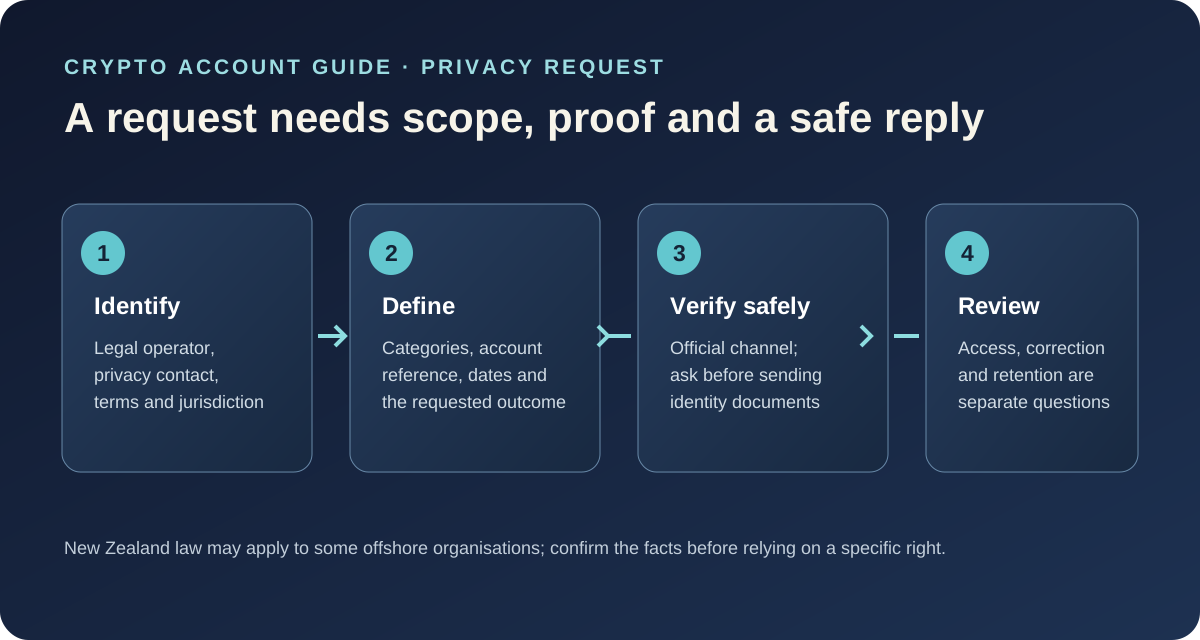
To request personal data from a crypto casino, first identify the legal organisation that operates the account, then send a narrowly scoped request through a contact route the operator itself publishes. State which account you mean, how the operator can verify you safely, the categories and date range of records you want, and whether you also want correction of a specific item. Ask for a secure delivery method and for the operator to explain any withholding, retention or deletion position in writing. Keep the request, delivery evidence and reply together.
Do not assume that using cryptocurrency makes a casino anonymous or changes which privacy law applies. A casino account can still be associated with login details, identity checks, device data, support messages, payment references and gaming activity. At the same time, a New Zealand resident should not assume that every overseas platform is automatically subject to every New Zealand rule. The Office of the Privacy Commissioner (OPC) says an overseas organisation can be covered when it carries on business in New Zealand; the assessment depends on its activities and circumstances. The relevant law and complaint route therefore need checking for the named operator.
Access, correction and deletion are different requests. Access asks what information the organisation holds and can retrieve. Correction asks it to consider a stated change to inaccurate, incomplete or misleading information. A request to delete data asks a different question about retention and lawful purposes; it is not a universal shortcut that guarantees erasure. If New Zealand’s Privacy Act applies, the OPC’s public guidance describes access and correction rights and a usual response period, but the specific facts, exceptions and overseas application matter. This is practical information, not legal advice.
The page is limited to personal-data requests. It does not explain how to reconcile a casino ledger or transaction statement; use the separate account ledger reconciliation guide for that task. It also does not repeat the separate promotional communication controls guide, which deals with marketing preferences.
Identify the organisation before sending anything
Start with the operator’s current terms, privacy notice, account footer and help centre. Record the legal entity name, registration or company details if published, privacy officer or privacy contact, stated jurisdiction, and the date you checked the page. A familiar casino brand can be a product name rather than the contracting company. The payment or wallet processor can be a separate organisation with its own data and privacy contact. A request sent to a game studio or blockchain explorer will not necessarily reach the casino’s account controller.
Compare the terms that applied when the account was opened with the current terms if a dispute concerns older activity. Save each relevant version as a PDF or screenshot and include its “last updated” label if available. A current privacy notice can explain present contact channels; an older contract may help identify the entity and applicable wording for the time period. Do not treat an address found on a forum, mirror site or unsolicited message as verified. Navigate to the company’s published site independently and confirm that the privacy contact is stated there.
Make a small identity table before drafting:
| Item | What to record | Why it helps |
|---|---|---|
| Account | Username or account reference, if safe to disclose | Helps staff distinguish similar names |
| Operator | Contracting entity and brand | Separates a brand from a payment or game supplier |
| Contact | Privacy officer or official support route | Gives the request a traceable destination |
| Dates | Account opening, activity period, request date | Defines the search window |
| Channel | Account inbox, secure form or published email | Reduces delivery and impersonation risk |
If the privacy notice names multiple companies, ask which one holds each requested category. A casino may process account credentials itself while a verification vendor stores a copy of an identity check and a payment processor retains its own transaction information. One company may be able to retrieve only part of the overall record. Ask the operator to identify the other data-holding organisation rather than assuming the casino can export every provider’s file.
Decide what information you are asking for
“Send me everything” sounds complete but can be difficult to action, especially where the service separates account, payment, game, fraud-prevention and support systems. A precise request is more likely to produce an answer that can be checked. List the categories that matter to your reason for asking and the approximate dates. You can ask the organisation to tell you if a category is not held, is not readily retrievable, belongs to another controller, or is withheld under an identified reason.
Possible account-related categories include profile fields, registration and verification status, login or security events, account restrictions, support messages, consent and communication preferences, and records of changes to personal details. If a particular decision or disputed event matters, name it and give the date range. If the service uses a case, payment or game identifier, include that identifier only when it is already visible in your own account records and safe to share through the verified route.
For a crypto-facing account, distinguish personal information from raw chain data. The account may contain an email address, chosen username, declared location, verification material, wallet address associated with deposits, internal transaction references, and support messages that mention a public transaction hash. The blockchain itself is not the same thing as the casino’s customer file. Ask the casino which account-linked records it holds and ask any exchange, wallet service or third-party processor separately about its own records if needed.
Define the date interval using exact dates and state the time zone if you know it. “From when I joined until closure” is understandable, but adding the account-opening month, approximate last active date and any event dates can help a search. If you do not know when the account was opened, say that and ask the operator to identify the earliest retained record. Avoid asking a support team to reconstruct a period without giving any anchor unless that is genuinely all you know.
Keep the request about information relating to you. It should not demand another customer’s account records or employee details. If a record includes information about other people, an organisation may need to protect those details when responding. If you are acting for another person, do not send a request without authority the operator can verify. OPC guidance states that a person generally cannot ask for someone else’s personal information without acting on their behalf with written permission.
Access, correction and retention are separate paths
An access request asks the organisation to confirm whether it holds personal information about you and provide access to information it can lawfully disclose. It is not necessarily a request for a full commercial database export or every internal document. The OPC explains that access can include personal information held by a business, while the way it is retrieved and supplied depends on the record and the legal rules. A focused list helps the operator search and helps you identify a gap in the response.
A correction request should identify the exact field, the value currently recorded, the corrected value you seek, and evidence that supports the change. Examples might include a misspelled name, an outdated email address, or a date-of-birth field that does not match the document previously supplied. Do not ask to rewrite an accurate historical record merely because it is inconvenient. If the organisation does not agree to change the record, the OPC describes the option of asking for a statement of correction to be attached so that the disagreement is visible alongside the data, where the Act applies.
A retention question asks what categories are kept, for what stated purpose, how long the organisation says it needs them, and what happens after account closure. Ask whether a retention schedule or privacy notice describes the period. A platform may have regulatory, security, accounting, dispute or contractual reasons to retain some records after a user stops using the account. A public request cannot tell you which reason applies to a specific operator unless the operator answers.
Deletion should be framed as a question rather than an assumption. You can ask whether particular information can be deleted, anonymised or restricted, what legal or operational reason prevents that, and whether the answer differs by data category. Do not claim that a New Zealand resident has an unlimited right to erase every record. The Privacy Act’s access and correction principles are not the same as a blanket right to be forgotten. The OPC’s 2025 explainer on overseas organisations is the starting point for territorial scope; the operator’s privacy notice and the relevant law must also be considered.
Do not ask the casino to delete information while an unresolved account dispute depends on that information. Preserve the relevant correspondence and records first, and avoid destroying material that may be needed for a complaint or a legal process. If the company says it must retain a category, ask for the purpose, category, retention period or review point, and the route for a further question. A clear answer can be useful even when it is not the deletion result you requested.
Check whether New Zealand privacy rules apply
The OPC’s guidance says that an overseas organisation can be subject to the Privacy Act when it carries on business in New Zealand. Its public explanation identifies factors such as repeated or systematic personal-information activity, offering or targeting services to people in New Zealand, activity taking place or being acted on here, and local trademarks or domains. These are indicators for context, not a self-administered legal ruling. A crypto deposit by itself does not decide the question.
The Privacy Act 2020 section on territorial application addresses actions by an overseas agency in the course of carrying on business in New Zealand. The OPC also stresses that a physical office here is not essential to its analysis. Whether a particular casino meets the test can depend on details that a visitor cannot verify from a public catalogue alone. Keep the company’s representations about New Zealand service, the account terms, privacy notice and actual communications so a qualified adviser or regulator can assess the facts if required.
If the operator provides a privacy-law jurisdiction clause, note it but do not assume that a contract’s choice-of-law wording automatically answers the statutory territorial question. Conversely, a website loading in New Zealand or a person holding an account does not, by itself, prove every law applies. The article gives the OPC’s framework; it does not decide jurisdiction for an unnamed offshore operator.
If the operator appears to be covered by New Zealand law, cite the specific OPC page and describe your request as one under the relevant New Zealand privacy principles, while still using the operator’s published privacy contact. If the organisation says another jurisdiction governs, ask it to identify the privacy controller, applicable process and complaint authority. Do not send sensitive identity material until you have established that the destination is an official channel.
Verify identity without exposing an account
An organisation may need to confirm that the requester is the account holder before disclosing sensitive data. Ask what information is necessary and how it can be supplied securely. A request through an authenticated account inbox may be sufficient for some records, while other platforms may ask for additional verification. The exact procedure belongs to the named operator. Do not assume that a general email address can safely receive a passport scan or a full payment document.
Never disclose a password, one-time authentication code, recovery phrase, private key or seed phrase to prove account ownership. These credentials can authorise access or transactions and are not ordinary identity evidence. If the operator sends a message asking for them, stop and verify the request through a known support route. If a document is needed, ask if the operator accepts a redacted copy or a secure upload page and whether unnecessary numbers can be obscured.
For an account you can no longer access, say so and request the official alternative verification route. Keep the request on the privacy issue rather than trying to bypass the account’s security checks. Do not create another account to reach support, use someone else’s login, or attempt to impersonate the account holder. If the operator cannot verify your identity, ask for a written explanation of the verification options rather than sending increasingly sensitive material to unverified contacts.
A request template you can adapt
Use this as a drafting aid, not a guarantee of a particular outcome:
Subject: Request for access to my personal information and correction review
Hello Privacy Officer, I am requesting access to personal information associated with my account with [legal operator name / brand]. My account reference is [safe identifier]. Please tell me what information you hold about me for [date range], including [specific categories]. If a category is not held, cannot be located or is held by another organisation, please identify that limitation or the correct contact where you can.
I would like the information supplied through [secure preferred channel]. Please tell me what identity verification is required before I provide documents. I also ask you to review this specific field: [field and current value]. I believe it is inaccurate or incomplete because [brief reason]. The correction I seek is [requested value]. If you decline to change it, please explain the decision and how I can provide a statement of correction.
Please also explain your current retention position for [specific category], including the purpose and any period or review point described in your policy. I understand that access, correction and deletion are separate questions and am not asking you to remove records required by law or a legitimate retention rule. Please acknowledge receipt and identify the date you treat as receipt of this request.
Edit out any paragraph that does not apply. Name the account, the dates and the categories, rather than asking for unrelated product information. If you only want a correction, omit broad access language and describe the disputed field with enough context to locate it. If you want retention details rather than data copies, ask that specific question without presenting it as a right to erase the file.
Do not include a full identity document in the first message unless the official procedure requires it and the channel is verified. You can ask the privacy officer to tell you whether authentication through the account or a secure upload is acceptable. Avoid including payment card numbers, wallet secrets or full wallet balances. An account ID, registered email or transaction reference can be enough to identify the subject, but the operator decides what verification is reasonable.
Make a correction request easy to assess
A useful correction record has four parts: where the disputed data appears, what it says now, what you say is accurate, and why. Add supporting documents only if they are relevant. For example, a correction to a contact email might need a confirmation from the verified account. A correction to an identity field may need an official document, but ask first how to send it safely. Keep the original file unchanged and send only the necessary page or fields.
Distinguish an error in a live profile from a record of what happened earlier. A profile might be updated while an audit log retains the historic value and the time it changed. That is not automatically evidence the account data was not corrected. Ask whether the corrected current field is now being used and whether the historic record is retained for security or legal purposes. If the operator declines, ask whether your statement can be attached to the disputed record and read with it.
If the source record is in a language or date format you do not understand, quote the exact label and provide the context. For dates, specify day, month and year to avoid ambiguity. For crypto addresses, make sure you do not mistake a public deposit address for a customer profile field or send a private key. For account names, preserve punctuation and case as shown on screen. Small differences can help staff find the right entry.
Track the response without assuming the deadline
The OPC says that where the Privacy Act applies, an agency normally has 20 working days to respond to an access or correction request; limited extensions require notice and an explanation. Holidays and the calendar method matter. Treat this as New Zealand guidance, not as a universal promise for every offshore casino or every kind of request. If a request is incomplete or needs identity checks, ask the operator to confirm the date it considers received and whether it believes the time period has started.
Save a copy of the sent message, the destination, the date, any automated acknowledgement, upload receipt and later correspondence. If the operator asks a clarification, answer in a focused way and preserve the original question. If it transfers the request or names a different privacy entity, record that date and ask who is now responsible for the response. Do not infer that a short automated reply is the complete response unless it says so.
If the expected date passes, send a polite follow-up to the privacy contact with the original request date and a copy of the acknowledgement. Ask whether the request is still open, whether more information is needed and when a response is expected. Avoid submitting duplicate requests through several public channels at once; that can fragment the case and make it harder to establish which message was received first.
Review the response and ask about gaps
When files arrive, keep the operator’s original filenames and do not overwrite them. Make a list of the categories you requested and mark each as provided, explained as not held, withheld, referred elsewhere or unanswered. If the data is a spreadsheet, preserve the original and create a separate working copy before sorting it. If it is a PDF, retain the original timestamp and any accompanying explanation. A partial response can still be useful, but you need to know which part is incomplete.
If you find an error, make a separate correction request pointing to the exact record. If you believe an expected category is missing, ask which systems and date ranges were searched, whether the information is readily retrievable, and whether another company holds it. The OPC has guidance on “readily retrievable” information; it considers practical retrieval factors, not only whether bits may technically exist somewhere. The operator’s answer should explain the actual search as far as it can.
If information is withheld, ask the operator to name the reason and the process for review. Some legal systems permit withholding in defined circumstances or allow third-party material to be redacted. Do not publish a claim of wrongdoing just because one requested file was not included. First ask whether the item is outside the controller’s records, was never held, was deleted under a retention policy, or is being withheld under a stated ground.
Escalation and New Zealand help
If New Zealand privacy law appears to apply and the operator does not respond, refuses a correction without explaining why, or does not deal with a statement-of-correction request, the OPC’s guidance says to raise the problem with the organisation first and then consider a complaint to the Commissioner. Keep the original request and every response. The OPC’s complaint guidance asks for copies of the request, reply and follow-up when information appears missing. It can assess the privacy issue; it is not a casino payments desk and does not decide gambling outcomes.
If the operator is outside the Privacy Act’s scope, check its stated privacy regulator and the law named in its terms. You may still ask a company voluntarily for information or for an explanation of retention. A refusal does not automatically mean the company has broken a New Zealand privacy rule. A New Zealand lawyer or the appropriate privacy authority can give advice about jurisdiction and remedies in the concrete case.
For account balances, game-round outcomes or a withdrawal dispute, use the operator’s separate complaint process and keep those issues distinct from the data request. A privacy request can help you understand what records exist, but it is not a substitute for an account statement, a transaction reconciliation or a request to review a disputed round. Keep one issue per message where possible so the reply can identify its scope.
Keep the request safe and proportionate
Personal records can contain more than the account holder expects: location history, identity data, security logs, payment references and correspondence. Store downloaded files in a private location protected by device security. Do not upload a complete data package to public forums or send it to a third party that has not been checked. If you need advice, share only the part needed and remove unrelated identifiers where appropriate.
Use a record log with these fields: message date, official contact used, subject line, account reference, date range, requested categories, identity documents supplied, acknowledgement date, due-date estimate, clarification requested, response date and remaining questions. Do not put passwords, two-factor codes or private keys in the log. The log should let you see the history without duplicating secrets.
Set a retention reminder for your own copies. There is no need to preserve every draft forever, but keep the original request and material needed to understand a correction or complaint for a reasonable period. If you delete your local copy, check whether the unresolved issue has been closed and whether you have saved the operator’s final explanation. This is about your personal records and does not control the operator’s retention schedule.
Frequent mistakes
Calling a data request a “blockchain audit” can send it to the wrong team. Ask for account-linked personal information, and request wallet or exchange information from that service separately. Requesting “my account history” without a date or category can produce a narrower answer than expected; define whether you mean profile, identity, support, security, transactions or a particular decision. Treating a fiat estimate as a separate personal record may be unnecessary unless the display or conversion itself is in question.
Demanding immediate deletion while seeking access can obscure which outcome matters most. If you need a copy first, request it before discussing removal. If you are correcting a fact, specify the field. If you are asking about retention, name a category and ask about purpose and schedule. The organisation can then answer distinct questions rather than treating the whole message as an unclear request to close the account.
Another mistake is assuming that an offshore company is beyond New Zealand law because its servers are overseas. The OPC describes circumstances in which an offshore agency carrying on business here may be covered. The reverse mistake is asserting that every website reachable from New Zealand is necessarily covered. Preserve facts and ask a qualified adviser if the jurisdiction question matters.
Finally, do not provide your account password, seed phrase or one-time code in a privacy request. Do not rely on a search-result snippet to locate an official privacy contact. Verify the channel from the operator’s own site, ask for secure identity verification and keep a receipt of submission. These basic steps reduce the chance that a good request becomes an account-takeover risk.
Quick checklist
- Identify the legal operator and its published privacy contact.
- Save the current privacy notice, terms and last-updated date.
- Decide whether the request is access, correction, retention, deletion or a combination.
- List the specific personal-data categories and a date range.
- Give an account reference through a verified channel.
- Ask what identity check is required before sending documents.
- Ask for a secure response and file format.
- For a correction, name the current field, requested value and reason.
- For retention, ask about purpose, category and review period without assuming deletion is automatic.
- Note that New Zealand’s law and usual response timeframe depend on whether it applies to the operator.
- Save acknowledgements, follow-ups and the final response.
- If relevant, raise the issue with the operator before asking the OPC about a complaint.
Primary sources and review limits
New Zealand primary sources reviewed 8 October 2026: Office of the Privacy Commissioner: Your privacy rights and access requests; OPC: overseas organisations and the Privacy Act; OPC: correcting information; Privacy Act 2020, section 4. The request checklist is editorial guidance, not a legal opinion. The law’s application to a specific offshore casino, the existence of a particular record, any response exception, and any deletion entitlement must be checked in context. No operator account or private-data request was tested. No demand or search-volume figures are claimed.