Crypto account guides · South Island guide
One crypto balance for casino and sportsbook: shared wallets, reserved funds and limits
 Best casinos available in New ZealandUpdated 7 November 2026

A shared login does not prove that casino and sportsbook funds use one freely spendable balance. This guide separates account identity, product wallets, reserved wagers, available funds, units, product limits and account-wide restrictions, then provides a cautious way to reconcile what an operator actually displays.
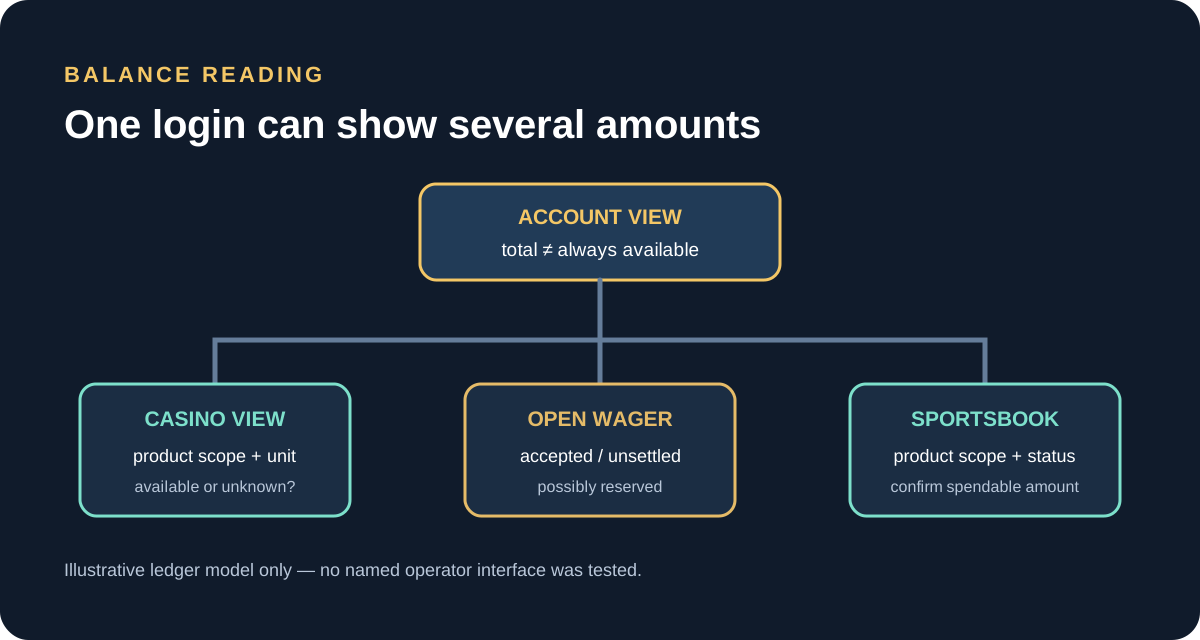
The short answer
The phrase “one crypto balance” can describe several different account designs. A casino and sportsbook may use one login but maintain separate ledgers. They may show a single account total while reserving part of it against an unsettled sports wager. A balance card may combine spendable funds with amounts held elsewhere in the account. A displayed New Zealand dollar estimate may be a conversion view rather than a second pot of money. The interface alone does not tell you which model applies.
Before treating a number as available for a casino game, identify its unit, product scope and status. Ask whether the amount is a token quantity, a fiat-denominated account value, an approximate conversion, or a total that includes reserved, promotional, pending or restricted funds. Then check the product-specific terms and the current account ledger. If a sports wager is accepted, look for the amount allocated to it and whether the remaining casino amount changes. Do not use an “account total” as though it were a confirmed spendable figure.
This guide explains a neutral reading method for shared casino-sportsbook interfaces. It does not describe betting selections, recommend an operator, establish access in New Zealand, or claim that any named platform has a unified wallet. An example from Stake’s published terms is useful only as a source-specific illustration: the terms discuss an account balance and say accepted wager funds can be allocated and become unavailable for other use. That contract example cannot be generalised to a different casino, and current terms can change.
Four things that “one balance” might mean
Start by separating four layers. The first is identity: one username, password and verification profile may open both casino and sportsbook areas. The second is the ledger: how the operator records deposits, credits, stakes, returns, reversals and restrictions. The third is product access: which part of the ledger a particular game or bet slip can draw on. The fourth is presentation: what the screen chooses to combine into one visible figure. A common login establishes only the first layer.
An account can have one ledger with product-specific available amounts. It can also have two product wallets under one login and a transfer control between them. In a third model, the screen displays a portfolio total, while separate panels show casino funds and sportsbook funds. A fourth possibility is that the casino and sportsbook use different denomination rules even where they refer to the same account. Each model creates different consequences for holds, limits and error checks.
Treat words such as “wallet”, “balance”, “cash”, “available” and “total” as interface labels until the operator defines them. A wallet icon is not a contract. A shared header is not proof of fungibility. A total that updates after a wager does not show whether funds were debited, reserved, moved into another product wallet or merely hidden from the current view. The useful evidence is the combination of the operator’s terms, the accepted-wager record and the account’s transaction history.
Shared login, shared ledger and shared spending are separate questions
A shared login makes it easier to switch product screens, but it answers none of the accounting questions. Consider a person who sees the same account name in a slot lobby and a sportsbook. The casino page may display one asset amount, and the bet slip may use the same asset symbol. That still does not prove that an accepted sports stake remains available to start a casino round. Some interfaces reserve it until settlement. Others may show it in a separate “open bets” panel, while the general header reports a combined value.
Ask the questions in order. Does the operator say one account covers both products? Are the currency and denomination the same? Is there an explicit transfer between product wallets? Does a bet slip show a stake as “placed”, “accepted” or “pending”? After acceptance, does the displayed amount change, or does another line show the reserved portion? Which source is considered authoritative if the header and bet slip disagree? A clear answer should specify the state and the unit, not simply say “your account”.
Stake’s currently published terms provide an example of why accepted status matters: the terms say a wager is finalised as accepted when confirmation is received, and funds allocated to bets are not available for other use. The sportsbook rules separately describe bet settlement and the account credit on cash-out when that feature is offered. These are operator-specific contract statements, not evidence about other websites or every market. Check the terms applicable to the exact service, region and date rather than copying a rule from an example.
What a reserved or pending amount can represent
“Reserved” is a useful plain-language description for funds that a platform has committed to an unresolved transaction. It may include an accepted but unsettled wager, a withdrawal request, a payment review, a bonus condition or another contractual hold. Do not assume all these items are treated alike. The reason, release event and ability to cancel can differ. A pending amount may still appear in a grand total even though a new casino stake cannot use it.
For an open sports bet, record the amount shown before confirmation, the confirmation state, the reference or bet identifier, the amount remaining in the sportsbook panel, and the amount available in the casino. If the interface has an open-bets page, compare that record with the wallet panel without repeating or editing the wager. This is an accounting observation, not a sports strategy. It helps distinguish a genuine balance discrepancy from an amount that has been deliberately reserved.
If the bet is later settled, voided, cashed out or corrected, check the corresponding ledger entry and resulting balance. Cash-out, where available, is a distinct settlement event; it is not proof that the original stake was never reserved. A cancelled event can trigger a different adjustment from a winning settlement. A reversal can also appear as a separate credit rather than an edit to the original line. Keep each status and timestamp intact instead of combining several changes into one guessed net figure.
Never treat a feature such as cash-out as a guaranteed way to release an amount at a chosen value. Availability may depend on market state, timing, rules and technical conditions. If the interface shows an action as disabled, unavailable or pending, retain that exact display and use the operator’s published support route for a factual query. Do not make a new wager to test whether money is free.
Identify which denomination the account is actually using
Crypto interfaces can display a token quantity alongside an estimate in a local currency. They can also display an account ledger in fiat while accepting a payment asset at conversion. The phrase “one crypto balance” does not tell you whether casino and sportsbook products use the same token, the same conversion time or the same rounding precision. Record the label exactly as shown: asset ticker, fiat currency, estimate marker, decimal places and any “available” or “locked” status.
Compare like with like. If the casino panel shows a token quantity and the bet slip shows an NZD estimate, those are not two independent balances. If the sportsbook uses a different active currency selector, the screen might be presenting a conversion rather than moving funds. If the operator offers multiple asset pockets, the user may need to select a specific wallet for each product. A single overall account total can hide the fact that only one pocket is spendable in the selected area.
Rounding deserves special care with small decimal quantities. A display rounded to zero in NZD can still correspond to a non-zero token amount, while a rounded local-currency estimate can move when the conversion rate is refreshed. Conversely, a large-looking fiat estimate is not proof that the account holds that exact number of dollars. Keep the denomination adjacent to the amount when you take a note or screenshot. Do not remove the ticker or estimate label from evidence.
If a game or bet slip accepts stakes in a different unit from the account header, inspect the final confirmation before accepting any transaction. It should make clear which amount and unit will be used. If the active unit is unclear, stop and ask support how the product settles; do not infer an exchange rate, minimum stake or conversion fee. This topic is about the interpretation of already displayed account balances, not a deposit, withdrawal or cryptocurrency purchasing guide.
A practical reconciliation without placing a test wager
You can document the account in a read-only sequence. First record the time and the visible denomination in the account header. Next open the casino balance view and write down each line separately: available, reserved, promotional, pending, or any other label actually present. Then inspect the sportsbook balance and open-bets list, again without placing or changing a bet. If both screens show a total, retain both labels rather than deciding that one must be wrong.
Build a simple observation table with columns for screen, amount, unit, status, product, timestamp and source. A useful notation might say “casino panel — displayed amount and ticker — available label — local time” rather than “money in account”. For a sports commitment, record the original stake and the current status from the confirmation record. Do not add or subtract amounts unless the interface or terms establish that they share a unit and scope.
After documenting the read-only views, compare the terms. Look for definitions of account, wallet, balance, accepted wager, unsettled wager, funds available for wagering, funds allocated, bonus balance, reversal and account restrictions. Terms might place definitions in different sections. Save the title, effective date or access date, and the exact paragraph location. A general help article can explain interface labels; the contract may control the actual treatment.
If the figures cannot be reconciled, ask a narrow question. State the screen labels, currency, time zone, transaction or bet reference, and whether the event is still open. Ask which amount is spendable in each product and how the reserved amount is reflected. A precise question reduces ambiguity. Avoid sharing passwords, one-time codes, wallet seed phrases or private keys. A casino support agent should not need a seed phrase to clarify an account ledger.
Worked illustration: a headline total with a held stake
Suppose an illustrative screen shows a combined headline value, a casino panel, a sportsbook panel and an open bet record. Do not assume the headline is a sum of only spendable funds. The bet may already have been allocated even if the open-bet panel displays its original stake next to the potential return. If the interface shows “available” separately, use that field only for the product it names. If it does not, the spendable amount is unknown until the terms or support clarify it.
In a worksheet, preserve each value exactly as shown instead of converting it yourself. Use separate rows for casino available, sportsbook available, open wager, pending payment and promotional balance only when those labels are present. Mark missing categories “not displayed”, not zero. A blank does not mean no funds exist; it means that the screen did not provide an amount in that view. This practice avoids turning an incomplete UI into a false accounting statement.
The example is intentionally not a real account, operator screenshot or numerical promise. It is a structure for comparing named values without making a second transaction. If the product uses a unified ledger, the operator’s own allocation records should explain the movement. If it uses sub-wallets, the controls should identify which product owns each amount. If the evidence still does not reconcile, do not play on the basis of a guessed total.
Product-specific limits versus account-wide protections
A “limit” can constrain a single game, a particular product or the whole account. A sportsbook bet limit may apply per selection, market or ticket. A casino game may have its own stake controls. An account-wide deposit, spend or time control may apply across more than one area, but only the operator’s terms and settings can confirm its scope. Do not assume that setting a control in the casino automatically governs the sportsbook, or that the same label means the same measurement period.
When checking a limit, record the exact type, scope, denomination, reset window, time zone, effective time and whether it is a hard block or an informational alert. “Daily” can depend on the operator’s boundary, not the local midnight a person expects. “Spend” may be defined differently from “deposit” or “loss”. A product-level setting may not include pending or promotional funds. These details matter before treating the control as a safety barrier.
For any account-wide restriction, use the official settings page and save the confirmation it provides. If the account offers separate product panels, check whether the same setting appears in each area and ask support to confirm the scope. Do not test a limit by trying to exceed it. A clear confirmation is stronger evidence than a menu label. If a limit does not behave as documented, pause use and retain the time and wording.
This article does not recommend gambling, staking or increasing a limit. For people who need help with gambling harm, use the existing New Zealand support information in the site’s safer gambling guide. That resource is separate from an operator’s product limits; an account setting should not be treated as a substitute for support.
How to read an account screenshot and keep it useful
A screenshot can be useful only if it preserves context. Capture the active product tab, the unit label, the status word, the time and the relevant open-bet or transaction identifier. If the account contains private information, redact login details, email addresses, account numbers, QR codes, wallet addresses and unrelated activity before sharing it. Preserve an unedited private copy for your own records if needed, and never post sensitive evidence publicly.
The image should not crop off the heading that explains whether the value is total, available, pending or reserved. On a phone, a sticky header can separate a number from its ticker or hide the active product label. Scroll to show the complete panel, or record a second screenshot with the heading visible. A screenshot of only a number without its unit does not resolve the key question.
Write down whether the screenshot is a live account view, a terms page, an in-game screen or a test illustration. Do not annotate a provider’s published game page as though it were the operator’s live balance UI. If a support response explains that a certain field includes reserved funds, preserve that response alongside the screenshot and current terms. Keep the answer date because the interface and contract may later change.
An account statement may list transfers, wagers, winnings, adjustments and fees, but this page is not a full transaction-history guide. For a detailed ledger reconciliation, use the separate account statement guide. Here the focus remains the boundary between products and the meaning of the displayed available amount.
Common interpretation errors
The first error is adding amounts in different units. A token amount and a fiat estimate cannot be summed unless the conversion basis is explicitly defined. The second is counting an open wager both as a held amount and as available balance. The third is treating a potential return or displayed payout as a current credit. A return becomes account money only when settlement confirms it and the ledger records the credit.
Another frequent mistake is equating “shared account” with unrestricted transfers. The operator could maintain one account identity while applying product restrictions or review holds. A casino bonus may also be tracked separately from cash funds and subject to its own terms. This guide does not explain bonus contribution or eligibility; check the particular offer’s terms and the site’s separate bonus coverage rather than assuming promotional credit is a withdrawable or cross-product balance.
People can also mistake an accounting delay for a loss or a duplicate debit. An accepted bet, pending settlement and later adjustment may appear as separate events. Compare transaction references and timestamps before concluding that an entry is missing. An event can be displayed in one product history before another panel refreshes. Do not refresh repeatedly and then infer a final state from whichever number appears last.
Finally, never treat an account-wide limit or reality check as a prediction or guarantee about future outcomes. A spending control limits a defined account action; it does not change game odds, guarantee a balance, or prevent every user choice unless the operator enforces that exact function. Confirm scope and behaviour in writing. If gambling is causing financial or personal harm, step away and seek support rather than trying to optimise an account balance.
Questions to ask support
If the UI and terms do not answer the question, request factual clarification in writing. Ask whether the casino and sportsbook use one ledger or separate product wallets; what a given “total” contains; whether open wagers are deducted, reserved or only noted; which amount is available for a new action in each product; whether units are converted; and when pending funds become available. Refer to screen names rather than describing an amount as simply “my balance”.
Ask which document controls if help text and terms appear inconsistent, and what time zone is used for account history. Ask how the user can download or retain the relevant transaction and wager records. Do not ask support to predict what a game will pay or whether a future bet is likely to win. If an answer names a feature that is not visible in your account, request the exact settings location rather than assuming it is active.
Do not send a seed phrase or private key. Do not send a one-time code to someone who contacts you unexpectedly. Start from the operator’s known official help centre or signed-in support panel, not a link in an unsolicited message. If the response asks for unusual access, stop and verify the route independently. This safety check is about protecting an account; it does not establish that an operator is licensed or available in New Zealand.
A final checklist
Before relying on a displayed balance, confirm that the screen names the product, unit and status. Separate available amounts from open wagers, pending payments and promotional funds. Check whether the account is one ledger, product wallets or a combined display. Verify that an accepted wager has a confirmation record and that the operator explains allocation. Confirm the time zone and reset window for limits. Save dated records without exposing credentials.
If no screen identifies which amount is spendable, treat that amount as unknown. Do not place a test wager to settle an accounting question. If the product shows contradictory values, keep the evidence and ask support which ledger entry governs. Use the correct account statement guide for transaction-by-transaction reconciliation, and use the safer-gambling resource for help with harm. Do not turn a shared login, a combined number or a local-currency estimate into a claim the underlying records do not support.
The central distinction is simple: access, accounting and presentation are different things. A shared account can make two products look close together while the operator still applies distinct rules to each. Reading the labels, status and terms carefully is more reliable than guessing what “one wallet” means.
The Department of Internal Affairs’ current advertiser guidance identifies online casino advertising as prohibited while the licensing transition is underway and names affiliate marketing among the prohibited initial advertising decisions. That compliance question must be reviewed before release.
Primary sources and review limits
The source reviewed for this topic was Stake’s public policies index, its Terms of Service and its Sportsbook Rules, checked on 8 October 2026. The terms include account-level balance language and state that funds allocated to accepted wagers are unavailable for other use. That is a current example from one operator’s own contract, not a universal crypto-casino rule. No account was opened and no operator UI was tested. No New Zealand availability is asserted.
Search-result sampling surfaced third-party guides that present numerical RTP, stake and game-setting claims for unrelated titles. Those pages were not used to establish shared-wallet facts. No search-volume figure or New Zealand demand estimate was available. No common cross-site topic register was supplied, so the overlap check is limited to the cumulative South Island project archive.
Sponsored offers shown by the shared site components are separate from the editorial game or account evidence above. They do not establish local eligibility or verify an operator configuration. Read the current operator terms and local requirements independently.
