Crypto account guides · South Island guide
Crypto casino deposit, spend and time limits: what to verify
 Best casinos available in New ZealandUpdated 7 November 2026

A crypto casino can display several controls that sound similar but do different jobs. Before treating a setting as a safeguard, identify whether it limits deposits, gambling spend, or elapsed time; confirm the account currency, period, reset time and enforcement behaviour. A reality check is a time-awareness prompt, not automatically a financial ceiling. New Zealand requirements discussed here apply to operators within the regulated framework, not every offshore crypto site.
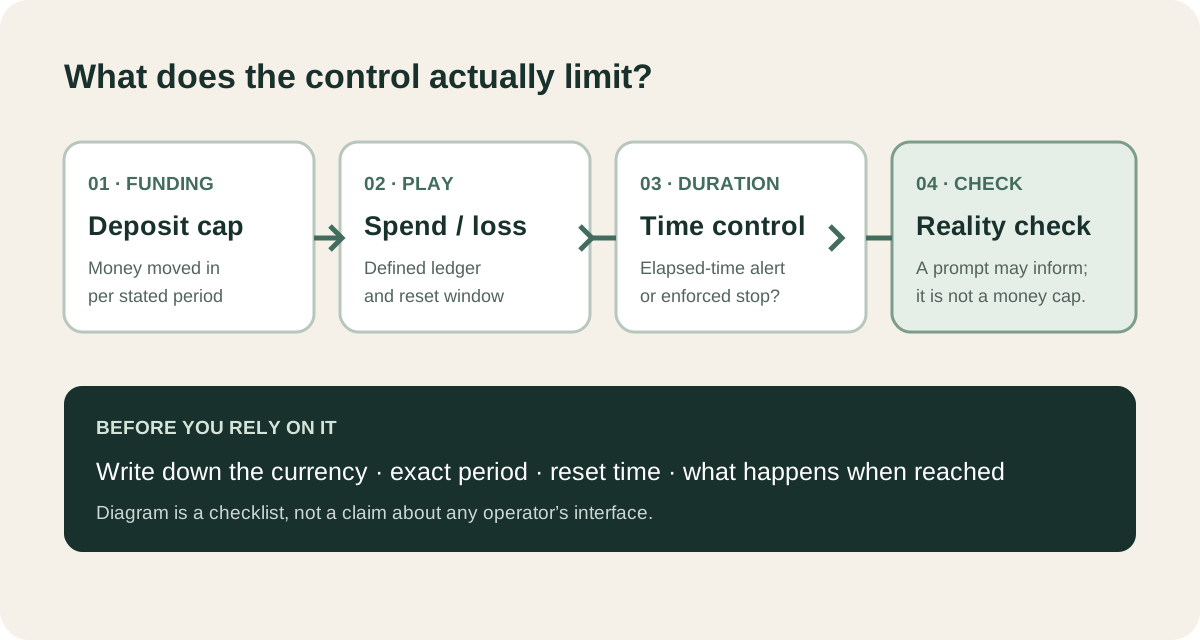
The short answer
A deposit limit restricts money entering an account over a defined period. A spend limit is intended to constrain gambling expenditure according to the platform’s stated calculation. A time limit constrains time on the platform or gambling activity. A reality check tells you that time has passed; by itself it need not prevent another wager or a deposit. The words can appear beside one another in an account menu, but their effects are not interchangeable.
For a crypto account, the unit is part of the control. A cap written in a coin may move in New Zealand dollar value while the coin price changes. A NZD estimate can also be only a display conversion, rather than the ledger unit the platform uses to enforce the setting. A useful check therefore reads the limit type, amount, currency, period, reset point and what the platform does when the threshold is reached. Save the wording before relying on it.
This guide separates those controls, explains what to inspect in a real account, and gives a practical evidence checklist. It does not claim that all operators offer every control, or that a supplier, policy page or crypto balance proves a particular account is eligible for New Zealand play. The earlier session-budget guide covers a personal entertainment ceiling; this page focuses on platform settings and whether they are enforced.
Start with the control, not the label
A setting called “limit” can refer to an amount added, an amount wagered, a net amount lost, a stake per round, or a time window. These values can all be displayed as numbers without measuring the same thing. A person who sees “100” in a control cannot infer its meaning without the unit and definition: 100 NZD, 100 tokens, 100 deposits, 100 minutes, or a different measure entirely.
Read the explanatory text attached to the setting, not just its title. Does the account describe a deposit cap, a net-loss cap, total spend, a stake limit, or a session duration? Does it explain which account balance or transactions count? Does it apply to casino activity only or all products on the platform? If those answers are missing, record “not explained” rather than filling the gap with what another site does.
A useful mental model has three layers. The first is the control’s purpose: money in, gambling spend, or time. The second is its measuring frame: asset, currency, period and reset time. The third is enforcement: what the system blocks, when it recalculates, and what changes can be requested. A screen that names all three clearly is more informative than a large number with no definition.
Four controls that should not be collapsed
| Control | What to look for | What it does not automatically prove |
|---|---|---|
| Deposit limit | Eligible deposits, unit, period, pending transactions and reset | That a later stake or loss is blocked |
| Spend or loss limit | Whether it measures stakes, net loss or another defined amount | That deposits themselves are capped at the same amount |
| Time limit | The clock being measured and the action stopped at the limit | That every game session is timed by the same clock |
| Reality check | Interval, message, pause or acknowledgement behaviour | That money movement or further play is disabled |
This table is a question list, not a universal product specification. A platform’s own rules, the governing framework and the current settings screen determine what applies. Do not assume that “reality check” is a synonym for a spending limit merely because both appear under responsible-gambling settings.
New Zealand rules have a defined scope
New Zealand’s Online Casino Gambling Act 2026 and its supporting regulations create requirements for operators within the licensing regime. The Department of Internal Affairs’ minimum-standards page says the time, deposit and spend limit functions of operators under the Act must be easy to access, offer free-text entry, apply the lowest limit when a customer sets simultaneous periods, and enforce a waiting period of at least 24 hours before a requested increase or removal takes effect. The standards came into force on 8 July 2026. The same standards require a way to track time and, where a full-screen app hides the device clock, require the platform to show the time or elapsed app time.
That is useful context when assessing a New Zealand regulated service, but it is not evidence that any specific website has a licence, that an offshore site follows the same requirements, or that a crypto payment option is accepted. The licensing transition is staged. Verify the current regulator information and the exact platform before treating a legal minimum as an account feature. A product page, token wallet or availability claim on a supplier site does not establish operator status.
The Act’s scope matters because a setting can be voluntary, legally required for a defined operator, or only an informational prompt. Those are three different propositions. A help article may describe a feature without proving it is enabled in a particular jurisdiction. A rule can require a function without telling you which currency a user interface displays. An account screenshot can show a chosen value without demonstrating that the service actually blocks a transaction at the threshold.
For an editorial statement, keep the subject narrow: “New Zealand minimum standards for operators under the Act require…” is better than “all crypto casinos must…”. If you cannot verify the named operator against current official information, say that its regulatory status was not established. This distinction avoids transferring a rule from one jurisdiction or one operator to every crypto-branded platform.
Deposit limits: define the money entering the account
A deposit limit usually concerns transfers into the gambling account during a chosen period. It may cover successful deposits, or a platform may state that initiated, pending, reversed or failed transactions are treated differently. Do not decide from the progress bar alone. Find the operator’s definition and see whether the limit counts each transaction when initiated, confirmed on-chain, credited to the account, or settled in the platform’s ledger.
For crypto deposits, the transaction may have several events: a wallet request, a blockchain broadcast, network confirmation, an exchange rate quote, and account credit. These timestamps may not match. If a deposit is pending when a period resets, the public help should explain whether it counts in the earlier period or the next one. If it does not explain the edge case, support can clarify before money is sent. Keep the answer and its date; do not use a second account or a different payment path to get around a limit.
A cap can be shown in a coin, a fiat value or both. If the control is a fixed token amount, its NZD equivalent can change with the exchange rate. If the control is fixed in NZD but deposits are credited as tokens, the system needs a conversion price and timestamp to calculate the amount. Ask which price source and valuation moment are used. A rounded NZD label might be a convenience display, not the exact enforcement unit.
Check whether the deposit limit is distinct from a spend limit. If a person deposits 50 NZD and later withdraws part of the balance, the deposit total, amount staked and net result may each be calculated differently. A “deposit remaining” figure should not be treated as permission to wager that amount, and a “spend remaining” figure should not be treated as available balance.
Spend and loss limits: inspect the formula
“Spend” is not self-defining. A platform may use that word for stakes, net loss, or another accounting measure. If the terms define it as stakes accepted in the period, then a winning stake may count even if the account later receives a payout. If the definition is net loss, the formula may subtract returns or withdrawals. Some interfaces distinguish “loss limit” from “spend limit”; others use labels that require the help text to interpret.
Ask the platform to define the inputs and the moment of calculation. Does an accepted bet count when placed or when settled? Are voided rounds excluded? How are partially returned stakes, bonus funds, promotional credits, fees or currency conversions handled? The help should say whether the calculation is per account, per product or broader. Do not infer the answer from a displayed balance or an account statement label.
For cryptocurrency, keep the asset arithmetic separate from the gambling arithmetic. A token can rise or fall in NZD value while the platform’s token-denominated ledger remains unchanged. That market movement is not itself a casino stake, deposit, win or loss. Conversely, a wager placed in a token may have a different fiat-equivalent value from the one shown when it was funded. State the unit each line uses, and avoid combining values until the conversion basis is clear.
A spend cap should be treated as a platform control only when the operator documents how it is applied and when it blocks activity. A dashboard that estimates losses, an email summary, or a reality-check window can help someone review activity but does not prove a hard stop. For a New Zealand licensed operator, compare the interface with the minimum standards that apply to that operator; do not project those legal requirements onto unverified sites.
Time limits and reality checks are different
A time limit is an amount of time plus a defined consequence. The account may stop gambling, ask the user to finish a round, prevent new rounds, or restrict access until a reset. The precise behaviour matters. Does the clock begin at login, when the casino opens, when the first wager is accepted, or when a game launches? Does it count inactivity? Does time spent in a wallet or cashier count? A control with an unclear clock cannot be compared reliably across platforms.
A reality check is typically a prompt that makes elapsed time visible. It can be valuable because game screens may not show the device clock, especially on a phone or full-screen app. Yet a reminder may only require acknowledgement before continuing. It might not stop a deposit, close the account or impose a money ceiling. Read the words on the prompt and its documented effect. If it says “session reminder,” do not report that it enforces a loss cap.
New Zealand’s minimum standards require a customer to have a way to track the passage of time on covered platforms. They also specify an operator response where an application obscures the device clock. That is a time-awareness requirement; it does not make every timer a financial control. The regulation’s separate categories for limits and time-outs reinforce why the labels should remain distinct.
A practical test is to write two sentences before play: “The time limit measures ___ from ___ and at the limit it ___.” Then: “The reality check appears every ___ and requires ___.” If the help cannot complete either sentence, the details are not confirmed. Do not rely on memory from a different website or a previous version of an app.
Periods and reset windows
A daily, weekly or monthly period can be fixed-calendar or rolling. A calendar day might reset at local midnight, UTC midnight or another operator-defined time. A rolling 24-hour limit may look different from a calendar-day limit because each transaction drops out of the window at its own timestamp. A weekly limit may begin on a named weekday, while a monthly limit might follow a calendar month rather than 30 days. Ask which model is used.
Time zones require care. New Zealand observes daylight saving for part of the year, so a local day does not always map to a fixed UTC hour. That fact does not tell you how an operator configures its control; the help or account should identify the reset zone. If the platform only says “daily,” do not assume whether the boundary follows the device, account country, server clock or a standard time zone.
When several periods are active, inspect how they interact. A daily cap of 20 and weekly cap of 80 may both apply; the platform may block when either is reached. New Zealand’s minimum standards state that, when simultaneous periods are set for a relevant limit, the lowest limit must apply. That is a rule for operators within the framework, not a promise about an unrelated offshore platform. The user interface should make the periods visible enough to understand.
Record the displayed amount just before and after a reset rather than trying to test the system with a deposit or bet. Use the account’s history and explanatory material. If the reset time is ambiguous, ask support and wait for a written answer. A screen showing a refreshed counter is not enough to conclude that a separate weekly or monthly cap also reset.
Asset units, NZD display and conversion
Crypto interfaces can show a native asset amount, a fiat-accounting amount, or an approximate NZD display. Those are not interchangeable. A native amount is a number of tokens. A fiat ledger may record a value after conversion. An NZD estimate may be only a display layer that changes as market prices move. The earlier balance-denomination guide explains those differences in more detail; for a limit check, the key question is which one the control uses.
Look for the asset ticker, decimal precision, rounding direction and conversion timestamp. A displayed 0.001 coin could be rounded, while the internal ledger may keep more decimal places. A cap of 0.001 per day could therefore be enforced against an exact token quantity even if the NZD estimate shifts. A cap labelled NZD may instead use a conversion quote at deposit, at wager acceptance, at settlement or at each recalculation. The text should identify the rule or disclose that detail is unavailable.
Stable-value tokens are not the same as cash held in a New Zealand bank account. A pegged price can move, an issuer or venue may have operational restrictions, and fees or conversion spreads can affect the amount that arrives. This guide does not provide investment advice or say which asset to use. For the limit question, note the amount actually credited, the unit on the control and the method the operator states for converting it.
Do not add unrelated market-price changes to gambling spend as if they were wagers. At the same time, do not ignore them when evaluating the NZD value of funds used. Keep two ledgers if you need to reconcile: one for the platform’s gambling transactions, and another for asset valuation or external transfer costs. Label each source and timestamp. That prevents a balance estimate from being mistaken for the limit’s enforcement record.
Increasing, reducing or removing a limit
The direction of a change can alter the waiting period. Reducing a cap may be applied immediately, while increasing or removing it may be delayed. New Zealand’s minimum standards require at least a 24-hour wait before a covered operator allows a requested increase or removal of a previously set time, deposit or spend limit. That cooling-off period is useful precisely because a decision made during a session can be impulsive. It should not be treated as a setting to work around.
Check whether the countdown starts when the request is submitted, verified or accepted. Find out whether the old limit remains active during the wait. Do not assume that cancelling and re-entering the request restarts or shortens the delay; the relevant platform rules determine that. If a decrease is available, it can be a protective choice, but it does not change transactions that already settled under the earlier setting.
Some platforms use different controls for time-outs and limit changes. A time-out can temporarily restrict account access, whereas a reduction changes an ongoing cap. Self-exclusion is a more substantial barrier and may have a minimum duration or irreversible period. Before selecting a control, read the help for its actual effect. If a person wants a break, the relevant support service can help them consider which option fits, without the site making assumptions about their circumstances.
If the account has reached a limit, the safe interpretation is that the control has done what its displayed threshold says. Do not use another account, another currency or an external wallet to continue. If you believe a settlement or calculation is wrong, collect the transaction and limit records and contact the operator; do not try to solve a mismatch by depositing again.
A verification walk-through before any session
Start outside a game. Open the platform’s responsible-gambling or account-controls area and record the exact names of the controls. A useful screenshot should include the visible setting name, amount, unit, selected period and explanatory text. Avoid capturing passwords, private keys, authentication codes or other account secrets. A redacted record can be enough to compare public wording later.
Next, read the linked help and terms. Identify what is counted, when the period starts, the reset zone, whether multiple periods run at once and what action is stopped when the limit is reached. For a time control, identify when its clock starts and whether inactivity counts. For a reality check, identify the interval and whether it pauses the game, requires an acknowledgement or merely displays a reminder.
Then check currency. Does the cap use NZD, a token or another fiat unit? If the UI displays two amounts, mark which one is stated to govern the limit. Look for a conversion quote’s time and rounding rule. If the page does not say, ask support before funding the account. The answer should be specific enough to distinguish a display estimate from an enforced ledger value.
Finally, confirm that the setting is in force. A value typed into a box may need a save action or a confirmation step. The interface should show the active amount and period afterward. Do not make a test wager or deposit to discover how the cap works. Use documentation, account history and a support response. If the product does not explain the feature, treat its behaviour as unverified rather than assuming it will stop activity.
What to save as evidence
A clear record helps when a user, editor or support worker needs to reconstruct what a control said. Keep the platform name and the date, the control title, selected amount and unit, period, reset zone, help-page version if available, and any explanatory text about enforcement. If an account has a transaction history, record the transaction ID and status instead of relying on a memory of the balance.
For a limit that appears not to have applied, write down the sequence without conclusions: setting chosen, save confirmation, time and time zone, deposit or bet ID, account unit, and the resulting screen. Distinguish pending, credited, rejected and settled events. State whether the screen showed a cap remaining, a reality prompt or a hard block. This makes it easier to ask a factual support question such as “Which amount counted toward this period?” rather than asking whether the system “ignored the limit.”
Do not include wallet seed phrases, private keys, full card details, passwords, one-time codes or unredacted identity documents in a support ticket or an editorial screenshot. Redact personal information that is not required. Use the operator’s secure contact route, and retain the case number and date. A written response is evidence of what support said, not necessarily proof that the account’s underlying calculation is correct.
If a concern relates to money harm or gambling becoming difficult to control, New Zealand’s Gambling Helpline lists budget support and a Gambling Debt Helpline among its resources. A help service is separate from an operator’s limit screen and can discuss support options. If the issue is immediate safety, contact local emergency services. A site article should not substitute for personal financial, legal or clinical advice.
Common interpretation mistakes
Treating a reminder as a stop. A modal that reports elapsed time can be dismissed. Unless the operator says it blocks wagers or deposits, it should be described as a prompt, not a limit. Check the exact action required.
Comparing unlike currencies. A token quantity and a NZD estimate can differ without any change to the ledger. Compare the same unit and timestamps. If a conversion is part of the cap, find its documented price source.
Assuming every period is a calendar period. “Weekly” could refer to a rolling seven-day period or a defined week. “Daily” does not identify a time zone. Record the actual reset rule.
Confusing deposit totals with net loss. Money entering the account, accepted stakes and settled results are different transaction measures. Use the exact definition in the terms.
Assuming a supplier’s responsible-gambling label describes the operator. Game and supplier pages do not prove how the casino account applies a cap. Only the current operator interface and rules can establish that.
Assuming one site’s feature transfers to another. A policy page for a named service is evidence about that service’s own published policy at the time checked. It is not evidence that another platform has the same menu, limit rules, jurisdiction or currency behaviour.
Trying to overcome a reached threshold. An additional account or wallet does not clarify the limit and may violate terms or defeat a protective control. If the reading appears wrong, preserve records and ask the operator instead of continuing through another route.
A compact comparison checklist
Before relying on a control, make sure the following questions have answers:
- What is limited: deposits, spend, loss, stakes or time?
- What transaction event is counted: initiated, credited, accepted or settled?
- Which currency or asset controls the cap?
- Is the displayed NZD value a ledger value or an estimate?
- Is the period calendar-based or rolling?
- Which time zone and reset moment apply?
- How do simultaneous limits interact?
- What exactly happens at the threshold?
- Does a reality check merely inform, or does it stop a defined action?
- How are changes saved, and is an increase delayed?
- Does the account’s current jurisdiction bring the operator under New Zealand standards?
- Where can the user obtain the current written answer without sharing account secrets?
A “not stated” answer is important. It is a reason not to treat the feature as a reliable safeguard. Do not replace missing documentation with a guess from a different product.
FAQ
Is a reality check a deposit limit?
No. A reality check is a time-awareness message unless the operator’s rules expressly attach a blocking action to it. A deposit limit concerns qualifying funds entering an account over a period. Check both features separately.
Does a coin-denominated limit keep the same NZD value?
No. A fixed token quantity can have a changing NZD estimate. Whether the platform’s enforced cap itself changes depends on the control’s documented unit and conversion rule.
Do New Zealand rules apply to every crypto casino?
Do not assume so. The standards describe obligations for operators under the New Zealand Act. A crypto label neither proves nor excludes that status. Verify the specific operator with official information.
Can I raise a limit immediately after reaching it?
Do not assume that. The current New Zealand minimum standards require at least a 24-hour wait for increases or removal of covered limits by an operator under the Act. Other services may have different rules, and their New Zealand status must be checked.
What if the controls are vague or unavailable?
Treat their operation as unverified. Do not deposit to test them. Ask the operator for written clarification; if the service cannot explain its unit, reset or enforcement, do not rely on the control as a hard cap.
Editorial conclusion
A meaningful limits review names the control, its unit, the period it covers and the consequence when it is reached. For crypto, the distinction between token ledger and NZD display can change what a number means. For time, a reality-check prompt is not automatically a financial or activity block. For New Zealand, quote the minimum standards only within their operator scope and verify the service separately.
The practical approach is deliberately simple: inspect before funding, save the wording, identify unknowns, and do not bypass a limit. If a control has been reached, stop and use the account record or support process to resolve a factual discrepancy. When the subject is financial stress or gambling harm, seek independent support rather than treating another session or deposit as a solution.
Sources and verification boundary
- New Zealand Department of Internal Affairs: Online Casino Gambling Minimum Standards — checked 8 October 2026; minimum-standards provisions for covered operators include limit access, free-text settings, simultaneous periods, the increase/removal delay and time tracking.
- New Zealand Department of Internal Affairs: Online gambling for advertisers — checked 8 October 2026; regulatory scope and staged licensing information.
- Gambling Helpline NZ resources and specialist services — checked 8 October 2026; support and debt-help information.
- Stake policies and Stake self-exclusion policy — checked 8 October 2026 as the assigned operator-source example. Their terms are service-specific and do not verify New Zealand access, a particular crypto limit or settings on any other operator.
- No live operator account was accessed. No operator-specific New Zealand eligibility, active screen, currency enforcement, current game session or deposit behaviour was verified. No CPA route was opened or changed.
