Crypto account guides · South Island guide
Crypto casino session budget in NZD: plan without token-price gains
 Best casinos available in New ZealandUpdated 7 November 2026

A session budget is an amount of entertainment money that can be lost without affecting essentials. Convert that ceiling into a conservative NZD amount before looking at a crypto balance, subtract known conversion or network costs, and do not increase the limit because a token price moved or a game result was unfavourable. A wallet value, an exchange estimate and a casino ledger can describe different things. This guide gives a practical, non-investment checklist and points to New Zealand support.
The short answer: set the ceiling in NZD first
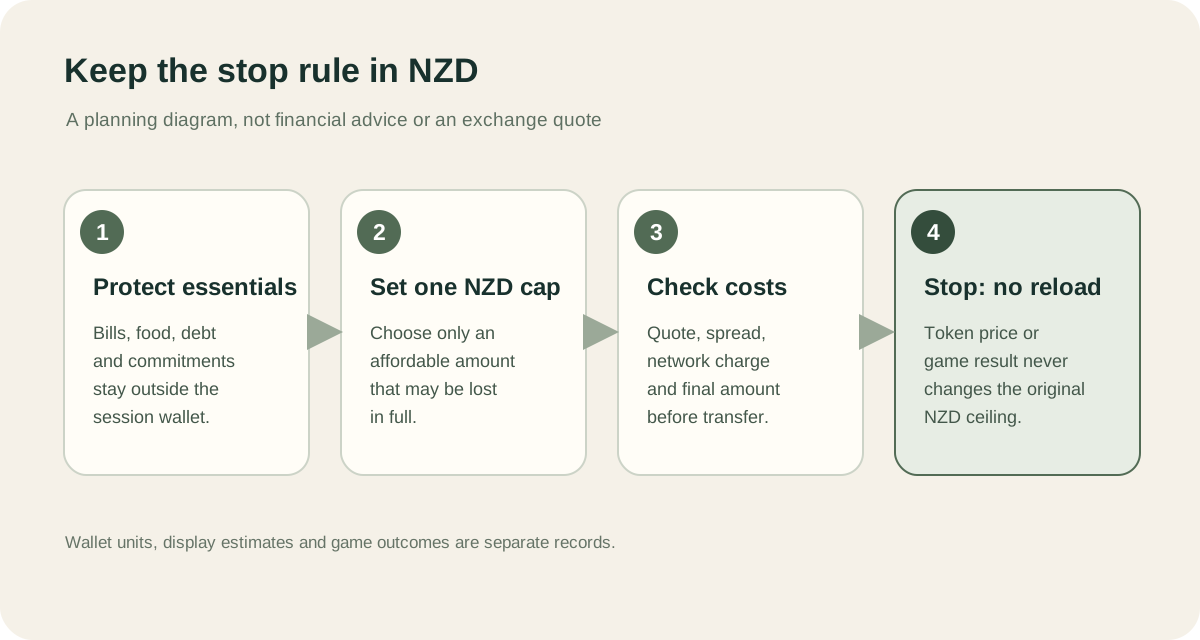
A crypto casino session budget should begin with a New Zealand dollar amount, not with the number of coins visible in a wallet. Decide what you are prepared to spend on entertainment, assume that amount could be lost, then convert only that bounded amount if you still choose to proceed. A token’s NZD price can change while it is held, transferred or displayed. That price movement is a separate event from a game result and must never be treated as a reason to gamble more, wait for a recovery, or chase a loss.
The safer planning sequence is deliberately simple: protect rent, food, power, transport, debt payments, savings commitments and other essentials; choose a session ceiling from what remains; identify fees and conversion uncertainty; move no more than the planned amount; and stop when it is used or the preselected time ends. Do not rely on a future win, a token rally, a bonus, or an exchange quote to make the plan work. If a limit feels difficult to keep, make the next action a break and use independent support rather than a new top-up.
This is a budgeting explainer, not investment, tax, financial-product or gambling advice. It does not recommend a token, casino, payment service or stake size. No operator’s live cashier or NZD conversion flow has been checked for this article, so the examples below are arithmetic illustrations only.
What a session budget does and does not measure
A session budget is a precommitted cap on entertainment spending for one bounded occasion. It is not a target to use in full, a prediction of losses, a measure of affordability by itself, or a promise that the session will last a particular time. If the cap is NZ$25, the useful interpretation is “up to NZ$25 of discretionary spending may be put at risk”; it is not “I should keep playing until I have wagered NZ$25” and it is not “I will lose exactly NZ$25.” A game can end sooner, continue longer, or produce a return. None of those outcomes changes the original ceiling.
Separate money availability from money permission. A wallet may contain a large balance, but that does not make the whole balance suitable for entertainment. An exchange may show a total portfolio value, but that does not mean the amount is cash available for spending. A casino may show a balance, but it may combine real-money, promotional, pending or restricted amounts. The session plan uses only the amount deliberately allocated to entertainment after essentials and obligations are covered.
The New Zealand Gambling Helpline’s resources discuss money rules and direct people to budgeting and gambling-debt support. Its advice is not a crypto conversion guide, but it reinforces the practical value of deciding a limit in advance and seeking help when money rules are hard to maintain. See the Gambling Helpline resource library and the site’s New Zealand safer-gambling support page.
Distinguish wallet holdings, account value and amount at risk
Use three separate figures in your notes. First, record the wallet quantity: the number of token units under your control. Second, record a reference NZD value and its timestamp, if you need one to understand the conversion; treat it as an estimate that can become stale. Third, record the amount you authorised for this session and the actual amount that can be lost after conversion and fees. Only the third is the spending ceiling. These figures answer different questions, so they should not be merged into one “casino budget” number.
For example, a screen might show 0.01 units of a volatile token and a converted display near NZ$40. That visual estimate does not say that NZ$40 is free to spend. If the person’s planned entertainment ceiling is NZ$12, their session is still capped at NZ$12, even if the wallet holds more. Conversely, a screen may show a stablecoin quantity whose intended reference is close to one US dollar. It is still a token balance, not a guaranteed NZD cash amount: the reference currency, market quote, conversion path, spread, network, custody arrangement and redemption conditions can all matter.
If the site displays a fiat estimate, note whether it is a convenience conversion or the unit actually used for stakes and settlement. A rounded NZD figure may be present only to make a crypto amount easier to read. It can move without a new deposit or wager. For the difference between stored units, ledger units and display values, see the existing crypto casino balance denomination guide. The session budget uses that distinction as a starting point, then adds a strict amount-at-risk boundary.
Choose a limit from discretionary money, not available credit
Start by looking at the period your normal budget covers, such as a week or pay cycle. List the commitments that must be paid regardless of entertainment: housing, utilities, groceries, essential travel, childcare, minimum debt payments, insurance and planned savings. Leave a margin for bills that vary and for costs that are due soon. Only after those are protected should you consider whether a small discretionary amount exists. A credit card limit, overdraft, buy-now-pay-later facility, borrowed money, tax set-aside, emergency fund or funds held for another person are not discretionary income.
Set a session amount that you could lose in full without changing any of those commitments. “Could lose” is the honest stress test. If losing the amount would lead to borrowing, missed bills, an argument about shared money, skipped food, or the need to sell something, the amount is too high for this plan; set it to zero. Do not use an income percentage or a generic internet rule as a substitute for your own essential costs. This guide cannot assess your personal financial circumstances.
Write both a money limit and a time limit before opening a game. A money-only rule cannot guarantee a session duration: the balance could last a short or long time, depending on activity and outcomes. A time-only rule cannot cap spending. Treat them as independent stop conditions. The session ends when either the authorised amount has been used, the planned time is over, or you notice that you are breaking the rules. A win does not reset either limit or create a fresh budget.
Convert the NZD ceiling without turning the token into a target
Once the NZD ceiling is fixed, look up the actual quote used by the exchange or payment route at the point you are considering a conversion. Record the quote source and time, the quoted pair, the token quantity you expect to receive, and any visible fee or spread. If the quote is not available, the fee is unclear, or the unit in the casino is ambiguous, pause rather than guessing. A later NZD value can differ even when the token quantity is unchanged; that is a valuation change, not a change in your authorised gambling amount.
For a plain illustration, suppose a person chooses a maximum entertainment loss of NZ$20. A displayed conversion implies NZ$20 buys a certain number of tokens, but the exchange or network will deduct a cost. If the person wants NZ$20 to remain the maximum amount at risk, they need to account for costs before the transfer and avoid adding extra funds to compensate for an uncertain quote. A simpler conservative approach is to treat every amount sent, plus unavoidable conversion costs, as spent entertainment money and lower the game balance accordingly. Do not calculate a larger session from a token that has appreciated since it was acquired.
Keep the cap in its original currency in your notes: “maximum session spend NZ$20.” Do not replace it with “0.000X token” and forget what that was worth when authorised. If the casino accepts only a crypto denomination, convert the planned amount once using a timestamped quote and round down rather than up. If the unit changes or the quote has moved by the time you are ready, re-check against the original NZD ceiling. Never increase the ceiling to preserve a particular number of spins, coins or game credits.
Volatile assets: price movement is not a gambling signal
A volatile token can rise or fall against NZD between purchase and conversion, while moving through a network, during a session, or before it is withdrawn. Those changes affect the reference value of the asset. They do not alter the rules, randomness, theoretical return or result of a casino game. A screen that shows a larger NZD estimate after a token rise does not create additional disposable income for the session. A screen showing a lower estimate does not mean the game owes a recovery. Keeping those two systems separate prevents price movements from becoming a prompt to increase stakes or play longer.
Do not use a “break-even” price as a session condition. If a token falls after you acquire it, continuing to gamble until the exchange value returns to a prior level combines market risk with gambling risk. If it rises, treating the gain as a bonus bankroll adds another layer of risk. The session plan has a single fixed NZD limit, and the token’s market chart is not part of the stop rule. A price alert, a social-media prediction, or a recent high does not make a future price knowable.
For records, note the conversion rate at the moment of each material movement, rather than retrospectively selecting whichever quote supports a preferred result. Do not interpret a wallet’s estimated value as realised cash or assume that a quoted amount can be sold at that price. This guide does not recommend holding, buying, swapping or selling any asset. If market uncertainty is making the session hard to manage, close the gambling interface and consider whether continuing is sensible.
Stablecoins still have costs and conditions
The word “stable” describes an intended relationship to a reference asset; it does not guarantee a fixed NZD value, immediate redemption, zero fees or no operational risk. A token designed to track a foreign-currency unit can move against the New Zealand dollar. Its market price can depart from its target, a platform may apply a conversion spread, and access can depend on issuer, exchange, custody, network or account conditions. A stablecoin amount may also be displayed in an account ledger without being a direct bank deposit or NZD cash balance.
When preparing a budget, identify the unit that actually leaves your control. If the balance is in a token pegged to another currency, record that reference currency separately from NZD. If an operator page rounds a conversion, record the underlying token quantity and the time shown. If a coin is held in a custodial wallet, the wallet provider’s account terms and transfer rules are a separate layer from the casino’s game balance. A stablecoin can reduce one type of quote movement without removing all movement, fees or access constraints.
Do not describe a stablecoin as risk-free or use its name as a reason to raise a limit. For the same entertainment decision, NZ$15 remains NZ$15 whether the value is represented by a banknote, a card debit or a digital token. The practical question is how much of the household’s discretionary money is being authorised, what costs are deducted, and whether the final debit can exceed the planned amount. If that cannot be established clearly, do not proceed with the transfer.
Account for spread, network fees and other conversion costs
The amount spent on a session can differ from the headline token quote because an exchange or payment route may apply a spread, trading charge, network fee, minimum transfer, withdrawal fee or rounding rule. The specific costs depend on the service and asset; none should be assumed from a casino’s general payment logo. Check the current fee schedule and confirmation screen for the exact route. The final screen immediately before authorising a transfer is more useful than a saved marketing page, but it still may not describe every downstream account or withdrawal cost.
Keep a small transaction worksheet with four columns: timestamp, NZD amount authorised, token quantity sent or received, and disclosed cost. Add a note for the source of the conversion quote and whether the quoted NZD number was indicative. The point is not to produce a tax report or investment record; it is to make the session boundary auditable. If a fee is unknown, write “not confirmed” and reduce or stop the planned transfer rather than assuming the fee is zero.
Fees paid outside the casino can still affect the household cost of the entertainment. If the session cap is intended to include all conversion and network charges, subtract known costs before calculating any amount available for play. If instead your household budget treats a bank or network fee separately, make that distinction explicit and ensure it is also affordable. Do not double-count an amount, and do not quietly ignore a fee because it seems small. A second transaction to top up a first one can add a second fee and defeat the original boundary.
A worked example with a fixed stop point
The following figures are invented arithmetic for explaining a method; they are not current quotes, recommended stakes, or a prediction. A person sets NZ$18 as the maximum total entertainment cost for the session. The payment route displays an estimated NZ$1.20 in conversion and network costs before the game balance is credited. If the person intends that the full outlay, costs included, stay under NZ$18, the amount allocated to the game can be no more than NZ$16.80, subject to the final quote and any additional stated charges. If the route cannot guarantee the amount, a smaller transfer or no transfer is the safer interpretation of the ceiling.
Suppose that after the transfer the token price rises and the casino dashboard now shows an estimate equivalent to NZ$19. The person should not treat the extra NZ$1 as newly authorised game money. The authorised session remains NZ$18 total outlay. If the token price falls and the dashboard shows NZ$14.50, the person should not add NZ$3.50 to restore the display. That would turn a reference value into a top-up trigger. The planned stop still applies; the unused difference does not need to be played and the apparent shortfall does not create an entitlement.
In a simple worksheet, the record could read: “Limit NZ$18 total; quote checked at 7:10 pm; expected cost NZ$1.20; maximum game amount NZ$16.80; no additional transfer; stop at 8:00 pm or earlier if the amount is exhausted.” The exact timestamp and values here are only illustrative. For a real transaction, use the service’s current screen, do not share sensitive wallet details, and never publish a seed phrase, private key, one-time code or full payment credential in a help request.
Treat deposits and withdrawals as separate events
A deposit is not always credited instantly, in the same token unit, or at the amount shown in an earlier quote. Networks can take time to confirm transactions; a service may require a minimum; a receiving account can apply its own conversion or ledger rules. This article does not confirm any casino’s settlement or refund process. Before a transfer, read the current operator and wallet instructions for the exact coin, network and destination, and make sure you understand which party’s confirmation establishes completion. If the confirmation is missing or the amount differs, pause and gather records rather than sending a duplicate transfer.
Withdrawals are also separate from a game session result. The account may show pending, restricted, bonus or cashable funds in distinct buckets. A wallet display is not evidence that a withdrawal has completed, and a casino dashboard is not necessarily a bank or exchange settlement record. Keep the transaction hash or platform reference only in a secure personal record; share it with official support only through an authenticated channel and only when requested. Do not post it publicly if it reveals account activity or links identities.
The session budget should not depend on a future withdrawal clearing by a particular time. Money needed for a bill, travel, food or debt payment should not be placed into a gambling or crypto transfer path. If you need to recover essential money by continuing to play, the budget is no longer functioning as a protective limit. Stop, contact the relevant provider about an account issue, and reach out to a trusted person or support service where helpful.
Use a no-top-up rule, not a recovery plan
Write a no-top-up statement before the session: “When the authorised amount is gone, I will stop. I will not add funds, borrow, sell another asset or move money from a bill account.” This is a stop rule, not a forecast that the amount will be lost. The reason to state it before play is that decisions made during a disappointing or exciting session can be less clear than the plan made away from the game. A rule should be simple enough to follow without checking token charts, opening another wallet or asking a game to return a particular amount.
Do not create a reload ladder, a “one last deposit” exception, or a token-based recovery threshold. A winning balance does not authorise a longer session; a losing balance does not authorise a larger one. If an operator offers a deposit-limit tool, it is not a substitute for understanding how its time period, pending deposits and reset rules work. Use a lower limit only when the interface makes its effect clear, and do not rely on the ability to reverse it immediately.
If you find yourself negotiating with your own stop rule, close the game and cashier, log out if appropriate, and give yourself time away from the device. Ask a trusted person to help you keep the boundary if that feels useful and safe. New Zealand’s Gambling Helpline offers confidential support and can connect people with counselling; its resource page also points to debt and budgeting services. This guide is not a clinical assessment. Reaching out is appropriate before a problem becomes a crisis.
Keep gambling outcomes out of the token ledger
For a clean record, keep separate lines for game activity and asset movement. The token ledger records amounts sent, received, converted, charged or returned, with transaction times and reference units. The game record, if the operator provides one, records wagers, results, game currency and account balance changes. A fiat estimate can help compare them, but it should not overwrite the original units. Mixing the two records can make a token price change look like a game win or make a game loss look like a market loss.
For instance, a token might be worth more in NZD at the end of a session even if the casino balance in token units is unchanged. Alternatively, the token’s NZD estimate can fall while a game balance in token units rises. These are not contradictory: one measures asset valuation, the other tracks account units. To understand total household impact, use consistent timestamps and identify which quote converted each amount. Do not report a simple “win” based only on the dashboard’s NZD estimate.
Avoid turning this separation into a speculative performance spreadsheet. You do not need an expected-return estimate, an RTP simulation or a token forecast to keep an entertainment budget. The practical purpose is to answer three modest questions: how much NZD was authorised, how much was actually transferred or charged, and whether the session stopped at the agreed point. If those answers are hard to obtain, the uncertainty itself is a reason to pause and contact official support rather than adding funds.
A before, during and after checklist
Before: Check that essentials and shared obligations are protected. Choose a money ceiling and a separate time limit in NZD. Decide whether the amount includes conversion costs and write that down. Check the exact coin, network, exchange quote, fee display and game stake unit. If the quote, fees or balance denomination are unclear, stop before sending. Do not budget money that must be returned to an account for bills.
During: Use only the authorised amount. Ignore market movement, social-media price claims and game-history narratives. A previous result does not predict the next one, and an asset’s chart does not change a game’s rules. Do not top up, borrow, change the ceiling or extend the time because the balance looks close to a round number. If the game or account displays promotional or restricted funds, do not assume they are cashable or spendable until the terms say so.
After: Stop when either limit is reached. Save a private record of actual amounts, fees and timestamps. Reconcile the token transfer with the wallet and casino ledger without treating an estimate as settlement. Leave unused funds unplayed; do not plan a second session simply because there is a remaining balance. If the session exceeded the plan, note what made it hard to stop and consider a break, account limit or support conversation before another session.
Warning signs that the plan needs to stop
Pause if you are repeatedly checking a token price to decide whether to play, calculating how much more is needed to “get back” to a previous NZD value, converting essential savings, hiding transfers, borrowing, or trying to make a loss disappear through a bigger session. Also pause if gambling is affecting sleep, work, relationships, bill payments or your ability to enjoy other activities. These are not diagnoses; they are practical signs that a self-set entertainment budget may no longer be enough protection.
The Gambling Helpline’s materials describe indicators such as repeated borrowing, spending more time or money than planned, agitation and the belief that a machine or spot is special. Those warnings concern gambling behaviour generally and should not be recast as a crypto-specific checklist. If any of them feels familiar, you can contact the Gambling Helpline or the Gambling Debt Helpline through its current official contact details. Ask for an appropriate support option; you do not need to wait until every bill is overdue.
If another person’s money is involved, stop using it and avoid making them responsible for monitoring a plan without their agreement. A household discussion can help establish boundaries, but it should not become pressure, punishment or an excuse to hide a transfer. For urgent emotional or financial distress, use local emergency or crisis services. This page does not collect your records or provide counselling.
Questions readers commonly ask
Should I budget a fixed token amount or a fixed NZD amount?
Choose the maximum in NZD because that is the household-spending reference. A token quantity can be noted as a transaction detail, but it can change in NZD value. If the game only accepts a token denomination, convert down from the NZD ceiling at the time, account for disclosed costs, and stop if the amount becomes uncertain. Do not revise the ceiling to preserve a coin count.
If a token appreciates, can I use the increase for a longer session?
No. An appreciation is a change in the asset’s estimated market value, not a new entertainment authorisation and not a game payout. Keep the original cap. If you want to realise an asset change, that is a separate financial decision; this guide does not advise on it. Do not treat a favourable quote as permission to gamble more.
Does a stablecoin mean the budget is fixed?
No. The token may aim to track another currency, while NZD conversion, market price, fees, redemption conditions and account restrictions remain separate. Record the reference currency and timestamp, and use the same NZD spending ceiling. Stability language is not a guarantee of a final NZD amount.
What if the casino’s estimated NZD balance changes but the token units do not?
That may be a display-rate movement, rounding change or refreshed quote rather than a deposit or game result. Compare the underlying units, account history and transaction records. The existing balance denomination guide explains how to distinguish those fields. Do not use a display estimate to justify an additional stake.
What if a fee was not shown until the transfer confirmation?
Stop and review the final confirmation before authorising anything. If the fee pushes the total above the original ceiling, cancel if the interface allows it and revise the amount down or do not continue. Do not accept a higher total merely because a transfer has already taken time to prepare. This is a budgeting rule; the payment provider controls whether a transaction can be cancelled.
Does the NZD example tell me how much I should spend?
No. The figures on this page are arithmetic examples only. A suitable entertainment limit depends on an individual’s obligations and circumstances, and for some people the right limit is zero. The Gambling Helpline and local budgeting services can provide personal support; this article cannot assess affordability.
The practical boundary
Keep the planning question narrow: “What amount of discretionary NZD can I afford to lose on this one occasion without touching anything essential?” If the answer is unclear, choose not to transfer. Once a ceiling is set, a token price chart, bonus balance, recent game result or unplayed remainder should not move it. Record the actual transaction and game units separately, account for costs before authorising a transfer, and stop when the money or time boundary is reached.
The crypto layer can make a screen look more complicated, but it does not need to make the spending rule complicated. The most reliable plan is the one that can be explained in one sentence, checked before play and followed without a second deposit. If you cannot confidently follow it, step away and use support rather than trying to engineer a better conversion or a recovery session.
Sources and verification boundary
- Gambling Helpline NZ — Resources, checked 8 October 2026. Supports the availability of self-help, counselling referrals and budgeting/debt support; it does not provide crypto-specific advice.
- Gambling Helpline NZ — Specialist services, checked 8 October 2026. Describes free specialist financial and gambling-debt counselling services.
- New Zealand Department of Internal Affairs — Online gambling for advertisers, checked 8 October 2026. Consulted for the current advertising context; this page does not provide a gambling offer.
- No casino cashier, exchange quote, token issuer terms or crypto fee schedule was inspected. Worked figures are explicitly illustrative, and no asset, operator or amount is recommended.
