ELK Studios game rules · South Island guide
ZapLab: rules, features and settings to verify
 Best casinos available in New ZealandUpdated 7 November 2026
ZapLab is ELK Studios’ charged-cluster slot built around Zappy, a Wild that can move after a win, attack Dr. Mayhem symbols, leave a Wild and increase its multiplier. The supplier also describes a Monster Meter that awards features when full and a Shockwaves state associated with a later fill. That feature vocabulary is published by ELK, while the current RTP, volatility, cap and operator-specific settings still need the loaded game’s help panel.
The short answer
ZapLab is an ELK Studios slot that uses a charged-cluster grid. Its supplier page names Wilds, symbol upgrades, Wild flips, big symbols, Zappy, a Monster Meter and Shockwaves. Zappy is described as a Wild that changes position when it participates in a win, then attacks Dr. Mayhem symbols, leaves a Wild behind and increases its multiplier. The Monster Meter counts collected symbols and can award a random feature or feature symbol; a later meter state is linked to Shockwaves.
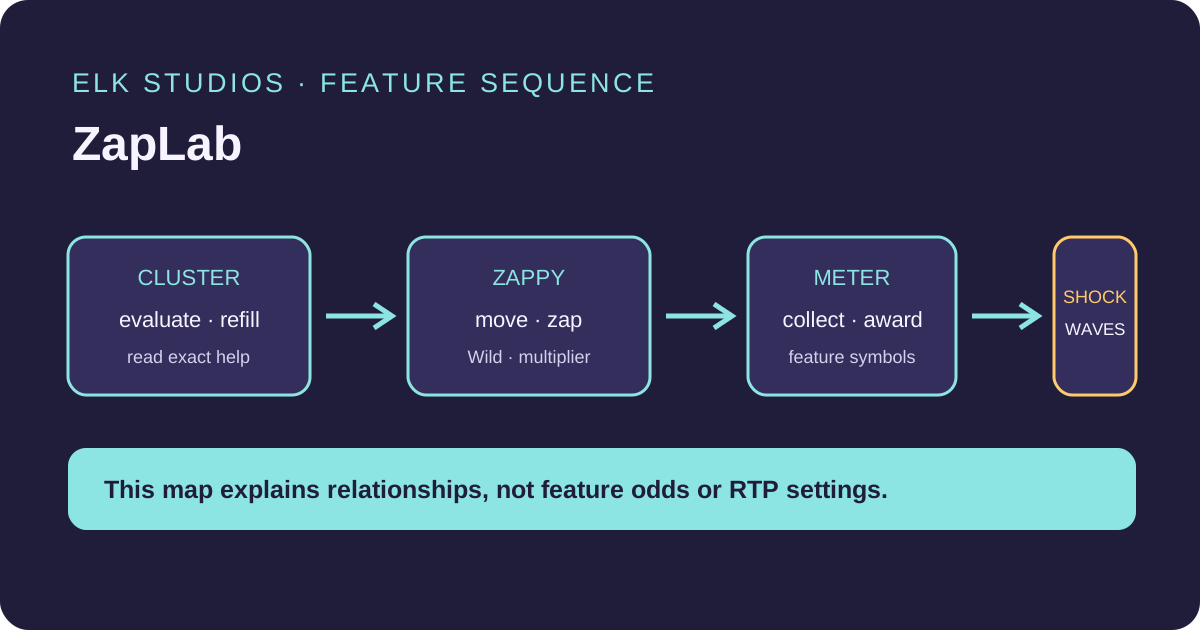
The most useful way to follow ZapLab is to separate the board’s base result, any resulting symbol changes, Zappy’s action, and the meter’s feature award. Those stages can affect one another, so a single spin animation may show several events before settlement. A feature name alone does not establish its chance, average return or exact order in every operator build. Use the active game help to confirm how the charged clusters win and how each feature transforms or replaces symbols.
ELK’s public product description does not provide the current operator version’s RTP variants, volatility label, hit frequency, wager limits or active maximum payout terms. The supplier page gives a broad product description, but the assignment requires numerical settings to come from current game help. No operator help screen was supplied here, so those values remain unverified and are not repeated. This page also does not say that ZapLab is accessible to New Zealand accounts or that a free demo is available in New Zealand.
What “charged cluster” means in this guide
ELK calls ZapLab a charged cluster slot. In cluster-style games, wins are generally formed by groups of matching symbols under the game’s adjacency and minimum-group rules, rather than by a fixed list of paylines. “Charged” is part of the title’s feature language, not a standard mathematical definition shared by every supplier. The current paytable should explain what constitutes a winning cluster, whether diagonal neighbours count, whether the group must touch, and how the game resolves multiple groups at once.
Do not infer a cluster rule from a screenshot. The client may use a particular symbol count, a particular direction or a special treatment for Wilds. If Wilds contribute to clusters, the help should say whether they substitute for ordinary symbols, whether a Wild can form its own group, and what happens when a special Wild is also an expanding or transforming feature. Those details matter because “Wild” identifies a broad role, not every interaction.
The supplier names symbol upgrades, Wild flips and big symbols alongside Zappy and the meter. This signals that symbols can change size, identity or status during the play sequence. It does not fully define whether an upgrade increases a symbol’s paytable value, whether a flip changes a symbol into a Wild, or whether a big symbol occupies more than one grid cell for every interaction. Read each feature’s in-game explanation and paytable illustration before assigning a result to it.
As a practical reading model, record what is on the grid before a win, what symbols were counted, which symbols cleared, what refilled, and which feature activated. Then check whether a later animation is part of the same paid round. If the game uses an avalanche or refill sequence, a fresh arrangement may follow a previous result without creating a new independent wager. The rules should explain where the paid round ends and how all intermediate wins are totalled.
Zappy’s Wild movement
Zappy has a distinct role from a stationary Wild. ELK says he is a Wild and jumps to a new random position when he is part of a win. After moving, he attacks Dr. Mayhem symbols, leaves a Wild behind and increases his multiplier. On a last zap attack, the supplier says Zappy can expand into one of several larger shapes. These linked actions make it important to track the original position, the new position and the symbols affected by the attack.
When a Zappy action begins, first check which winning cluster included him. The word “part of a win” suggests that a prior qualifying result is relevant to movement, but the exact rules for chained wins, random placement and unavailable positions belong to the active help. The supplier synopsis does not tell us whether Zappy can land on every cell, whether a new position can overlap a feature symbol, or whether the move happens before or after the grid refills. Do not fill those gaps with assumptions from another charged-cluster title.
The attack is a transformation event. Dr. Mayhem symbols are removed by the zap and a Wild is left in their place according to the supplier’s description. That does not mean every removed symbol pays, or that every removed position is eligible for a cluster. A Wild may help connect symbols after the board has changed, but whether a new cluster is immediately evaluated depends on the game’s event order. The feature guide should be read together with the paytable, not as a standalone promise of repeated wins.
The increasing multiplier is attached to Zappy in the supplier description. Verify how it is displayed, what increases it, whether it starts over after a paid round and which wins can use it. A multiplier can be local to Zappy’s Wild, attached to a position, or applied across a broader feature state. The public summary does not define all those boundaries. Look for exact wording such as “this Wild,” “symbols hit,” “cluster win,” or “global” instead of assuming every displayed multiplier applies to every result.
The final zap expansion is also a named visual event whose practical effect must be read carefully. A shape that covers several cells might convert the covered spaces to Wilds, clear them, or interact with them in another way. ELK’s short page gives the possible shape sizes and says the expansion occurs during the final attack, but not the full cell-by-cell selection rule. This article intentionally uses no numerical expansion dimensions as a verified client setting because the current help was not provided.
Monster Meter and feature awards
The Monster Meter counts collected symbols. When it fills, it can award random Monster features or random feature symbols, as described by ELK. The meter is therefore a progress display associated with collected symbols, not a simple visible payout. A full meter may cause a feature event, but the meter itself should not be mistaken for a cash balance. Confirm which symbols count, whether more than one collection can occur in a round, and whether the meter persists across drops or resets after a feature.
Feature symbols can land during a symbol drop or be awarded by the meter. The official page says they activate after a refill and upgrade stage and then replace, convert or upgrade symbols on the grid. That ordering is particularly useful: it gives the player a way to understand why a feature may not activate at the instant its icon first appears. The current game client may show the symbol being collected first, then complete the board update, and only afterwards reveal its effect.
The supplier also says that five Monster Features can trigger randomly when the Monster Meter is full, and names Shockwaves in connection with a later fill of the meter. Since numeric trigger requirements are supposed to be verified in current game help, this guide does not restate the fill count or feature count as operator-confirmed values. The useful qualitative point is that the meter has multiple feature outcomes and a special Shockwaves state. An operator may use a version or setting that needs confirmation from the active help.
When a feature symbol appears, identify whether it is a trigger, a modifier or a result. A trigger starts an effect; a modifier changes a symbol or subsequent evaluation; a result may award a direct amount. Some icons can serve more than one role at different points. Read the tooltip or paytable entry for each symbol instead of treating all feature symbols as interchangeable “bonus” icons. ZapLab’s feature vocabulary makes that distinction important because a meter award can produce a feature symbol that then performs a separate board action.
The “random” wording in a supplier overview does not describe odds. It means the page calls the selection random; it does not disclose the probability of any particular feature or how those probabilities change by build. A player cannot use meter progress to infer that a chosen feature is due next. If a feature did not appear in several prior rounds, that history does not establish what the next full meter will award.
Shockwaves and the feature sequence
ELK connects Shockwaves to a later Monster Meter state and says it awards all Monster Features. This makes Shockwaves sound like an umbrella event, while ordinary meter activations may select individual feature effects or feature symbols. The exact animation and settlement depend on the current client, but the reader should watch for whether Shockwaves combines features in a single sequence or activates them one at a time.
If multiple features act on one board, the order can affect how symbols are evaluated. An upgrade might change a symbol before a conversion; a Wild flip might happen before a cluster check; a large symbol may span positions that a later effect also targets. The supplier page does not list a full priority table. Use the actual game’s help, demonstration mode if permitted, and round history to verify which event happens first rather than trying to derive an unlisted order from a single outcome.
A sensible event log for a confusing round is: collected symbol(s), meter state, awarded feature, board refill or upgrade, symbol conversion, cluster evaluation, win calculation, and remaining feature state. Not every step needs to occur in every round. The point is to keep separate stages from being collapsed into one vague “shockwave win.” If a result seems inconsistent, compare the visible change with the payout history and ask the operator which help text applies to the loaded version.
Shockwaves is not a guarantee that every feature produces a winning cluster. A feature can change or enhance a board without ultimately creating a paid group, depending on its definition. Likewise, a feature animation can look extensive while the settled return remains limited. The maximum shown in a supplier product page is not a typical result or an expectation for a session.
X-iter and optional entry modes
ELK’s page includes an X-iter description with modes that can start a round in a selected state or make a named event more likely. It also describes a high-cost entry that begins with a larger symbol and a boosted meter. These are supplier-published feature options; the current client help is needed for the exact mode names, cost, conditions and outcome rules. No optional feature-buy prices are repeated here because they cannot be verified against an operator build.
If the active client has an X-iter menu, compare its terms with ordinary play before deciding whether to use it. Confirm the total cash cost in the account currency, whether it is a multiple of the base bet, what feature state begins, and what remains random. A mode that increases access to a feature changes the distribution of play and the immediate amount at risk. It does not guarantee a profit, a particular Monster Feature or a specific multiplier.
The menu should not be treated as a separate free demo. A purchased or optional start is still a wager under the operator’s rules. Check whether the mode is disabled in some jurisdictions, whether a promotional balance is eligible, and whether any max-win rule differs from ordinary spins. Do not proceed if the interface does not display the total cost clearly. This guide is informational and does not recommend an operator, offer or feature purchase.
RTP, volatility and the meaning of a settings panel
RTP is a theoretical long-run percentage associated with a particular mathematical configuration. It is not a forecast for the next spin and does not cap a loss in a short session. A game name alone does not identify the configuration. If an operator’s help panel presents more than one RTP variant, the correct figure is the one tied to the loaded version, not a value copied from a different jurisdiction or review.
Volatility is a description of how results are distributed over time. It is not a promise that wins will arrive after a quiet sequence or that a high-volatility game will eventually pay a large award. Hit frequency also needs its definition: one source may count any win, while another may count all feature starts or non-zero results. Without the methodology and build, two percentages cannot be compared responsibly.
No operator’s ZapLab build, current game-help screen or paytable was supplied for this assignment. The official public page describes mechanics and names a maximum potential, but it does not verify the RTP variants, volatility, hit frequency or current stake range required here. This guide does not publish numeric RTP, volatility, cap, bonus-trigger odds, bet limits or optional-mode costs. Nor does it claim that one competitor’s percentage is the active value for New Zealand.
To complete a build-level check later, record the table or operator name, game title, help-screen date or version, RTP field, paytable, wager range and any cap wording. Photograph or save the information panel if permitted. If the panel identifies only one RTP value, record that exact value and do not call it the only version worldwide. If it lists an interval or several selectable configurations, preserve the labels for each. The article should then state which source was checked and when.
Mobile play and visual accessibility
ZapLab’s feature sequence depends on following symbol changes across a grid. On a phone, a player needs to see the grid, meter, Zappy’s current position and the prompt without confusing one with another. Before wagering, open the instructions on the same device and check whether the game can enlarge the board without pushing the stake and action controls off screen. The supplier’s desktop recommendation does not establish a mobile layout or the usability of every operator skin.
Animation speed can make the feature order hard to follow. If a speed setting exists, slow it down while learning or review the round history after a result. Do not assume the first highlighted number is the final award; it may be an intermediate meter state or a symbol count. Keep the screen orientation stable and avoid repeated taps while a feature is resolving. A second tap might queue a spin or repeat a selection depending on the interface.
Players who need reduced motion, larger text, a screen reader or high contrast should check the game and platform’s actual controls. An SVG diagram on this page explains only the broad relationship between named mechanics and is not a substitute for the game’s accessible help. If the client hides essential rules in small tooltips, use the operator’s support channel before betting rather than relying on a visual guess.
Demo access and release status
The official supplier page publishes a Play control and product materials. It does not establish whether that control opens a demo in a particular country, whether a casino has integrated the title, or whether any demo uses the same configuration as a cash game. A playable demonstration can be unavailable, region-restricted or configured separately. No demo was launched for this review.
The supplier catalogue lists ZapLab as a game, and ELK’s official news archive includes a release announcement. Those are supplier-level product records. They are not confirmation of current NZ availability, operator eligibility or a particular casino’s support for the title. The page avoids saying that ZapLab is “available in NZ” without an identified operator and an eligibility check.
If a demo is offered through a lawful, accessible platform, it may help someone recognise buttons and feature names. It cannot establish a live operator’s RTP, account currency, wager limits, settlement, bonus terms or actual availability. The rules and help of the eventual client remain decisive for those questions.
How to assess the feature design
ZapLab asks the player to watch a chain of events rather than a static payline: clusters are evaluated, a Wild may move, a character attacks symbols, a meter may award an effect, and a feature can transform the board. A reader who likes transparent, step-by-step mechanics may find the sequence easier to follow when each event is clearly logged. Someone who prefers one simple payout table may find the transitions busy. Those are usability observations, not claims about the game’s quality or expected return.
The feature map can help compare ZapLab with other cluster games, but only at a conceptual level. Ask whether a game’s Wild moves after a win, whether its meter counts symbols or wins, whether a meter fill awards a random feature, and whether a broad feature state combines effects. A game with a similarly named Shockwave or Monster Meter may use different rules. Similar words are not a basis for borrowing probabilities or payout values.
For a product comparison, separate three evidence layers. The first is supplier documentation, which confirms the game exists and names public features. The second is operator game help, which explains how the active build settles a hand or spin. The third is an independent review, which may explain an interface or report an observed demo but can be tied to a region and date. Do not let a review’s numeric table silently override the first-party client help.
A pre-play verification checklist
If the game later appears in a permitted operator catalogue, start by checking the title spelling and provider. Open the help and paytable, confirm the cluster definition, Wild role, symbol-upgrade rule, Wild flip, big-symbol behaviour and the exact Zappy movement and attack sequence. Then read the Monster Meter collection condition, each feature-symbol entry, Shockwaves wording, and what is retained or reset between states.
After understanding the mechanics, check account settings: the displayed RTP configuration, any volatility field and its definition, currency, minimum and maximum stake, payout cap, and optional X-iter terms. Verify whether the interface’s “win” figure includes the stake or shows profit only. Confirm what is recorded in the round history and where to find the reference if an animation is interrupted.
Set a spend and time limit before play, and include any optional feature cost or side wager in the same total. Do not keep spinning because a meter looks close to full: a progress graphic does not say when a feature will occur unless the actual rules say so, and it does not make the next result due. Stop if the help or price is unclear. The New Zealand safer gambling guide provides information for taking a break and finding support.
Frequently asked questions
What kind of slot is ZapLab?
ELK Studios describes it as a charged-cluster slot. Its public product page names Wilds, symbol upgrades, Wild flips, big symbols, Zappy, a Monster Meter and Shockwaves. The exact cluster and symbol rules come from the active game help.
What does Zappy do?
ELK says Zappy is a Wild that can move after participating in a win, attack Dr. Mayhem symbols, leave a Wild and increase its multiplier. The current paytable is needed for the exact order and scope of those effects.
What is the Monster Meter?
It is a supplier-described progress meter that counts collected symbols and can award a Monster feature or feature symbol when full. Its current fill, persistence and feature odds are not established by the short public description.
What is Shockwaves?
ELK connects Shockwaves with a later Monster Meter state and describes it as awarding all Monster Features. The active help should confirm the precise trigger and event order for the operator version.
What RTP does ZapLab use?
This review does not state a numeric RTP because no current operator help or paytable was supplied. The active client’s information panel is required to verify the exact configuration.
Is ZapLab high volatility?
No verified volatility label for the reviewed operator build was available. A third-party rating is not substituted for the current game-help field.
Can I use X-iter or a demo in New Zealand?
This review does not verify NZ access or operator availability. The supplier page names X-iter and has a Play control, but those facts do not establish that a specific account can use a mode or demo.
Does a full meter mean the next spin will win?
Do not treat a progress indicator as a promise about a future result. Follow the current help’s exact meter condition and avoid inferring a probability from prior rounds or a near-full display.
Sources and verification boundary
Primary references checked 15 June 2026: ELK Studios’ ZapLab page for the supplier-described grid and feature relationships; ELK Studios’ official games catalogue; and DIA guidance for online-gambling advertisers for New Zealand context. Competitor pages checked the same day include Slot Gods’ ZapLab review, OLBG’s ZapLab page, and Bigwinboard’s review. These pages publish review-specific numeric claims that are not treated as a current New Zealand setting.
The article paraphrases the supplier’s feature outline and does not copy its promotional story text. A live operator build, current help panel, numeric game sheet or New Zealand operator listing was not supplied. The requested verified RTP variants, volatility, hit frequency, bet range, max-win cap and optional-mode pricing are therefore left unreported. No game or demo was launched, no operator account was checked, no CPA destination was opened, and no claim of local availability, ranking or search demand is made.