ELK Studios game rules · South Island guide
Knight Fight: rules, features and settings to verify
 Best casinos available in New ZealandUpdated 7 November 2026

Knight Fight is ELK Studios’ medieval CollectR slot. Its supplier page describes knights moving around an expanding board to collect same-colour crests and feature symbols, with upgrades, transformations, Wilds, coin wins and bonus states. Collected bonus symbols lead to a free-drop feature where some board progress is retained. The current RTP, volatility, stake limits and cap must still be checked in the operator’s active help; review-site figures are not enough to verify a particular build.
The short answer
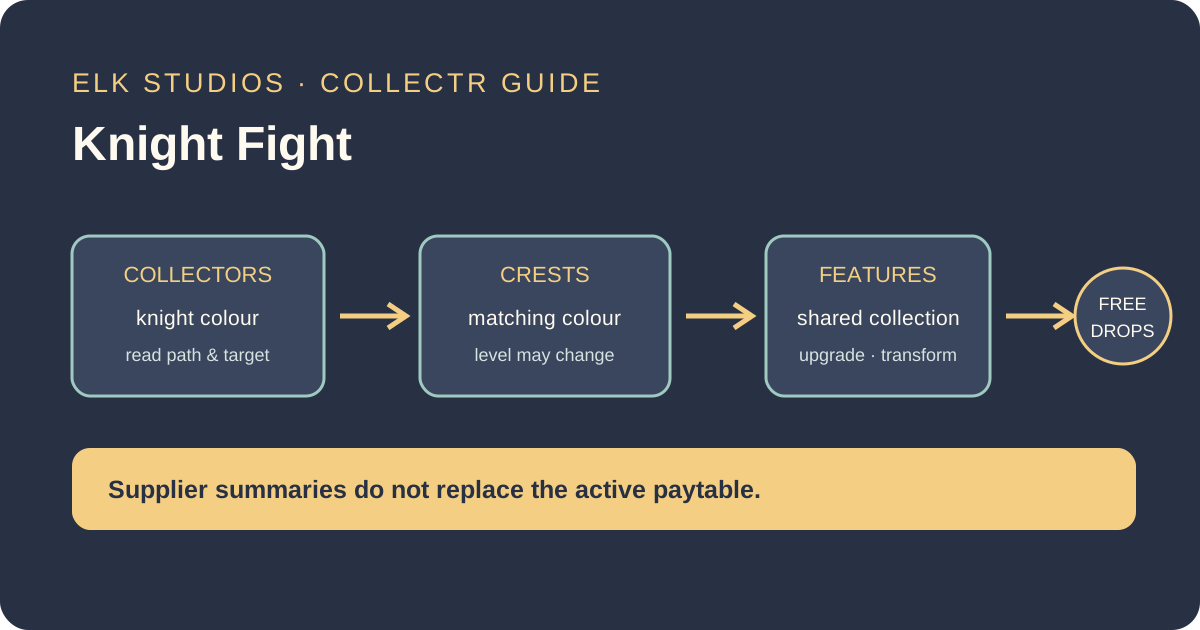
Knight Fight is a slot built around ELK Studios’ CollectR mechanic. The supplier’s public description says the knights move around the board, collect crest symbols matching their colour and collect feature symbols. The board can expand, symbols can upgrade or transform, and the game includes Wilds, coin wins, a bonus and a super bonus. A free-drop bonus begins after collected bonus symbols meet the game’s trigger condition; the supplier says selected progress remains during that feature.
The best way to read a round is to follow each collector separately. Note the colour of a knight, the crest or feature it reaches, any upgrade applied, and whether the board state changes before the next collection. A matching crest and a feature symbol have different roles: one is a paying collection, the other may activate a modifier or a bonus step. The exact sequence and values should come from the active paytable rather than from a review of a different build.
The supplier’s page establishes a distinctive feature outline, but it does not supply the current operator’s RTP variants, volatility label, hit frequency, bet range or payout cap. The assignment says numerical settings must be based on current game help; that help screen was not supplied. This article therefore does not adopt a numeric setting from a competitor or from another casino. It also does not claim that Knight Fight is available to New Zealand accounts or that a demo can be played from New Zealand.
The board and its CollectR identity
Knight Fight uses a grid rather than a simple fixed row of symbols. ELK describes it as a dueling slot with CollectR, an expanding game area, upgrades, transformations, Wilds, coin wins, and bonus states. The visual theme is a group of knight brothers whose disputes appear as duels. For rule reading, the characters matter because they are the collectors; the story itself does not determine whether a symbol pays or how much a result is worth.
CollectR is the central mechanic named by the supplier. A collector moves to pick up a symbol according to a rule—here, the official summary associates each knight with crests of the same colour and says feature symbols can be collected by any knight. That distinction is essential. A coloured crest is not necessarily collected by every character, while a feature icon may be available to any of them. The paytable should show the colour mapping and explain whether a collector can visit the same space more than once.
When a board expands, additional positions may become available for later drops or collections. The exact trigger for expansion, whether it persists for the rest of a base round, and whether it carries into a bonus are operator-help details. Do not assume that “expanding grid” means the board grows every time a knight moves. The supplier page names the feature but does not expose a full state diagram.
The mechanic creates several layers to track: a symbol can land, a knight can collect it, a crest can be upgraded, a feature can transform another symbol, and the board can change size. A player should distinguish the moment each action occurs. A single animation may show a collection and a refill; the resulting symbol arrangement may then be evaluated again. The game rules should explain whether that is one paid round with cascades or a sequence of separate outcomes.
Knights, colour matching and crest collection
The supplier says knights collect crest symbols of the same colour as the knight. This is the first rule to check on the screen. Identify the collector’s colour and the crest colour, then follow the highlighted path or target. If the game has several collectors, each may make a distinct collection during a resolution. A highlight can indicate the current target, the path travelled, or a completed pickup; read the help icon if the symbols overlap visually.
The public description says crests can be upgraded to higher payout levels. An upgrade is a change in a symbol’s award category, not necessarily a direct win by itself. The paytable should state whether collection awards the current crest value, whether an upgrade applies before or after collection, and what happens if the same crest is upgraded more than once. If the level indicator changes during a feature, note whether that state is local to one colour, one collector, one spin or a longer feature.
Do not treat an upgraded crest as a guaranteed high payout. The symbol still has to be collected or otherwise evaluated under the game rules, and the value depends on the client’s paytable. A higher label or brighter animation tells you that the state changed; it does not reveal the underlying payout amount or its probability. A current help panel is needed to establish the exact symbols, values and maximum collection level.
Colour matching also creates a useful distinction from generic collection games. In some titles, any collector can pick up any paying symbol; here ELK’s description specifically calls out same-colour crests and separately says all feature symbols can be collected by any knight. That means the two symbol classes should not be collapsed into “the knights collect everything.” Use the official mapping and any in-game legend to see which actions are restricted and which are shared.
If two knights approach one object, the order or eligibility may matter. The public summary does not say how the client resolves competing paths, unavailable spaces or a symbol placed beneath another collector. The current rules can define a priority order or random selection. Do not derive that rule from one observed round, because a game can use a different path based on the particular board state.
Feature symbols and transformations
ELK lists symbol upgrades and transformations as part of Knight Fight and says feature symbols can be collected from any knight. These effects can alter a board position or change what a later collection means. A feature symbol may be consumed when it activates, may leave a changed symbol behind, or may affect other positions. The supplier description does not list every icon-to-effect pairing in the short overview, so use the live help for the exact named feature and timing.
When a feature symbol appears, ask whether it is collected, activated or merely displayed. Those are separate events. Collection means a knight has reached it under the rule. Activation means the game executes its effect. Display means the icon is present, possibly waiting for the required sequence. A feature can be collected by one knight and activate after a refill or another event. The help panel should tell you if there is a delay between collection and effect.
Symbol transformation is also not always the same as symbol upgrade. An upgrade can raise the pay level of an existing crest; a transformation can replace its identity or role. A Wild may substitute for a paying symbol, but a special Wild can have additional restrictions. If the screen shows a Wild in a transformed position, confirm whether it can be collected by a knight, whether it participates in a win, and whether it remains on the board after the current evaluation.
Coin wins should be treated as a distinct award type until the paytable explains their calculation. Check whether a coin carries a displayed value, uses the current bet as a unit, or is combined with a multiplier. The supplier’s overview confirms that coin wins exist but does not provide the full accounting. A trophy, crest and coin may all look like collectibles while representing different parts of settlement.
The quickest way to make feature interactions understandable is to use a simple event table in the game’s history if available: starting symbol, collector colour, collected item, transformation or upgrade, board change, win calculation and final amount. This is not a tactic for increasing results; it is a way to verify what the interface says happened. If the round summary skips an important step, preserve the hand or spin identifier before asking support.
Free-drop bonus and retained state
ELK says collected bonus symbols trigger a free-drop bonus. The official page also says the grid size, crest payout level and feature-meter progress persist throughout that bonus. That persistence is a key part of the mechanic: a free drop is not necessarily a clean reset to the base board. Some state from earlier in the feature remains relevant, so the player should check what is held, what can change and what can be added as the sequence continues.
The source page does not specify every entry and end condition in its short public text. The active game help should identify whether bonus symbols need to be collected within one paid round, whether they can appear or be collected during the free-drop state, and what happens to progress at the end. Do not copy an exact symbol threshold or free-drop count from an older review unless it matches the current client. The current rules are required for numerical trigger claims.
During the feature, keep the retained state separate from a new event. A board may remain expanded while a new drop changes symbols; a crest level may stay high while a knight makes another collection; a meter may continue from its prior progress. The player should know which items persist and which reset after settlement. This detail is more useful than simply calling the feature “free spins,” because the supplier describes free drops with preserved board conditions.
A bonus can continue without producing a large final award. Persistence gives features a stateful structure, not a guarantee that the next drop will complete a win. If an award is displayed after a sequence, check whether it is an intermediate event or the combined bonus result. The final credit should be visible in the account balance or round record and should agree with the published paytable.
The supplier also names a super bonus. A name alone does not establish whether it is triggered through the normal game, is a separate bonus mode, or is offered through an optional entry menu. Those routes can have distinct costs or starting states. The help for the active build should explain how the super bonus relates to the free-drop state. This guide keeps both terms within the one Knight Fight article rather than creating a second bonus page.
Reading upgrades and board expansion
The board’s expansion and the crest upgrades influence where collectors may move and the value associated with a collection. These are connected but different concepts. An expanding board changes the available space; an upgrade changes a crest’s payout level. A player should not assume that a larger grid automatically raises every symbol’s value or that a high-value crest causes a board expansion.
When the client displays an upgrade, identify its scope. Is it one crest, one colour, every crest currently on the board, or a feature-state change? The public supplier overview says payout levels can be upgraded, but does not provide a full persistence rule. Read whether the improvement is retained between drops, during the bonus only, or across a broader session. A value can reset when the feature ends even though the visual board looked continuous.
Similarly, if a collector appears to move across multiple cells, the path itself may be an animation of the collection mechanic. Confirm whether the knight can move only to reachable positions, whether a movement can pass an empty cell, and whether multiple objects can be picked up in one path. A screenshot after the round may hide the sequence. The game’s rules and history should be used for a precise explanation, not an inferred path from a promotional image.
RTP, volatility and payout settings
RTP is a theoretical return across a defined number of plays under a specific math configuration. It is not a promise for an individual round and cannot be inferred from the CollectR mechanic, a maximum-potential statement or the provider’s portfolio. The same title can be supplied with different RTP configurations to different operators. A review that lists one percentage may refer to a particular casino, region or version.
Volatility is often used to describe how a game’s returns are distributed, but labels such as low, medium or high may come from an operator, a supplier or a reviewer. These are not interchangeable sources. If the game help itself has a volatility field, record its wording. Do not transfer a “high” tag from a review site to a client that does not show that field. Hit frequency requires a definition too: it may describe wins, features or another event.
No current Knight Fight operator help, paytable, RTP selector or New Zealand-facing game listing was provided for this package. Therefore this article does not state a numerical RTP, volatility, hit frequency, max-win cap, bet range, feature-trigger count, feature-buy price or coin payout. ELK’s public product page supports the qualitative CollectR description but is not a substitute for the current help required by the assignment. Competitor review numbers are not treated as the game’s verified current settings.
For a proper settings check, record the exact title and version, then open its info screen and note the displayed RTP label, paytable, minimum and maximum stake, currency, settlement basis, and cap. If the RTP is not displayed, report that it could not be verified rather than substituting an outside number. If more than one variant appears, state which one was selected and preserve the label for each. Include a date, because an operator can update game settings.
X-iter and feature-start options
ELK’s official page describes X-iter as a set of modes that can begin at altered feature states, including a super-bonus route. The page does not establish that every operator offers every mode or what price applies in a particular client. The cost and start state are exactly the type of numerical details that should be checked in the active help before anyone makes a decision.
If a mode is present, compare its complete cost with the ordinary stake. Check whether the menu states a total price in account currency, whether the cost is a multiple of a selected bet, whether the round begins with an expanded board or upgraded state, and whether randomness still determines the result. Do not interpret “feature start” as an assured payout or as a normal free demo.
This article does not recommend purchasing an X-iter mode. The potential increase in initial exposure should be considered alongside the game’s variance, the player’s preset limit, and any jurisdiction or operator restriction. If the cost or settlement is not clear, close the menu and use the regular help screen. No CPA route or operator promotion is included in this guide.
Similar titles and scope boundaries
Knight Fight can be compared with other ELK games that use collectors or expanding boards, but similar mechanics do not transfer exact rules. The site’s Pirots 4 guide is a separate title guide. A reviewer may call Knight Fight a relative, revival or reskin of another game; that editorial comparison does not establish identical paytables, collector paths or RTP settings. This page covers Knight Fight’s own supplier-described rules only.
The same caution applies to series vocabulary such as CollectR. A mechanic name can indicate that symbols are gathered, while the title-specific help decides who collects which colour, which features are shared, what state persists and how a bonus begins. A general provider page can introduce the term, but should not replace the individual title rules. The current article remains one owner URL for the Knight Fight query and does not create separate pages for the RTP, demo or bonus subtopics.
When assessing a competitor review, separate description from proof. A feature walkthrough may be useful for recognising a visual state. A configuration table needs a dated source and a clear game build. A claimed personal experience should not be adopted as a fact on this site, and a casino call-to-action does not verify that the game is available in New Zealand. Our review pages do not claim an actual play test.
Mobile display, controls and history
Knight Fight’s board has moving collectors and colour-coded objects. On a small screen, check whether colour labels remain distinguishable and whether a knight’s path can be followed without covering the stake display. If the game provides a zoom, landscape layout or help overlay, make sure the overlay does not block an active prompt. The supplier’s general screen recommendation is not evidence about a specific operator’s mobile skin.
Open the game’s instructions on the device you will use and verify that the paytable can be scrolled and closed. Check that the board and feature meter are both visible, particularly during a free-drop sequence when retained state matters. Avoid repeated taps while an animation is resolving. If an action button is disabled, the game may be processing a collection or waiting for the next event rather than rejecting the input.
Where available, the round history can make a colour-matched collection easier to audit. Look for a list of symbols, an event trace or a final payout breakdown. If the interface shows only a total, save the round reference and ask the operator what state was carried into the bonus. A browser freeze or interrupted stream is not proof that a collection did or did not settle.
Release, demo and New Zealand access
ELK’s catalogue and product page document Knight Fight as a supplier title. That is a supplier-level release record. It does not confirm the title’s inclusion in any specific operator lobby, current licensing position, New Zealand account access or local demo availability. This review did not launch a game client, create an account or test access.
If a demo is offered through an authorized site, it might help a reader recognise the CollectR movement, but it cannot verify another operator’s RTP, currency, stake limits or settlement. Demo outcomes should not be treated as statistical evidence because a sample of spins cannot establish long-run return, and the demo may be configured differently. Always use the help screen of the intended game version for the settings relevant to that session.
New Zealand access requires a separate current check of the operator and its applicable rules. The supplier’s corporate licences and product page do not prove that an online casino is authorised to offer the title in New Zealand. No operator is named or recommended here, and no availability claim is made.
How to judge whether the game’s rules are clear
Before play, a reader should be able to answer a few plain questions from the help screen: What symbols pay? Which crests belong to which knights? Can every knight collect a feature icon? What exactly changes after an upgrade or transformation? What starts the free-drop bonus? Which states persist during it? How does the game end the sequence? If those answers are not available, the rules are not yet clear enough to support a confident understanding of the result.
The paytable should also make the settlement readable. Look for whether values are shown per stake unit or in cash, whether coin wins use a separate calculation, how multipliers apply, whether total win includes the original stake, and whether the client defines a maximum award. A numeric maximum from a marketing page should not replace the active paytable’s cap. Keep currency consistent when comparing displays.
Good product documentation separates three things: the visual story, the feature logic and the mathematical configuration. Knight Fight’s medieval setting explains why knights duel; its supplier overview describes the CollectR feature; its current game help should state the operational rules and selected settings. Competitor commentary may add opinion, but it cannot fill a missing operator-specific number without evidence.
Play limits and responsible use
Slots have uncertain outcomes. A collector route, progress meter or persistent bonus state does not make a next result predictable. Choose an entertainment amount that can be lost without affecting essentials, and set a time boundary before opening the game. Include any side bet or optional feature cost in the total; do not judge exposure only by the base spin amount if another mode multiplies it.
Do not increase the stake because the board has expanded or a crest has upgraded. Those are game states, not a signal that a win is due. Likewise, a previous losing sequence does not make a feature more likely unless the help explicitly defines a state-dependent rule. If the session stops being enjoyable or it is difficult to close the game, take a break and use the New Zealand safer gambling guide for independent support information.
Keep account funds separate from money for food, rent, travel, bills or savings. Avoid borrowing or using credit to chase a result. A pause is useful before a decision, especially when the game offers an optional mode or repeats a saved stake. If a game’s rules or price are unclear, do not wager until the operator explains them.
Frequently asked questions
What is CollectR in Knight Fight?
ELK describes the knights as collectors that move around the board, collecting same-colour crests and feature symbols. The active help explains the exact paths, timing and payout rules.
Do knights collect every crest colour?
The supplier says crests are collected by knights of the same colour. It separately says feature symbols may be collected by any knight. Use the client’s legend for the current colour mapping and exceptions.
What persists during the bonus?
ELK says the grid size, crest payout level and feature-meter progress persist through the free-drop bonus. The current rules should confirm the exact start and end conditions and what resets after settlement.
What RTP does Knight Fight use?
This guide does not publish a numeric value because no current operator help was supplied. Check the RTP field in the active game’s information panel and record the precise build or label.
Is its volatility high?
No verified volatility field for the relevant operator build was available. A third-party tag may refer to a different source or client and is not repeated as a confirmed setting here.
Does the supplier page confirm an operator’s maximum win?
The supplier page describes product potential, but it does not verify the current operator’s payout cap. The active help and paytable must be checked before reporting an operator setting.
Is Knight Fight available to New Zealand players?
This review does not verify a New Zealand-facing operator or account eligibility. A supplier catalogue listing is not proof of local availability.
Does Knight Fight have the same rules as Pirots 4?
A review may compare their collector mechanics, but that does not prove the rules or settings are identical. Read Knight Fight’s own help; the separate Pirots 4 page covers that title.
Sources and verification boundary
Primary material checked 15 June 2026: ELK Studios’ Knight Fight page for the supplier’s CollectR, colour-matched crest, upgrade, bonus and persistence descriptions; ELK’s catalogue; and DIA advertiser guidance for New Zealand’s current online-gambling advertising regime. Competitor examples checked the same date include Bigwinboard’s Knight Fight review, Casinos.com’s review, and Slots Temple’s review. Their published settings and opinions are not adopted as New Zealand operator facts.
ELK’s page provides a supplier-level mechanic outline, not current operator game help. This review did not receive a dated paytable, selected RTP variant, volatility specification, current client, operator listing or NZ eligibility evidence. Consequently no numeric RTP, volatility, hit frequency, payout cap, stake range, trigger count or optional-mode price is claimed. Search volume and rankings were not available. No client or demo was tested, no CPA route was opened, and no statement about lawful access to an operator is made.
