ELK Studios game rules · South Island guide
Black River Gold review: Revolver, Wild Compass and Free Drops
 Best casinos available in New ZealandUpdated 7 November 2026

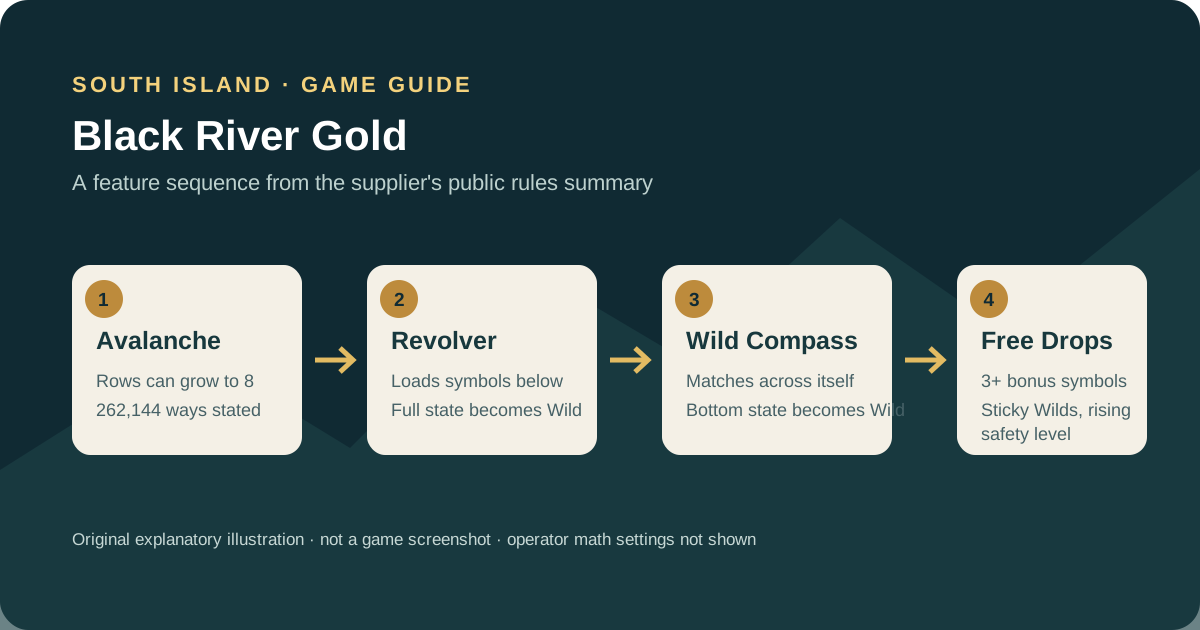
Black River Gold is the fourth title in ELK Studios’ Gold Series. Its supplier page describes avalanches that can grow the layout to eight rows and 262,144 ways, large symbols, the Revolver, a Wild Compass and a Free Drops feature with sticky Wilds and a rising safety level. The linked game data sheet could not be fetched, so no current RTP variant, volatility label, stake range or multiplier win cap is confirmed here.
The short answer
Black River Gold is an ELK Studios slot built around expanding rows, large symbols and two named special mechanics: the Revolver and Wild Compass. A winning avalanche can add rows until the supplier’s stated ceiling of eight, which corresponds to 262,144 ways. Three or more bonus symbols start Free Drops; Wilds stay in play until used, and a win raises the feature’s safety level. That summary helps identify what to inspect, but it does not provide every paytable entry or a current casino setting.
The supplier describes the Revolver as a container for symbols beneath an oversized symbol. It loads those symbols until they sit level with the surrounding layout, represents their combined size and becomes Wild if full. The Wild Compass makes matches across itself Wild, then becomes a Wild when it reaches the bottom. These are distinct effects. The first concerns symbol space below a large symbol; the second concerns matching across a moving feature.
The official game information page is the primary source for those mechanics. Its linked Game Data Sheet did not load when checked on 7 October 2026, so the game’s RTP, volatility, stake limits, maximum win expressed as a multiple, precise trigger paytable and any operator-specific settings remain unverified. This article therefore explains the mechanics and a careful verification process without filling missing fields with casino-review numbers.
Identify the exact title before comparing settings
Start with the full name, Black River Gold, and the ELK Studios attribution. The supplier’s catalogue and dedicated page list the title as part of the Gold Series. This establishes the product identity in ELK’s public catalogue; it does not show that a particular operator currently distributes the game, or that a New Zealand account can open it.
A name match is the first check, not the last. If a casino lobby shortens the title, compare the game’s information screen with the supplier listing before using a paytable or review for comparison. Avoid transferring assumptions from another Gold Series release. Shared series branding can indicate a design family, but each product has its own symbols, feature rules, return model and possible settings.
Record the title exactly as displayed, the provider, the operator’s version label if present, the date of the help screen, and whether the information page identifies a mode. If a menu offers a base game and a paid feature mode, record those as different configurations. A figure shown for one is not automatically valid for the other.
How avalanches change the board
ELK describes winning avalanches that allow the rows to expand to a maximum of eight and the game to reach 262,144 ways to win. In a cascading game, a win can remove or change symbols and let new symbols enter the layout. If the new state also qualifies, another evaluation can follow within the same paid spin. The word “ways” describes the number of possible symbol paths under the game’s layout rules; it is not the number of independent bets or a promise that every spin will use the maximum layout.
The distinction between a base layout and an expanded layout matters when reading a result. A screen with more rows can create more eligible combinations than the starting configuration, but the symbol distribution and paytable still determine whether a particular combination pays. More possible paths do not mean a fixed increase in expected return, and they do not allow a reader to predict a win from a screenshot.
The supplier’s public summary states the ceiling but does not expose the complete row-by-row ladder in the readable text. Do not reproduce a table from an unaffiliated review as if it were official. If the active game help shows a progression table, note every row and the condition for adding it; otherwise record only the supplier-confirmed maximum and leave intermediate steps open.
Large symbols and the Revolver are not the same thing
The official page says low-, middle- and high-value symbols, as well as Wilds, can appear in large sizes from 2×2 through 4×4. A large symbol occupies more than one position visually. The paytable must explain how such a symbol is evaluated: whether all covered positions count as the displayed symbol, how it interacts with reel paths, and whether wins use the full layout or a specific edge-to-edge condition.
The Revolver adds a separate state. ELK says a large symbol with empty positions beneath it can become a Revolver and load all symbols below until the feature reaches an even level. It then represents the size of the symbols it has loaded. A full Revolver turns Wild. The useful mental model is a sequence: eligible gap, collection of symbols below, a levelled shape, and a possible Wild conversion.
Do not assume that every large symbol becomes a Revolver. The public summary describes the condition of empty spaces underneath, but an exact game-help screen should define eligibility, which symbol shapes can participate, what happens if the column is already level, and whether collection affects a win in the same evaluation. If one of those points is missing, retain it as unknown rather than infer from an animation.
The feature’s visible growth can make a reel screen look like a guaranteed improvement. It is only a change in symbol state. The Revolver becomes Wild only if the stated completion condition is met; before then, its effect depends on what is collected and where it sits. For a reader, the practical question is not “How large is it?” but “Which symbols are included, when is it evaluated, and what event completes the Wild conversion?”
Read the Wild Compass as a matching rule
The Wild Compass has a different job. ELK says it matches symbols across itself and turns those matches into Wilds. When the Compass reaches the bottom, it becomes a Wild. “Across itself” is a compact supplier description, so a careful reader should look in the game help for the exact directions and positions that count. Do not silently turn that phrase into “every symbol on the screen” or assume diagonal matches.
Separate three questions in the help menu. First, what makes a symbol a match across the Compass? Second, does the transformation happen before or after a winning combination is evaluated? Third, does reaching the bottom happen during every avalanche, or only under a named sequence? These timing details affect how the display should be interpreted and can differ from a feature with a similar name in another slot.
The bottom-row change is also distinct from a permanent Wild. The supplier states that the Compass becomes a Wild when it reaches the bottom, but the readable summary does not give a persistence duration. Check whether that Wild contributes to the current drop, remains through a later cascade, or applies only to the next evaluation. A player should read the exact wording instead of assuming a symbol remains active because it was visible in an earlier frame.
Free Drops: trigger and feature state
ELK says three or more bonus symbols trigger the Free Drops game. The supplier’s description uses “drops”, while some third-party reviews call the feature free spins. Follow the wording shown in the exact version’s help. The terminology matters because a drop, spin and cascade may be counted differently in a particular feature.
The supplier page gives two important feature rules. Wilds are sticky in the bonus until used, and each bonus-game win raises the safety level for the remainder of that feature. Those details make state tracking central to the feature. A Wild remaining on the board is not merely part of the picture; the help should clarify what event counts as “used.” A safety level that rises after a win is not itself a payout. The exact consequence of each level and whether it changes the layout or continuation should be read from the active rules.
The page does not state how many drops a trigger awards, whether the number changes with scatter placement, whether retriggers are possible, or what the safety levels do numerically. Do not borrow counts or extra-spin rules from a different ELK Gold game. Before comparing two builds, record the trigger requirement, the starting number of drops, retrigger conditions, the Wild-use condition and each safety-level effect exactly as the game help presents them.
This helps distinguish a feature’s visible activity from its financial result. A bonus may create more symbol evaluations, persistent Wilds or an expanding board, yet each outcome still uses the title’s paytable and mathematical model. A longer sequence is not automatically a more valuable sequence. It can be useful to note the mechanics, but it cannot replace a confirmed RTP or cap.
Build a paytable record instead of copying a review stat
Open the in-game paytable and record the exact date and configuration shown. Capture the symbol names, the minimum and maximum combination lengths, the payout basis, and the exceptions for Wilds, bonus symbols and feature symbols. If large symbols or a Revolver are part of the game, include their special evaluation rules. A row labelled “5 symbols” can mean something different in a ways game than in a fixed-line game, so retain the labels instead of translating them loosely.
Keep each setting in its own field: displayed RTP, volatility descriptor if any, stake range and currency, maximum-win wording, feature cost, and any jurisdiction note. An empty field means “not confirmed”, not zero. If an operator help page contains a number that differs from a third-party review, the operator’s current displayed version is the relevant source for that session; preserve the discrepancy in research notes rather than averaging the figures.
For a meaningful comparison, hold the game version and bet basis constant. A percentage, a coin amount and a multiple of stake cannot be compared as if they were the same measure. The supplier’s current Black River Gold summary does not publish a readable RTP or a maximum-win multiple. A secondary review may list numbers, but that is not proof of the active configuration at a New Zealand operator.
RTP, volatility and a win ceiling answer different questions
RTP is a theoretical modelled return for a specified game configuration over a very large number of plays. It does not forecast the result of a short session or indicate what a particular player will receive. A displayed figure belongs to the exact game or mode identified by the help screen. If the help is inaccessible, the precise value should remain unreported.
Volatility describes the distribution of outcomes in broad terms, but a label such as “high” does not tell a person when a win will occur. It cannot be derived reliably from one sequence of spins, a testimonial, a demo session, or the theme of the game. This page does not assign Black River Gold a volatility score because the official data sheet could not be accessed and the operator configuration has not been checked.
A maximum win is a different field again. It might be stated as a multiplier of stake, a currency sum, or another unit. Do not convert an advertised coin ceiling into an x-stake figure unless the source identifies the stake basis and denomination. Do not treat a largest result seen in a test as the game’s formal cap.
These distinctions are especially important here because the expanding layout and large symbols invite speculation about a top result. A dramatic feature path is not evidence of its odds, expected value or maximum payout. Check the active paytable, game data and operator rules as separate records.
What is known about release status and New Zealand access
ELK has a dedicated Black River Gold page and includes the title in its public games catalogue. That supports the statement that the supplier documents the product. It is not a live list of New Zealand casino offerings and does not establish whether a particular operator currently enables the title.
The readable supplier page has no dated release-status field. This guide therefore does not assign a launch date or call the title “new”. A catalogue page can remain available after a launch, and a current supplier listing does not say when a specific operator added a game. Use dated primary evidence if a publication needs a release chronology.
For New Zealand, distinguish game documentation from consumer access and from lawful advertising. The Department of Internal Affairs says the Online Casino Gambling Act took effect on 1 May 2026, providers may not advertise to people in New Zealand during the transition, and third parties can be covered by advertising rules. This page does not contain an operator offer or affiliate link. Regulatory details may change, so read the DIA page before distributing a commercial promotion.
Check a demo without mistaking it for a settings certificate
A demo, when the supplier or operator makes one available in a person’s jurisdiction, can help recognise the interface and observe a feature sequence. It cannot establish that the same title is offered for real money, that the demo uses an operator’s active RTP, or that the stake and currency match an account. This guide did not launch a demo.
If a lawful free-play version is offered, use it to inspect the menu before treating it as a rule source. Open help from inside the build and compare the title and version to the supplier’s public page. Note whether the demo disables a paid feature, changes currency, limits a mode or replaces account controls. A promotional video is not a playable demo and may show a selected example.
Never use a location workaround to get around a regional restriction. If the page says the game or a feature is unavailable in your location, stop there. The absence of a demo does not prevent a reader from asking the operator for the text of the applicable rules, but it should not be filled by a different market’s build.
A practical pre-session inspection
Before a round, a reader can make a short checklist from the actual game screen:
- Confirm the displayed title and supplier, then open its own help.
- Find the starting layout, the maximum rows and the stated ways rule.
- Read the evaluation for large symbols and the specific condition that starts a Revolver.
- Locate the Wild Compass rule, especially the match direction and bottom-row condition.
- Record the bonus-symbol threshold and what the game calls its feature rounds.
- Check when a Wild is considered “used” and what each safety level changes.
- Record the currency, per-round stake and any maximum payout wording.
- Take note of the help version or access date.
This is a documentation task, not a strategy for improving the mathematical result. The reader is not selecting which symbol will land or controlling an avalanche. The checklist reduces the chance of mixing the supplier summary with a separate operator setting.
If a help label is unclear, write down the exact phrase and ask support a narrow question. “Does a Wild stay through the next avalanche, or only until the next winning evaluation?” is more useful than “How does this game work?” Keep the response with the title and date. Support statements about account-specific access should not be presented as a universal game rule.
Compare Black River Gold with another game responsibly
A fair comparison starts with the job the reader wants the game to do. Someone checking a complex layout may care about cascades and symbol transitions. Another reader may want a game with a short rules explanation. Compare the mechanics, not a vague adjective such as “better”. Black River Gold has a documented expanding-row structure, plus the Revolver and Wild Compass. A different title could use fixed lines, clusters, or another kind of persistent state.
Make a small comparison table with separate rows for layout, win condition, special symbol, bonus trigger, persistence, displayed RTP, volatility, maximum payout, currency and source date. Put “not confirmed” where no current help supports a field. This prevents the common error of filling blanks with a number copied from the first result in search.
Do not compare the maximum rows of one game to the maximum win of another. The eight-row and 262,144-ways ceiling describes the possible layout under the published feature summary. It is not the same as a payout ceiling and does not explain how often that layout occurs. Likewise, a higher stated RTP would not say whether the sequence feels fast, whether a bonus triggers often, or how one individual session performs.
If the game is being compared for a New Zealand audience, check the availability question separately. A supplier’s global catalogue and a foreign review’s “play now” widget are not confirmation of local eligibility. Keep the comparison useful even without a call to action: readers can evaluate mechanics, check help and decide whether to continue research without a casino referral.
Mobile presentation and readability
ELK recommends a 1600×900 desktop browser size and a 16:9 ratio if scaling is needed. That is the supplier’s desktop recommendation, not a mobile test or a promise that every casino interface will fit every device. The operator may wrap the game in its own lobby or cashier elements, and those can change the usable display area.
On a phone, identify the information or question-mark control before starting. Check whether the paytable can be read without clipped labels, whether the board’s row changes remain clear, and whether a feature-history panel distinguishes a current Wild from one that has already been used. Rotate the device only if the interface permits it and does not obscure the controls.
Avoid treating a smooth animation as evidence that a feature was applied in a particular order. If a symbol collection is difficult to follow, use the history or help screen and compare the recorded outcome to the rule text. This guide has not tested Black River Gold on a phone or tablet, and it makes no claim about loading speed, software compatibility or accessibility conformance.
Responsible play and session limits
A feature-rich slot can hold attention because one spin may lead into several cascades or a bonus state. Set a time limit and a fixed amount you can afford to lose before opening any real-money game, then stop when either limit is reached. Do not increase a stake to recover a previous loss or interpret a rising safety level as a reason to continue.
Keep the stake small enough that the ordinary base game is affordable without relying on a bonus. The feature might not appear within the planned session; no trigger count promises the next trigger. A budget should account for the possibility of no bonus and the possibility that a bonus pays little or nothing.
The site’s New Zealand safer-gambling support page lists support resources and ways to seek help. If gambling is causing stress, debt, conflict or sleep disruption, pause and use independent support rather than trying to solve the problem through another game. A game guide cannot diagnose risk or replace professional assistance.
Questions readers ask
Does Black River Gold have 262,144 paylines?
No. ELK’s public page says the expanding layout can reach eight rows and 262,144 ways to win. Ways are a layout-based count of possible symbol paths under the game’s rules. That is not a claim that the game has that many fixed paylines. Check the exact help screen for how this build evaluates wins.
Is the Revolver always Wild?
The supplier says the Revolver loads symbols beneath an eligible large symbol, represents the combined size of what it loads, and turns Wild if it fills. The public summary does not say it is Wild at every stage. Use the exact in-game explanation for the completion condition.
What does the Wild Compass change?
ELK says it matches symbols across itself and turns matches into Wilds; when it reaches the bottom it becomes a Wild. The readable summary does not specify every direction or how long the bottom-row Wild lasts. Those details should be checked in the current game help.
What RTP does Black River Gold use?
The supplier’s readable product summary does not provide a current RTP. Its linked data sheet could not be fetched on 7 October 2026. Secondary review sites display figures, but they do not confirm the configuration of an operator’s current build. Check the help in the actual version and record its date.
Can I play the game in New Zealand?
The supplier listing does not confirm whether a specific New Zealand operator carries the title or whether a particular account is eligible. Check the operator’s current information and local regulatory guidance. This article does not advertise an operator or provide an affiliate route.
Sources and verification boundary
- ELK Studios, Black River Gold product page, checked 7 October 2026. Supplier-published mechanics and desktop ratio.
- ELK Studios, games catalogue, checked 7 October 2026. Product listing, not New Zealand operator availability.
- ELK Studios Game Data Sheet link from the product page: fetch error on 7 October 2026; settings not verified.
- Competitor pages opened 7 October 2026: SlotCatalog, Online-Slot UK, SlotsData. These are secondary sources; numeric settings are not treated as an active operator configuration.
- New Zealand Department of Internal Affairs, advertiser guidance and customer guidance, checked 7 October 2026.
