ELK Studios game rules · South Island guide
Reindeer Royale: rules, features and settings to verify
 Best casinos available in New ZealandUpdated 7 November 2026

Reindeer Royale is an ELK Studios slot built around reindeer that collect ammunition caches and interact through respins. ELK says the game includes coin wins, a Super Collect feature, Wilds, a Bonus and a Super Bonus; reindeer can remain sticky during the bonus, and base-game reindeer carry into it. The active RTP, volatility, stake range and exact feature settings still need to be checked in the operator’s game help.
The short answer
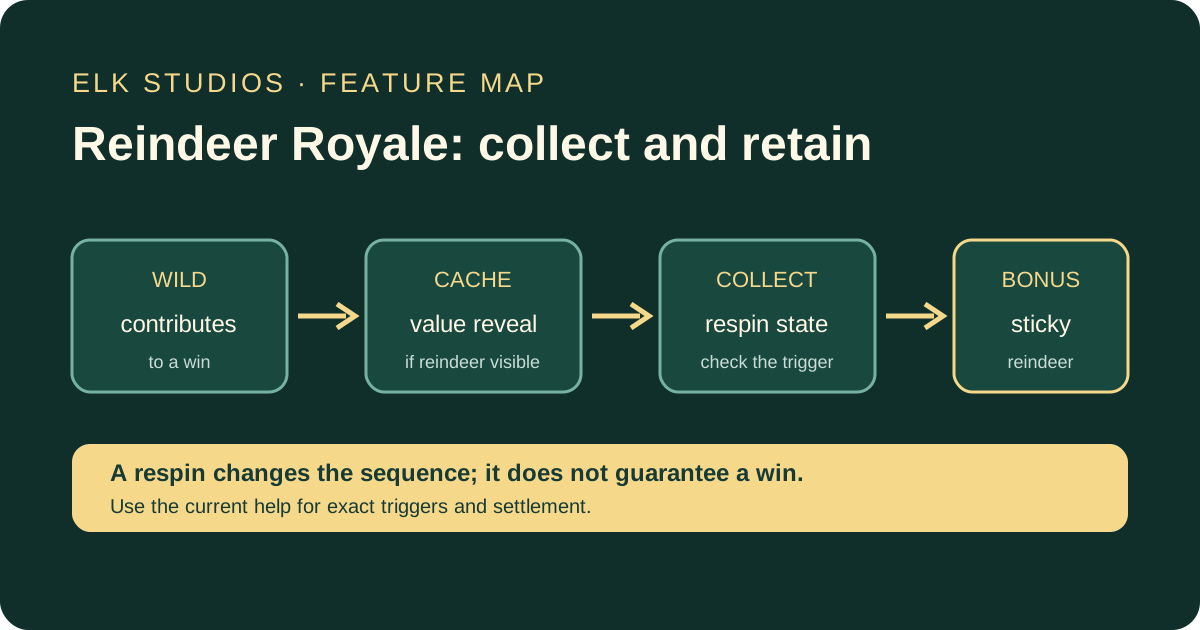
Reindeer Royale is an ELK Studios slot whose public feature summary revolves around reindeer, ammunition caches and respins. ELK describes reindeer that can collect a cache, appear during a respin or face another reindeer, with each of those events capable of awarding a respin. A Wild that contributes to a win can reveal a cache when a reindeer is visible. Adjacent reindeer may collect from one another through Super Collect, while Ghost Collect can trigger a collection between selected reindeer elsewhere on the grid.
The bonus state uses retained symbols. ELK says that the bonus is triggered by collected bonus symbols and gives free spins with sticky reindeer; additional bonus symbols can change how many spins and reindeer are awarded. Reindeer from the base game carry into the bonus, reindeer stay sticky during it, and a reindeer respin does not consume a free spin. Those rules make it important to separate a feature event from the final settlement: a respin or collection changes the board, but does not guarantee a winning result.
The supplier’s public profile describes a maximum potential but is not the current operator help. Since the brief requires numerical settings to come from active game help and that help was not provided, this review does not repeat the game’s numeric ceiling, RTP, volatility, hit rate or stake limits. It also does not claim that a casino in New Zealand carries the game. Those items remain questions for the exact client.
This article keeps the title’s rules, feature states and verification checklist together in one URL. It explains the supplier-confirmed mechanics without turning an old review figure or a different operator’s version into a current setting.
Match the supplier title to the game client
Before comparing game descriptions, confirm that the casino client identifies the title as Reindeer Royale and names ELK Studios as the supplier. ELK’s dedicated profile and games catalogue provide a first-party match for the product name and its feature outline. A festive reindeer theme is not enough to identify the title; other games can use similar artwork while having unrelated rules.
The official supplier profile is public, and its catalogue lists Reindeer Royale as an individual title. That supports describing the product as part of ELK’s published catalogue, but it does not prove current distribution at a specific casino. A New Zealand player would need to check the operator’s own game lobby, terms and account access. No operator was tested for this review, and no account was used.
Open the help menu from the actual client that would be played. Record the game title, any displayed version or help date, and the paytable. If the lobby card links to a game with a different title or if the information page appears to describe an older client, pause and compare the exact product. A similar sequel, a supplier-side announcement or a demo embed might not match the casino’s loaded configuration.
A review site can help surface reader questions, such as whether a reindeer remains in place, what happens when it faces another reindeer or whether a respin uses a free spin. Those questions should be checked against the current supplier description and then the operator’s help. Review-site numbers may refer to a different market or version, so they are not used here to set the active game’s mathematics.
Reindeer as collectors and persistent symbols
Reindeer are not merely decorative characters in the official feature summary. ELK describes them as participants in collection events: they can collect ammunition caches, take part in a face-off with another reindeer and remain sticky during the bonus. A reader should therefore track each reindeer as a game element with a position and possible state, rather than treating all symbols as ordinary paytable icons.
The public description says base-game reindeer carry into the bonus and that reindeer stay sticky through the bonus. “Sticky” means the symbol remains in place across relevant feature steps, as described by the game, but the precise duration and any exceptions belong to the active help. It does not mean the reindeer persists forever. A new paid round or a completed feature may reset the board, depending on the rules.
The first practical distinction is between a symbol appearing and a symbol collecting. A reindeer may be visible before it triggers any event. A cache can be revealed or collected under a separate condition. A face-off may then transfer or award something according to the feature text. Watch for the event label and the game history to understand which action happened; one animation can contain several steps.
If multiple reindeer occupy the grid, their relative positions may matter to Super Collect. The supplier describes adjacent reindeer facing off and collecting from each other before a respin is awarded. The exact meaning of adjacency, eligible cache or value, and order of resolution should be checked in the game help. Do not assume that two reindeer that appear close on a mobile screen count as adjacent under the game’s actual grid coordinates.
Retained symbols can make the bonus’s starting state different from a clean board. A reindeer carried in from the base game may interact with new feature symbols during the bonus. The help should say whether its position, collected value or other state is retained. This is more precise than a broad claim that the bonus “keeps progress,” because different games preserve different parts of a board.
Ammunition caches and the Wild interaction
Ammunition caches are a named part of Reindeer Royale’s collection system. ELK says that a Wild which contributes to a win reveals a cache with a random value if a reindeer is in view. This condition combines three concepts: a Wild has to contribute to a win, a reindeer has to be visible, and the cache reveals a value. The public summary does not say that every Wild triggers a cache or that every cache is collected automatically.
A helpful round review checks each condition separately. Did the Wild form part of a qualifying win? Was a reindeer present at the relevant moment? Did the interface reveal a cache? Was it collected, stored or left in view? The paytable or help should explain whether the value is paid directly, transferred to a reindeer or used by a later feature. Do not infer the settlement from the ammunition artwork alone.
The Wild’s role also needs to be read carefully. A Wild can substitute in a winning combination, but this title adds a special interaction described by ELK. If the Wild contributes to the win, the cache effect may follow. The distinction between contributing and simply appearing matters. A Wild that is visible but not part of a winning combination may not meet the stated condition.
The supplier says that the cache value is random. That does not reveal the possible range, distribution or chance of any value. A secondary review or a single round cannot establish the full probability model. Check the current help for the description of cache values and any limits. This guide does not publish a numeric range because no in-game help file was available for verification.
When a cache contributes to a bonus, track its role through the feature. It might be collected before a reindeer respin or interact with a Wild in the later state. The rules need to say whether the value is attached to a symbol, a collector, a feature round or an overall payout. If the interface displays a changing counter, note when it rises and when the result is credited.
Respins and why they do not equal a payout
ELK describes several triggers that can award a reindeer respin: a reindeer collecting an ammunition cache, a reindeer appearing during a respin or a face-off between reindeer. These are separate conditions that share an outcome. The respin changes the game state and may give another opportunity for a feature event; it is not the same thing as a winning cash award.
A reader can understand a respin as a continuation within the game sequence. The relevant symbol or symbols can remain while other parts of the board update, depending on the current rule. The official summary does not lay out every symbol held in place, the number of potential repetitions or what ends a chain. Open the help to see which elements persist and whether a respin can award another respin.
A new respin can generate a new arrangement without producing a cache or a new win. If the animation repeats, that does not establish an increasing payout. The final amount should come from the paytable and the settlement result, not from counting how many times the screen refreshed. When the interface offers a round history, compare each respin event with the credit line.
The bonus has a specific relationship to these respins: ELK says reindeer respins do not consume a free spin. That means the feature can resolve a respin inside the bonus without reducing the displayed free-spin count. It does not mean free spins never end or that every respin extends the bonus. Distinguish a respin from an additional free spin; they are not necessarily the same game event.
If a respin is disputed, note the state before it began, which listed trigger occurred, what stayed on the board and how the result was credited. An operator support team can use the round identifier to investigate. A promotional review cannot establish how the specific casino client settled a particular hand.
Super Collect and Ghost Collect
Super Collect is described as a face-off between adjacent reindeer. The reindeer collect from one another before a respin is awarded. This differs from a standard cache collection: the interaction is between two reindeer, and the official overview positions it as a feature sequence. The exact “collection” target, value and eligibility are not fully set out in the short description, so they need confirmation in the live help.
Ghost Collect adds a different targeting pattern. ELK says the Ghost can trigger a face-off and collection between a random number of reindeer anywhere in view. Unlike the adjacency condition in Super Collect, this supplier description allows the Ghost’s event to reach reindeer in different positions. It is useful to keep the two labels separate rather than calling both of them a generic collect feature.
The word “random” describes selection in the Ghost feature but does not provide the distribution of outcomes. The public profile does not show how many reindeer can be selected, how the collected values are calculated or how often the Ghost appears. Those are not suitable fields to fill from a competitor’s test session. The active help should explain the eligible symbols and settlement.
The sequence can be read as: identify the triggering Ghost, check which reindeer the client highlights, follow the face-off animation, note what was collected, then see whether a respin follows. If a coin or cache also appears, determine whether the rules resolve it before or after the collection. The event order can affect how the feature is understood, although only the paytable determines the credited amount.
These features make Reindeer Royale more stateful than a slot in which each spin is an isolated arrangement. Still, “stateful” is descriptive, not a promise of a better result. A feature can change which symbols remain visible and what event may follow; it cannot guarantee a positive return. Keep feature complexity separate from the game’s mathematical settings.
Bonus entry, sticky reindeer and free spins
The supplier says collected Bonus symbols trigger the Bonus Game. It describes a starting award of free spins with sticky reindeer, with additional Bonus symbols increasing the number of free spins and reindeer. The exact number of symbols or spins is numerical and should be verified in the current game help; this review does not repeat the numbers from the supplier summary without that help screen.
A key detail is that reindeer from the base game carry into the bonus. A feature may therefore begin with an existing symbol state rather than a blank board. Additional reindeer awarded at entry can add to that state. During the feature, ELK says the reindeer remain sticky. The reader should check if any other symbols are sticky, whether newly appearing reindeer behave differently, and which events can change or remove the retained symbols.
The supplier also says reindeer respins do not consume a free spin. That is a specific feature rule that affects the sequence: a respin can resolve inside the bonus while the free-spin counter stays unchanged. Do not interpret this as a guarantee that another spin will be added after every respin. A respin can be part of a current bonus step without extending the total number of free-spin steps.
When Bonus symbols are collected, distinguish the trigger from the award. A collected symbol can start or extend a feature under its own conditions. The exact collection zone, trigger timing and any difference between standard Bonus and Super Bonus should be read in the help. The same symbol name may have different roles depending on whether the game is in its base state or bonus state.
At the end of the bonus, confirm which feature values were included in the total and whether the game returns to the base game with any persistent state. The supplier overview says sticky reindeer remain in the bonus; it does not establish that they persist after the feature completes. The game’s final result screen and help should be used to interpret the transition.
A bonus can last longer because respins do not consume free spins, yet duration is not the same as value. A sequence with many actions can still settle below its cost. Do not increase a stake in anticipation of a feature or treat a prolonged sequence as evidence that a higher payout is due.
Coin wins, Wilds and the Super Bonus
ELK’s product profile identifies coin wins, Wilds, a Bonus and a Super Bonus. It does not provide a full symbol table in its short public description. A reader should open the paytable to see which coins carry values, when those values are collected and whether they are multiplied by another feature. Likewise, check if a coin win is immediate or requires a collector to reach it.
A Super Bonus is a separate named state. It should not be assumed to be simply a longer standard bonus. The current help should say how it begins, what is different about its initial state, which symbols are retained and how the feature settles. If an optional mode offers direct entry, the interface should disclose its cost and conditions before confirmation. This review does not assume that any specific casino exposes the mode.
The official page also describes X-iter as providing predefined modes, including a Super Bonus option with a stated feature setup. Those mode details are supplier-published but do not prove operator availability or the exact current configuration. Since the assignment requires values to come from current game help, this article avoids copying mode prices, awarded spin counts or exact reindeer quantities from the marketing overview.
If a feature menu shows a cost, compare it with the base stake and read whether the amount is charged once or calculated from the selected bet. Check whether the mode uses a different RTP or maximum win. A direct-entry feature can begin closer to a named bonus, but its price can be a larger amount than an ordinary spin. A guaranteed feature event is not a guaranteed profit.
For a reader, the most useful questions are practical: what is the cheapest way to learn the interface, what setting is selected, where does the help panel show the feature sequence, and can the operator provide the exact client rules? A clear answer is more valuable than an unverified claim that a mode is “worth it.”
RTP, volatility, cap and stake fields
RTP is a theoretical long-run setting associated with a game configuration. It is not an individual session forecast or a promise of an amount returned after a chosen number of spins. If different RTP variants exist, a review may quote one that a particular operator does not use. Check the value shown in the active client, if it is displayed, and note the game version and market separately.
Volatility labels describe an outcome distribution at a broad level. A secondary page might use high, medium-high or a numeric rating, but those descriptions can come from different scales and may not be aligned with the operator’s configured build. Volatility does not say what will happen in the next round. The active game help is the relevant source for the exact label or explanation.
The supplier’s public page lists a maximum potential for Reindeer Royale, yet the numeric amount in the current game help was not supplied. The brief requires that game figures be verified in current help, so this review does not repeat a cap, RTP, hit frequency, stake range or mode price from review sites. These settings are unverified for any operator version.
If you open the client, record the currency first. Then check the minimum and maximum stakes, payout language, selected return setting, volatility description and maximum-win basis. Look for differences between a base game and an optional feature mode. A maximum described as a multiple of a bet may use a particular total-wager basis; do not convert it into NZ dollars unless the display and currency make that calculation clear.
A useful record marks each field as “shown,” “not shown” or “unclear.” Do not fill a missing value from an old review just to complete a table. If the current client and a secondary source disagree, the sources may be describing different setups. Ask the operator for clarification or leave the field open. This article does not claim current local game availability or a tested configuration.
Mobile controls and demo boundaries
A demo may let a reader observe the difference between a cache collection, Super Collect, Ghost Collect and a bonus respin without a real-money stake, where that demo is offered and access is permitted. This article did not launch a demo. A supplier play link or review-site embed is not proof that the demo works in New Zealand or that its settings match a casino’s real-money version.
On a small screen, a grid with multiple collectors can be harder to read than a desktop presentation. Check that the help, paytable and history controls remain available, and that the selected stake is not hidden behind a feature panel. If the animation is quick, use any available speed or history controls to follow the sequence. Changing animation pace does not change the mathematical result.
Before a round, verify the amount selected and any optional feature purchase. Touching an adjacent control can change a wager or open a mode. The confirmation panel should show the total cost. If a reindeer respin occurs, look at whether the game labels it as a respin or a free spin, because the distinction affects the bonus counter.
A permitted demo can teach a reader where the information panels are and how the game labels a collector event. It cannot establish the operator’s local limits, chosen RTP, cash settlement or account eligibility. Use the current real-money client’s help for those fields, and do not rely on a demo to claim New Zealand availability.
If a game freezes during a reveal or the result does not match the displayed history, do not refresh repeatedly or assume the wager was cancelled. Preserve the round ID, time, game name and account transaction details, then use the operator’s support process. A feature explanation is not a substitute for an account-level investigation.
How to use secondary reviews without importing their claims
Third-party Reindeer Royale pages commonly focus on the dark holiday theme, reindeer collectors, ammo caches and respins. Some give verdict scores or numerical configurations. These pages are useful for seeing what readers ask, but their figures may reflect a UK, Canadian or other operator build. A review’s stated version should be matched to the current help before its settings are repeated.
The official supplier profile is the stronger source for the mechanics it names: ammunition-cache reveals, face-offs, the Ghost interaction, bonus retention and respin behaviour. A supplier page is not a complete account configuration, however. It does not identify which casino currently distributes the title to a specific market, or which value is selected inside an operator’s client.
Some reviews use first-person testing language. This article makes no personal-play claim, score or recommendation. No operator client or demo was tested. The evidence boundary is explicit: supplier-described feature rules are presented as such; numeric game settings are withheld until current game help is available; local access remains unverified.
That distinction also makes future updates easier. If an operator supplies a current help file, the settings section can be updated with the exact version and date without rewriting the core feature explanation. If a supplier changes a mechanic, the official product profile can be checked again. A review should not silently change its claims based on a new search snippet.
Frequently asked questions
What causes a Reindeer Royale respin?
ELK lists a reindeer collecting an ammunition cache, appearing during a respin or facing another reindeer as events that can award a respin. The exact event order and state retention should be confirmed in the current game help.
What happens when a Wild contributes to a win?
ELK says that if a Wild contributes to a win and a reindeer is in view, an ammunition cache with a random value is revealed. The public summary does not specify the full value range or collection settlement.
Does a respin use a free spin in the bonus?
The supplier says a reindeer respin does not consume a free spin. That is distinct from awarding an additional free spin; check the current client for the bonus counter and extension rules.
Do base-game reindeer carry into the bonus?
ELK says they do, and that reindeer remain sticky during the bonus. The supplier summary does not establish persistence after the feature ends; verify that transition in the game help.
Is Reindeer Royale available at New Zealand casinos?
The ELK catalogue lists the title, but that does not prove any particular operator distributes it to a New Zealand account. Availability was not tested and should be checked with the operator.
What are the current RTP and volatility settings?
They are not verified in this review because the active game-help screen was not supplied. Use the exact client’s information panel rather than a figure from a review of another market.
Does a long respin sequence mean the bonus will pay more?
No. A respin changes the sequence, but its length does not guarantee a particular award. The final settlement depends on the rules and symbols in the game state.
Can I use X-iter to test the Super Bonus?
Only if the current operator client makes that option available and its cost and rules are clear. A feature mode can have a different price and conditions; a demo or supplier description does not prove local access.
Sources and verification boundary
Checked 6 October 2026. ELK’s public profile confirms the feature outline used here. Its linked product-sheet PDF returned HTTP 403 in the research browser. The active operator help, numeric RTP/volatility/cap/stake settings, exact mode costs and New Zealand availability were not supplied or tested. NZ search demand was not measured. This article is informational and contains no casino referral button.
