ELK Studios game guide · South Island guide
Boomberries: rules, Hot Zones and settings to verify
 Best casinos available in New ZealandUpdated 7 November 2026

Boomberries is an ELK Studios 6-column, 7-row slot whose published features centre on Hot Zone multipliers, multiplier placement, three distinct Wild types and persistent values during the Bonus Game. This review maps the mechanisms without importing unverified RTP or volatility figures from third-party listings.
The short answer
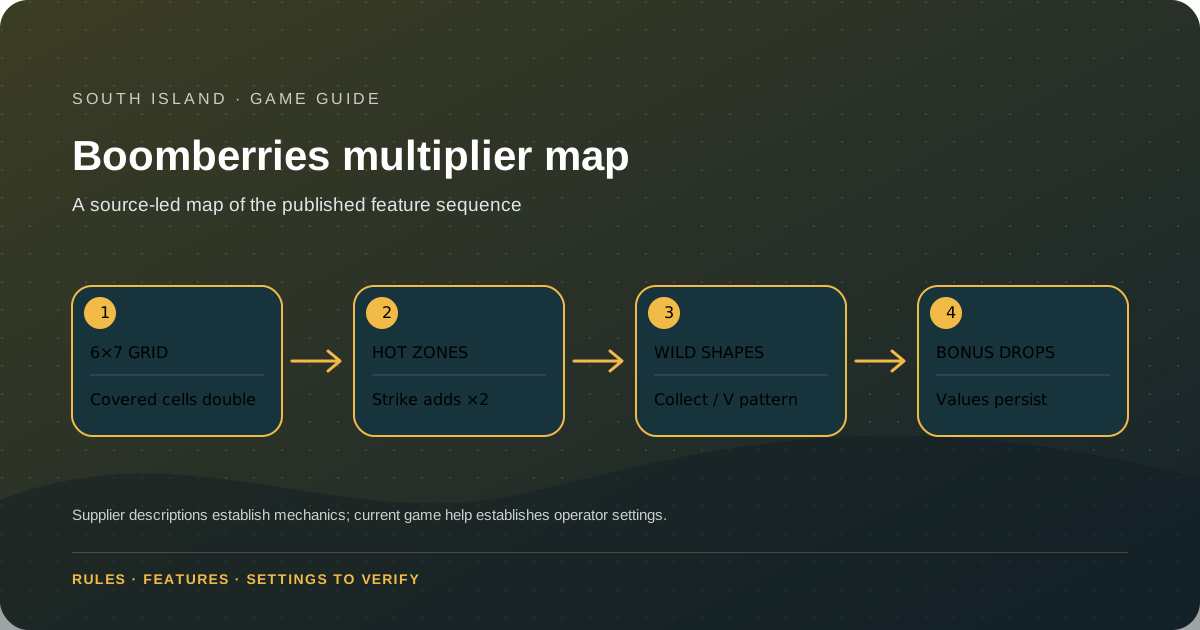
Boomberries is an ELK Studios 6-column, 7-row slot. The official page describes Hot Zones that double the multiplier value on positions covered by a winning combination, a Hot Zone Strike that puts a ×2 multiplier on random positions, and three Wild types with different effects. A normal Wild is listed alongside an X-bomber Wild, which replaces payout symbols in an X shape, and an Exploding Wild, which removes payout symbols in the X-shaped area above and below it. The Collector gathers multiplier values in view; the Dealer multiplies the values in one or more V shapes. ELK says both can be persistent. Three Bonus symbols trigger the Bonus Game, where multiplier values persist between bonus drops. The page states a potential maximum of 25,000 times the bet.
That summary is enough to explain the game’s multiplier-driven structure, but it is not a complete paytable. On 6 October 2026 the accessible official text did not display RTP, volatility, stake limits, full symbol values, all feature timings or a verified release date. The linked product sheet returned 403. Third-party pages publish more settings, but those values should not be treated as the current configuration of a New Zealand operator. This article marks those fields as unresolved and does not claim local availability.
The official page and its evidence boundary
The primary source is the ELK Studios Boomberries page, with the title listing checked on 6 October 2026. The title page names a 6-by-7 layout, Hot Zone features, symbol removal, special Wilds, a Bonus and Super Bonus, and the stated 25,000× potential. It also recommends a 1600×900 desktop window or a 16:9 ratio when scaling.
The accessible product page includes a Play control but no dated release line or separate status statement. That establishes a catalogue page, not a release date or an operator’s current availability. A casino may use a particular configuration, show fewer optional features or apply market-specific restrictions. We did not enter an account or open a real-money game, so this guide cannot verify what any operator currently displays.
The official page links a product sheet and asset package. The sheet returned HTTP 403 during this check. As a result, we have not used its contents, including any settings that might appear in the document. The article distinguishes supplier-confirmed game mechanics from values that a current game help screen must supply.
What a 6-by-7 grid says and what it does not
The supplier gives six columns and seven rows for Boomberries. Those dimensions define the visible base grid. They do not state whether the game pays through lines, ways, clusters or another evaluation system, and they do not list how many matching symbols form a win. Use the active help and paytable to answer those questions before interpreting a board.
This difference is important because the main features act on positions. The Hot Zone doubles the multiplier on positions covered by a winning combination. A reader must know exactly which symbols formed a valid win and how the game identifies “covered” positions before assessing the multiplier change. If the win method is unknown, the scope of the Hot Zone is unknown as well.
To read the board, separate symbol identity from position history. Record where payout symbols land; which positions are included in a settled combination; whether a multiplier already exists in any covered cell; and how the next drop changes those cells. A static screenshot might show a multiplier after a previous win, not a new multiplier assigned by the current one. The game’s history panel and rules may explain those state changes.
Do not infer that a larger board creates a larger payout. Grid size sets the number of display positions; it does not reveal symbol weights, odds or the cost of a round. Likewise, the theme’s fruit and bomb imagery does not determine the official feature rules. Those come from the title-specific help, not visual conventions drawn from another slot.
Hot Zones and position-by-position doubling
ELK says every winning combination doubles the multiplier value on symbol positions covered by that combination. That description makes position the unit of analysis. The effect is local to the cells included by the winning result; it should not be described as a global multiplier increase unless the game help says it applies more broadly.
Consider a simple hypothetical sequence: a position has a displayed multiplier value of ×2, and a later winning combination covers that position. The supplier’s description says the Hot Zone doubles the value at a covered position. The resulting value would be ×4 if no other rule changes how that value is represented. This is a mechanics illustration, not a prediction about how often the cell appears, how a win is evaluated or what cash settlement would follow.
If a winning combination covers several positions, evaluate each one separately. Some positions may have no multiplier, while others may carry a value from an earlier event. The public summary does not specify a starting multiplier, maximum value, reset point or whether the game caps the feature. Do not assume all cells share the same number or that every chain doubles every multiplier visible anywhere on the board.
The active game help should answer whether multipliers affect the combination that creates them, a later drop, a total feature result or another defined calculation. “The value doubles on positions covered” describes a state change, but a complete settlement formula needs the target and timing. If the current help is silent, present the effect as a positional modifier and mark the payout interaction unverified.
Hot Zone Strike adds or doubles a random position
Hot Zone Strike places a ×2 multiplier on a random number of positions on the grid. ELK states a specific replacement rule: if a selected position already has a multiplier, its value is multiplied by two instead. This is distinct from the ordinary Hot Zone, which responds to a winning combination’s coverage.
The phrase “random number of positions” does not publish the count range or selection probability. The accessible page also does not say whether empty positions and positions with existing multipliers have equal selection chances. A reviewer should not invent those details or turn the animation into a statistical observation. One activation can show what happened on that board; it cannot establish the distribution over many rounds.
Track the state before and after the Strike: which positions were selected, which already carried a value and how each displayed value changed. If a pre-existing ×3 became ×6 in an illustration, that is multiplication by two, not addition of two. Keeping addition and multiplication distinct is especially useful when a game presents several modifiers in sequence.
There may be a timing question if a Strike appears before a drop: does it modify the upcoming result, remain for later cascades or persist into the Bonus Game? ELK’s public description says the feature can be triggered before any drop only for some titles; for Boomberries it says that Hot Zone Strike places multipliers on random positions but does not fully define the sequence. Use the current help for timing. Do not import wording from another ELK game.
Collector and Dealer: two different transformations
The Collector gathers all multiplier values in view. The Dealer multiplies all multiplier values in one or more V shapes. The title page says both features can be persistent. Those short descriptions show that the mechanics interact with existing multiplier values, but they are not the same operation: one gathers values, while the other applies a multiplicative effect to a shaped group.
“All values in view” requires a clear definition of the feature’s view area. It may mean the entire grid or a defined section; the official summary does not specify. It also does not say how the Collector resolves several values, where the collected value is placed, or whether the original positions are cleared. Check the active help before writing a formula such as “the Collector adds the multipliers into one cell.” That detail is absent from the accessible summary.
For the Dealer, establish how the V shape is drawn and whether a single activation can affect more than one V. A grid can contain overlapping V patterns, and overlap may change which positions are included. The public text says it multiplies values in one or more V shapes; it does not state a universal placement rule or number of shapes. Record the visible pattern and the written rule separately.
Persistence means that the supplier identifies an effect as capable of remaining, but the summary does not state the exact duration, reset condition or mode. A persistent multiplier may remain through multiple drops or another feature stage, but the specific boundary should be explicit. Keep a timeline of a value across the sequence and confirm the reset in help rather than assuming that “persistent” means permanent for the whole game.
Three Wilds and the difference between substitution and removal
The official summary describes three Wild symbols: a normal Wild; an X-bomber that replaces payout symbols in an X shape; and an Exploding Wild that removes all payout symbols in an X-shaped region above and below itself. These are distinct board operations. A substitution changes what symbols count in a position; a removal clears symbols from positions. They may lead to different next-board states.
The summary does not say whether the normal Wild substitutes for every payout symbol, whether it has exclusions or whether it pays as a symbol on its own. The X-bomber wording says it replaces payout symbols in an X shape but does not spell out the exact geometry at grid edges. The Exploding Wild’s wording specifies the symbols removed above and below itself in an X-shaped region; the exact number of positions is not visible in the text inspected. These are all game-help questions.
If a Wild and multiplier occupy related positions, do not assume the effect order. The supplier says the game combines Wilds, symbol removal and multipliers, but the accessible summary does not publish a full action sequence. A board may be evaluated before or after a special symbol modifies the cell. The active rules should define that timing. If they do not, avoid an exact claim about an interaction.
For a reader, a useful feature note is concrete and visual: “This Wild altered these positions; this multiplier was shown; the subsequent result was evaluated under the help’s rule.” Avoid claims such as “the X-bomber guarantees a hit.” A transformed board can still fail to form a qualifying win.
Bonus and Super Bonus persistence
ELK says three Bonus symbols trigger the Bonus Game and that all multiplier values are persistent between bonus drops. This is a narrower and more useful statement than “the board state carries over”: the named values persist from one bonus drop to another. The public summary does not state that the symbols, Wild positions or every board element also persist.
If a Super Bonus symbol appears among the trigger symbols, the Super Bonus is started. The accessible page does not describe the number of drops, starting multipliers, extra features or the difference in settlement. Read those conditions in the active help. “Super” is a mode label, not enough evidence to say it always produces a larger return.
The persistence rule changes how to read a sequence. Before a drop, note each visible multiplier and its position. After the result, see which positions remain and whether an effect raised or gathered their values. Repeat that comparison between drops. This shows how the feature’s state develops without turning it into a statement about expected value. A high displayed multiplier can matter only under the game’s own payout rules.
Check what ends the feature and what resets the state. The public supplier page does not state the termination count or retrigger conditions. If the rules mention a drop limit, a symbol trigger or a special end condition, include that in a full review. If it is missing, do not fabricate the round length.
X-iter and the price of direct feature entry
ELK describes five X-iter modes, including a 3× bet option with more than three times the chance of triggering the Bonus and a 500× bet Super Bonus at the upper endpoint. The other mode names, costs and precise start conditions do not appear in the accessible product text. The current menu and help should be checked before describing all five options.
The “more than three times the chance” phrase compares with a baseline that ELK does not publish in the summary. It cannot be translated into an exact percentage or guarantee. A 500× feature price describes an amount linked to a bet; it does not set an expected return. If an operator’s screen uses stake multipliers, verify whether the mode’s cost is charged once, which mode begins and whether the ordinary game’s RTP or payout cap differs.
For arithmetic only, a 3× mode against a hypothetical NZ$1 stake would total NZ$3. A 500× mode at that same hypothetical stake would total NZ$500. These examples do not confirm that an NZ$1 bet, a particular currency or either mode is available to a New Zealand player. The client’s total shown before confirmation is the relevant price.
Direct entry is optional. A reader can learn how the base game works without buying a feature. If a selection uses most of a pre-set spend limit, skip it; a mode name or animation is not evidence of value. Treat the purchase price as an immediate stake that can be lost.
The 25,000× ceiling and settings a reader must verify
The official page states a potential maximum of 25,000× the bet. That is the most prominent numeric payout information in the accessible summary. It is not an average, an expected session result or a promise that an operator build reaches the same cap. Attribute it to the supplier and retain the word “potential.”
RTP, volatility, hit frequency, stake range and symbol values are not shown in the accessible ELK text reviewed on 6 October 2026. Competitor pages disagree or supply their own ratings, but they do not identify the exact New Zealand-facing operator configuration. The product sheet returned 403, so this article cannot say whether it contains additional settings. The safest answer to a request for one of those fields is “not verified in the official source accessible for this review.”
RTP is a long-run theoretical measure for a defined model; a single feature or short session can differ substantially. Volatility is a description of outcome distribution, not a schedule for when a multiplier will land. Maximum win is a ceiling. Stake limits are operational settings that can depend on currency, market or account. These values should be recorded separately and never used as substitutes for one another.
Before play, a reader can write down: the exact title; provider; help/version date; operator and location; currency; minimum and maximum stake; RTP if displayed; volatility label if displayed; potential cap; X-iter availability and price; and any mode-specific restrictions. If a value is absent, leave it blank and ask the operator. A filled-in table is not automatically a verified table.
Screen reading and mobile layout
ELK recommends 1600×900 on desktop or 16:9 scaling. The 6-by-7 grid contains many more positions than a narrow screen can show at full size, and the V-shaped Dealer or X-shaped Wild effects may be harder to inspect on mobile. That makes readability a rule-reading issue as much as a presentation issue.
Before staking on a phone, open the help panel and confirm that text can be zoomed or scrolled. Find the history screen and check whether it records the positions changed by a Wild or multiplier. Verify that the stake and any X-iter price remain fully visible. If the panel covers the board, read each part before play instead of rapidly switching between controls.
The supplier’s desktop recommendation is not a promise of universal mobile support. This article has not tested a device, app, network connection or casino client, and has not launched a demo. The official page has a Play control but the accessible description does not establish demo conditions or New Zealand accessibility. No performance claim is made.
A compact feature interaction audit
When a game contains several positional effects, an interaction log helps avoid attributing a change to the wrong feature:
| Check | Question to answer from help or screen |
|---|---|
| Base result | What win method and symbol pattern is valid? |
| Hot Zone | Which positions did the winning result cover? |
| Strike | Which random positions received ×2, and what happened to existing values? |
| Collector | What is in view, where does it go and what is removed? |
| Dealer | How are the V positions drawn and which multipliers change? |
| X-bomber | Which payout symbols in its X were substituted? |
| Exploding Wild | Which cells were cleared and what remains for the next drop? |
| Bonus | Did multiplier values remain between drops? |
| Reset | Which effect ended or reset at the feature boundary? |
Use one line per event and include the game-help version. This is more reliable than remembering that “the multipliers stacked.” Stacking could mean addition, multiplication, carrying a value forward or moving values to a new location. The game’s help should specify which operation occurred; the article should not collapse them into a general verb.
New Zealand availability and responsible play
An ELK title page does not verify that a casino makes Boomberries available to New Zealand players. The operator, customer eligibility, current product list and any licensing transition are separate questions. We have not tested an operator or opened the CPA route.
The Department of Internal Affairs says online casino advertising is prohibited during the current transition, and its advertiser guidance includes third parties that publish or arrange advertisements. The 2026 regulations list advertisements involving an affiliate arrangement as a prohibited form. Because /go/south/south-cashdesk-8a14.php is the assigned CPA affiliate route, no offer buttons are added pending owner/compliance review. This is a conservative editorial blocker grounded in public guidance, not legal advice for an individual. See DIA advertiser guidance and the Online Casino Gambling Regulations 2026.
Set a spending and time limit before play and stop when either is reached. A multiplier graphic or a theoretical cap is not a reason to increase a stake or pursue a previous loss. The DIA player information lists New Zealand support services; the site’s safer gambling guide is also available.
Questions readers commonly ask
How large is the Boomberries grid?
ELK lists six columns and seven rows. The accessible product text does not say whether ordinary wins use lines, ways, clusters or another system.
What do Hot Zones do?
Every winning combination doubles the multiplier value on positions it covers, according to ELK. The active help should clarify timing and how the changed value affects settlement.
How are Collector and Dealer different?
The Collector gathers multiplier values in view. The Dealer multiplies values in one or more V shapes. Their exact scope and persistence conditions need the game help.
What does each special Wild do?
The X-bomber replaces payout symbols in an X shape; the Exploding Wild removes payout symbols in an X-shaped area above and below itself. The normal Wild’s substitution rules are not fully described in the summary.
What persists in the Bonus Game?
The supplier says multiplier values persist between Bonus drops. The summary does not say that every symbol or position also persists.
What is the RTP?
The accessible official text did not show a numeric RTP. Verify the version displayed in the active game help rather than adopting a third-party value.
What is the potential maximum?
ELK’s page states 25,000 times the bet as potential maximum. That is not an expected or guaranteed outcome.
Is Boomberries available in New Zealand?
The supplier page does not establish availability or customer eligibility through an NZ operator. This guide makes no access claim.
For independent help, visit the site’s New Zealand safer gambling guide. This article contains no casino offer.
Sources and verification boundary
- ELK Studios Boomberries product page and games catalogue — grid, named features, Bonus persistence, X-iter endpoints, potential maximum and display guidance; checked 6 October 2026.
- Product Sheet linked from ELK’s page — returned HTTP 403 on 6 October 2026; not used.
- Competitor pages opened 6 October 2026: Slotsimulations and BigWinBoard. SlotSite and CasinoMeerkat surfaced but could not be opened. Their settings are not treated as official operator facts.
- DIA advertiser guidance, DIA player guidance, and Online Casino Gambling Regulations 2026 — checked 6 October 2026.
