ELK Studios game rules · South Island guide
Cluster Kingdom ELK Studios slot review: rules and settings
 Best casinos available in New ZealandUpdated 7 November 2026

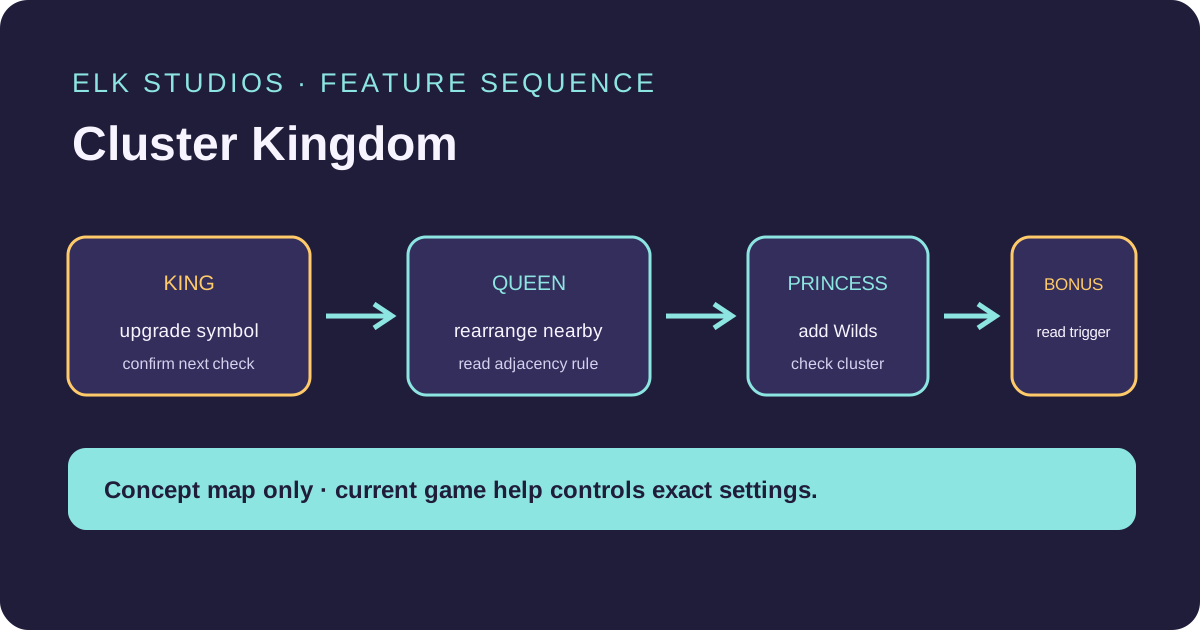
Cluster Kingdom uses cluster results and a set of royal feature symbols: the King upgrades a payout symbol, the Queen rearranges neighbours, and the Princess adds Wilds. ELK also describes sticky redrops and bonus states linked to the King meeting other royal symbols. The official page does not verify a current New Zealand operator build, so RTP, volatility, cap, stakes and mode prices remain unknown here.
The short answer
Cluster Kingdom is an ELK Studios cluster slot in which a board result can interact with royal feature symbols. ELK says the King upgrades a payout symbol, the Queen rearranges symbols next to her, and the Princess randomly adds Wilds. A winning cluster can include ordinary Wilds or multiplier Wilds, while a redrop can continue if it adds a new matching symbol. Bonus states are linked to the King connecting with the Princess, the Queen or both.
This Cluster Kingdom ELK Studios slot review focuses on how to read that feature system without borrowing settings from another casino. The official Cluster Kingdom page was checked on 6 October 2026. A current New Zealand operator help screen was not provided, so this guide does not publish RTP variants, volatility, maximum payout, stake range, feature-entry costs or exact trigger values. It also does not claim that a New Zealand casino currently carries the title.
Confirm the exact title and source
The official catalogue and game page identify Cluster Kingdom as an ELK product. That confirms the supplier’s documentation for the named title, but not a particular casino’s release, account eligibility or configuration. The supplier page’s product label is the right starting point for name matching; the operator’s own information panel is needed for the rules that apply to an actual client.
Open the help panel from the same environment that launches the game. Check that the title is spelled Cluster Kingdom, that the provider is ELK Studios and that the rules page matches the symbols on screen. If the operator presents a differently named variant or a locale-specific edition, record the exact wording. Do not silently blend it into this page. A search result can show an old listing, and a game aggregator may attach figures collected from a different market.
Keep the date of the check. Product pages and operator menus can change; a dated record lets an editor distinguish a present observation from an old cached description. The title’s medieval design is not evidence that a rule is old-fashioned or traditional. Every feature below should be understood through the current help rather than the theme.
What cluster pays means in this game
ELK describes Cluster Kingdom as a cluster-style slot. That means the reader should look for a group-based win definition instead of assuming that traditional paylines govern every result. The active paytable needs to define what makes symbols connected, which symbol types can form a qualifying group, how Wilds substitute and when the amount is settled. For a separate ELK example built around cluster-created Wilds and merged values, see this site’s Ryze guide; its rules are different and should not be copied to Cluster Kingdom.
Do not infer a cluster rule from a picture of touching symbols. Some games count only certain directions or shapes, and feature symbols may be excluded from ordinary payouts. The public product summary confirms the cluster format but does not answer every adjacency or edge-case question. Use the operator’s help for that level of detail.
The feature symbols are not automatically part of an ordinary paying cluster. A King, Queen or Princess may change the board or start a bonus while remaining separate from standard symbol settlement. Verify which symbols pay, which act only as modifiers and whether a feature symbol can contribute to a win. This prevents the misleading shorthand that “every group of matching pictures pays”.
When describing a result, separate the base evaluation from the feature that follows it. A cluster might pay, clear, or create a redrop; a royal symbol may act during a feature stage. The rules should say which order applies. A clear explanation records the sequence without claiming that a visual change necessarily adds value.
The King upgrades a payout symbol
ELK says the King upgrades one payout symbol to a higher-value symbol. This is a symbol-state change, not a payout by itself. The important questions are which symbol is selected, whether the destination is fixed or chosen by a rule, how many positions are affected and when the changed symbols are evaluated.
Read the paytable before describing the effect as an upgrade in expected value. “Higher-value symbol” describes the destination’s rank in the pay table, but it does not guarantee that enough matching symbols will appear to form a win. A transformed symbol can change the board’s possible combinations without necessarily forming a qualifying cluster. Keep possibility separate from outcome.
Check what happens when the King acts near another royal symbol or a Wild. The public overview does not provide a full interaction chart. The active help should explain whether feature symbols are excluded from the upgrade pool, whether existing Wilds are altered and whether the game evaluates newly formed groups immediately. If it remains silent, do not infer the answer from another ELK game.
A useful record of one King event includes the starting symbol, the selected destination, the positions changed, the next cluster check and the final settlement. It does not include a claim about how often the King appears or how frequently an upgrade produces a win. One observed event demonstrates a rule path, not the game’s probability distribution.
The Queen rearranges neighbouring symbols
The supplier says the Queen rearranges symbols adjacent to herself. This identifies a local board effect. It does not explain how positions are selected, whether symbols are shuffled or moved according to a pattern, or whether a particular arrangement is more likely after the effect. Those details belong in the active game help.
Check how “adjacent” is defined at the edge of the board and whether the Queen can affect a feature symbol. Determine whether the rearranged symbols remain in place for a new evaluation, are followed by a drop, or are used only within the feature sequence. A quick animation may show a shuffle but not whether the game treated the resulting state as a new independent check.
Do not describe the Queen as “creating a win”. Rearrangement can produce a new combination, but only the cluster rules determine whether it qualifies and how much it settles for. The help should also state if the same Queen can activate more than once in a sequence or if a particular bonus state changes its effect.
For a transparent review, label the input and output. The input is the board around the Queen; the output is the displayed board after her effect. If the game history shows only the final amount, say that the intermediate process was not exposed. An editor should not recreate a hidden shuffle formula from a handful of examples.
The Princess adds Wilds
ELK says the Princess randomly places Wilds on the game grid. A Wild may substitute for a paying symbol under the paytable, but the exact eligible symbols, position-selection rule and settlement order still need the current help. The public description does not say that every placement creates a cluster or that each Wild has the same role in every mode.
Start by distinguishing the ordinary Wild from the multiplier Wild. The supplier identifies both types. The standard Wild substitutes for any paying symbol; the multiplier Wild multiplies a winning cluster by the multiplier shown. A review should explain whether these roles can overlap, whether a multiplier applies to one group or several, and whether a Wild created by the Princess may be a multiplier Wild. Do not assume the answer from the feature name.
Then check the placement timing. Does the Princess add Wilds before the next cluster evaluation, during a redrop, or in a bonus state? Do existing symbols remain where they are? Are newly added Wilds sticky, or do they disappear after the evaluation? Those mechanics change what a reader should expect from the animation and need a version-specific answer.
Random placement is a description of the feature, not a claim about its odds. A single round cannot show which cells are equally likely or whether positions are weighted. If no distribution is published, describe only what the help reveals and avoid saying that the Princess “usually” improves a result.
Multiplier Wilds and payout calculation
ELK says a Multiplier Wild multiplies the winning cluster by its displayed multiplier. That still leaves calculation details for the client: which winning cluster is affected, whether multiple Multiplier Wilds combine, whether a Wild that touches more than one group affects both, and when a cap applies. The operator paytable is the right source for those terms.
Do not add displayed multipliers together or multiply them by hand unless the rules specify the order. An animation may show more than one Wild participating, but the final amount can be calculated under a particular sequence that the screen does not explain. A table of example payouts is useful only if it comes from the same version and includes all relevant rules.
Also confirm whether the multiplier value is stateful. It may be a fixed label, may change during a bonus, or may persist only for part of a feature. The supplier overview says the Super Bonus includes increasing persistent multiplier Wilds, but the operator help must define the start, increase condition and reset point. A claim about persistence should identify which state is retained and for how long.
Keep the multiplier’s role distinct from the base symbol value. The multiplier modifies a qualifying cluster under the described rule. It does not itself turn an incomplete group into a win unless the help says it does. This distinction makes a review clearer and avoids presenting a feature as an assured payout.
Sticky redrops and continuation rules
The supplier’s Sticky Redrops feature awards a new redrop for each redrop that adds at least one new matching symbol. The key test is whether a new matching symbol has been added. A redrop that merely repeats an existing arrangement may not qualify under the stated description. Exact matching and timing should still be read in the client help.
Find out what stays sticky between eligible redrops. Does the game retain all previous symbols, only symbols that participated in a cluster, or a particular feature group? Does each new redrop reset anything? The product summary gives a continuation condition but does not provide a complete diagram of all states. The current rules should say when the sequence ends and how the result is paid.
Do not call redrops “free spins” unless the operator’s rules use that term. A redrop is a feature continuation that may have its own evaluation and state; it is not necessarily equivalent to a separate paid base-game action. Keep the terminology the game uses so that a reader does not confuse it with the game’s bonus state.
When explaining a sequence, show the trigger condition, the symbols added and whether they satisfy the new-match requirement. If the board appears to change but no match is added, the visual event alone does not prove the redrop continuation rule was met. Round history can help, but the paytable remains authoritative for settlement.
Bonus links: Regular, Mini and Super
ELK identifies Regular Bonus, Mini Bonus and Super Bonus states. The public page says they are triggered by connecting the King to the Princess, the Queen or both for the Super Bonus. This is a relationship between named symbols, not a generic scatter rule. The exact trigger language, animation and bonus content should be verified in the operator’s help.
Keep each named state separate. Confirm what symbol arrangement triggers each mode, whether a connection means adjacency or another defined relationship, and what rules change after entry. Avoid importing a trigger count or drop total from a review written for a different configuration. This assignment allows game numbers only when verified in current game help; no such help was supplied.
The Super Bonus is described as having increasing persistent multiplier Wilds. Check whether all multiplier Wilds participate, when an increase occurs, whether it persists from one feature step to the next and what resets at exit. For Regular and Mini modes, find the corresponding starting state and explain any differences only where the help documents them. A feature label by itself does not prove a better expected return.
A bonus is a different game state, not a promise of a particular outcome. Its entry condition and mechanics can be described neutrally. Do not turn the word “Super” into an assertion that a person will get a larger or more likely prize. The math configuration and the actual result are separate from the name.
X-iter and optional feature entry
ELK lists X-iter modes for Cluster Kingdom. Such a menu may let a player start from a defined state or alter the chance of reaching a feature, but the supplier’s overview does not verify which options an operator enables, what they cost locally or whether a restriction applies to a particular account. Read the active menu before describing any option.
Compare each mode with the standard game: its label, price, entry state, rules document and any separate return information. Confirm whether the cost replaces the usual wager or is added to it. Check whether a mode changes only feature entry or also the available bonus state. If the description says a feature is guaranteed, make clear that only the starting state is guaranteed; the result is not.
Do not give purchase advice. Optional feature entry changes the amount at risk and can produce a result below the charge. Without active terms and a defined probability model, a claim that one option is good value is unsupported. If the menu hides the total cost or does not explain its effect, do not proceed.
No X-iter price or mode availability is stated in this article. Third-party pages describe jurisdiction-specific menus that may not exist in the client a New Zealand player sees. The supplier catalogue is a lead to the feature family, not the current operator contract.
RTP, volatility, win cap and stake settings
No live operator help was supplied for Cluster Kingdom. There is no verified New Zealand setting for RTP, possible RTP variants, volatility, maximum payout, stake range, hit frequency, bonus entry or mode cost in the material available for this page. The official ELK page describes game features; it does not prove the operator-specific mathematical configuration.
Competitor reviews can help identify questions but should not be treated as a universal configuration. The pages inspected display different volatility labels and promote demo access or casino offers. Their numbers may refer to one build or a particular market. This review does not copy them into a New Zealand record.
RTP is a theoretical measure for a defined configuration and a large number of modelled rounds. It is not a prediction for a session. If the operator’s help lists several settings, note the active one and the document date. Volatility is a broad description, not a promise about the timing of bonuses. A maximum payout is a ceiling under a stated rule, not a likely result. Each figure needs its unit and applicable mode.
Stake limits can differ with currency and operator. A foreign casino’s minimum or maximum does not establish a New Zealand account’s limits. If a client cannot be inspected, state that the values are unverified. Do not fill a table with repeated figures merely because several review sites show similar numbers; matching figures are not proof of the local build.
How to inspect a complete Cluster Kingdom sequence
Read the help and paytable before watching play. Record the exact title, provider, rules date, currency and any configuration label. Find the cluster definition, Wild substitutions, multiplier order, King upgrade rule, Queen movement, Princess placement, redrop condition and each bonus trigger. Make a list of fields the help does not answer.
Then follow one authorised sample round. Record the board before the feature symbol acts, the event it causes, the changed symbols, the next cluster evaluation and any settlement. For a redrop, note the new matching symbol and the resulting state. For a bonus, record the trigger connection and which multiplier Wilds or symbols persist. Do not infer how common the event is from one or a few rounds.
Compare the event history with the written help. If the help uses words such as “connect”, “adjacent” or “persistent” without defining them, keep those terms attributed to the source and identify the unresolved point. If an apparent mismatch affects a payout, the operator is the source to ask; a competitor article cannot settle an account dispute.
This method creates a useful guide without claiming to have tested the game mathematically. It tells readers how the documented features relate and which settings still need a current source. If no authorised client or demo is available, say that no client inspection took place.
Display, mobile and clarity checks
ELK publishes a recommended desktop presentation ratio, but that does not confirm that each casino has implemented the same layout on phones. In an authorised mobile client, check whether the feature symbols and paytable fit without obscuring the grid. The King, Queen and Princess effects should be distinguishable from ordinary paying symbols even when the screen is narrow.
Inspect the rules at the device’s normal zoom. If text is too small, the amount is clipped, or a modal blocks the feature explanation, record it as a usability issue. Check whether the game can be paused and whether round history remains available after a bonus ends. A feature-heavy game should make it possible to understand what happened without relying on a fast animation alone.
Look for more than colour as an identifier. Royal portraits and Wild marks should have distinct shapes or labels. Sound and motion may support an event, but the rule should still be understandable visually. Check whether sound can be muted and animations reduced without losing decision information.
No device or current operator client was supplied for this guide. It therefore makes no claim that Cluster Kingdom was tested on mobile, tablet or desktop. A later hands-on check should identify the device, browser or app, operating-system version, game build and date.
Questions readers often ask
What do the King, Queen and Princess do?
ELK describes the King as upgrading one payout symbol, the Queen as rearranging adjacent symbols, and the Princess as randomly adding Wilds. The operator’s current help should define timing, scope and any exceptions.
What triggers the named bonus states?
The supplier links Regular and Mini states to the King connecting with the Princess or Queen, and the Super Bonus to the King connecting with both. Read the active help for the exact meaning of connection and any additional condition.
Do Sticky Redrops always continue?
The supplier describes a new redrop when the prior one adds at least one new matching symbol. Confirm which symbols count as matching and when the sequence ends in the live help.
Which RTP and volatility setting is active?
This guide cannot verify those values because no current operator help was supplied. Review-site figures can be tied to another market or version and are not used as New Zealand configuration data here.
Is the game available in New Zealand?
The official supplier page confirms documentation for the title, not distribution by a particular operator or local account eligibility. A current operator source would be needed to answer availability.
Sources and verification boundary
- ELK Studios: Cluster Kingdom — supplier feature summary, checked 6 October 2026.
- ELK Studios games catalogue — product-name cross-check, checked 6 October 2026.
- Department of Internal Affairs: information for advertisers — New Zealand advertising guidance, checked 6 October 2026.
- Competitor pages checked 6 October 2026: Online-Slot.co.uk, FruitySlots, SlotGods, and SlotCatalog. They include market-specific numbers and promotional material; their volatility labels are not consistent, so no setting is imported.
No operator help, NZ distribution statement, verified configuration, live client or mobile test was supplied. This article is limited to supplier-described mechanics and source verification.
