ELK Studios game rules · South Island guide
Thoro ELK Studios slot review: rules and settings
 Best casinos available in New ZealandUpdated 7 November 2026

Thoro combines Lightning symbols that settle through a paytable with a walking Wild called Thoro, respins, Mjolnir upgrades and a Bifrost bonus. ELK also describes a Thunder Strike interaction involving Loki. These features depend on a particular rules order, so this guide explains what the supplier confirms and what an operator’s current help must still establish.
The short answer
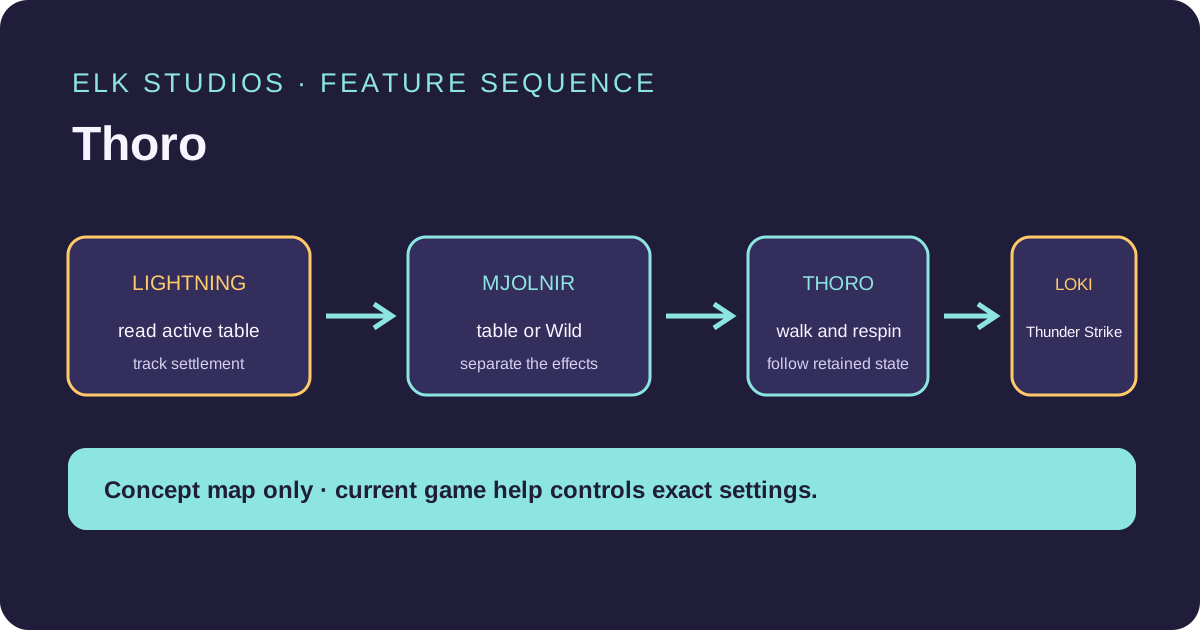
This Thoro ELK Studios slot review covers a game that combines Lightning symbols and their payout table with a walking Wild, respins, Mjolnir-driven upgrades and a Bifrost bonus. ELK also describes a Thunder Strike feature in which Thoro and Loki interact on the board. To understand the game, follow the Lightning settlement separately from the movement and bonus features; the visible symbols can belong to different rule paths.
The official Thoro product page was checked on 6 October 2026. No current operator help or paytable was supplied for this review. Therefore, this article does not publish active RTP settings, volatility, maximum payout, stake limits, Lightning thresholds, multiplier values, bonus counts, feature-entry prices or a New Zealand access claim. Those figures need the rules in the exact operator client.
Confirm the title and keep related games separate
ELK’s catalogue lists Thoro as its own title. Do not confuse it with Wild Toro, Wild Toro 3, Toro 911 or another game with similar branding. A studio may reuse a character or visual theme while changing the reel layout, symbol rules, feature order and mathematics. This page concerns Thoro only. The site’s separate Wild Toro 3 guide covers that title’s mechanics and is not a source for Thoro’s settings.
Inside a current game client, verify the full name, provider and help heading. Record the date, locale, currency and any version or rules identifier. A third-party review may display a title image beside data from an older market or a separate build. If the operator’s screen uses a different product name, do not silently attach its rules to this page.
ELK’s product page describes the supplier-level mechanics, but it does not list every casino that distributes the game. A supplier’s “Play” link or catalogue status is not evidence that an operator offers it in New Zealand. Access and account eligibility require current operator evidence and should be treated separately from the rule explanation.
Lightning symbols and their paytable
ELK says Lightning symbols can pay a scatter win multiplied by a corresponding Lightning paytable. It also says Thoro can upgrade that table when carrying Mjolnir. These statements identify the central payout route: a Lightning result is read against a table, and the table itself may change during a feature state.
The active help must define which Lightning symbols count, what threshold qualifies, how the number or arrangement maps to a payout, and whether the displayed multiplier applies before or after another modifier. This guide intentionally does not state a numerical threshold or payout because the assignment permits game numbers only from current help and none was supplied. A figure on a review page for another market is not a substitute.
Separate a Lightning symbol’s role from its visual design. ELK says Bonus symbols also function as Lightning symbols. The client help should explain whether that dual role means a qualifying symbol contributes to a Lightning result and triggers the bonus at the same time, and how those results settle. Do not assume that one event cancels or doubles the other.
When an operator publishes the paytable, check its currency basis, total stake basis and any different tables available by mode. A single screenshot might show only one stage. Note whether the table is at its base state or has already been modified by Mjolnir. Without that context, a payout example is incomplete.
Mjolnir can change the Lightning table or Thoro
The product description says Thoro may upgrade the Lightning paytable or his own multiplier while carrying Mjolnir. That creates two distinct upgrade paths. One changes the payout table for Lightning results; the other changes the value associated with the walking Wild. A review should not combine them into a generic “multiplier boost”.
Check the help for the condition that lets either upgrade occur, how the game chooses between them and whether both can happen during one sequence. Determine when the altered Lightning table takes effect and when it returns to its original state. For Thoro’s own multiplier, confirm which wins it affects, when it increases and whether its value is retained through a respin or bonus.
The same event can look like a single animation but contain more than one calculation step. If the table changes, a Lightning result may be evaluated under a different payout schedule. If the Wild’s multiplier changes, that may affect a separate cluster or line result. The live rules should state how the client distinguishes these amounts and in what order they are combined.
Avoid describing Mjolnir as a guarantee of a better result. An upgrade changes a rule parameter or displayed state; it does not ensure that a qualifying Lightning result or winning combination follows. The reader needs to know what changed, when it applies and what still must occur before any payout is produced.
Thoro as a walking Wild
ELK describes Thoro as a walking Wild that generates respins as he moves leftwards. A walking Wild is both a symbol role and a movement rule. The client help should define which symbols Thoro substitutes for, where he begins, how he moves, and what event ends his movement or the associated respins.
Do not assume that every step is a new paid spin. The supplier says the movement generates respins; the active rules should explain whether the original stake covers them, whether the board is partly held and how the next state is drawn. This matters when a sequence includes symbols that remain fixed while other positions change.
ELK states that Bonus and Lightning symbols are sticky during Thoro’s respins. Verify exactly when that retention begins and ends. Check whether all such symbols remain in their positions, whether a symbol can be both sticky and part of a payout, and what happens if Thoro’s movement reaches a retained symbol. The public outline does not resolve every interaction.
Keep the Wild’s role separate from its multiplier. A symbol can substitute for an eligible payout symbol while also carrying a multiplier value, but the rules must show whether both functions operate together and how the amount is calculated. The symbol’s artwork alone is not a paytable.
Respins and the retained state
Respins are a sequence rule, not simply a faster way to play. The review should identify what triggers the sequence, what remains fixed, which symbols can still change and when the next evaluation takes place. If the client allows a history view, use it to distinguish the opening spin from later respins.
The sticky Lightning and Bonus symbols are particularly important because they can preserve a route to a later result. A retained symbol does not mean that a payout has already been secured. The remaining positions and the final settlement rule still matter. A retained Bonus symbol may contribute to a trigger, but the exact threshold must come from the current help.
Record the sequence without making a probability claim. Note the starting state, Thoro’s position, each movement, each respin and whether the paytable or multiplier changed. A single observed sequence can show a possible path. It cannot show how often that path appears across all rounds.
If a client shows a sticky symbol disappearing or changing at an unexpected point, compare the event with the help and version note. Do not resolve a mismatch with a review from a different casino. The operator is responsible for the actual rules presented to its account, while the supplier page gives the broad product concept.
Bifrost Bonus entry
ELK describes a Bifrost Bonus that begins when the bonus condition is met. Bonus symbols are also Lightning symbols, and the supplier notes that respins do not consume free spins. This makes entry, Lightning settlement and the bonus’s own counter separate rule questions.
The current help should say which pattern or threshold triggers the bonus, how many free spins or drops begin, whether an entry event also pays a Lightning result and how retriggers work. This article does not state any counts because current game help was not supplied. The product summary’s qualitative description is not enough to populate a numerical payout table.
Check the state carried into the bonus. Do retained Lightning or Bonus symbols remain? Does Thoro enter with a multiplier or Mjolnir? Does the Lightning paytable keep a previous upgrade? The source summary does not provide a complete starting-state matrix. List each detail independently and only report the fields confirmed in the live rules.
“Bifrost” is a theme label; it does not by itself tell a reader whether the bonus is based on free spins, drops or respins. Use the operator’s exact terminology. If different clients use different wording or a different bonus label, document the version rather than treating the names as interchangeable.
Thunder Strike and Loki’s symbols
ELK says Thoro together with Loki triggers Thunder Strike, where Thoro leaves a trail of Wilds as he knocks Loki symbols off the grid. This is a named interaction that depends on both characters being present. The useful review task is to establish when that interaction starts, which symbols it affects and whether the Wild trail remains for a later evaluation.
The public description does not specify every trigger condition. Read the current help for how Thoro and Loki must appear, whether the event can happen in the base game, a respin or a bonus, and what happens if one symbol is already held. It should also explain whether the trail replaces the removed Loki positions, how many Wilds are created and when the outcome settles. These are numerical and positional details that require active rules.
Do not describe the feature as a “battle win” or a guaranteed payout. The source describes an exchange of symbols and the creation of Wilds. A payout still depends on whether the resulting board forms an eligible win under the paytable. A Wild trail can change the board without settling money on its own.
When documenting the animation, separate the symbols removed from the symbols added. This helps identify whether a Wild replaces every Loki or only the positions involved in the event. If the history panel does not expose the trail, say the visual sequence is not fully represented in the record.
Super Bonus and X-iter
ELK describes a Super Bonus setup in which Thoro carries Mjolnir and a multiplier and the Lightning paytable begins at its maximum level. That is a supplier description of a feature’s starting state. The operator help must still establish the trigger, the exact starting values, what can change during the mode and how the state resets.
The supplier also lists X-iter options for Thoro. An optional mode may begin closer to a bonus or in a defined state, but the active operator menu determines which options are enabled, their cost and any regional restriction. Check whether the menu changes the base stake, guarantees entry or changes the mathematical configuration. Do not publish a cost or mode claim from a foreign casino.
A paid entry may guarantee a feature state without guaranteeing a prize. The subsequent feature remains subject to its rules and outcome. Compare the amount at risk with the displayed terms before considering any optional choice. This guide does not encourage or recommend feature purchases.
If a mode has separate RTP or payout information, keep it distinct from the ordinary game. The same title can have materially different settings between a base round and a paid mode. A product-page description cannot establish which setting is active in a particular client.
RTP, volatility, stake and maximum payout
No current New Zealand operator help or Thoro paytable was supplied. The active RTP and possible variants, volatility label, maximum payout, stake limits, Lightning table, multiplier values and feature-mode prices therefore remain unverified. Competitor reviews can surface questions but do not establish this operator’s configuration.
RTP is a theoretical long-run measure for a specific rule and math configuration. It does not predict a person’s session. If an operator lists alternatives, identify the one actually served and preserve any mode-specific differences. A search result that repeats a number without an exact client source is not sufficient evidence.
Volatility is a broad description of distribution, not a signal that a bonus is due. A maximum win is a ceiling, not a likely outcome. The stake basis, mode and payout conditions must be clear before either number appears in an article. In Thoro, a changing Lightning paytable makes it especially important to say whether a cited value reflects the base table or an upgraded state.
Minimums and maximums can depend on the casino’s currency and account settings. A review written for pounds or euros does not confirm a New Zealand-dollar limit. If an operator does not publish the setting, state that it is unknown rather than estimating it from another game in the supplier’s catalogue.
How to review the rules without confusing the feature paths
Begin by collecting the exact title, rules date, operator locale, currency and configuration label. Open the paytable, then locate the Lightning conditions, Bonus symbol role, Thoro movement, respin retention, Mjolnir upgrades, Thunder Strike and bonus rules. Save a separate note for each field. A feature summary from the studio should not be used as a replacement for missing operator terms.
During one authorised sample round, trace events by category. First record any Lightning result and the table state used. Separately note whether Mjolnir changed the table or Thoro’s multiplier. Then follow Thoro’s movement, retained symbols and respins. If Thunder Strike occurs, record which Loki symbols are removed and where Wilds appear. End with the settlement shown by the client.
Use this sample only to explain the order of one observed sequence. It cannot verify frequency, average return or fairness. If the live help and history disagree, note the difference and ask the operator. Do not use a reviewer’s memory or a short video to determine which version is correct.
This approach keeps the review readable even though the game has several linked features. The reader can see that Lightning uses a table, Mjolnir can affect a table or multiplier, Thoro changes positions during respins, and Loki participates in a separate named event. Each answer remains attached to its own source and state.
Display and mobile clarity
ELK publishes a desktop ratio recommendation, but that does not establish compatibility for each operator’s mobile wrapper. If a client is available, check whether the Lightning paytable can be opened at phone size, whether it clearly shows the current upgraded state and whether the user can distinguish retained symbols during respins.
Check that a movement animation does not obscure a multiplier or stop the user from understanding which positions remain sticky. Sound and flashing can signal an event, but the rule should also be readable on screen. Look for a mute control, an accessible rules menu, a visible focus state for keyboard operation and enough time to review the result history.
The distinction between a base table and an upgraded paytable should remain visible. If a client changes the Lightning values but gives no persistent indicator, that can make a payout hard to interpret. Record the specific issue rather than assuming the interface is identical across casinos.
No live Thoro client was tested for this guide. These are checks for a future device review, not evidence of current mobile performance or accessibility. A proper record should identify the device, browser or application, operating-system version and exact game build.
Questions readers often ask
What does Mjolnir change?
ELK says it can upgrade the Lightning paytable or Thoro’s own multiplier while he carries the hammer. The live help should define the trigger, selection and duration of each path.
Are Lightning symbols and Bonus symbols separate?
ELK says Bonus symbols are also Lightning symbols. The active rules should explain whether one symbol can settle a Lightning result and satisfy bonus entry at the same time.
What happens during Thoro’s respins?
The supplier describes Thoro moving left as a Wild and generating respins, with Bonus and Lightning symbols sticky during them. The current help defines the exact movement and reset rules.
Does Thunder Strike guarantee a win?
No such guarantee is stated. ELK describes Loki symbols being removed and Wilds being left behind; the resulting positions still need to form an eligible payout under the paytable.
Which Thoro settings apply in New Zealand?
They are not verified here because no current operator help or NZ distribution statement was supplied. Supplier documentation alone does not establish local availability or configuration.
Sources and verification boundary
- ELK Studios: Thoro — supplier feature summary, checked 6 October 2026.
- ELK Studios games catalogue — product identity cross-check, checked 6 October 2026.
- Department of Internal Affairs: information for advertisers — New Zealand advertising guidance, checked 6 October 2026.
- Competitor sample checked 6 October 2026: SlotsHawk Thoro review, FruitySlots, Gambling.com UK, BigWinBoard, SlotCatalog, and AboutSlots. Their pages display market-specific numeric fields, state variants and promotional content; this guide does not use those figures as current New Zealand settings.
No current operator help, NZ account-access evidence, mobile client, or verified settings sheet was supplied. This guide covers only supplier-described feature relationships.
