ELK Studios game rules · South Island guide
Catemple: rules, features and settings to verify
 Best casinos available in New ZealandUpdated 7 November 2026

Catemple is an ELK Studios slot built around a bottom Collect Zone. Its supplier describes coin wins, Golden Coins, Wilds, Hot Wilds, multipliers, Mystery symbols, Bonus and Super Bonus features. Collected Bonus symbols can start a feature with an expanded Collect Zone, while Hot Wilds can spread across the grid. The exact RTP, volatility, stake limits and numerical settings should be checked in the current operator help.
The short answer
Catemple is an ELK Studios slot whose public feature summary places a Collect Zone at the bottom of the grid. Golden Coins and feature symbols can interact with that zone, while Mystery symbols reveal a feature symbol. ELK names Wilds, Hot Wilds, multipliers, coin wins, a Bonus and a Super Bonus. The supplier says a collected Bonus symbol starts a bonus with an expanded Collect Zone, and a collected Super Bonus symbol starts a higher-tier feature with a further-expanded zone.
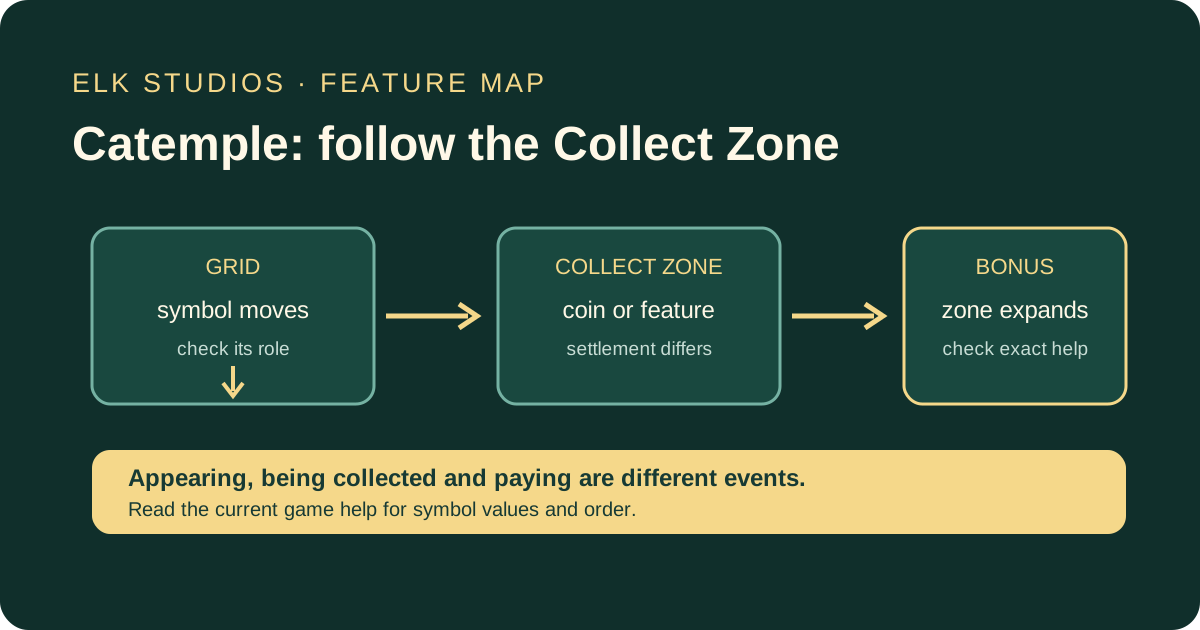
The key distinction is between a symbol appearing somewhere on the board and reaching the Collect Zone. The zone is where the supplier says Golden Coins trigger. That makes position and movement part of the rules: the reader should understand how symbols fall, which items are collected and when the game evaluates the result. A screenshot of the grid alone does not explain whether a symbol has already been collected or is still moving toward the bottom.
ELK’s public page describes headline mechanics and a potential maximum, but the current operator help was not supplied. This review therefore does not repeat a numeric cap, RTP, volatility, hit rate, stake range or bonus count from a review site. The exact numerical game settings must come from the active client’s help. No casino account or demo was tested, and no claim is made that Catemple is available to New Zealand players.
This page answers the one-title intent in one place: how the grid and Collect Zone work at a conceptual level, what the supplier confirms about bonus progression, which values remain unknown and how to verify the active version. It does not create a second URL for RTP, demo or bonus questions.
Identify the exact Catemple client
The first step is to confirm the full game name and supplier in the casino lobby and again after the game opens. ELK’s official catalogue lists Catemple as an individual title and links to a dedicated profile. This gives a first-party identity and feature description. A different cat-themed game, an ancient-temple title from another supplier or a similarly named slot is not an authority for Catemple’s rules.
A supplier page establishes that the game exists in the catalogue; it does not establish distribution by a particular casino. The operator may have a different game library, may not make every title available in each country, or may apply a configuration that differs from a third-party review. The product profile was checked on 6 October 2026, but no New Zealand operator version was opened or tested for this article.
Use the Help or Information icon inside the current game client. Check its title, rules date if displayed, symbol descriptions, paytable, stake currency and any selected return setting. If a review page includes details that are not visible in the active client, mark them as unverified rather than assuming that they still apply. A public review may describe another jurisdiction or a demo build.
The supplier’s profile is the primary source for the mechanics that it names. It is not a complete payout table. The operator’s help and paytable are the evidence needed for active numerical settings and exact symbol values. Keeping those sources separate prevents an editorial summary from turning into an unsupported claim about what a casino currently offers.
The grid and the Collect Zone
Catemple’s defining visual structure is a grid that feeds symbols toward a designated bottom Collect Zone. ELK describes the zone as the place where Golden Coins trigger. The exact size and dimensions are not repeated here because the assignment requires game numbers to be verified in current help, which was unavailable. The important rule concept is directional: a symbol’s position relative to the bottom area can determine whether a collection event occurs.
A reader should follow a symbol through the sequence. It may appear on the grid, move or fall as the layout changes, reach the Collect Zone and then activate its feature. Those events can occur within one paid round. The help should explain whether an item can be collected only once, whether it falls by a fixed rule, how cascades work and what happens to other symbols when a win clears part of the board.
Do not assume that every symbol in the zone pays in the same way. A coin can carry a value, a multiplier can affect a later win, and a Bonus symbol can start a separate feature. They share a destination but have distinct roles. The game’s symbol guide should name each item and explain whether it is paid immediately, collected toward a feature or held for another step.
The Collect Zone expands in bonus states, according to ELK’s public profile. That changes the area where symbols can be collected, but it does not by itself establish how many extra items will appear or how much any of them will pay. The current game help should specify which bonus state uses which zone and whether it remains expanded throughout the feature.
When reviewing an animation, notice whether a symbol is simply visible or has activated. A gold coin graphic may not be credited until it reaches the correct area; a bonus icon may need to be collected before it triggers; a Mystery symbol may first reveal what it represents. The final result panel and round history are useful checks for the order and settlement of those events.
Coin wins and Golden Coins
The supplier identifies coin wins and Golden Coins as central feature elements. ELK says Golden Coins trigger when they reach the Collect Zone and that the coin family can include coin wins, multipliers, Bonus symbols and Super Bonus symbols. This means “coin” can describe more than one outcome type. Read the revealed symbol or label to see whether it is a cash award, a multiplier state or a bonus trigger.
A coin with a displayed value should be interpreted according to the paytable. The help should say whether that number is a direct amount, a multiplier of the selected stake, a value collected into a meter or a contribution to an overall result. Do not convert it into currency without confirming the displayed denomination and stake basis. The same-looking icon can be used in different states, so match the exact name shown in the information panel.
A coin win and a multiplier are not interchangeable. A cash coin may add a stated amount under the game’s settlement rules; a multiplier may alter another award. If both appear in one sequence, check whether the multiplier applies before or after the coin is collected. A short product summary does not state the full calculation order. That is why the game help is essential for reconstructing a specific result.
The zone makes placement matter. A coin that does not reach it may not trigger in the same way as one that lands in it. If symbols cascade or drop, the game can create a new arrangement and a later collection opportunity. The rules should identify whether the action repeats until no further change occurs, whether a coin remains on screen and how the game handles multiple coin values in one round.
A review site may list sample symbol payouts or stake ranges, but those details can reflect a separate version. This article does not publish a numeric payout table without the active help. Use a screen capture or round record only as supporting evidence; the current paytable tells you what the symbols mean, and the account ledger confirms the amount credited.
Mystery symbols and feature reveals
ELK describes a Mystery symbol that reveals a feature symbol. Its public list includes Wild, Hot Wild, Paw Strike, Multiplier, Bonus, Super Bonus and Coin outcomes. The summary does not specify whether all Mystery symbols in one sequence reveal the same feature, whether a reveal can happen before the Collect Zone or what determines the selected result. Those details should come from the exact client’s rules.
A Mystery symbol is therefore a placeholder until it resolves. Do not count it as a Wild, Bonus or coin before the interface reveals its role. When several Mysteries appear, watch whether they reveal consistently or independently; the help should say how the game handles multiple symbols. A game-history record can help if the reveal and collection animations overlap.
After the reveal, the feature symbol’s own rule applies. If it becomes a Wild, check which paying symbols it can substitute for and whether it remains on the grid. If it becomes a multiplier, check the scope and reset condition. If it becomes a coin, confirm whether it has a value and whether collection is required. If it becomes a Bonus symbol, determine whether it must reach the Collect Zone before entry.
The name Paw Strike appears in the supplier’s Mystery-symbol list, but the public summary does not explain its effect. Secondary reviews may describe an effect, but this article does not substitute their version for current help. Read the live description before stating what Paw Strike clears, changes or awards. A feature name alone is not a full rule.
This staged approach is more reliable than assigning a Mystery symbol an expected value. Its outcome is part of the game’s configured rules and random process. A single reveal cannot establish the probability of another feature symbol, and a previous Mystery result does not tell a player what the next one will be.
Wilds, Hot Wilds and multipliers
Wilds and Hot Wilds are separate names in the official profile. A standard Wild commonly substitutes for certain paying symbols, but the exact eligible set should be checked in Catemple’s help. A Hot Wild has an additional spreading behaviour: ELK says it can spawn new Wild or Hot Wild symbols and that each new Hot Wild can spread further. The supplier overview describes the effect but not every boundary or trigger condition.
When a Hot Wild appears, check whether it spreads immediately, whether it can continue through a cascade, and which positions are eligible. Does it replace symbols or add new ones? Can it reach the Collect Zone? Does another Hot Wild repeat the same action? The exact sequence can affect whether the final arrangement is a paying combination, but the public summary does not provide a complete state diagram.
A multiplier symbol has a different role from a Wild. The multiplier may modify a win rather than substitute for a symbol. ELK lists multipliers among the Golden Coin types, suggesting that collection in the zone is relevant. The live help should state whether a collected multiplier applies to the current award, a later award, a feature total or a particular state. It should also explain whether more than one multiplier adds, multiplies or is handled another way.
The order of a cascade can matter. If a win removes symbols and new items fall, a Hot Wild might spread before or after the next evaluation. A multiplier coin may reach the zone during the same resolution. A casual viewer can mistake these animations for simultaneous actions, so check the event log where possible. The paytable should explain how each step is calculated.
A feature that changes symbols can produce a longer animation without producing a larger credited amount. Wild coverage and multiplier states can make an arrangement more complex, but complexity is not a prediction. The game’s final result is governed by the stated symbol and payout rules.
Bonus and Super Bonus progression
The supplier says a collected Bonus symbol triggers the Bonus Game. ELK describes the standard Bonus as beginning with win drops and an expanded Collect Zone; additional Bonus symbols increase the number of drops. A collected Super Bonus symbol instead triggers a Super Bonus with a further-expanded zone. The current game help should verify the exact symbol threshold and drop counts before those numeric details are published; this review omits the supplier-page numbers for that reason.
The rule sequence matters. A Bonus symbol must be collected under the game’s conditions, not merely appear somewhere on the screen, according to the supplier summary. Once the feature begins, the zone changes, which can alter the chance for coins and feature symbols to reach it. Additional Bonus symbols can extend the state as described by ELK, but the exact timing—before the next drop, after a collection or at settlement—belongs to the game help.
The Super Bonus is a distinct named state, not simply a synonym for the regular bonus. Its zone layout and feature sequence may differ. Check the help for which symbols trigger it, how its award is calculated and whether the game can enter it in ordinary play or through an optional mode. If the operator client offers X-iter, check the cost, starting state and whether the same rule applies as a naturally triggered feature.
A bonus sequence can contain coin collection, Mystery reveals, Wild spread and additional feature symbols. Treat each event as a step with its own conditions. If the bonus summary shows a final total, do not assume every visual symbol was paid. Check how the game accounts for collected coins, multipliers and any non-winning drops.
A longer feature is not a guaranteed profit. An expanded zone creates a different layout; it does not promise that valuable symbols will arrive or be collected. The final outcome can be lower than the paid stake. Read the feature rules and decide on a budget before playing rather than increasing a stake because a bonus appears close.
Cascades and the order of resolution
The official profile centres on the Collect Zone and the movement of feature symbols but does not give a complete technical explanation of every cascade. This guide treats cascading as a behaviour to verify in the current help, rather than assuming that every win causes the same refill. Some review pages describe repeated drops, yet an older or market-specific description may not match the exact game client.
If the game removes winning symbols, observe what happens to the remaining grid. New symbols may fall into gaps, a Hot Wild may spread, and coin or bonus symbols may move toward the Collect Zone. The help should tell you which of those actions can occur in the same resolution and whether a new win is evaluated immediately. That order determines how to interpret the animation, even though only the paytable can determine the amount.
A round history can make the sequence clearer. Start with the initial layout, then identify the win or collection that caused a change. Follow the remaining symbols, note any Mystery reveal, and check whether an item reached the zone. Finish by comparing the game’s result with the account record. This method helps explain a disputed round without claiming to predict future outcomes.
Cascades can make a single paid round appear to contain several smaller events. Keep the total stake and total credit separate from the number of animations. A repeated drop is not necessarily a new independent paid spin. If the interface calls a step a “win drop,” check whether it consumes a feature counter or simply resolves within the current sequence.
If the controls offer turbo or skip animations, using them can make it harder to observe feature order. A slower mode or history view can be helpful while learning. It changes how quickly the game is displayed, not the rules or probability.
RTP, volatility, maximum win and stake settings
RTP is a theoretical return assigned to a game configuration over a very large number of plays. It is not a promise of a return for one session, and it does not predict the amount of a coin or bonus. If more than one setting exists, an operator can expose a different configuration than a review page or another casino. The exact active value should be taken from the game’s current help panel.
Volatility is a broad description of how results are distributed. Editorial sites may use different labels or rating scales. A label cannot predict whether a bonus will trigger soon or what it will pay. Check the current client’s wording and keep it attached to the title/version you observed. This article does not select a secondary label as the “true” value.
ELK’s product page publishes a potential maximum, but the active operator help was not supplied. The topic brief requires numeric settings to come from game help, so this article does not repeat a numeric cap, RTP, volatility rating, hit frequency, stake range or bonus count from third-party pages. Those settings remain unverified for an operator build.
When the current client is available, check the currency, allowed stake range, selected RTP if shown, volatility wording, maximum payout basis and whether the base game and optional modes use separate settings. Read whether a limit applies to the total wager, a single paid round or a feature. Avoid converting an amount into NZ dollars without knowing the operator’s account currency and settlement basis.
If a review gives a number that the client does not display, do not assume the review is current. If two sources disagree, compare their date, market and version. If you cannot make a like-for-like comparison, write that the value is unconfirmed. A clear unknown is more useful than a precise number attached to the wrong build.
X-iter and optional mode costs
ELK’s public page says X-iter offers predefined modes for Catemple, including a Super Bonus mode. A feature mode can start closer to a chosen game state, but its price is an additional wager decision. The supplier description does not prove that a particular casino enables the option, or that every market uses the same menu.
If the live client displays X-iter, open the details before selecting a mode. Confirm the cost, which feature state begins, how the current stake is used, and whether the mode has separate rules or a different return setting. A guaranteed bonus entry is not a guarantee that the final award will exceed the cost. A larger feature state can still finish below the amount spent to start it.
Compare a mode with ordinary play by looking at the total cost and the exact feature included, not only the word “Super.” If the option lists a maximum or return, confirm the basis in the current help. A mode can change the starting condition while retaining the same overall risk; the name itself does not show whether it is good value.
Do not confuse an X-iter selection with a free demo. A mode is normally part of the game’s paid feature menu, while a demo is a separate play environment if provided. This article has not opened either option. Use the operator’s information panel to understand the price and the supplier’s permitted demo page to learn controls where available.
If a button or mode cost is not clear, do not confirm it. The interface should give enough information to understand what is being charged. Ask the operator for clarification if the description is incomplete.
Mobile, demo and help-screen checks
Catemple’s visual grid and lower Collect Zone need enough screen space to distinguish a symbol landing from its collection. On a phone, verify that the game controls do not cover the bottom of the board, where the feature zone is located. Open the paytable and Help panel before any wager, and make sure the display can show feature descriptions without hiding the stake amount.
A demo can help a reader understand where coins and bonus symbols move, where a Wild spreads and when a feature panel appears. Access may depend on the supplier page, operator or location. This review did not launch a demo, and a visible play link does not prove local availability. A demo can illustrate the mechanics but may not use the same mathematical setup as a real-money client.
The help screen is especially important for Mystery symbols. It should identify which outcomes are possible and what each revealed feature does. If the game only shows an abbreviated tooltip, look for a complete paytable or rules menu. Do not fill missing information using a similarly named effect in another ELK title.
Check touch interactions before play. Some controls can be close together; ensure that a spin, stake change or mode selection is intentional. Confirm the total before every wager and verify whether any optional X-iter mode is selected. If an animation is difficult to read, use the round history or slower display setting where available.
If a feature appears to settle incorrectly, record the title, date, operator, round identifier and the on-screen result. Do not share account passwords. The operator’s support team can inspect the account transaction and exact game version; a third-party article cannot validate a particular account credit.
How to read competing Catemple reviews
Search results for Catemple commonly describe the Collect Zone, Golden Coins, Mystery symbols and a feature-rich bonus structure. They can help identify what a reader wants explained. Their settings tables may differ: some give RTP and volatility, some repeat a cap or stake range, and some describe market-specific demo routes. Those figures should not be treated as current New Zealand operator values without the exact client help.
ELK’s official profile is the stronger source for the named feature outline used here: the Collect Zone, coin categories, Mystery reveals, Hot Wild spread and the distinction between Bonus and Super Bonus. It does not replace an operator’s live paytable. Competitor sources do not prove that a casino offers the same Catemple configuration or that a visitor can use a demo in New Zealand.
Some secondary pages include a rating or personal-play impression. This guide does not claim to have tested a demo, seen a particular payout or assigned a score. Instead, it separates source facts from unresolved settings. That distinction is valuable for this title because the feature names make it easy to overstate what a short official product description actually says.
A useful update would add only information verified against the current client, with its date and market recorded. It would not simply copy another site’s values. If an operator later provides a current help file, the article can add precise settings without changing its basic explanation of how the Collect Zone works.
A practical pre-play checklist
Before using the game, check the exact title and provider, help revision, meaning of the bottom Collect Zone, coin settlement, Mystery outcomes, Wild and Hot Wild rules, multiplier scope, Bonus and Super Bonus entry, cascade order and any optional mode. Then record the displayed currency, stake limits, selected return setting and volatility label if the game shows them. Mark any missing item as unknown.
The most important feature distinction is simple: a symbol appearing is not the same as it being collected, and collection is not automatically the same as a cash payout. A Golden Coin can represent more than one feature type; a Mystery symbol must first reveal its role; and a Bonus symbol may require the stated collection condition. Follow the client’s own rule text for each step.
Compare the help screen with any external review. If their numerical settings differ, use the current client for the operator version and note which market the review covered. If the help does not expose a value, do not infer it from the headline description. A missing figure should not be turned into an assumed default.
Set an entertainment budget and a stopping point before starting. The Collect Zone and expanded feature states explain how a round progresses, not how likely a particular award is. A bonus can take time and still return less than its starting cost. Do not raise a stake to recover losses or to force a feature to appear.
This review is informational and has no casino referral button. Its current boundary is the public supplier description; the active operator settings and local access remain unverified.
Frequently asked questions
What is the Collect Zone in Catemple?
ELK describes a zone at the bottom of the grid where Golden Coins trigger. The exact movement, symbol collection order and payout calculation should be checked in the current game help.
What can a Mystery symbol reveal?
The supplier lists Wild, Hot Wild, Paw Strike, Multiplier, Bonus, Super Bonus or Coin as possible feature symbols. It does not explain every effect in its brief summary, so use the live help for the exact rules.
How do Bonus and Super Bonus differ?
ELK describes separate feature states with different Collect Zone layouts. The current client should confirm the trigger, drop count and settlement for each; this review does not repeat unverified numeric settings.
What does a Hot Wild do?
The supplier says a Hot Wild can spawn new Wild or Hot Wild symbols and that new Hot Wilds can spread further. The eligible positions and timing are not fully documented in the public summary.
What is Catemple’s current RTP?
It is not verified here because the current operator game-help screen was not supplied. Check the exact client’s help and do not assume that a figure from another market applies.
Is Catemple available to New Zealand accounts?
The supplier has a public product profile, but that does not establish distribution or account access through a particular New Zealand operator. This review did not test availability.
Can I use an online demo to verify the real-money version?
A permitted demo may help explain the feature sequence, but its settings can differ from an operator’s real-money version. This article did not launch a demo; confirm active settings in the exact client’s help.
Does an expanded Collect Zone guarantee a larger payout?
No. It changes the feature layout, but it does not guarantee that particular symbols will arrive or be collected. The final result depends on the rules and outcome of the active game state.
Sources and verification boundary
Checked 6 October 2026. ELK’s product page confirms the Catemple feature outline used here. The linked product-sheet PDF returned HTTP 403 in the research browser, and the current operator game-help screen was not supplied. Numeric RTP, volatility, maximum-win, stake and mode settings were therefore not independently verified. No New Zealand operator access or demo was tested; search demand was not measured. This informational article has no casino referral button.
