ELK Studios game rules · South Island guide
Phoenix Graveyard: rules, features and settings to verify
 Best casinos available in New ZealandUpdated 7 November 2026

Phoenix Graveyard is a five-reel, three-row ELK Studios slot whose supplier summary describes expanding win ways, a walking Grim Reaper Wild, a jumping Phoenix Wild, battles and Free Spins. The key to reading it is to separate the two Wilds’ roles and then verify how their interaction changes a specific win. Phoenix Graveyard II is a separate product. This guide does not claim an RTP variant, volatility rating, maximum win, operator availability or New Zealand access without the active game help.
The short answer
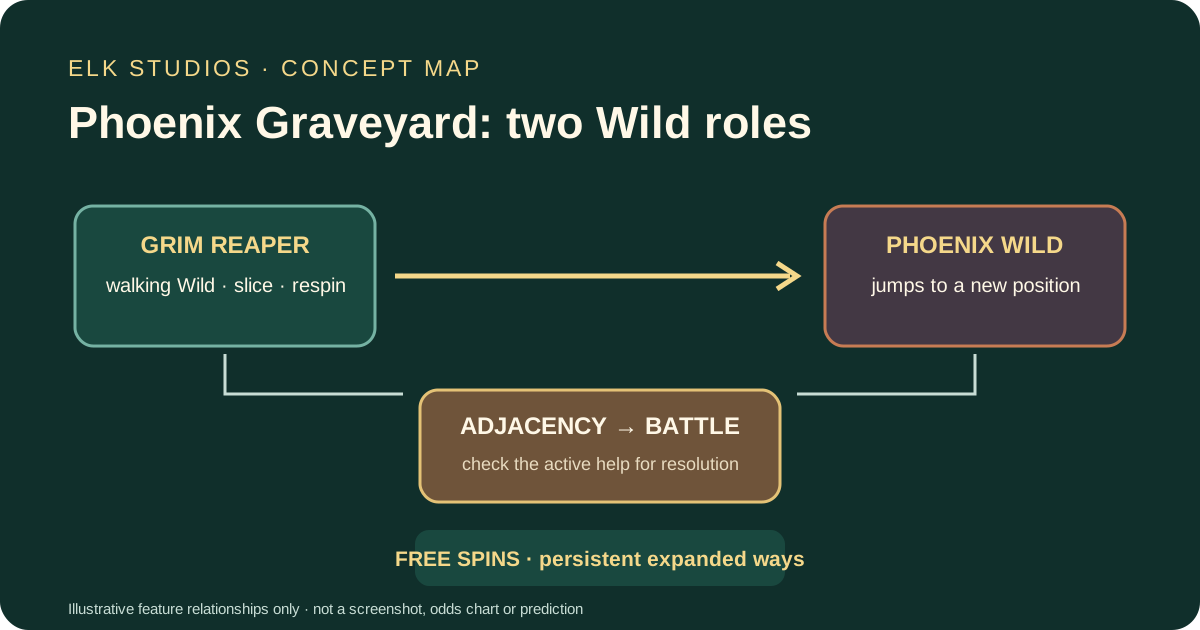
ELK describes Phoenix Graveyard as a five-reel, three-row slot with expanding win ways, a walking Grim Reaper Wild, a jumping Phoenix Wild, battles and a Free Spins bonus. The Reaper is described as a walking Wild that triggers respins and slices high-value symbols. The Phoenix moves to a new location for each respin and free spin. If the two become adjacent, they can battle; the supplier says a battle can double a winner’s multiplier or create another Phoenix Wild. Three or more Bonus symbols trigger Free Spins, where expanded win ways persist and Phoenix Wild multipliers are tied to the position’s ways.
That is a useful feature map, not a complete paytable or verified operator configuration. ELK’s official linked Game Data Sheet returned HTTP 403 when checked on 7 October 2026. No active casino client was supplied. This guide therefore does not repeat RTP, volatility, cap, stake range or probability numbers from secondary pages, and it does not claim availability in New Zealand.
Identify the original title
This article covers Phoenix Graveyard, without a sequel marker. ELK also lists Phoenix Graveyard II, a distinct product with its own page and rules. The original’s public summary describes five reels and three rows; the sequel’s page discusses a Feature Row and a different set of interactions. Treating the products as interchangeable would move rules from one entity into another and could make a reader misunderstand the active game.
Check the title inside the client, not only the artwork. Record the exact name, supplier and game-help version, then compare those details with the appropriate ELK profile. A casino thumbnail can be cropped or abbreviated, and a search result may omit “II”. The provider credit and written rules help resolve the difference. If the in-client heading includes “II”, leave this article and consult that game’s own guide.
ELK’s catalogue marks the original Phoenix Graveyard “Live Now”. This is supplier catalogue information; it is not proof that a given casino offers the game, that it is enabled for a New Zealand account, or that its active RTP setting matches an overseas review. Product status, operator distribution and country eligibility are separate facts. This page only asserts what the supplier’s public game summary supports.
The single planned URL keeps the original’s mechanics, evaluation notes and setting caveats together. It does not divide the same title into separate bonus, RTP or demo pages, and it does not take over the intent for Phoenix Graveyard II. That boundary matters when the two products share imagery and character names but expose different feature systems.
Five reels, three rows and expanding win ways
ELK describes a five-reel, three-row layout and says the game has expanding win ways. The supplier’s public page does not give the complete base paytable, the exact way-count progression, the symbol order or a full diagram of how every expansion is evaluated. A reader should therefore treat “expanding win ways” as the broad feature label and use the active game help for the precise settlement rule.
In a ways game, the displayed number of possible combinations can change with the number of symbol positions available across reels. Expansion may alter the number of positions considered on a reel, but the exact implementation belongs to the rules for this title. Do not assume every reel expands, that every symbol becomes eligible, or that the highest visible way count is active for the entire round. The help should state when the grid changes and how a winning path is selected.
To read a round, compare the grid before and after the Reaper’s slicing action. Note which symbol positions were affected and whether the game shows an updated ways display. Then check the result panel to see whether the new arrangement contributed to a win. Expansion is a change to the set of possible evaluations; it is not itself a payout. An increased ways count can still produce no matching symbol sequence.
The distinction between a grid event and a settlement is especially important when animation removes a symbol. The Reaper’s action may change rows or symbols, while the ordinary game evaluation still has to find an eligible combination under the paytable. Follow the event order as presented: initial result, any Reaper action, respin, resulting grid, then evaluated outcome. If the interface compresses the sequence, use the history or help screen rather than guessing from the animation.
Grim Reaper: walking Wild, slices and respins
The supplier identifies the Grim Reaper as a walking Wild that triggers respins and slices high-value symbols. These two effects should be tracked separately. “Walking Wild” describes the Reaper’s movement and substitution role; “slicing” describes its interaction with symbols or the board. The public summary does not describe every target condition, movement step or end state, so the client help remains necessary for exact rules.
When the Reaper appears, first establish where it is placed and how the active rules define a Wild. A Wild commonly substitutes in certain combinations, but the title’s help must say which symbols qualify and whether there are exclusions. Then observe the movement or slice event. Does the feature remove a symbol, change the number of rows, trigger a respin, or do more than one thing? Write down only what the help confirms; a dramatic animation may combine several events.
The supplier specifically connects the Reaper with respins. A respin is another evaluation within the feature sequence, not automatically an additional paid wager or a winning result. The game’s history should make clear whether it is attached to the original spin and how any win is accumulated. Check whether the Reaper can act more than once, whether it remains Wild while moving, and which event ends the sequence. The official summary does not supply all of these edge cases.
ELK says the Reaper slices high-value symbols. Do not interpret that wording as proof that every sliced symbol becomes a lower-value symbol, that a win is guaranteed or that the feature can only affect one reel. Confirm what “slice” means in the client’s help illustrations and whether symbol values or layout change before the next evaluation. A later review should make clear the difference between a supplier summary and a fully documented transition rule.
Phoenix Wild: movement and multiplier scope
The Phoenix Wild jumps to a new location for every respin and free spin, according to ELK’s description. The movement gives it a different role from the Reaper, whose summary emphasises walking, slicing and respins. Keep these descriptions separate: the Phoenix relocates, while the Reaper is the moving Wild associated with board interaction. Similar on-screen motion does not mean that the two symbols share all conditions.
ELK says a multiplier can be added when the Phoenix battles the Grim Reaper. The public summary does not state the specific multiplier values, ceiling, calculation order or every condition that qualifies as a battle. If an operator game help shows a value, record it from that version. Do not infer a multiplier from a competitor’s review or apply a number from Phoenix Graveyard II.
A multiplier only matters when the game applies it to a qualifying result under its rules. A multiplier graphic can be visible without a winning combination; it is not a forecast of the next spin. Ask whether the multiplier is attached to one Wild, one symbol position, one evaluated combination or a wider set of wins. If more than one multiplier appears, check whether the client adds them, multiplies them, uses the largest or follows another rule. The accessible ELK summary does not settle those details.
For a careful observation, record the Phoenix’s position before a respin or free spin, where it moves, whether a Reaper is adjacent, and what the result panel attributes to the interaction. Separate battle outcome from the later payout. The supplier says a battle can double a winner’s multiplier or create another Phoenix Wild; both are feature outcomes, not promises that a win will be produced. Exact odds and values remain unverified here.
Battles and feature order
The battle rule creates a conditional interaction between two symbols. ELK says that adjacent Phoenix Wild and Grim Reaper trigger a battle. The winner’s multiplier may double, or an additional Phoenix Wild may be born. That description does not identify all placement constraints, how a tie or repeated battle is resolved, which symbol starts with a multiplier, or whether one outcome is random. The game help should answer those questions before a numeric explanation is written.
Feature order changes what a player sees. If the Reaper moves, the Phoenix jumps, and the two become adjacent, the battle may change the feature state. A resulting multiplier or new Wild can then affect later symbol evaluation. When explaining the order, do not collapse these steps into “the Wilds battle and pay”. Instead, describe the trigger, the battle resolution, the changed symbols or multiplier, and the subsequent evaluation as separate events.
A simple event log can help: (1) starting grid and special-symbol positions; (2) whether the Reaper starts a respin; (3) where the Phoenix moves; (4) whether adjacency meets the written battle rule; (5) what battle result appears; and (6) which combination, if any, settles afterward. This is a way to read a round, not to influence it or forecast a repeat.
If a game history shows only a final total, the help screen can still define the general rule. If both are silent on a particular edge case, mark it as unconfirmed. Do not use one observed outcome as evidence that every battle has the same consequence. The supplier’s public prose lists alternatives and does not disclose their probability distribution.
Free Spins and persistent expanded ways
ELK says three or more Bonus symbols trigger the Free Spins feature, which can begin with up to three Phoenix Wilds. Expanded win ways are persistent throughout the bonus. Phoenix Wilds are awarded a multiplier equal to the position’s win ways, according to the public summary. These statements describe the broad bonus structure. The exact number of spins, retrigger rules, eligible positions and settlement details must be read in the active game help.
The word “persistent” is meaningful: ELK says the expanded ways remain throughout that bonus, rather than describing a fresh reset before every free spin. It does not mean that the feature continues after the bonus ends or carries into a later paid round. Identify when the bonus state starts and ends, then observe what the display says is retained. Do not confuse a persistent feature state with a guarantee that a win will occur on each spin.
The supplier’s summary relates Phoenix Wild multiplier to position win ways. That relation is unusually specific and should not be rewritten as a generic multiplier. The help needs to show what “position’s win ways” means in the client, how a Wild receives the associated value, and how it participates in a winning combination. If the grid changes during Free Spins, note whether the Wild’s position changes the displayed ways before the multiplier is resolved.
At bonus entry, make a record of the trigger, free-spin award and initial Phoenix Wild count. Then check whether subsequent feature events add Wilds or alter the count, how a spin is consumed after a respin, and which conditions retrigger the bonus. ELK’s public text confirms a start condition and “up to 3 Phoenix Wilds”; it does not disclose every operator setting or all retrigger values.
RTP and variant settings
RTP is a long-run theoretical percentage tied to a particular game version. It is not a guarantee of how much a person receives from a short session, and it does not say whether the next spin wins. A game can have several permitted configurations. When a review says “the RTP”, it should identify which configuration and where the figure came from.
For Phoenix Graveyard, ELK’s public game page links a Game Data Sheet, and the official asset catalogue lists the same title. The linked PDF returned 403 Forbidden when checked on 7 October 2026. No operator’s help screen was available. As a result, this guide does not give a numeric RTP or claim that one variant is active in New Zealand. Third-party pages have different or inconsistent descriptions of the grid and settings, so copying a figure would add false precision.
To verify a setting, open the game help inside the exact client you are assessing. Record the full title, supplier credit, operator, date and displayed configuration. Look for a theoretical-return label and check whether the value refers to base game, a feature mode or a complete setup. If multiple RTP values are listed, preserve the exact labels instead of choosing the highest, lowest or most widely repeated. If the value is absent, mark it not shown and seek the rules or data sheet from the operator.
Do not use Phoenix Graveyard II’s data to fill this gap. A sequel can use different mathematics even if it shares characters or theme. The original’s five-by-three grid and battle summary are not enough to derive an RTP. Neither a supplier logo nor a casino’s marketing description is a numeric source.
Volatility, cap and stake fields
Volatility concerns how outcomes are distributed over time. The public ELK profile does not give a verified volatility rating for the active operator build, and the linked data PDF could not be read. This review therefore does not categorise the game as high, medium or low volatility. A visually complex Wild battle is not a volatility measurement; nor can a short sequence of results establish a stable statistical property.
If active help lists volatility, retain the supplier or operator’s exact wording and identify the game version. If it gives no label, say that no label is shown instead of assigning one from personal impressions. A review should not convert “dramatic feature animation” into “high volatility” because the two describe different things.
The maximum win, minimum and maximum stake and any optional feature prices are also not verified in this package. If those fields are shown in the current client, record the unit and the conditions. A maximum may be a total-round cap, a per-spin cap or another limit; the wording matters. A multiplier, highest symbol payment and maximum win are not interchangeable concepts. Do not infer one from another.
Any optional purchase or accelerated mode should be evaluated separately from ordinary rules. Check the client’s price, what event is bought, eligibility and whether the mode changes return or feature state. No purchase is required to understand the core game, and no feature option can guarantee a profit. This guide does not recommend selecting paid modes or assign prices to them.
How to read a round and compare it with another review
Start with the title and base grid. Note the five reels and three rows, then use help to determine how the game evaluates symbol sequences and expanding ways. If the Reaper appears, write down its location and the action named by the client. If a respin occurs, record what was retained and what changed. If the Phoenix moves or a battle begins, capture the trigger and the displayed resolution separately from the final payout.
When comparing two reviews, use the official ELK page for the title-level features and treat third-party content as a list of questions to investigate. Check whether a reviewer is describing Phoenix Graveyard or Phoenix Graveyard II, which operator was used, and whether that page gives a date and source for its number. A review can contain useful diagrams while still using settings that do not match the build a New Zealand reader might encounter.
In a current game history, separate the feature event from the settlement: grid expansion, Wild movement, battle result and any multiplier are not themselves an amount returned. The settlement panel or paytable tells you whether there was a qualifying combination and how it was paid. If the rules do not explain a specific interaction, do not invent its sequence from an animation; record the gap for later verification.
An illustrative scenario can explain the logic without asserting probabilities. For example, the Reaper walks, a respin is shown, the Phoenix jumps beside it, and the client reports a battle outcome. A later screen then evaluates symbols. That sequence only describes the categories of state a reader should track. It does not imply that adjacency always creates a certain multiplier, that the resulting layout wins, or that the feature will reappear.
Mobile, demo and local availability
ELK’s official page recommends a 1600×900 desktop display and a 16:9 ratio if scaling is needed. That recommendation does not establish that all mobile devices are supported or that a particular operator has made the game available in New Zealand. This review did not launch the game client, use a demo or test a mobile layout.
If the named game appears in an operator’s client, check the paytable, bet display and feature-state labels on the device you use. Confirm that opening help does not obscure the current spin history and that the close control returns you to the same screen. Landscape and portrait views can present a grid differently, so judge readability by the actual interface rather than a general claim that a title is “mobile-ready”.
A demo can illustrate movement and feature order, but only if it is the same title and version. Note whether it uses simulated credit, whether any features are omitted and whether a demonstration mode has a different configuration. A free demo is not proof of a real-money listing, country permission or the same RTP. No demo for a New Zealand operator was verified here.
New Zealand access is not confirmed by the supplier’s catalogue status. The Department of Internal Affairs’ advertising guidance describes the current restriction and third-party obligations. Since this site uses affiliate routes, no CPA button is included in this local draft pending compliance review. The existing /go/south/south-cashdesk-8a14.php route was not clicked, changed or inserted.
Quick verification list
Before publishing an updated review, check all of the following in the active version: exact title and provider; five-reel, three-row display; expanding-ways rule; Reaper movement and slice effect; Phoenix jump timing; definition of adjacency; battle outcomes; multiplier value and scope; Free Spins trigger; initial spin award; up-to-three-Wild statement; persistence boundary; retriggers; RTP variant label; volatility; win cap; stake range; mobile controls; demo identity; and operator eligibility. Mark fields not shown as unknown rather than relying on another casino page.
Keep a note of the source and date for each value. If the supplier data sheet becomes accessible, compare it with the operator’s help and record any difference. If one source applies to a different jurisdiction, do not silently replace the client’s rules. If the operator provides an updated build, review the full title and version again before changing the article’s date or numbers.
The checklist is intended to make a later update verifiable. It does not claim that each setting appears in this game, that it is currently available to New Zealand readers or that a source document has already been obtained. It only identifies the fields required for a complete one-page evaluation.
Questions readers ask
Is Phoenix Graveyard the same as Phoenix Graveyard II?
No. ELK lists them as separate catalogue products with separate official pages. This guide covers the original Phoenix Graveyard. Check for the “II” in the client title before using its rules.
What does the Grim Reaper do?
ELK describes the Reaper as a walking Wild that triggers respins and slices high-value symbols. The exact movement, affected positions and ending conditions should be checked in current game help.
What does the Phoenix Wild do?
The supplier says it moves to a new location on each respin and free spin. A battle with the Reaper can change a multiplier or create another Phoenix Wild. Exact values and settlement scope were not verified.
What is the RTP and volatility?
They remain unverified for an operator build. The supplier’s linked data sheet returned 403 on 7 October 2026 and no active client was supplied. Check the current in-game help.
Does an expanding way count guarantee a win?
No. It changes how positions may be evaluated under the rules. A qualifying symbol combination still has to occur, and the round can produce no return.
Readers looking for support can use the site’s New Zealand safer gambling page; the ELK Studios index keeps this title among the supplier’s other, separately documented games.
Summary
Read Phoenix Graveyard through four linked but distinct pieces: expanding ways, the Grim Reaper’s walking and slicing actions, the Phoenix’s movement, and the battle or Free Spins state that follows. The official ELK page supports the broad mechanics and five-by-three board. Exact RTP, volatility, cap, stake range and operator availability remain unverified because the official data PDF could not be retrieved and no live client was examined. Keep the sequel separate and use the active help before relying on a numeric setting.
Sources and verification boundary
- ELK Studios: Phoenix Graveyard — title status and supplier-described mechanics; checked 7 October 2026.
- ELK Studios: Phoenix Graveyard II — separate product checked to preserve the title boundary, 7 October 2026.
- ELK Studios: Game Assets — official catalogue links the title’s data sheet; checked 7 October 2026. PDF retrieval returned 403 Forbidden.
- Department of Internal Affairs: Online gambling for advertisers — guidance checked 7 October 2026.
- Online-Slot: Phoenix Graveyard review — competitor sample opened 7 October 2026; its descriptive material conflicts with the supplier’s currently published grid dimensions, so no numeric claims were adopted.
Only supplier-published qualitative mechanics are asserted. RTP, RTP variants, volatility, hit frequency, maximum win, stake limits, event probabilities, active operator configuration, mobile support, demo and New Zealand availability remain unverified. No casino link or demo was opened.
