ELK Studios game rules · South Island guide
Ryze ELK Studios slot review: rules and settings
 Best casinos available in New ZealandUpdated 7 November 2026

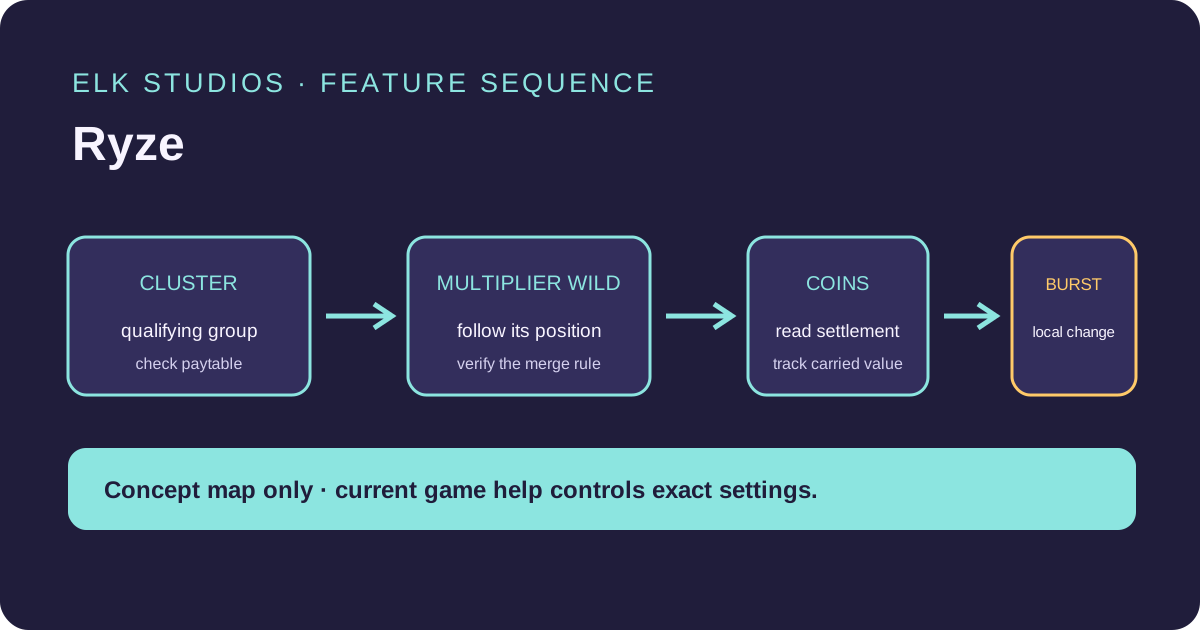
Ryze is an ELK Studios cluster slot built around three linked ideas: a winning cluster can leave a Multiplier Wild, coin clusters can carry an aggregated value into a new coin, and The Burst can change adjacent symbols. Its bonus states alter which features remain on the board. The supplier page documents those mechanisms, but no current New Zealand operator help was supplied to verify RTP variants, volatility, payout caps, limits, or local availability.
The short answer
Ryze is a cluster slot from ELK Studios in which wins can create Multiplier Wilds, coin clusters can transfer an aggregated value to a newly left coin, and The Burst can change itself and adjacent symbols. The official product page also describes a Bonus and Super Bonus with different sticky-symbol behaviour. Those are the useful mechanics to understand before looking for a numerical review.
This Ryze ELK Studios slot review separates the supplier’s public feature outline from an operator’s active version. The official Ryze product page was checked on 6 October 2026, but the assignment did not include a live operator help screen or paytable. For that reason, this guide does not state an RTP, alternative RTP setting, volatility label, maximum payout, stake range, bonus-entry price or exact trigger count. It also does not claim that a New Zealand casino currently offers the title. Those details must be read in the specific client a person is permitted to access.
Confirm that the title is Ryze, not Ryze 2
Start with the exact product name. ELK has a separate game called Ryze 2, and this site already has a distinct Ryze 2 guide. The titles share a name, but they are separate products. A page about one should not borrow feature rules, settings or a release status from the other. This guide is only about the original title named Ryze on ELK’s product page.
In a current client, compare the title shown on its loading screen with the name in the information panel. If the casino labels it differently, look for the provider name, game identifier and rules heading before relying on a search result. A logo, theme image or remembered title is not enough to prove the version. Save the displayed title and the date of the check in your notes. That simple record helps distinguish a current product from a cached demo or a page that has kept an older label.
The official catalogue establishes that ELK documents Ryze as its own product. It does not identify which operators distribute it, which account regions can launch it, or whether a casino uses a particular mathematical configuration. Treat catalogue confirmation, game identity and local access as separate findings. A supplier page answers “which product is this?”; the operator screen answers “which client can this account open?”
How to read the board and a cluster result
ELK describes Ryze as a cluster slot with a changing column arrangement. The public summary does not replace the active paytable’s definition of an eligible cluster, adjacency, symbol substitution or settlement. Read those base rules first. They tell you which symbols count as a win, whether a Wild participates, and at which point a cluster result is final.
It is useful to separate the board’s visual event from its accounting event. A group of symbols may disappear and leave vacant spaces; that visual change is not itself a new payout. The help should explain whether symbols drop into the spaces, whether another evaluation follows and which resulting clusters qualify. If the interface animates several changes quickly, use round history or the in-game rules to understand their order rather than inferring it from the animation alone.
When documenting a round, describe the sequence in neutral terms: starting board, qualifying cluster, removal or transformation, any feature created in an empty position, later evaluation and final settlement. Avoid calling a sequence a “win chain” unless each stage actually settles as a separate paid result. A feature can change the next board without paying immediately. The distinction matters when a game combines cluster wins, coins and multipliers.
A cluster can create a Multiplier Wild
ELK says that winning clusters of payout symbols create a Multiplier Wild in a vacant position produced after a win. It also says the multiplier value grows for each winning cluster that the Multiplier Wild joins. The important concept is a feature with board position and history: the Wild is created in an opening, can later participate in a cluster, and its value can then change under the supplier-described rule.
The exact client help must clarify how the game selects a vacant position, what value appears when the Wild is created, and how its increase is shown. It should also define which type of winning cluster qualifies, whether one Wild can be involved in multiple clusters during the same resolution, and when the value resets or disappears. Those details cannot be inferred from a screenshot of a later state.
For a reader, the practical question is not simply whether a multiplier can rise. It is which event increases it and which later win it modifies. Keep creation, participation and payout as separate steps. If a Multiplier Wild appears beside a winning group but does not touch it, do not assume it changes that result. If it participates, check whether the displayed multiplier belongs to one group or combines with other modifiers. Use the paytable’s order of operations rather than adding displayed values yourself.
Coin wins and the value left behind
The supplier describes Coin Win + Merge as a coin cluster that pays its aggregated value, after which that value is given to a new coin left behind when the cluster is removed. This is different from treating each coin as a standard symbol with an ordinary fixed payout. The feature has a settlement stage, then a retained value represented by a new board object.
The active help should define which coins can join the same cluster, how the aggregated amount is calculated, and how the new coin is positioned. It should explain whether a coin that remains can join a later group, whether it can receive another merged value and what ends or clears its state. No amount, coin frequency or expected return is published here because those depend on a verified paytable and configuration.
When reviewing a recorded round, note whether the total shown at settlement matches the coins in the qualifying group. Then check whether the new coin displays the transferred amount or a different label. This is an observation of one round, not evidence about how often the feature occurs or how much it returns over time. A short clip can demonstrate a mechanic, but it cannot establish a probability or average result.
Do not equate “value carried forward” with guaranteed future value. A retained coin may be removed, remain unused, or be subject to rules that only the current help can explain. The useful review question is: what state is carried to the next evaluation, and what exact event pays it? If the help does not answer that question, label it unknown rather than filling the gap from another ELK title.
Multiplier Merge is a distinct operation
ELK’s summary describes Multiplier Merge as increasing the individual multipliers after a win, then multiplying and merging them into a new Multiplier Wild. That wording signals an order of operations. It should not be simplified into “multipliers add together” or “the game multiplies every visible number” without the active rules’ formula.
Look for the point at which each individual value is increased, whether only multipliers that participated in the win are eligible, and what happens to their original positions after the merge. The resulting Wild may occupy a new location, while the old values may no longer remain separately available. The official short description is enough to identify a merge mechanic, but not enough to publish the exact calculation used by an operator’s version.
This distinction helps prevent a common reading error. A display might animate two values separately and then show a much larger number. That animation alone does not reveal whether the game added, multiplied, capped or transformed the values according to a hidden formula. The paytable or game help should state the formula. If it does not, explain the visible sequence and do not reverse-engineer a payout from one sample.
In a careful review, ask whether a merged Wild can later take part in another winning cluster, whether it grows again under the same condition, and whether a bonus state changes its behaviour. Separate each answer by source: supplier summary, in-game help, or an observed interface event. That makes the guide more reliable than a single adjective such as “stacking”.
The Burst changes a local area
The Burst is described as changing itself and all adjacent symbols to the same payout symbol or coins. The word “adjacent” is important because the effect is spatial. It suggests that the feature acts around its own position instead of selecting the entire board, but the public summary does not define every edge case or the full symbol-selection rule.
Check the rules panel for which symbols can be selected, whether the Burst can choose coins, what counts as adjacent at a corner or edge, and whether another Burst can be changed by the same event. Then look for the next evaluation point. A changed set of symbols could form a cluster, but the rules must explain whether the newly formed group is checked immediately, after a drop, or only at the next spin resolution.
The feature is best described as a transformation, not as a promise of a cluster. Changing several neighbours to one type can create a matching arrangement, but whether that arrangement pays depends on the grid, the eligible shape and the client’s evaluation order. If the Burst turns nearby pieces into coins, check whether coin settlement follows the ordinary coin-merge mechanic or a special rule.
This is also a good example of why screen captures can mislead. A still image may show the transformed board but omit the original layout, the trigger condition and the subsequent settlement. A useful article tells readers what the transformation changes and what remains unknown, without implying that every Burst produces a winning result.
Bonus and Super Bonus: track what sticks
The official page describes a Bonus reached when a bonus symbol reaches a key mould below the grid. It says the Bonus has free drops and that Multiplier Wilds are sticky there. The Super Bonus uses a separate key mould; ELK says both coins and Multiplier Wilds are sticky in that state. The active assignment prohibits using numerical game values without current game help, so this guide leaves the exact drop counts and trigger thresholds unpublished.
The key mould is a path or destination described by the supplier, not a generic scatter rule. The current help should show how a bonus symbol moves, which conditions let it reach the ordinary or Super mould, whether movement is deterministic or affected by another symbol, and what happens if both potential states are shown. Do not assume that “reaches” means a bonus symbol simply lands in a fixed cell on one spin.
Sticky symbols change what remains from one free drop to the next. In the ordinary Bonus, the supplier specifically names Multiplier Wilds; for the Super Bonus, it names coins as well as Multiplier Wilds. Verify when those symbols are retained, whether their displayed values can change, and what resets at the end of the sequence. “Sticky” does not mean permanent beyond that feature unless the help says so.
Keep feature entry and feature value separate. Triggering a Bonus starts a different rule state, but it does not guarantee a positive result or a particular payout. If a mode is accessible only through an optional purchase, its entry price and rules must be stated separately from the naturally triggered feature. No such current operator terms were supplied for this review.
X-iter and optional game modes
ELK lists X-iter modes for Ryze and describes them as ways to start in or move closer to selected feature states. A product-page summary is not a universal menu, and it does not establish whether a particular casino enables the modes, which market may use them or what each option costs. The precise operator menu is the only appropriate place to verify those terms.
If an X-iter menu appears in an authorised client, read each mode from top to bottom. Record its label, total charge, starting state and whether it changes the ordinary stake. Confirm if the mode guarantees a feature trigger, raises a chance, or merely changes the starting scenario. A guaranteed entry is not a guaranteed profit; the feature can still produce a result lower than its cost.
Do not group every mode under “bonus buy”. Different entries may have different consequences, including a chance modification, a starting board or a direct feature state. If a mode displays a separate RTP or other mathematical note, record it as a separate configuration. The base-game figure cannot be assumed to cover all optional states.
This guide does not recommend using X-iter or compare its cost with a likely return. Such a comparison would need verified active terms and probability data. A reader who cannot see the complete price and effect should stop before confirming the option. The most useful editorial treatment is a neutral explanation of what the current menu says, including restrictions and the date it was checked.
RTP variants, volatility and payout cap
No operator game-help document was supplied for Ryze. Consequently, this page cannot verify a current RTP, whether several return settings exist, a volatility label, a maximum payout, a stake range or any feature-entry cost. ELK’s public page identifies the game and its mechanics; a review site’s number belongs to the configuration and jurisdiction it inspected, not automatically to a New Zealand client.
RTP is a theoretical return measure attached to a defined configuration over a very large modelled volume. It does not forecast one session, and it does not promise that a particular stake will be returned. If an operator shows multiple RTP choices, record the selected setting for the client actually opened. A page that lists alternatives without naming the active one does not establish what a user would receive.
Volatility is a broad description of how outcomes may be distributed, not a timer or a forecast of when a feature should arrive. A high or low label cannot be used to predict an individual result. A maximum payout is a ceiling under stated rules, not a likely outcome. Verify the unit it uses, the applicable mode and any cap interaction in the current help before reporting a number.
The same evidence rule applies to stake minimums, maximums and optional-mode prices. These can differ by currency, operator, client and account setting. If the operator panel is inaccessible, list the field as unverified. Do not round a figure from a foreign-language review or treat a commonly repeated value as universal.
A practical way to inspect one complete round
If a permitted demo or active client is available, begin with the help, not with repeated spins. Capture the title, provider, rules date and configuration note. Then locate the base symbol table, the cluster definition, Wild rules, coins, The Burst, bonus triggers and any X-iter section. Record unanswered questions before watching a round so a visually striking event does not replace the actual rule text.
During one round, note the starting board and each relevant transition: which cluster qualifies, what clears, whether a Multiplier Wild is created, whether a coin group settles, whether a merge occurs, and whether The Burst transforms a local area. Do not use a single round to estimate event frequency, average return or odds. It can only help explain the sequence shown by that particular client.
When a bonus begins, record what remains from one drop to the next and distinguish the ordinary Bonus from the Super Bonus. Then check the history screen against the help. If the interface omits a rule or displays a value without explaining it, do not guess. Note the missing field and contact the operator through its documented support route if the detail matters to account access or settlement.
A disciplined inspection is finite. Decide in advance which rules you need to understand, how long you will inspect the interface and what information would make you stop. Demo access, where offered, may still require age checks or be unavailable in some places. Its presence does not imply that real-money play is suitable, legal or accessible to a particular person.
Mobile layout, sound and accessibility checks
ELK’s product page recommends a desktop display ratio, but this guide does not treat that as proof of mobile support in every casino client. If a mobile version is available through an authorised operator, check the game at the phone’s normal text size and orientation. Look for labels hidden beneath controls, clipped payout text, symbols that become difficult to distinguish and buttons too close together to use reliably.
The mechanics rely on board changes and feature states. A useful mobile interface should let a person pause or revisit the rules, distinguish a new Multiplier Wild from a retained one and read the amount attached to a coin. Check whether animations can be reduced or sound muted without hiding information. Do not assume a desktop manual describes the mobile layout exactly.
Accessibility is not only a matter of whether the game launches. A colour-coded symbol should also have a shape, label or other cue. Important changes should be understandable without relying solely on sound, flashing or fast movement. If the interface cannot be read at a comfortable size, or the help cannot be opened while a round is paused, that is a material limitation for the user.
No live client was tested for this article. The mobile and accessibility notes above are a checklist, not a claim that Ryze passed a device test. A report should identify the device, operating system, browser or app, game version and date if someone later performs such a test.
Questions readers often ask
Is Ryze the same game as Ryze 2?
No. ELK lists them as separate titles, and this site maintains a separate Ryze 2 reference. Use the exact title and help panel shown in the client. Mechanics or configuration details from the sequel should not be transferred to the original Ryze.
Which RTP setting does Ryze use in New Zealand?
That is not established here. No current New Zealand operator help screen was supplied. A number on a foreign casino or review page cannot confirm the setting of a different operator’s client.
Do coins and Multiplier Wilds stay in place in every feature?
The supplier distinguishes ordinary Bonus and Super Bonus behaviour. Its public outline says Multiplier Wilds are sticky in the Bonus and coins plus Multiplier Wilds in the Super Bonus. Confirm the exact retained state and reset condition in the active rules.
Does a Multiplier Wild guarantee a larger cluster payout?
No such guarantee follows from its name. The official summary describes how it is created and increased when it joins winning clusters. The live paytable determines the value and calculation order.
Can this guide confirm Ryze is available to a New Zealand player?
No. Supplier documentation confirms the product page, not a specific casino’s distribution or local account eligibility. Availability needs a current operator source and must be assessed separately from the game rules.
Sources and verification boundary
- ELK Studios: Ryze — supplier feature summary, checked 6 October 2026.
- ELK Studios games catalogue — product-name cross-check, checked 6 October 2026.
- Department of Internal Affairs: information for advertisers — New Zealand advertising guidance, checked 6 October 2026.
- Competitor review sample: Online-Slot.co.uk Ryze review, AboutSlots, SlotCatalog, FruitySlots, and BigWinBoard, checked 6 October 2026. These pages contain market-specific figures, experience-based opinions and promotional material; those figures are not used as current New Zealand settings.
No live operator help, paytable, client build, New Zealand eligibility statement or demo session was provided. This article is a source-limited rules guide, not a claim of local availability or operator configuration.
