ELK Studios game guide · South Island guide
Crescendo: rules, features and settings to check
 Best casinos available in New ZealandUpdated 7 November 2026

Crescendo uses a poker-hand framing inside a slot format. ELK’s public page describes a feature row that interacts with winning hands, respins and modifiers carried into a bonus. The exact hand rankings, trigger conditions, RTP and active operator settings still need the current game help.
The short answer
Crescendo is an ELK Studios game that borrows the language of poker hands while keeping the presentation and feature logic of a slot. Its public supplier page describes a feature inventory above the card area, winning hands that can lead to respins, a complete hand that changes the next multiplier state, and a bonus in which features and multipliers carry over. Those ideas are enough to explain how the game is organised, but they are not a full substitute for the rules and paytable inside the current operator build.
No active game-help panel was supplied for this assignment. This guide does not publish an RTP percentage or variants, a volatility label, stake limits, bonus trigger counts, starting spins, feature-buy prices or a payout cap. It also does not assert that Crescendo is available to New Zealand accounts. The key review question is how the loaded game defines each hand, when it holds or respins cards and how the feature row changes a result. Exact settings belong to the current help panel, not to an unrelated casino or review database.
Confirm which Crescendo is on screen
Check the exact client title and supplier credit, then compare them with ELK’s official Crescendo page and the studio catalogue. These official pages establish the supplier’s public description. They do not show every operator build, prove a particular market listing or tell you which optional mode is active in a specific account.
Record the casino name, date inspected, game mode and any displayed revision or build identifier. Open the paytable and help before starting a round. If the client separates ordinary play, a bonus and an optional X-iter menu, record each separately. A demo can share the art and title while not exposing the same settings as an operator’s game.
Do not confuse a poker-themed slot with a table-poker product. The game may use familiar hand names, but its card selection, symbol positions, payout table and respin rules are defined by its own help. A strategy from a card room or another video-poker variant does not apply automatically. The first task is to read how Crescendo constructs and evaluates a hand.
The design is minimal compared with a full card table, which can make feature states easier to see but can also hide the underlying slot logic. A card illustration is a symbol in a game interface; it is not a promise that ordinary poker rules govern every event. Use the paytable rather than assumptions about the theme.
Read the layout as a slot with a feature row
ELK’s public description identifies a card area and a feature row or inventory. Start by locating the positions that form a hand, the place where feature modifiers appear and the box where a result is shown. The feature row should be treated as a separate system: it can affect how a hand is evaluated or how an upcoming event proceeds, but it is not itself a hand-ranking rule.
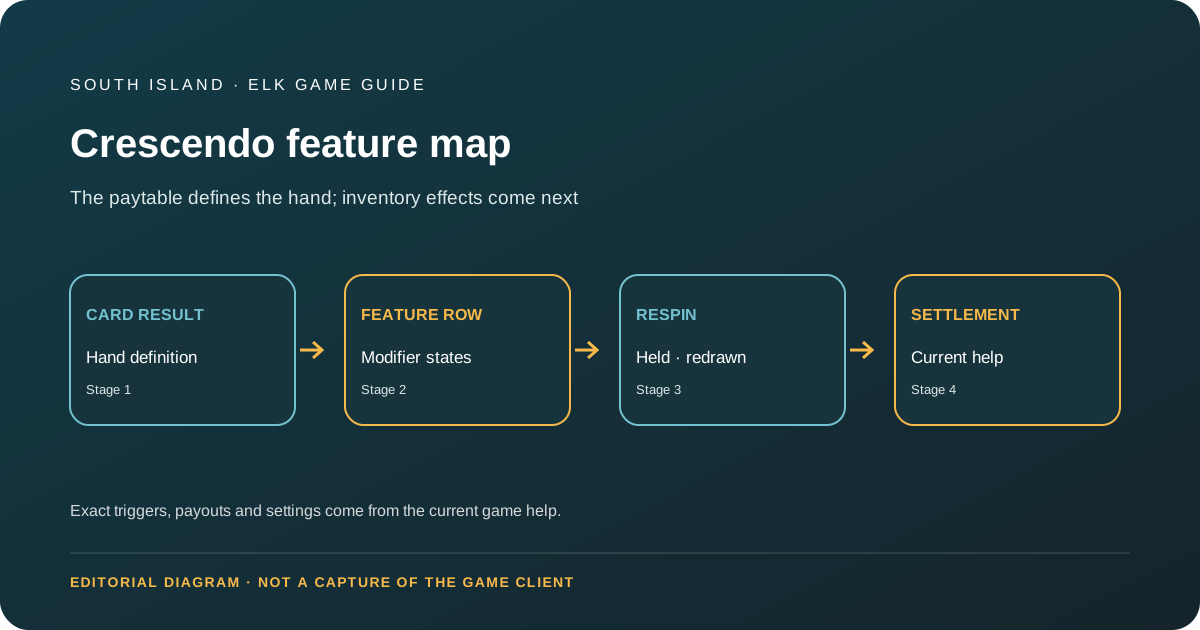
Read one round in four passes. First, note the card symbols shown and the game’s result label. Second, identify the active feature icons and their text. Third, see whether a win holds some cards or causes a respin. Fourth, compare the new state with the final result. That sequence makes it easier to distinguish “the hand improved”, “a feature modified the hand” and “the game credited a payout”.
The help panel should define when a feature enters the inventory, whether it is selected before or after the card result and whether an empty slot has any significance. It should also say what happens if more features are generated than the visible row can hold. The supplier summary names the feature inventory but does not answer every operator-specific condition.
If the interface presents a base amount and a multiplier separately, do not recompute a total unless the game explains the order. A multiplier may apply only to a specific feature or result. The settlement panel or history should show which values were credited. A review should preserve the game’s own labels and not turn every number on screen into an assumed payout.
Poker-hand labels need the game’s own paytable
Familiar terms such as pair, straight, flush or full house can help readers understand a card game, but they do not establish Crescendo’s exact ranking or payout table. The current help should show which patterns qualify, how ties or overlapping patterns are handled and whether the game selects one result or evaluates more than one. No active paytable was supplied, so this article avoids setting out a hand hierarchy as if it had been checked.
Look for the definition of a valid hand: which positions count, whether cards are selected from all visible positions or a defined set, and whether suits matter. Some games use familiar hand names while modifying construction or payout conditions. If the paytable lists categories in a particular order, use that order. Do not substitute a general poker chart or assume a casino table’s rules apply.
Then check how the game resolves competing patterns. Could the cards form more than one recognisable hand? If so, does the game choose the highest listed result, settle a single combination or use a special evaluation? Does a feature row change the hand’s strength or only the payout? These points affect the meaning of a result and need exact help text.
Readers should also find out whether a hand requires a particular arrangement or simply a pattern among displayed cards. The theme may show a row, but the visual row alone does not tell you if every position participates. If the help uses technical terms, a plain-language guide should define them without changing the rule.
Winning hands and respins
The supplier page says winning hands can lead to respins and describes a special full-hand event that causes a complete respin. The public summary also associates that event with a changed starting multiplier for later wins. These are supplier-level feature relationships. The current help must define which cards stay in place, which positions are redrawn, what counts as a qualifying hand and how the next evaluation occurs.
During a respin, track held and moving positions separately. A common reader mistake is to assume that every card is redrawn or that the winning cards always stay locked. The interface should show what is held; help should explain why. Note whether the respin is part of the original paid round and how the stake is represented in history. Do not call it “free” unless the rules state that no new wager is taken.
The complete-hand event deserves its own explanation because it can change the following multiplier state. Check the exact condition, whether every card position is redrawn, whether an earlier win remains credited and whether the boosted multiplier applies to the next result or another event. The supplier page gives the broad idea but not the full settlement sequence for an operator client.
Do not describe a respin as a chance to improve a hand in every case. It may create a new combination, leave the result unchanged or fail to meet a paytable condition. A feature’s possibility is not a guaranteed upgrade. Explain the transition, then let the actual rules and result determine what happened.
Feature inventory: effects are not interchangeable
ELK’s public summary indicates that the feature row can contain different modifiers and that its contents interact with winning hands. That means the inventory is not simply a score or progress bar. Each icon can have a different function: adding to a base result, modifying a multiplier or changing a later evaluation. The exact list and calculations have to be checked in the paytable.
When reading the current help, copy each feature’s exact name and description. Ask what event activates it, whether it applies before or after a hand is identified, whether it is consumed after use and whether it remains for later events. Two icons may look similar but have different scope. A general phrase such as “boosts your win” hides whether the modifier changes value, multiplier or eligibility.
Check how many feature spaces are shown and what happens when the inventory is full. The assignment restricts numeric game details to current help, so this article does not repeat a quantity or claim that every possible feature can appear together. The help should explain any replacement, overflow or selection rule. If it does not, the interaction remains unknown.
Do not make a strategy recommendation from the inventory. A modifier that increases a potential payout also may be rare, conditional or attached to a result that does not qualify. The interface can make the row feel like accumulating progress, but that impression is not a probability statement and does not mean an outcome is owed.
How to compare the card result and modifier result
The cleanest explanation separates three layers: the underlying hand, the feature effect and the final amount. First identify the hand using the game’s own category. Next identify which feature inventory items apply and their stated effect. Finally read the settled amount in the result panel or history. Mixing those layers makes it easy to mistake a modifier for a hand or a displayed possibility for credited value.
If a multiplier is involved, see whether the interface shows a base amount and a modified total. Find out if the multiplier is attached to a card position, the entire round, a bonus state or an inventory item. The term “global” or a large visual number should not be assigned unless the help uses that scope. A multiplier with no qualifying result may have no payable effect.
If an additive modifier is shown, do not assume it adds to every outcome. It may apply only to hand categories listed in the paytable. Likewise, a “multiply” icon may multiply a base win, an existing multiplier or another defined amount. The game’s exact definition matters. A reviewer should quote the function in plain language, not reconstruct a math model without documentation.
The history is useful for checking whether the displayed total matches the sequence. If it only shows the final credit, then the guide should not publish an invented breakdown. State what could be confirmed and what the interface did not expose. That is particularly important where several feature icons act in the same round.
Bonus state and retained features
ELK’s public page says a bonus game exists and that multipliers and features are carried into the bonus and between its free spins. It also says feature-row items remain sticky throughout that bonus. The current client still needs to define how the bonus begins, what state carries in, how a retrigger works and whether the same feature timing applies throughout.
Compare the base and bonus sections of the help. Look for any change to the card evaluation, the feature inventory, multiplier persistence, respin rules or round-end condition. A modifier can carry over while other state resets; “features carry over” does not necessarily mean the entire screen is unchanged. The exact language should be preserved.
Check whether a bonus ends after a fixed sequence or can extend, and what happens to unconsumed feature icons at the end. Do not supply an initial spin count or trigger threshold without current game help. Competitor pages and old launch previews may describe a different configuration or may have been written before a mode was finalised.
Persistence can create a strong sense of momentum, but it should be described as a rule, not as a promise of value. The total still depends on the card outcomes and how the active modifiers apply. If the current panel omits a lifecycle detail, keep it on the verification list rather than borrowing behaviour from another slot.
RTP and configuration settings
No current operator game-help panel was provided for Crescendo. This article does not state an RTP value or variant, volatility label, stake limits, hit frequency, bonus condition counts, X-iter cost or maximum payout. Those figures are configuration-dependent and competitor sites can present a single value without identifying the operator or mode. The exact game help is needed before publishing them as active settings.
RTP is a theoretical long-run return for a named configuration. It is not a forecast for one session or a guarantee that a particular number of rounds will return a certain amount. Volatility describes a broad distribution characteristic, not a bonus timer. A maximum return is a cap, not an expected result. Readers should see the definitions alongside any later verified numbers so a specification panel is not mistaken for a prediction.
When a client is available, record each value with its label, mode, currency or stake unit, source screen and check date. If several RTP options appear, identify which one the operator’s client says is active and which are only alternatives. If the same game title appears in a demo and a casino lobby, compare the help rather than assuming identical math.
Search-volume data and first-party user research were not supplied. The assigned search query is preserved, but this guide makes no claim about demand, ranking or popularity. A fact-check editor should update the fields only after inspecting a current source for the exact client.
Optional modes and feature purchases
Some ELK titles expose X-iter options; this does not prove which menu is present in a particular Crescendo client. If the game shows a mode or purchase panel, read its name, cost basis, starting state and any terms before choosing it. Record whether it changes the chance of reaching a bonus or starts a feature directly. Those are not interchangeable options.
A paid mode changes the amount at risk and may change the game state from a standard round. It is not a discount, investment or safe route to a return. Avoid “best buy” language unless a current, defensible comparison supports it. This guide does not recommend a feature purchase and does not list prices that were not verified in active help.
If no menu is visible, describe only what was actually inspected. A missing menu might mean the mode is not offered in that build, hidden by account or jurisdiction settings, or unavailable because no game was opened. Without a client, those explanations cannot be distinguished. No paid mode was selected or tested for this assignment.
It is useful to know a menu exists because it can affect the result context. But the article’s main intent is to explain Crescendo’s card and feature system. Optional-mode information belongs here only as a secondary rule question; it does not justify a separate bonus-buy page.
A step-by-step way to verify one round
When the exact game is legitimately accessible, record the client title, supplier, operator and date. Open the paytable and note the qualifying hand definitions. Then identify the feature inventory and look up each modifier. Do not start with a session result and work backwards; start with the rule definitions, then observe a sequence if one happens naturally.
For an event, write down the initial cards, any winning label, the active feature icons, the cards retained, the cards redrawn, the next evaluation and the final settlement. This is a data sheet, not a claim about what normally happens. Use the round history to confirm whether the same wager covers a respin and whether the total shown is cumulative.
Next verify the full-hand effect, if it appears in the help. Record exactly what changes in the multiplier and when it applies. Do not estimate its frequency from a short observation. If a feature never appears during a limited check, that does not prove it is unavailable; if it appears once, that does not prove the trigger is common.
Keep facts, observations and unknowns in separate columns. A fact comes from current help. An observation comes from a specific visible event. An unknown is a question not answered by either. Publish the first two with their source and context; keep the third clearly marked for follow-up. This method prevents an illustrative demo or one lucky event from becoming a general rule.
Demo use, if an authorised version exists
The official product page does not guarantee a demo for every country or operator. If an authorised demo is offered, check whether it provides the same help panel and mode menu as the operator’s version. The no-money environment may help a reader learn the card and feature vocabulary, but it may not establish the current real-money configuration.
Use a demo to test comprehension: can you find the paytable, identify the selected hand, see which cards are retained and read what the feature row does? Does the game history show a respin as part of a round? Can you see when a multiplier changes? Those questions are more useful than measuring a short sequence of results.
Do not use a demo run to calculate RTP, estimate volatility or predict the chance of a bonus. Those require long-run mathematical and configuration evidence, not a handful of spins. Do not describe a mode as safe because the demo uses credits. A paid feature panel may still demonstrate the cost basis, but it should not be selected just to produce a more dramatic screenshot.
No active Crescendo client or demo was supplied for this task, so no test session is claimed. The article’s SVG is an original editorial diagram of the card-to-feature sequence, not a game screenshot or a representation of a particular operator interface.
Mobile layout and accessible help
On a small screen, verify that the card positions can be distinguished and the feature inventory stays readable. If the row scrolls horizontally or collapses, the player should still be able to see which modifiers are active. A tiny icon without a text label makes it difficult to understand why a result changed. No mobile pass is claimed here because the exact game client was not available.
Check whether help text can be enlarged, scrolled and revisited without losing the round state. Keyboard users should be able to move through controls in a visible order; the focus indicator should not disappear against the game canvas. If a multiplier state is shown only by colour or a flash animation, look for a persistent label or accessible history entry.
Sound and music can support the theme, but they should not be the only indication that a respin or bonus has started. A clear visual status, text description and history make the transition easier to understand with audio muted. The paytable should remain available when the game is not spinning.
These are review criteria rather than measured results. A page can tell readers what to look for while accurately stating that the device and operator build were not tested. Do not imply that an interface passed mobile or accessibility testing because its supplier page is responsive.
Competitor coverage and the useful gap
The competitor sample includes feature reviews, demo pages and specification tables. Some pages emphasise the game’s departure from conventional reel mechanics; others provide a detailed list of poker hands and modifiers. These can be useful for discovering questions, but they may reflect a different operator, country or demo configuration. They do not establish which settings are active in a New Zealand account.
The gap addressed here is a clear separation between the poker vocabulary and the slot’s own rules. The guide explains what the feature row does conceptually, which card and respin questions need the game help and why a familiar hand name is not enough to establish a payout. It avoids subjective ratings, unverifiable session stories and commercial offer cards.
Where a competitor gives a number, treat it as a lead to verify. A published percentage without an operator build can be outdated or market-specific. A hand description without an exact version may omit a special priority rule. Do not average inconsistent values or copy the most recent date unless the underlying source is clear.
The supplier product page supports the public high-level feature descriptions. The operator’s help panel should control the active rules and numerical configuration. Keeping those sources in their proper roles lets the article be useful without claiming more evidence than it has.
New Zealand access and commercial publication
ELK’s catalogue does not confirm that a named casino currently offers Crescendo in New Zealand. Local availability must be checked against the operator’s current game lobby and terms, and a listing for another market cannot be treated as a guarantee for every account. No operator was specified, so this guide leaves availability unverified.
The New Zealand Department of Internal Affairs currently states that the online-casino advertising prohibition is in effect, advertising and marketing rules apply to third parties, and affiliate marketing is among initial prohibited advertising decisions. Accordingly, the requested CPA buttons are withheld and this page has no direct operator replacement link. The existing route /go/south/south-cashdesk-8a14.php was not opened, followed or changed.
This is a compliance publication hold, not a statement about the legality of every activity or the game’s availability. A later responsible review should rely on current official guidance before adding any commercial referrals. Until that point, the page remains an informational rules guide and should not be turned into an indirect offer placement.
How to decide whether the game’s rules are clear
Before forming an opinion, confirm that you know how Crescendo constructs a hand, which patterns qualify and what a winning result triggers. Make sure the help explains how cards are retained or redrawn, how the feature row acts and how the multiplier is applied. If the rules use a poker term, verify whether the game’s paytable assigns it a familiar or modified meaning.
Then look at the configuration fields. Confirm active RTP or alternatives, volatility, stake limits, bonus entry and optional-mode cost. Record each number with the mode and date. If the help is missing or does not identify the active settings, treat them as unknown. A product review from another market is not a reason to proceed on assumptions.
Consider time and spending limits separately from the hand-building animation. A feature inventory can feel like strategy or saved progress, but it does not ensure that the next hand will qualify. If gambling is lawful and you choose to participate, decide limits before starting and do not increase them to recover money or wait for a specific feature. The site’s New Zealand safer-gambling page lists independent support.
Frequently asked questions
Is Crescendo poker or a slot?
It is an ELK Studios slot using poker-hand language and a feature inventory. The current paytable defines how hands are formed and paid; ordinary poker or video-poker rules should not be assumed.
What happens after a winning hand?
ELK’s public summary describes respins and a special complete-hand event. The exact hold, redraw and payout rules need the current game help for the client being reviewed.
Do features carry into the bonus?
The supplier says features and multipliers carry into the bonus and that feature-row items remain sticky during it. The active help should define the precise bonus conditions and state transitions.
What is Crescendo’s RTP?
No current operator settings were supplied, so this page does not give a percentage. Check the in-game information panel and note which mode and configuration it describes.
Can a demo verify the game’s odds?
A demo can help explain controls and feature order, but a short run cannot establish probabilities or long-run RTP. No Crescendo demo was available for this assignment.
Sources and verification boundary
- ELK Studios: Crescendo — official public feature summary, checked 6 October 2026.
- ELK Studios: games catalogue — catalogue identity, checked 6 October 2026.
- Competitor sample and retrieval notes:
research/batch13/SOURCE-REVIEW.md, checked 6 October 2026. - New Zealand DIA guidance for advertisers, checked 6 October 2026.
No current operator help panel, named New Zealand client or demo was available. Hand payout details, numeric configuration, exact trigger conditions, bonus settings and local availability are unverified. CPA buttons are withheld pending compliance review; the existing affiliate route was not opened or modified.
