ELK Studios game rules · South Island guide
Micro Knights review: queue, cluster wins and six flag features
 Best casinos available in New ZealandUpdated 7 November 2026

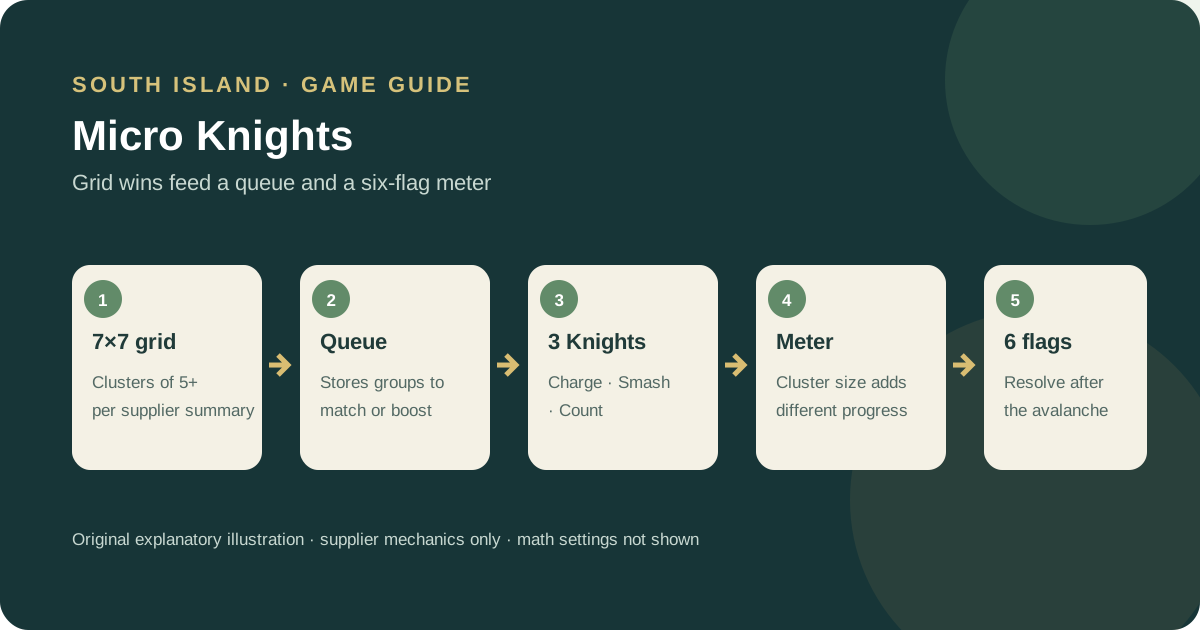
Micro Knights is an ELK Friends Series slot with a 7×7 grid where clusters of five or more matching symbols win. Its symbol queue can add to or enlarge clusters, while Sir Charge moves eligible symbols into the queue, Sir Smash enlarges queued groups and Sir Count measures cluster wins toward six Feature Flags. The official data sheet was inaccessible, so current RTP, volatility and maximum-win settings remain unverified.
The short answer
Micro Knights is a grid slot rather than a fixed-payline reel game. ELK describes a 7×7 symbol grid in which clusters of five or more matching symbols create wins. A queue stores groups of symbols that can be matched with the board or used to boost an existing cluster. Three characters affect how this process develops: Sir Charge moves eligible symbols from the grid into the queue, Sir Smash increases the size of queued groups, and Sir Count tracks cluster wins toward one of six Feature Flags.
The six named flag outcomes are Inferno, Extra Wilds, Super Size, Charge, Epic Charge and Boosted Queue. Each becomes active after the avalanche flow has ended, and the supplier says the feature can start another avalanche and possibly produce additional wins. Some flags create a stated guaranteed win; that is a rule about a feature outcome, not a guarantee that the overall paid round returns more than its cost.
ELK’s public product page supports these mechanics. Its linked Game Data Sheet returned HTTP 403 on 7 October 2026. Therefore this review does not state an active RTP variant, volatility score, bet range or maximum-win multiple. Secondary pages list differing figures, none of which proves the configuration of a particular New Zealand casino.
Read the grid as clusters, not paylines
The official page identifies a seven-by-seven grid and a cluster threshold of five matching symbols. It does not describe the game as a set of traditional paylines. A reader should therefore resist importing a left-to-right line rule from another slot. The exact help screen should explain how symbols need to touch, whether adjacency is orthogonal or includes diagonals, and how a cluster is counted.
The supplier summary says clusters of five or more generate a win, but the readable page does not provide a full symbol paytable or every adjacency example. Do not infer that two groups touching only at a corner count as one cluster. If a diagram in the in-game help answers that, use the diagram’s rule. If not, record the adjacency question as unresolved.
Cluster size matters to the Feature Flag meter: ELK says all cluster wins count, and larger clusters add more to the meter. That does not mean the number of symbols is a payout multiple by itself. A paytable or settlement display still determines the amount of a cluster win. Meter progress and monetary settlement are two separate outputs of the same event.
The symbol queue is a second part of the board
Micro Knights’ queue is not just a visual side panel. ELK says it stores a reserve of symbols ready to match with symbols on the grid and form new winning clusters. The supplier also says queue symbols can boost existing clusters. That gives the game a two-part state: symbols currently on the grid and groups stored for a later interaction.
For a useful mental model, track what entered the queue, what group size it had, which symbols can be brought back or used in combination, and whether they completed a cluster or expanded one already present. The public summary does not specify queue capacity, exact order, whether groups can be bypassed, or how a queue boost changes the payout. Those are not details to guess from animation.
The queue can make the same grid look different from a conventional cascade. A symbol group may be removed from the visible board but remain relevant as a reserve. If a reader only watches the 7×7 field, it can appear that symbols vanished. The feature logic depends on checking the queue as well as the main board.
An empty or small queue is not evidence that a cluster is due. The game may refill the grid and resolve the current avalanche according to its rules, but a future match remains a random outcome. Queue mechanics define how symbols interact; they do not allow a player to choose the next group.
Sir Charge: movement at the end of an avalanche
ELK describes the Charging Knight as remaining on the left side of the game view. At the end of an avalanche flow, he may randomly charge the grid and push the symbols he reaches down into the queue. The supplier says Bonus symbols and Wilds are too heavy to be pushed and remain on the grid.
That exception is important. Charge does not sweep every visible position indiscriminately according to the public description. A reader should distinguish eligible ordinary symbols from the named heavier symbols. If a cluster continues after a charge, inspect which symbols were retained and which moved to the reserve rather than assuming the board was cleared.
The supplier summary calls the movement random and does not provide a fixed frequency, direction, number of rows moved, or queue placement order. It also does not state whether a symbol pushed into the queue is immediately available to form a cluster or waits for a later stage. The exact operator help should answer timing. This page does not describe the charge as a player-controlled action.
Charge and the Charge Feature Flag are related by name but are not identical. Sir Charge is a character who can move symbols at an avalanche boundary. The Feature Flag named Charge pushes two to five rows of symbols into the queue and then starts another avalanche. Keep the two descriptions separate so a reader does not mistake a random character action for the flag outcome.
Sir Smash: queue groups grow
The Smashing Knight is shown near the upper-left corner in ELK’s description. He randomly strikes the queue and increases every symbol group there by one. The source does not state how many strikes can happen in a round or whether several hits can accumulate before a group is used.
The practical effect is on the reserve rather than a direct grid payout. A larger group may have more symbols available when it is later matched or when it boosts an existing cluster. The phrase “increase by one” describes a group-size change; it does not mean the group automatically becomes a winning cluster or that a payout is multiplied by one.
To follow the feature, write down the queue before and after the Smash event and note which groups changed. If the display is animated, wait for the settled state or check game history. Do not count an effect twice if the game shows a temporary visual flourish and then a final queue size.
The supplier does not explain whether Bonus symbols and Wilds in the queue are treated differently by the Smash Knight. ELK says those symbols are too heavy for Sir Charge to push, but it does not apply that exact exception to Smash in the public text. Treat each named rule as feature-specific and ask the operator if a game-help page is silent.
Sir Count and the six-feature meter
Sir Count tracks the size of winning clusters and awards a Feature Flag when the meter is full. ELK says every cluster win contributes, regardless of size, while a larger cluster adds more to the meter. The public summary does not state the meter threshold, the weighting for each cluster size, or whether one cluster can award more than one flag.
This creates two records to monitor after an avalanche: the amount paid for winning clusters and the progress toward a feature. A small cluster can count toward the meter even if its financial settlement is modest. A large cluster can move the meter more, but the current source does not provide a conversion table from cluster size to meter points.
When the meter fills, the awarded flag comes into play only after the avalanche flow has ended. This timing means the feature is not necessarily resolved at the same instant as the cluster that filled the meter. A player trying to understand the history should identify the last cluster, the end of the avalanche, the flag that was awarded and the following board state.
Do not treat the words “life-saving features” in promotional copy as a guarantee of financial recovery. The rules describe modifiers, and some may produce a guaranteed cluster or avalanche event, but the outcome of the full sequence can still be zero or less than the original stake.
What each Feature Flag does
ELK lists six flags with distinct effects:
- Inferno removes all low-value symbols from the grid, then begins another avalanche with potential additional wins.
- Extra Wilds places three to fifteen Wilds randomly on the grid; they may create clusters and another avalanche.
- Super Size adds a 2×2, 3×3 or 4×4 symbol that the supplier says creates a guaranteed cluster win.
- Charge moves two to five rows into the queue and starts another avalanche.
- Epic Charge empties the whole grid into the queue, then adds new symbols and guarantees another avalanche.
- Boosted Queue ignores the order of the queue so its groups can be used simultaneously; after resulting clusters, another avalanche begins.
The feature names should not be collapsed into a single “bonus round”. Inferno changes which symbols remain; Extra Wilds changes the Wild population; Super Size changes a symbol’s dimensions; Charge transfers rows; Epic Charge resets the board into the reserve and refills; Boosted Queue changes how the stored groups are used.
The supplier page says some flags bring a guaranteed win, and specifically describes a guaranteed cluster for Super Size. It does not say that every flag guarantees a positive payout or that each flag produces the same expected return. A guaranteed cluster is not identical to a guaranteed profit. The wager, cluster paytable and any subsequent state still matter.
The order of events is part of the rule
The safe sequence is to let the normal avalanche finish, update the meter, resolve a flag if one was awarded, and then watch the new avalanche that the flag may initiate. The exact game help should specify what happens if one flag creates another large cluster that fills the meter again. ELK’s public page says the flags enter when the avalanche ends and are likely to start a new avalanche, but does not explain every chained-award condition.
This timing matters in a game with a queue. A flag can change the grid or queue before the next cascade, and the next cluster can use that altered state. A result report should distinguish the original cluster, symbols moved or removed, the flag action, the refill and any new cluster. Saying only “the flag made a win” can lose the chain of events.
If the game history shows a single total for the paid spin, remember that the total can combine several feature events. It may not reveal the contribution of each individual cluster. The paytable and event log, when available, are better sources for reconciling a disputed result.
Paytable, Wilds and symbol values
The readable ELK page describes Wilds and the Feature Flag system but does not publish the full symbol table. It does not state which symbols are eligible for the queue, the exact pay values, the minimum cluster count beyond five, or whether special symbols pay as part of a cluster. Those details should be taken from the current game help.
Open the table while the exact game is loaded. Record each ordinary symbol, the cluster-size rows and the payout basis. Check whether a Wild substitutes, whether it has a separate cluster rule, and whether a symbol in the queue is counted in the same way as a symbol already visible on the grid. Do not assume that a Wild automatically substitutes for Feature Flags or other special symbols.
If the paytable expresses an award per stake, retain the unit. If it uses coins, identify the coin value and selected stake. A display that reads “x bet” cannot be compared directly with a currency amount unless the base bet and currency are known.
RTP, volatility and the maximum payout
RTP is a long-run theoretical property of a specific mathematical version. It is not a promise for one night, one bonus or a certain number of clusters. Volatility describes the distribution of outcomes and is not the same as the RTP. A maximum-win cap is a ceiling, not a likely result.
ELK’s linked Game Data Sheet returned HTTP 403 on 7 October 2026. Its readable product page does not provide an RTP variant, volatility number, stake range or maximum-win multiple. Some competitor pages list numerical values, and sampled values do not all match. None establishes the configuration currently attached to a New Zealand operator.
To verify an actual configuration, note the RTP shown inside the game, whether it is tied to a base or special mode, the exact currency and stake range, and the cap language. If the cap is expressed in coins, do not convert it to a multiplier without an official coin value and a clear settlement basis. If a volatility label is missing, do not reverse-engineer it from a few demo spins.
How to use a demo or a review page
A permitted demo can help a reader see how the queue is displayed, how a knight animation changes the board and when a flag comes into play. It does not certify that the same setup is used by an operator, and it does not produce a statistically reliable RTP estimate. No demo was opened for this review.
ELK recommends 1600×900 on desktop and 16:9 if the display must be scaled. A 7×7 board plus side queue and characters can become compact on a small screen. Before relying on an animation, check whether the board can be zoomed and whether the queue’s group sizes remain legible.
Third-party reviews can surface questions, but they can contain stale settings or descriptions of a different build. In this sample, some competitors discuss queue mechanics accurately at a high level, while setting values vary and are unsupported by the inaccessible supplier data sheet. Use a competitor page as a lead, then look for primary game help.
A concise worksheet for a real version
Before playing, capture these fields from the actual game:
- Exact title and provider.
- Seven-by-seven board and the help’s definition of adjacent clusters.
- Minimum cluster size and each symbol’s paytable.
- What enters the queue, its ordering rule and any limit.
- Sir Charge’s timing and the Wild/Bonus exclusions.
- Sir Smash’s group-size change and any exception.
- Sir Count’s meter threshold and feature-award sequence.
- All six flags and the exact wording for guaranteed outcomes.
- RTP configuration, currency, stake range and maximum-win basis.
Only fill a field when help or an operator source states the answer. If the help does not answer it, make the blank visible and ask a focused support question. A carefully dated unknown is better than a precise number copied from a different casino.
What this means for the reader
Micro Knights asks a reader to track the cluster grid and a separate reserve. The characters then move, enlarge or count elements of that system. Its most useful distinguishing feature is the interaction between cluster size, queue contents and the six flags. A short review that lists only “7×7, free spins, high volatility” would miss the central rules and may import a setting from another build.
Someone who wants a simple payline explanation may prefer a game with fewer state changes. Someone interested in following a board and queue may find this title easier to inspect with a diagram and a current help screen. Neither description predicts whether a player will enjoy a particular session or receive a positive result.
The queue’s apparent potential should not become a reason to keep staking. A larger queued group can be useful to understand the mechanic, but it is not a promise that the symbols will match the board. Make a fixed limit before opening the game and leave the session when the limit is reached.
New Zealand access and safer play
ELK’s global product page does not identify a New Zealand operator or confirm that the title is locally available. The Department of Internal Affairs says providers that served New Zealand before 1 May 2026 may operate during transition until 1 December 2026, but must not advertise to people in New Zealand. It also says third parties publishing or arranging online-casino advertising are covered by rules, with initial decisions prohibiting affiliate marketing.
This guide therefore contains no operator offer or CPA route. Readers should check current DIA information and the operator’s own terms rather than relying on a global supplier catalogue. A product listing is not an endorsement, eligibility check or licence record.
Set limits for time and spending before any gambling and do not increase a stake to chase a Feature Flag. The site’s New Zealand safer-gambling information points readers to support resources. If play is affecting wellbeing or finances, stop and seek independent help.
Questions readers ask
What counts as a Micro Knights win?
ELK says clusters of five or more matching symbols on the 7×7 grid generate wins. The readable summary does not fully define adjacency, so use the current in-game help for whether diagonal contact counts.
What does the symbol queue do?
It stores groups that can be matched with the grid to form clusters or used to boost an existing cluster. The exact queue order, capacity and timing should be checked in the active help.
Are Wilds moved into the queue by Sir Charge?
ELK says Bonus symbols and Wilds are too heavy for Sir Charge to push and remain on the grid. The rule is specific to his movement. The product summary does not state every interaction with the queue.
How do the six flags differ?
They alter different parts of the system: low-symbol removal, random Wild placement, an oversized guaranteed cluster, row transfer to the queue, a full-grid queue charge, and simultaneous queue use. The exact feature text is available from the game’s own help.
What is Micro Knights’ RTP?
The official Game Data Sheet link returned HTTP 403 during this review. The readable product page does not confirm the active RTP. A third-party number cannot establish a casino’s current version or New Zealand eligibility.
Does a guaranteed cluster guarantee a profit?
No. ELK’s description says Super Size creates a guaranteed cluster. It does not promise that the complete paid round will return more than its stake. Read the settlement and paytable.
Sources and verification boundary
- ELK Studios, Micro Knights product page, checked 7 October 2026. Supplier-published grid, queue, knight and Feature Flag descriptions.
- ELK Studios, games catalogue, checked 7 October 2026.
- ELK Studios Game Data Sheet link from the product page: HTTP 403 on 7 October 2026; current mathematical settings not verified.
- Competitor pages opened 7 October 2026: Online-Slot UK, Strafe, SlotTracker, SlotDataHub. Two page fetches failed; reported figures are not adopted.
- New Zealand Department of Internal Affairs, advertiser guidance and customer guidance, checked 7 October 2026.
