ELK Studios game rules · South Island guide
Pirots X ELK Studios slot review: rules and settings
 Best casinos available in New ZealandUpdated 7 November 2026

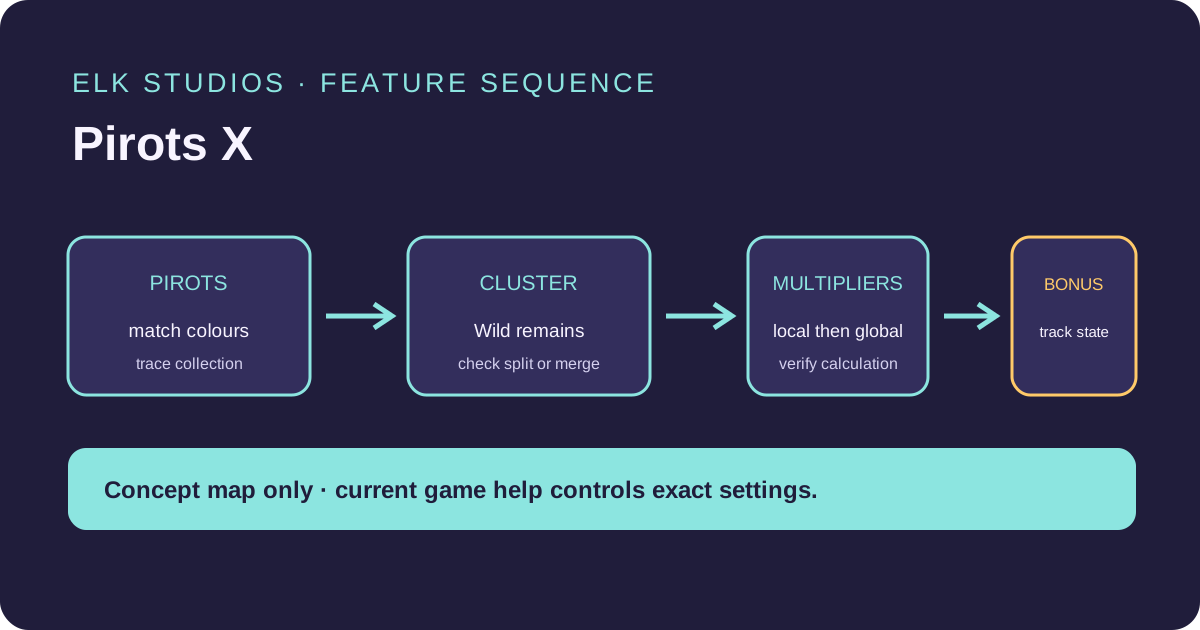
Pirots X is an ELK Studios cluster slot where colour-linked Pirots collect matching symbols, clusters can leave Wilds, and local multiplier Wilds are applied before a global multiplier. The supplier also describes ordinary and Super Bonus states. No current New Zealand operator help was supplied, so RTP settings, volatility, payout cap, limits, paid-mode terms and local access remain unverified.
The short answer
This Pirots X ELK Studios slot review focuses on a cluster game built around a relationship between the Pirots, symbols of matching colours, Wild features and a global multiplier. ELK says the Pirots land in nests, collect symbols of their respective colour, increase the global multiplier and can trigger features. A winning cluster leaves a Wild behind. The supplier also describes a bonus and a Super Bonus with persistent state.
The central review question is the order in which those events resolve. A colour-matched collection may change the global multiplier; a local multiplier Wild can affect a cluster; the global multiplier is applied afterward. The official Pirots X page gives that broad order, but no live operator help or paytable was supplied. This guide therefore does not publish any RTP, volatility, payout cap, stake range, bonus threshold, feature-entry cost or configuration variant. It does not say that Pirots X is available through a New Zealand casino.
Keep Pirots X distinct from other Pirots titles
The title in scope is exactly Pirots X. It is not Pirots 4, Pirots 5 or another game in the wider series. Shared characters and themes do not prove shared rules. This site has separate references for Pirots 4 and Pirots 5; neither is a substitute for the X title’s own information panel.
When opening a current client, verify the complete product name, supplier label and rules heading. If the logo says Pirots but the help panel identifies a sequel or an edition, use the help for that exact product. Keep a note of the date, operator and locale. A review image can be cropped so the title suffix is not visible, and search snippets can combine text from nearby series pages.
ELK’s product page confirms that Pirots X has its own supplier description and is listed in its catalogue. The page’s “Live now” label is a supplier-site product status at the time checked; it is not proof that a specific New Zealand operator distributes the game or accepts accounts in a particular location. Those questions need current operator evidence.
Start with the cluster rule
ELK describes Pirots X as a cluster game in which winning clusters contain adjacent identical symbols. The active help must explain the exact adjacency rule, eligible symbols, Wild treatment and payout. The supplier summary establishes the general structure but does not replace the version-specific paytable or define every edge case in the cluster evaluation.
Follow one result from the initial board through the outcome. Identify the matching symbols, determine which positions are considered connected under the paytable, and record any Wild that participates. ELK says each cluster win leaves a Wild behind. That describes a board change after a win; it does not mean the Wild is itself a paid result or that it must create another cluster.
If the game evaluates more than one cluster in a resolution, check whether a Wild can take part in several groups and how the client handles overlaps. Do not decide that two groups are separate just because the animation highlights them in turn. The rules should define the qualifying shapes and the settlement order. Round history is useful for interpreting the display, but one history entry cannot establish event frequency or expected return.
The word “adjacent” should be read literally through the help’s examples. Some games treat diagonal contact differently from horizontal or vertical contact; the supplier’s brief does not settle that question. If the operator’s help is unclear, describe the ambiguity and avoid importing a rule from a different cluster title.
Pirots collect matching colours
The product page describes Pirots landing in nests on the grid and collecting symbols of their respective colour. It says that collection increases the global multiplier and that the Pirots can also trigger features at random. This connects the visible collectors to a shared game-wide state, while keeping the colour match and feature trigger as two related but distinct events.
The operator help should identify each collector and its colour, what counts as a matching symbol, how collection is shown and how the global multiplier changes. It should also explain whether the collector must connect to a symbol through a line, occupy a particular nest or meet another condition. Do not infer the collection path solely from a character animation.
Record the global multiplier as a game state rather than treating it as a payout amount. It is applied to qualifying results under the rules; a higher displayed state does not mean that a win has occurred. Check whether the value resets on a new base round, carries between drops, remains during a bonus or changes after a feature. The supplier summary explicitly mentions bonus persistence, but only the active rules can define its exact start and end.
Because the feature is colour-linked, a reader should be able to distinguish each collector without relying on colour alone. If a client uses similar shades, inspect whether icons, labels or shapes also identify the Pirot. That matters for reading the game correctly on a small display or for anyone with colour-vision differences.
Wilds and multiplier order
ELK describes Wilds, multiplier Wilds and two Wild features. It says a Wild connected to several winning clusters splits, and multiple Wilds in a winning cluster merge into a multiplier Wild. Those descriptions suggest that the game can change the role and number of Wilds according to their relationships with clusters.
The order of multiplication is especially important. The supplier says that connected multiplier Wilds first multiply the cluster win, after which the global multiplier is applied. This is a source-level description of sequence, not a complete formula for every operator build. Read the active help for which Wild values count, how a split is allocated, what “merge” means for the displayed state and whether the global multiplier applies to all feature outcomes.
Do not add local and global multipliers together unless the rules explicitly say to. A sequence that applies one multiplier to a cluster and then another to the resulting amount is not the same as a sum of the two labels. Likewise, an animation that merges Wilds should not be reverse-engineered into a new value based on a single example. The paytable’s calculation controls.
When documenting a round, preserve the intermediate steps: cluster identified, connected multiplier Wilds, any split or merge, local result, global application and final settlement. If a particular step cannot be read in the history, mark it as not exposed. This makes the explanation clear without pretending to know hidden random outcomes.
Feature triggers and random events
The supplier says the Pirots may trigger features randomly, but its public summary does not list every feature, selection condition, frequency or interaction. Treat that statement as a prompt to consult the game help, not as a complete feature table. A reader should know the name of each effect and the event that activates it before describing a round.
Check whether a feature is triggered by a collector, a symbol, a specific grid state or a bonus entry. Note whether the effect resolves immediately or modifies the next evaluation. If the same feature name appears in a regular round and a bonus round, check whether the result differs between states. Do not assume the bonus version simply repeats the base-game feature.
Random activation cannot be demonstrated by observing one occurrence. A replay can show that an event happened; it does not establish how likely it is. Avoid review language such as “often”, “regularly” or “frequent” unless an authoritative source publishes a measurable basis and the configuration is known. Even a large set of informal sample rounds is not a substitute for the game’s probability model.
The feature list should also distinguish visual animation from rule effect. A Pirot moving across the board can be part of a collection animation, while a changed multiplier or new symbol is a game state. Explain the effect that the help says takes place, and do not turn a decorative motion into a new rule.
Bonus and Super Bonus states
ELK says the bonus begins when the stated bonus condition is met and the global multiplier persists during free drops. The supplier also says further free drops can be awarded by the free-drops symbol. The Super Bonus is a separate state: the product description says it uses the maximum grid size and awards a feature chest at the start of each free drop. This guide does not repeat trigger counts or total drops because no active client help was provided.
Read the exact trigger rule from the game’s information panel. Confirm whether all qualifying symbols must appear together, whether the Super Bonus requires a special symbol, and what happens if its condition is not met. The help should specify the number of free drops and how additional drops are awarded. Those are version-specific numerical facts and need the live rules, not a secondary review.
Persistence is a separate question from entry. The product page names the global multiplier as persistent in the bonus; verify whether that persistence means from one free drop to another, whether it begins at entry or is accumulated during the bonus, and when it resets. For the Super Bonus, confirm exactly when the feature chest appears and what it can release. A “maximum grid” label does not establish payout or likely outcome.
Treat free drops as feature rounds with their own rules, not as free money. A feature can add opportunities for evaluation, but the result may still be low or zero relative to the amount staked to reach it. A triggered state does not imply that another feature will occur or that the global multiplier guarantees a return.
Feature chest and the changing grid
The Super Bonus description includes a feature chest at the start of each free drop. The supplier’s overview does not state the chest’s full selection pool or whether the chest always releases the same kind of effect. The current game help should name its possible contents, the timing of each release and how a chosen feature interacts with the board.
For each chest outcome, record three things: what changes, when the change is applied and whether it remains after the current drop. If the effect alters the grid, identify which cells become active and whether pre-existing symbols remain in place. If it changes a multiplier, note whether that change applies before or after local Wild multipliers. These are distinct rule questions, even when a single animation shows them together.
If the chest outcome is random, do not imply that a particular item is more likely because it appeared in a sample. A sample round is a demonstration, not a distribution. If the operator client publishes odds, record the exact source and configuration; otherwise state that the feature distribution is not disclosed in the material reviewed.
This careful separation is valuable because feature names can sound like rewards. A chest may start a modifier, but that modifier is not necessarily a payout. Keep the review focused on the mechanic’s input and effect, and only describe a cash result when the paytable explains how it is settled.
X-iter and paid starting states
ELK lists X-iter modes for Pirots X. The supplier overview describes a range that includes a mode intended to increase a bonus chance and an entry into a Super Bonus, but it does not establish which options are active at a particular casino, the market restrictions or the exact price in an operator’s currency. Those terms must be checked in the client menu.
If an authorised client exposes X-iter, compare each option with the ordinary game. Record whether it changes the stake, begins in a feature, modifies the chance of a trigger or changes the grid. Look for a separate rules sheet and return information for each mode. Do not treat an entry mode as equivalent to naturally reaching the same state; its cost and configuration can differ.
A paid feature may guarantee a starting state while leaving the eventual result uncertain. “Guaranteed bonus” or “feature chest” describes entry or setup, not an outcome. Before any choice, a person should be able to see the total cost and understand how it relates to the ordinary stake. If not, do not proceed.
This article makes no recommendation to use an optional paid mode. Without a current operator menu and verified probabilities, a value comparison would be guesswork. A useful review can still explain how the mode is structured and identify the missing fields without presenting purchase language or pressure.
RTP, volatility and payout limits
No current Pirots X operator help was supplied. This guide therefore does not state an RTP, alternate return variant, volatility label, hit frequency, maximum payout, feature price or stake limit. A supplier catalogue description and an older market-specific PDF cannot confirm the settings of a New Zealand operator’s current game.
RTP belongs to a defined ruleset. If an operator lists options, the review should identify the configuration actually served to the account rather than copying an unspecific title-page number. It should also separate base-game return from any mode or bonus configuration when the help does so. One percentage cannot answer which build a casino is presenting.
Volatility describes a broad model of outcome distribution. It does not say when a bonus should arrive, predict a result or make a long session safe. A cap is a maximum under its stated calculation, not a typical prize. To report either one, verify the help’s units, mode coverage and any stake basis. This article leaves these fields open because the controlling client is missing.
Limits can also vary with account currency or operator policy. A stake range on a casino page may refer to another region, while a demo could have a different interface from a real-money client. Do not infer a New Zealand limit from a foreign casino’s display or a competitor’s summary.
A round-by-round review method
Begin with the exact title and help version. Save the operator name, display language, currency, rules date and configuration label. Then find the definitions for clusters, matching colours, collector behaviour, Wilds, multipliers, the bonus, the Super Bonus and X-iter. This creates a source map before any visual inspection begins.
During an authorised round, follow a single symbol path. Note which Pirot is active, whether it collects a matching colour, what happens to the global multiplier, and whether a feature activates. When a cluster resolves, trace any Wild left behind, any split or merge, the local multiplier step and the global application. Record only the result visible to the client; do not calculate hidden odds from it.
If the round enters a bonus, start a separate record. Identify the trigger condition, initial state, retained multiplier, free-drop changes, feature chest and the reset point. Compare the observed sequence with the help. Any mismatch should be reported to the operator, not explained away by a competitor’s page.
Finally, state the limits of the review. A demonstration can explain controls and sequence. It cannot verify long-run return, confirm local access or predict a session. A research article should say whether a live client was available, whether it was a demo, and what was not checked.
Desktop, mobile and readable controls
ELK provides a recommended desktop presentation ratio on its product page, but that recommendation is not a test of every browser or casino wrapper. A mobile review should inspect the game at the device’s normal zoom, both in portrait and landscape if the client permits rotation. Confirm that the collector, nests, symbol names and multiplier readouts remain visible.
Because the game links colour, character and symbol, look for more than one cue. A shape or label can help a reader distinguish a colour-matched collector where shades are close together. Check that the help is accessible without losing the current state and that a history panel explains the order of feature events. If small text forces zooming or controls obscure a payout explanation, record that as a usability issue.
Audio and motion are part of the presentation, but should not be the sole source of rules information. A reader should be able to understand when a feature begins from visible state and text. Check for mute controls and whether an animation can be shortened without skipping a decision or hiding an important amount.
No device test was supplied for Pirots X, so these points are a checklist, not a claim that mobile support was verified. Record the device, operating system, browser or application version and game client if a later test is performed.
Demo availability and what a sample can show
The existence of a supplier product page does not prove that a free demo is available to every visitor. A demo may be embedded by one review site, restricted by age verification or absent from the casino that distributes the game. Check the actual source, region and current terms before telling a reader that a demo is playable.
A demo can help someone learn where the rules menu is and how a feature is displayed. It cannot establish the operator’s real-money stake limits, active RTP, account eligibility or local access. It may also use a configuration that differs from another casino’s build. Keep any conclusion confined to what the demo visibly shows.
Do not describe a small sample as a test of fairness or expected return. Random outcomes can vary greatly in short sequences, particularly where a game has multiple feature states. Even a long casual session is not a controlled mathematical audit. For factual settings, use the version-specific help and any official certification information supplied for that jurisdiction.
If no demo link appears in the authorised environment, say that availability was not verified. Do not point readers to an unlicensed or unrelated casino just to demonstrate the title.
Questions readers often ask
Is Pirots X the same as Pirots 4 or Pirots 5?
No. They are separate ELK titles. Similar series branding and characters do not make their features, paytables or settings interchangeable. Use the exact name and help panel in the client.
How are the Pirots connected to the global multiplier?
ELK says the Pirots collect symbols of their respective colour and that this increases the global multiplier. The active help must explain the exact collection condition and when that state resets.
Does a cluster always leave a Wild?
The supplier says each cluster win leaves a Wild. Verify its position, participation rules and any exceptions in the operator’s current help before describing a particular client.
In what order are multipliers applied?
ELK’s public summary says connected multiplying Wilds affect the cluster first, then the global multiplier is applied. The current rules should be consulted for the complete calculation and any mode-specific differences.
What RTP does Pirots X use in New Zealand?
This article cannot verify one. It lacks current New Zealand operator help. A figure on an overseas review or product sheet is not evidence of the active local configuration.
Sources and verification boundary
- ELK Studios: Pirots X — supplier feature summary, checked 6 October 2026.
- ELK Studios games catalogue — exact product-name check, checked 6 October 2026.
- Department of Internal Affairs: information for advertisers — New Zealand advertising guidance, checked 6 October 2026.
- Competitor sample: FruitySlots Pirots X review, BigWinBoard, SlotCatalog, AboutSlots, and AllSlotSites, checked 6 October 2026. Their pages contain different market-specific configuration claims, and some present unverified feature or device descriptions; no foreign-market figures are used as active NZ settings.
No current operator help, local eligibility record, payout table, live client or mobile session was provided. This is a limited rules guide, not an availability claim or mathematical audit.
