ELK Studios game rules · South Island guide
Dead Man’s Gold ELK Studios slot review: rules and features
 Best casinos available in New ZealandUpdated 7 November 2026

Dead Man’s Gold links Treasure Targets, cannonballs and a Bottomless Chest to a changing slot grid. This guide explains the supplier-described sequence and bonus-state concepts, while leaving RTP variants, volatility, exact triggers and payout caps to the current operator help.
The short answer
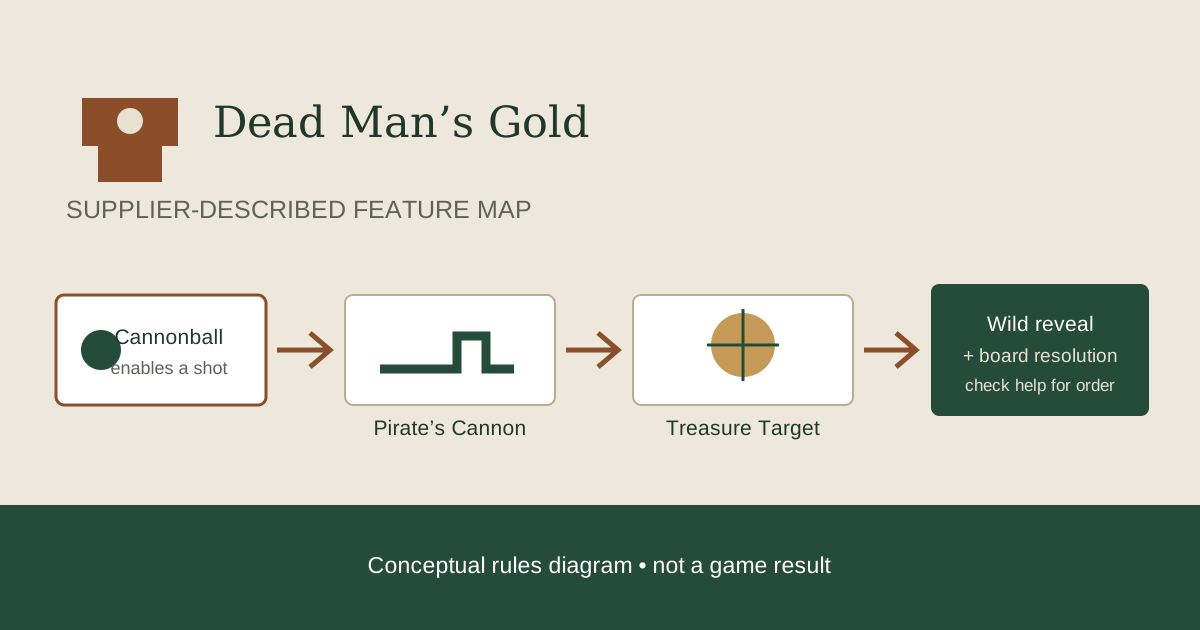
Dead Man’s Gold is an ELK Studios slot whose public feature outline connects Treasure Targets, cannonballs, Pirate’s Cannons and a Bottomless Chest. A target can reveal Wild symbols and remove non-winning symbols around itself; a multiplier target also changes a global multiplier. Cannonballs enable a cannon to fire when there is a target it can reach. A Bottomless Chest blocks a position and creates symbols in empty spaces in the same column. Those relationships make the round easier to follow when each step is considered separately.
This review explains the feature logic without turning a supplier summary into a promise about an operator’s exact math. The ELK Studios Dead Man’s Gold product page was checked on 7 October 2026. The public page provides a useful mechanic outline, but the downloadable game-data sheet could not be read during this research and no live New Zealand operator help screen was provided. Consequently, no RTP figure, volatility category, local availability or client payout cap is claimed.
Identify the precise game build
Check that the displayed title is Dead Man’s Gold. The pirate theme and treasure vocabulary are common across many games, so a review of another pirate slot cannot establish this game’s rules. In the client’s information panel, look for ELK Studios as the provider, the exact title, a game identifier or build label if available, and the date of inspection.
Supplier and casino are different actors. ELK describes the game’s design; an operator hosts a client and may provide a market-specific configuration. A game catalogue entry is not a directory of New Zealand offers. It cannot prove that a casino accepts local accounts, that this game is available to a particular account, or that the same rules are presented everywhere.
Use the ELK Studios guide hub to browse other reviewed titles, but keep their mechanics separate. A title-specific page should not borrow bonus counts from a related ELK release. If a casino’s game name differs from the supplier’s title, compare the help screen and provider attribution rather than treating artwork as proof of identity.
Start with the round’s basic sequence
Before examining cannons or treasure, read how a normal round evaluates symbols. The current help should state the board layout, what counts as a win, which combinations qualify, whether matching is based on lines, ways, clusters or another condition, and how symbols are replaced or removed. This page avoids specific line counts and trigger values because the active client was not available for verification.
A useful mental model is to separate the initial symbol result from later feature resolutions. First the game evaluates the board. Next it may create a feature object, remove or transform symbols, drop new symbols, or evaluate another result. Finally the client displays the round total and any separate prize. A symbol animation in the middle of that sequence is not necessarily a payout by itself.
If the game offers round history, open it after a complete round and compare its event list to the visible animation. Record which symbols formed the initial result, which feature began, what changed on the grid and when the total was credited. This helps distinguish a change in the board from a settled win. It also makes clear when the game has moved into a new bonus state.
Do not infer that a larger symbol or an explosion automatically improves the result. The paytable defines whether a symbol substitutes, blocks, pays, triggers a feature or simply changes a position. These roles can coexist, but only the current rules panel can establish them for the client.
Big symbols and stacked Wilds
ELK’s product description lists Big symbols and stacked Wilds. A Big symbol occupies a larger area than an ordinary symbol; a stacked Wild appears across several positions. The details that matter are the size definitions, whether a large symbol counts as one object or multiple matching positions, and whether the Wild substitutes for every pay symbol or excludes special symbols.
The help should also say how these features interact with a changing grid. A large object may cover empty positions, overlap a feature space, or be evaluated as a single unit. A stacked Wild might connect to a result without filling the whole reel. Do not interpret the art alone. The displayed paytable and symbol legend are the authoritative explanation for its role.
When a Big symbol appears near a Treasure Target, identify which event resolves first. Does the target remove surrounding symbols before the big object is evaluated, or is the big object excluded from that removal? The public product page does not answer every ordering question. A review should mark that detail as unverified unless it appears in the active help.
This separation is useful because promotional reviews often group all large-symbol mechanics into a generic “big win feature.” That phrase does not tell a player whether an object substitutes, pays directly or changes the board. A more careful description assigns a name and a rule to each visible symbol.
Treasure Targets and target resolution
The official page says that Treasure Targets fired by Pirate’s Cannons reveal hidden Wild symbols and remove non-winning symbols around the target. That makes target location important. The feature can be read as a sequence: a cannon has a targetable object, a shot resolves, the target reveals a Wild, nearby non-winners are removed, and the board can then be evaluated again under the relevant rules.
The current client help should specify what “around” means, which positions count as adjacent, and whether the target itself changes into a Wild. It should also explain if symbols that are part of a win are protected from removal, how a target is selected, and whether the effect can create new combinations after the removal. The public supplier summary gives the broad operation, not a diagram for every edge case.
For a review, document the before and after states separately. Note the target position, any symbols revealed, which non-winners disappeared, which winning symbols remained and whether the game ran another evaluation. A vivid blast animation can obscure the boundary between an eligible symbol and a blocked one; the round history or rules diagram is better evidence than an impression from a short clip.
Do not say that a Treasure Target “clears the board” unless the help says so. The supplier describes removal of non-winning symbols around a target. That is narrower than removing every symbol. Precise language matters because the difference changes how readers understand the following drop.
Multiplier Treasure Targets
A Multiplier Treasure Target is a separate named object. ELK says it reveals hidden Wilds, removes non-winning symbols around itself, and increases a persistent global multiplier. The shared removal effect should not hide the additional multiplier role. Identify the result as a combination of board transformation and a change to the wider bonus state.
“Persistent” raises a timing question: persistent for how long? The exact client help should identify when the multiplier begins, whether it applies to an immediate win or only a later result, whether it resets at the end of a round, and which bonus states retain it. A reviewer should not assume that “global” means every award in the game. It can mean a specific scope defined in the paytable.
When an eligible win resolves, inspect the help for the order of operations. Does the global multiplier apply to each qualifying win, only to wins from the target, or to a total after separate results are combined? If the client shows a value on screen, note whether it is a current modifier or an amount already added to the round balance. The interface should make that distinction clear.
A single round showing a large multiplier is not evidence about how often the target appears or how quickly the value grows. It is one recorded event. Do not estimate an expected return, probability or volatility from screenshots; those require the mathematical model and configuration.
Cannonballs and Pirate’s Cannons
The supplier says cannonballs drop in to activate Pirate’s Cannons, and cannons fire when they can target a Treasure Target. This describes a dependency: cannon ammunition and an eligible target must coincide before the cannon resolves. It is not simply a separate random win each time a cannonball appears.
Check the rules for how cannonballs enter the board, whether they remain until a target is available, how many shots a cannon can make, and whether a target is selected automatically. The public summary does not provide all those conditions. The current client help should also explain whether cannonballs have a separate payout or only enable the shot. Do not assign them a cash value just because another symbol in the game shows an amount.
The sequence can be reviewed with a state list: ammunition present or absent, a target visible or not, cannon action, target effect, board after the shot, and final settlement. This prevents the common mistake of attributing a later win to the cannonball alone. The cannon is an enabling part of the feature; the target and subsequent board evaluation complete the chain.
If multiple cannons or targets appear in one round, do not assume the first one has priority or that every target is hit. Look for a defined order in the help or event history. If no order is given, report that it could not be confirmed instead of inventing a deterministic path.
The Bottomless Chest is a blocker and board effect
ELK describes the Bottomless Chest as a blocking symbol that generates symbols in empty spaces in its own column. The generated symbols can be high-value symbols, Wilds or cannonballs. This makes the chest different from a paying symbol: its primary job is to affect space and what later appears around it.
The word “blocking” should be read literally only in the context defined by help. The rules should say which event is blocked, whether the chest occupies a position for one evaluation or persists, and what happens if a new symbol tries to enter the same space. It should also identify when the new symbols are generated and whether they trigger the ordinary paytable or a separate feature.
The supplier further says Bottomless Chests are sticky during the bonus game. In a feature-state guide, sticky means the object remains across the relevant bonus drops, not that the round is guaranteed to produce a win. The active help must still explain whether it is fixed in place, when it is used, and whether it can produce another set of symbols on later drops.
For a recorded round, note the chest’s column, the empty spaces before the effect, the symbols that appear and the next evaluation. This is more helpful than merely saying that the chest “fills the grid”. The public supplier page limits the effect to empty spaces in the same column, so that boundary should be retained.
Base bonus, Super Bonus and retained state
ELK describes a bonus game and a Super Bonus. It says that multiple bonus symbols trigger the ordinary bonus, with more symbols awarding more free drops, and that Treasure Targets, Multiplier Treasure Targets and Bottomless Chests are sticky during the bonus. This provides a clear broad difference between the base game and the bonus: several board objects can persist between bonus drops.
The client help should specify the exact entry count, the number of free drops, retrigger conditions, whether generated Wilds stick, and what happens to cannonballs. The public description does not establish every item’s persistence. This page therefore does not state exact trigger thresholds or awarded drop counts. Those are configuration facts that must be checked in a current, title-specific help screen.
A Super Bonus may change the bonus’s starting state or add a feature condition. The name alone does not say which. Look for an explicit comparison in the paytable. If it is selected through an optional mode, read that mode’s cost and included stake before making any decision. It is not appropriate to describe a paid entry as a shortcut to a likely win.
Keep an event ledger for the bonus: initial symbols, feature objects carried in, new targets, cannonballs used, multipliers at each drop, chests remaining and final balance settlement. Each line should describe an observed state, not predict the next one. A sticky object is a rule about persistence, not a statistical forecast.
X-iter and paid feature access
ELK describes X-iter as optional game modes that can start with a feature advantage or a Super Bonus. The public description for Dead Man’s Gold mentions modes with a guaranteed Big symbol and a Super Bonus with unlimited cannonballs. These are feature definitions from the supplier page; they are not a claim that the modes appear in every client.
If an operator presents an X-iter menu, inspect the local price, the stake basis, the exact included state, the RTP information and any restrictions. Make sure the amount displayed is understood before confirming. This guide does not quote the mode prices, encourage a purchase or imply that entering the bonus guarantees a return. A feature purchase changes the cost and the starting state; its result remains uncertain.
Some markets or game builds may hide or disable optional modes. A missing menu does not establish a defect. A public global product page may describe functionality that is not enabled in a particular jurisdiction. For review purposes, distinguish “the supplier documents this mode” from “this casino account offers the mode”.
Do not compare a paid-mode result with a base-game session as if the two were equivalent samples. They begin in different states and may use different cost structures. If you are researching a client rather than playing, the help screen is sufficient to identify its terms.
RTP and mathematical settings
RTP is a theoretical percentage calculated over a very large number of rounds under a defined game model. It is not the return a person should expect from the next session, a guarantee of getting a stake back, or a prediction that a bonus will appear. A brief play sample cannot verify the figure.
No RTP is published in this review. Search results and competitor articles repeat values, but they may refer to a different configuration, market or date. ELK’s public page did not give an accessible game-data sheet during the check, and no operator version was available for inspection. The exact title, build and jurisdiction matter more than the fact that a page contains a precise percentage.
Open the game information panel and look for an RTP or theoretical return field. Record whether there is one value or a selectable range, which value is active, and the displayed build or operator. If a rules panel shows multiple alternatives without identifying the active one, do not choose the most favourable number by assumption. Ask the operator which applies.
Volatility is a separate characteristic describing the variability of outcomes. A label such as “high” does not imply a specific losing streak or the timing of a bonus. This page does not assign a category because no current client evidence was available. Likewise, a maximum potential and an operator payout cap are not automatically the same. Verify the current rules for the stake basis, any round cap, and whether special bonus or X-iter outcomes are inside that cap.
Mobile, demo and accessibility checks
Check that the information button, paytable, stake control, history and exit action stay visible on a phone. The pirate theme can use dark backgrounds and bright effects; confirm that important symbol labels are legible and that the help does not rely on colour alone. If the game rescales after an animation, wait for the screen to settle before reading text.
Mobile compatibility does not establish New Zealand availability. It only tells you that the client can adapt to a display. A demo on a foreign review site is not proof that a casino serving New Zealand users offers the title. If a demo is available in a permitted context, check the displayed title and help panel and note whether it matches the actual operator version.
Use the controls to pause, leave or close the game rather than allowing a feature animation to keep a session open indefinitely. If a help screen is hard to navigate with a keyboard or assistive tool, ask the operator for accessible rules. A review should identify an access barrier plainly instead of describing the interface as easy without evidence.
How to form a useful review
A concise factual review can be built from a small evidence set: title and provider in the live information panel; the base paytable; written descriptions for each named feature; bonus and Super Bonus rules; displayed RTP and stake settings; the maximum-win rule; and a dated availability check with the operator. Mark every item as supplier-described, client-verified or unknown.
For Dead Man’s Gold, the most useful order is to explain the symbol roles first, then the target/cannon chain, then the chest’s board effect, and finally which objects persist in the bonus. This order follows the dependencies rather than the promotional sequence of images. It also helps a reader spot what the client leaves unexplained.
Do not report personal testing unless it actually occurred and was recorded. A sample run cannot verify long-run RTP or feature probability, and a screenshot cannot prove a local access rule. If an article uses a supplier source for mechanics and leaves operator settings blank, say so in the introduction and the settings section. That is more transparent than silently mixing sourced mechanics with unsourced statistics.
Responsible use and verdict
Dead Man’s Gold presents several interacting board events. Targets can reveal Wilds and clear nearby non-winners; a multiplier target also affects the global multiplier; cannonballs enable shots; and the Bottomless Chest produces symbols in empty spaces in its column. The bonus keeps selected objects in play, according to the supplier outline. A reader who wants to understand the game should focus on the order and persistence of those states.
There is not enough current client evidence here to rate the math, quote RTP variants, label volatility, give a payout cap, or confirm New Zealand access. The defensible verdict is about the feature design only. For the live settings, check the operator’s help with the exact title and date.
If you choose to gamble, set time and spending limits before play and stop when either is reached. Do not chase a target feature or a previous loss. If gambling begins to create stress or financial pressure, step away and seek independent support. The safer gambling guide lists New Zealand-focused ways to get help.
Frequently asked questions
What does a Treasure Target do?
ELK says a Pirate’s Cannon shot can reveal hidden Wilds at a Treasure Target and remove non-winning symbols around it. A Multiplier Treasure Target also increases the persistent global multiplier. Exact adjacency and evaluation timing should be confirmed in the active help.
What activates a Pirate’s Cannon?
The supplier describes cannonballs as activating the cannons, which fire when they can target a Treasure Target. The current client help should clarify whether ammunition persists and how a target is selected.
What does the Bottomless Chest do?
It is described as a blocker that fills empty spaces in the same column with high-value, Wild or cannonball symbols. The bonus rules should confirm its precise persistence and timing.
What is Dead Man’s Gold’s RTP?
This review could not verify a current operator value or variant. Check the RTP field in the exact client. A precise percentage on a third-party page may relate to another market or version.
Can a New Zealand account open this game?
This page does not confirm local distribution or account eligibility. An ELK catalogue page describes a product but does not prove that a particular operator in New Zealand offers it.
Sources and date checked
- ELK Studios Dead Man’s Gold product page and ELK game catalogue — checked 7 October 2026.
- Competitor sample checked 7 October 2026: SlotCatalog, HideousSlots, Online-Slot, and FruitySlots. Their numerical settings were not treated as New Zealand client evidence.
- DIA guidance for online gambling advertisers and Online Casino Gambling Regulations 2026 — checked 7 October 2026; commercial affiliate links withheld pending qualified compliance review.
