ELK Studios game guide · South Island guide
Deadcode: rules, features and settings to verify
 Best casinos available in New ZealandUpdated 7 November 2026

Deadcode is an ELK Studios cluster slot whose cascading wins can feed a Global Multiplier and column Collectors. This guide follows the Subroutine and Breach systems, separates the bonus states and identifies settings that need the active game help.
The short answer
Deadcode is an ELK Studios slot built around connected symbol wins, cascades and a cyberpunk-themed set of systems called Collectors, Subroutines and Breach. A win removes symbols and can create another drop; a Global Multiplier tracks the sequence; collectors above the columns can charge and activate distinct transformations or grid effects. The bonus changes how some of those systems persist, and a Super Bonus is a separate state with enhanced feature access.
The supplier’s official game page supports the high-level mechanic description, but a public overview is not a complete help file. It does not establish the RTP version, volatility label, active stake range, paytable, feature purchase prices or exact configuration at a particular casino. Check the game’s own information panel before using a number. Review pages opened for this guide disagree on some numerical settings, which is why they are not copied as a universal answer.
Confirm the title and operator version
Start with the official Deadcode product page and the ELK catalogue. These confirm the title and give the supplier’s own feature summary. If a casino lobby displays the game, compare the full title and provider credit on the loading screen before associating the page with that client.
The operator build is the relevant source for the rules a customer actually sees. Record any version identifier, rules revision, date and mode shown in the game. A game can be presented through different operators with distinct configured settings; a game guide that omits the build cannot promise which settings a reader will encounter.
The distinction is not technical trivia. A third-party page may be accurate for its sample casino and still be wrong for a different operator. The source hierarchy should be clear: ELK’s product page explains the intended feature vocabulary; the active game help explains the version being offered; the operator’s terms explain eligibility and account conditions. A corporate group page is not a substitute for any of those title-specific details.
Cluster wins and cascades
Deadcode uses connected groups rather than a conventional fixed-line layout. In a cluster system, symbols must meet the game’s connectivity rule before the result qualifies as a win. The exact qualifying size and adjacency rule are title-specific. The public ELK summary describes symbol removal and upgrades but the accessible page is not a complete paytable, so the active help should be used to confirm how many matching symbols qualify and whether diagonal connections count.
When the game accepts a cluster, the winning symbols can be removed and other symbols fall into the vacant positions. That follow-on fall is commonly described as a cascade or avalanche. A single paid spin can therefore contain several consecutive evaluations. The sequence should be described as a chain of game states, not as several separate paid spins unless the help explicitly defines it that way.
To follow a result, pause the animation or open the game history if available. Identify the starting cluster, note which symbols disappear and then observe what lands in the open spaces. The next outcome can trigger another win, a feature symbol or no win at all. Cascades are determined by the game; the player does not choose which new symbols fall or increase the chance by timing a button press.
Do not count every cascade as a separate opportunity with an independent stake. The help should explain the relation between the initial wager, later drops and settlement. Keep any feature round separate from the base spin when describing cost and payout.
The Global Multiplier
ELK describes a Global Multiplier that increases as winning cascades continue. This gives the sequence a shared progression marker: a win can raise the multiplier before a later drop is evaluated. In the base game, the meter has a reset boundary; in the bonus, the global state can persist between drops according to the supplier’s overview.
That boundary is important. “Global” does not mean the multiplier applies to every outcome in every game state. Read the help for its reset point, whether it affects each cluster or only eligible wins, how it combines with symbol values and whether any feature can change it. A screen showing the multiplier after one winning drop is not enough to explain the payout formula.
When taking notes, use a short state table: opening multiplier, result of the cascade, change shown, next evaluation and end-of-round reset. In a bonus, also record when the accumulated state carries forward and when the feature ends. That description helps a reader understand the mechanic without suggesting that it can be controlled or that a rising meter is a prediction of a large win.
Multiplier values and payout calculations should come from the current game help. This article does not publish a numerical multiplier range or a simulated outcome because an active operator build was not supplied. A review from a different market may show a version-specific value; preserve that as a lead to verify rather than folding it into this page as a general rule.
Column Collectors
Each column has a Collector meter associated with its own Subroutine. Matching symbols or other qualifying events can fill the meter, and a charged Collector can activate the linked effect. The supplier summary describes the Collectors as the route into the game’s special transformations. This makes the feature different from a random bonus symbol that simply opens a single round.
Watch which column is collecting progress and what event adds to that meter. Do not assume that the same symbol charges every Collector equally or that a win across multiple columns fills all of them. The help should state whether symbols, Wilds or special icons count and how much progress is needed. If the rules are not explicit, report the visible state without inventing a threshold.
The visual meter can be easy to overlook when cascades are moving. Use the round history or slow animation if available to understand which event caused a Collector to change. Record the column, the relevant symbol group, and the Subroutine that followed. This is a description of the client’s event sequence, not a claim that a reader can select or target a collector.
The Subroutines
Deadcode links its Collectors to several Subroutines. The supplier describes transformations that can alter symbol types, remove selected types, upgrade symbol values, convert symbols into bonus versions or add space to the grid. The names may be shown in the active game help; use those exact labels and explain what the board looks like before and after each activation.
A transformation effect can have more than one visible step. For example, symbols can change to a common type and then be evaluated as a cluster, or a removal can create additional empty cells and a new cascade. Explain the order that the rules state. Do not presume that an effect always creates a win just because it removes or converts symbols; a changed board may still fail to meet the cluster condition.
If a Subroutine upgrades symbol values, check whether the change lasts for the whole round, until the next win or across a bonus. If it changes the grid size, identify whether the new row is permanent for that feature or only for the current state. If it converts symbols into bonus symbols, see whether the conversion can trigger another feature immediately. Each of these questions affects how a reader interprets the game and belongs in the version’s help rather than an inferred pattern from another ELK title.
The published overview also associates the Super Bonus with a guaranteed set of Subroutine features during bonus drops. Treat that as a supplier description of the mode, and verify the exact current rule. “Guaranteed feature” does not say which result it produces or how much it pays. Keep the distinction between access to a feature and its eventual payout explicit.
Breach: a different kind of board refresh
Breach is described as an event that may occur at the end of a round and replace eligible non-winning, non-feature symbols. This is different from a standard cascade: the cluster has already been evaluated, then a further board refresh can give the round another state to inspect. The help should confirm what symbols remain locked and whether the refresh can trigger another evaluation or feature.
The feature’s timing changes how a guide should explain it. Do not say that Breach is a player-controlled respin unless the interface offers such a choice. Do not describe it as a guaranteed second win. A board refresh can make new symbols visible while still producing no eligible cluster.
When a Breach appears, note what stayed in place, what changed and whether the game then evaluates the grid again. If the title’s history displays the event, use it to verify the sequence rather than relying on an animation replay. Keep the rule separate from the Collector Subroutines even if both can alter symbols: one is a collector-linked effect, the other is a distinct round event.
Bonus and Super Bonus states
Deadcode has a bonus system that uses bonus symbols to enter a separate sequence. ELK’s summary describes a Super Bonus state when a special version of a trigger appears. It also notes that selected systems, such as the grid state or global progression, can persist across bonus drops. These are important differences from a base spin, where progression may reset between rounds.
Use the active help to check the entry condition, the number of bonus drops, whether the feature can retrigger and which settings carry over. Avoid the phrase “free spins” if the help uses another term such as drops. Similar words can imply different controls or payout rules. The exact game vocabulary is more useful than a familiar category label.
For Super Bonus, verify what the special trigger symbol changes. ELK’s accessible summary refers to a guaranteed set of Subroutine features, but a guide should not assume their order, result or multiplier effect without the game help. Record whether the state is visibly marked before entry and what happens to the Collector meters during the feature.
The bonus may feel like a continuation of the base game because it uses the same board vocabulary. Still, describe the state transition explicitly: trigger, board change, persistent values, each drop, feature end and final settlement. This prevents a reader from confusing a carried meter with a balance or a payout already awarded.
RTP variants, volatility and configuration
RTP is a theoretical long-run setting, not a forecast of a short session. A game may be supplied with more than one mathematical configuration and an operator can enable a particular version. That means an RTP displayed on a review page is not necessarily the value in every casino build.
Some third-party pages opened for this research list different Deadcode figures, including disagreement about the headline payout ceiling. Those pages appear to describe different market-specific values or contain inconsistent copy. The accessible ELK product summary and an operator’s live help must be consulted before publishing numeric values. Because no current game-help file from a New Zealand operator was supplied, this guide does not assert an RTP variant, volatility label, stake range or max win for the local market.
If the active help lists multiple RTP settings, capture them exactly and state which one the operator says is selected. Do not refer to the highest published version as the “default” unless the game or operator says that. If the help shows a volatility label, copy the exact words; do not convert them to a player-friendly scale or claim they guarantee a particular frequency.
Optional modes and feature access
The supplier catalogue mentions X-iter, ELK’s menu of optional ways to access a feature or alter the chance of entering one. The menu can include different paths rather than a single standard bonus purchase. Check the labels and prices in the active game before explaining them. Some modes may make a feature more likely; others may guarantee a state at a specified cost. Those are materially different claims.
The arithmetic can be explained without recommending a mode: if a menu charges a multiple of the selected wager, multiply the current stake by the displayed multiple to see the nominal feature cost. Do not convert it to NZD unless the operator actually displays NZD. Do not claim that paying more improves expected return, removes variance or makes a bonus profitable.
If a menu is absent, do not assume the casino is hiding it or that a promotional video proves it exists in every market. The operator may disable a feature or offer a different configuration. Record what the live help and menu show. Optional entry can consume considerably more than one ordinary round, so any responsible-use explanation should say to include the full cost in a pre-set spending limit.
A reliable way to inspect a round
Before play, open the paytable and the feature help. Find the cluster condition, the symbol replacement rules, the Collector descriptions, the Subroutine list, Breach conditions and the exact bonus entry wording. If those screens are not available until a round starts, pause before staking and locate the information icon. A few minutes with the rules prevents a fast animation from being mistaken for an outcome guarantee.
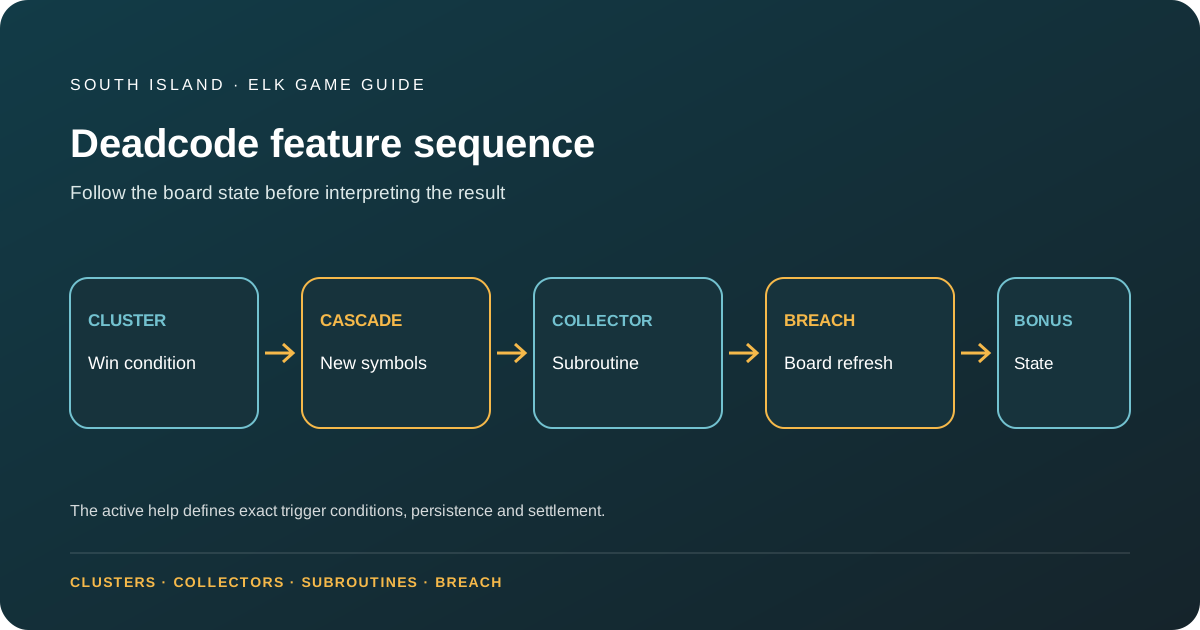
During a round, follow the action in a deliberate order: base grid, winning cluster, removed symbols, cascade, multiplier change, Collector progress, Subroutine activation, possible Breach and settlement. If the game transitions into a bonus, begin a separate sequence note and mark which values persist. This approach makes the screen easier to understand without suggesting any method of influencing its random outcomes.
After the round, compare the displayed result to the help’s payout basis. If you cannot tell whether a value is a multiplier, a meter or a settled credit, use the game history or ask the operator’s support team. A guide should never turn a balance display into an RTP claim or treat a feature meter as money already won.
Mobile readability and accessibility
Deadcode uses a dense interface with several meters and board effects. On a phone, verify that the collector labels remain legible, the multiplier can be read without covering the board and the information panel is reachable without triggering a stake. A responsive page can help with the guide itself, but it cannot prove how a particular casino embeds the game client.
Check whether the controls can be navigated with a keyboard, whether focus is visible and whether all feature explanations are available as text rather than only as animated effects. If the operator’s embedded game does not offer accessible help, request a text rules copy. The game’s source does not establish a specific device’s load time or mobile performance, and this editorial guide has not tested a live casino build.
A demo, if legitimately available, can demonstrate the location of controls and the visual order of the Collectors. It does not certify a live return setting or the game’s availability in New Zealand. A demo may omit real-money limits and can reset its play balance. Do not use it as a statistical test or extrapolate a short sample to future outcomes.
New Zealand availability and advertising boundary
ELK’s catalogue listing proves that the supplier presents Deadcode as one of its products. It does not show that a particular online casino offers it in New Zealand. Check the operator’s identity, current local terms and any applicable eligibility information separately. Another country’s site or a review’s demo widget cannot establish access for a New Zealand customer.
The Online Casino Gambling Regulations 2026 took effect on 3 July 2026. Regulation 3 defines an affiliate arrangement as a referral arrangement with a benefit contingent on a later outcome; regulation 40(c) prohibits advertisements involving affiliate arrangements. DIA states that the framework applies to third parties that publish or arrange advertisements as well as operators. This site’s existing assigned CPA route is outcome-based, and no compliance approval was provided. No affiliate CTA is included; placement remains blocked for review.
If gambling feels difficult to control, stop and use the site’s New Zealand safer gambling guide to find independent support options. Decide a time and money limit before play, do not chase losses, and do not borrow to gamble.
What competing reviews can and cannot tell you
The review pages checked for this guide generally identify the same broad structure: cluster-style wins, cascades, collector meters, Subroutines, Breach and persistent bonus state. That consensus is useful for learning what to inspect. It does not make every numeric field reliable across all markets.
Several pages differ on the RTP versions, whether the board can expand and the maximum payout. Some lead with a headline number while another part of the same page describes a different value. Such contradictions are a reason to verify, not a reason to average the numbers. A page might cover an outdated pre-release build, a market-specific configuration or simply contain an editing error.
The primary-source method is straightforward: use ELK’s product page for the official mechanic summary; open the operator’s current help for the actual configuration; save the URL or screen capture and date. If the two sources leave a point unresolved, say so. This guide does not claim a tested session, a review score or a firsthand casino experience.
Questions readers commonly ask
How do Deadcode wins form?
The game uses connected clusters and cascading symbol removal. Check the active help for the exact qualifying size, adjacency rules and settlement method.
What does a Collector do?
Column Collectors build progress and are linked to Subroutines that can change symbols or the grid. The current help should explain what charges each meter and what activates it.
Does the Global Multiplier persist?
ELK describes different reset and persistence behaviour between the base game and bonus. Use the operator help to confirm the exact state boundary and payout application.
What is the Deadcode RTP in New Zealand?
No New Zealand operator build was supplied for this guide. Check the exact game’s information panel; reviews for other markets are not proof of the active local version.
Why is the CPA link omitted?
New Zealand regulations prohibit advertisements involving a defined outcome-based affiliate arrangement. The existing CPA route has not received a compliance determination for this placement.
Sources and verification boundary
Primary pages checked 6 October 2026: ELK Studios Deadcode product page; ELK official catalogue; DIA online-gambling advertiser guidance; Online Casino Gambling Regulations 2026, regulations 3 and 40.
Competitor pages opened 6 October 2026: SlotArk, Bonkku, AboutSlots, Marvn, and SpinaSpin. They helped identify common feature explanations and disagreements between published figures. Their values are not treated as the active settings for a New Zealand casino. Search snippets, unavailable pages and copied review tables are not primary evidence.
No current operator game-help file, paytable or test account was provided. The page therefore omits RTP, stake, payout cap, hit-rate and volatility figures. Search-volume data was unavailable. The batch report records source-body word count; rendered text, production preview, mobile browser layout and Lighthouse metrics remain unverified because the archive’s build could not complete.
