ELK Studios game guide · South Island guide
Dream Diver: ELK Studios rules, features and setting checks
 Best casinos available in New ZealandUpdated 7 November 2026

Dream Diver is ELK Studios’ five-reel slot with stacked Wild respins, a Pick Me feature and a multi-level bonus that ends at a Dream Wheel. The supplier describes six levels, lives, multipliers and an alarm-clock end condition. Its public product page does not verify an operator’s RTP, volatility or New Zealand availability.
The short answer
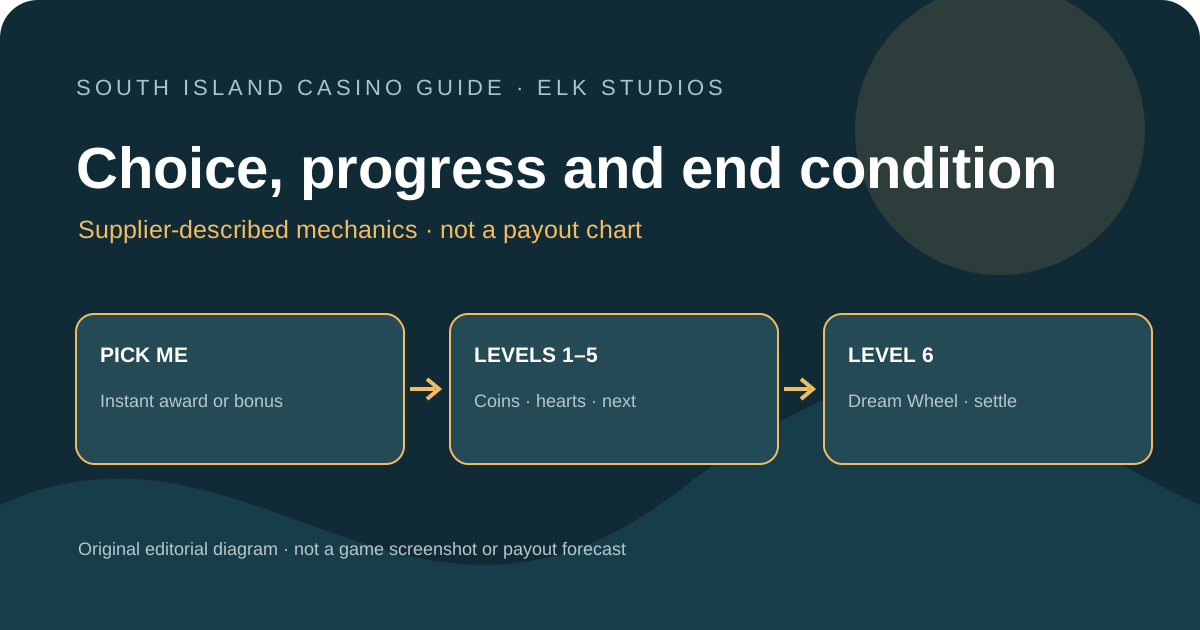
Dream Diver is an ELK Studios slot that combines stacked Wild respins with two Pick Me outcomes and a multi-level bonus. ELK says three or more Pick Me symbols can award an instant amount or begin the bonus game. The bonus has six levels: the first five use pick-style choices, while the last is the Dream Wheel. Coins and multipliers can add value, a heart grants an extra life, “Next” moves to a later level, and an alarm clock ends the feature. Stacked Wilds can nudge into place and award respins.
The supplier’s public product page confirms the broad structure, but it is not a full operator paytable. It does not establish the exact RTP, volatility, hit frequency, current stake range, cap or availability in New Zealand. ELK’s linked Game Data Sheet returned HTTP 403 during the research check, and no operator help was provided. This guide focuses on what the supplier actually says and how to verify the rest without importing a number from an unrelated market.
Check the title and the supplier source
ELK’s catalogue marks Dream Diver “Live Now”. This is a supplier catalogue label, not proof that a specific operator offers the game or that it is available to a New Zealand account. Verify the full name and provider in the casino’s information panel. Other dream-themed games may use a Pick feature, stacked Wilds or a wheel; similar imagery does not establish the same rules.
The official Dream Diver product page is the primary source for the public feature description in this article. The ELK Studios provider hub and game index help distinguish it from other ELK titles. Those catalogue references do not provide the operator’s current paytable or game configuration.
When checking a review, record its publication or update date, the operator or market it covers, the exact game title and whether it says it inspected current in-game help. Several secondary pages publish a 95% RTP, a maximum win or a volatility label, but the accessible supplier data sheet and a New Zealand operator version were not available here. Repetition across reviews is not the same as confirmation of the active setting.
The standard round and the feature map
Begin by separating ordinary reels from feature events. The normal round uses the game’s base symbols and paytable. A Pick Me event can reveal an immediate award or take the player into the multi-level bonus. Stacked Wilds are a separate respin feature that can nudge into position. If one of these events occurs during an ordinary round, the interface should explain the resulting state and any credited amount.
The public supplier description does not list every payline, symbol value or exact trigger timing. Read the paytable to identify normal symbols, Wild, Pick Me and any bonus icon. Then use the rules panel to see whether the Pick Me symbols need to land on particular reels, whether a count of three is sufficient wherever it appears, and whether the game has any exception to that threshold. Do not borrow a scatter rule from another slot.
The feature map on this page uses distinct boxes for the Pick Me choice, bonus levels and Dream Wheel. That distinction matters: an instant award is not necessarily the same as entering the bonus, and a final wheel is not a standalone event that every Pick Me trigger reaches. The client help defines the exact paths through the feature.
Pick Me: instant award or bonus entry
ELK says three or more Pick Me symbols trigger the Pick Me feature. That feature may award an instant amount or start the bonus game. This is a two-path result: the trigger opens a choice or reveal event, but it does not automatically mean the player enters all six bonus levels. The help should explain the available outcomes and how the amount or feature is determined.
When the feature begins, look for the number of selections, the set of objects or positions available, and whether the choice is a genuine player selection or simply a reveal animation. A game may let the player choose which item to reveal while the underlying value is determined by the game. Do not describe the interface as a skill decision unless the rules support that. A visible choice is not evidence that a player can influence the result.
If the Pick Me screen awards cash, note whether it is a fixed value, a bet multiple or a range. If it awards bonus entry, check whether the game displays the starting level, lives or other state before play continues. The supplier summary does not publish the exact Pick Me prize table, odds of each outcome or selection procedure. These remain operator-help questions rather than facts to infer from an animation.
The six levels and the Dream Wheel
ELK describes a six-level bonus, with the first five levels based on Pick’n’Click choices and the sixth level represented by the Dream Wheel. The broad aim is to collect coins and multipliers while advancing through the feature. “Next” advances to a later level with higher multipliers; an alarm clock can end the bonus. A heart grants an extra life. These are feature-state changes, not guaranteed outcomes.
Read the client’s help for the number of starting lives, what an extra life changes, whether a level can contain multiple coin or multiplier picks, and how “Next” is selected. The supplier’s page says the first five levels use picks, but does not provide every possible symbol or value. It is also important to know whether an alarm clock can end the game before a later level, whether a player gets a final selection after it appears, and exactly how the sixth-level wheel is settled.
The Dream Wheel should be treated as a final feature state, not as a promised jackpot. The supplier page describes the Wheel as the sixth level; it does not publish a probability of reaching it or a universal payout table. A review that says “win up to” a particular number may be describing another game version or market. Verify the active help before using any cap in a comparison.
Coins, multipliers, hearts and alarm clocks
Coins and multipliers have different roles. A coin can add an award to the feature total, while a multiplier changes how a qualifying amount is calculated. A heart gives an extra life according to ELK’s public description. An alarm clock ends the bonus. The game help should state the order in which collected cash and multipliers are combined and whether a multiplier applies to all collected coins or only a specific part of the total.
Write down each event in order during a feature: current level, remaining lives, coin amount, multiplier, and whether the next-level action was activated. Then check the final settlement against the game history. If a multiplier appears after a coin, do not assume it retroactively applies unless the rules say so. If two values appear on the screen, do not multiply them together merely because the symbols are displayed near each other.
The alarm clock is an end condition, not a sign that the game is “close” to a larger reward. A heart can add an extra life but does not guarantee another advancement. A “Next” symbol can move the bonus to a higher level, but it can also expose the player to the next level’s end condition. These decisions are feature rules and cannot be used to predict future outcomes.
Stacked Wilds and nudging respins
ELK says a stacked Wild can appear on reels two, three or four, nudge into the full reel and award a respin. Extra stacked Wilds during a respin can become sticky and provide additional respins. This is a separate base-game mechanic from the multi-level Pick Me bonus. It is useful to learn which reel positions are involved and how the sticky state persists through the respin sequence.
Read the help for the exact nudge direction, whether one or more stacks can land together, and what happens when the full reel is covered. Does an additional stacked Wild add one respin, reset a counter, or follow another rule? Does it remain fixed for the rest of the feature or only the next evaluation? ELK’s public summary establishes the broad sequence, but the complete counter and settlement details must come from the client.
Do not call a respin “free money”. It is an additional game evaluation under the original round’s rules, and the symbols can still fail to form a paying combination. A sticky Wild increases the number of positions that may participate, but it does not guarantee that the rest of a line will appear. Track the stake once for the original round; do not treat each internal respin as a separate paid spin unless the paytable expressly defines it that way.
How to distinguish an instant win from a bonus payout
The Pick Me feature can result in an immediate amount or entry into the bonus. These paths should be explained separately in any game guide. An instant amount may be settled at once, whereas bonus entry begins a sequence in which collected coins and multipliers build a feature result. The operator help should specify whether an instant amount is displayed in currency or as a multiple of the bet.
When comparing the two outcomes, do not assume that one is always better. The bonus may be longer and contain more feature states, but it can end before the player reaches the Wheel. The instant amount may be a defined settlement. Only the published rules and exact paytable explain how each event is valued. A review’s tone or rating does not prove that a particular route has a better expected return.
If the history panel logs the Pick Me reveal, compare its record with the final balance change. Save the game round identifier if you need to ask an operator about an apparent discrepancy. A final screenshot may not show whether the amount came from the instant branch, the bonus total, or a multiplier. The complete event history is more useful than trying to reconstruct a long bonus from memory.
RTP, volatility and win cap: do not infer the settings
The ELK product page accessed here does not provide a verified RTP variant or volatility rating for an active NZ casino configuration. Its Game Data Sheet returned HTTP 403 on 7 October 2026, and no operator game help was available. This guide does not repeat numerical values from review pages, even if several list the same figure. Their value may match one build while the question is which build, if any, an operator presents in New Zealand.
RTP is a theoretical long-run statistic for a named configuration. It is not a prediction for one bonus, session or deposit. Volatility describes the distribution of outcomes; it does not indicate how often the alarm clock appears or whether a heart will land. A maximum-win figure is an upper limit or marketing potential, not an expected bonus result or the probability of reaching the Dream Wheel.
If the active game help lists more than one RTP, record the selected variant, date, currency and game title. Check whether a paid mode changes the RTP or cap. Find the minimum and maximum stake in the same client. If the help omits any of these fields, state “not disclosed in the accessible help” instead of filling the blank from a secondary review.
X-iter modes and optional paid access
ELK describes X-iter modes for Dream Diver, including optional paths into feature play. The public page provides a high-level description, not a guarantee that an operator offers every mode in every region. If the menu appears, inspect the exact label, total price, number of rounds and guaranteed event. Confirm whether the price is a multiple of the base stake and whether the displayed value is the full charge.
A guaranteed start or feature is not the same as a guaranteed profit, minimum payout or particular multiplier. The actual result still follows the game’s rules. Before considering any option, check whether the operator help says that the mode changes RTP, the cap or bonus conditions. A review written for a different jurisdiction cannot answer those questions.
You can understand stacked Wilds and the Pick Me flow from the written help. An X-iter purchase is not required for learning the game. Do not choose a paid mode because a feature “seems due”, because an earlier round lost, or because a countdown or animation creates pressure. If a price or feature condition is unclear, close the menu without confirming the purchase.
Paytable and settlement checklist
Open the paytable before starting and identify ordinary symbols, Wild, Pick Me and Bonus. Record combination requirements, payout unit and any symbol exclusions. Then read the Pick Me rule: trigger count, allowed positions, selection options, instant prize and bonus-entry condition. In the bonus section, find the initial state, level structure, extra-life rule, multiplier application and the exact effect of an alarm clock.
For the stacked Wild sequence, note which reels can contain the stack, how it nudges, whether it covers the full reel, what is held through a respin and how extra Wilds change the counter. When a round finishes, inspect the history view for a sequence of states and the final credited result. These steps make it easier to understand settlement, but they do not reveal the probability of a feature or improve future results.
Check how the game expresses a payout: total bet, coin value, line bet or another unit. A “x bet” headline without a definition can be ambiguous. Also confirm the currency. If a review quotes pounds, euros or dollars, do not convert it into NZ dollars and then treat it as the active operator’s stake range. The client’s displayed terms are the relevant evidence for that configuration.
Device checks and demonstration access
No mobile or desktop test was performed for this article. If an operator offers Dream Diver to your account, check whether the paytable, bonus choices, remaining lives, multiplier, stake and close controls are readable on the device you plan to use. A six-level feature can display several counters at once. You should be able to pause and identify which level and rule apply before selecting a control.
Check that the “Next” choice is visually distinct from the alarm clock or an ordinary prize. If the interface relies on colour, open the symbol legend. If the feature moves quickly, look for a reduced-animation setting or replay in the game history. These are interface checks; they do not establish that the software works on every mobile device or that the operator supports a given browser.
A demo, when officially offered by an operator in a permitted location, can illustrate the controls and feature sequence. It cannot prove the RTP of a real-money client or that an NZ account can access the game. This page does not link a demo. Its illustration is an original diagram, not a screenshot or a representation of the actual client layout.
Dream Diver compared with other ELK games
ELK has games with Wilds, bonus symbols, respins and X-iter modes, but the same mechanic word can describe different behaviours. Dream Diver’s Pick Me choice, six-level progression, hearts, “Next” and alarm clock belong to this title’s feature map. Do not transfer those rules to another game that also has a wheel or pick screen.
When comparing two releases, write down the title and provider, board layout, feature trigger, bonus state, RTP shown by the operator, volatility, cap and stake range. Keep supplier facts apart from operator facts. A review rating or “medium” label may be editorial rather than a formal game setting. Do not choose a game solely because a review describes frequent wins; short-term experience and unverified anecdotes cannot establish long-run performance.
The ELK provider guide and game index keep the titles distinct. This guide answers the Dream Diver rules task in one page. It does not create separate pages for RTP, demo, Pick Me or the bonus, and it does not review a casino offer.
New Zealand availability and responsible-use context
This page does not claim Dream Diver is available to New Zealand players. A supplier catalogue listing or an overseas demo page is not enough to establish access. Check current operator terms and authoritative New Zealand information. Do not treat an advertisement as proof that the game is lawful, licensed or suitable for your account.
The Department of Internal Affairs states in its current advertiser guidance that the online casino advertising prohibition is in effect and that third parties publishing or arranging advertisements may be subject to requirements. It also describes affiliate-marketing restrictions in initial regulatory decisions. For this reason, this page has no in-text commercial casino CTA. That is an editorial compliance hold, not legal advice.
The page can answer the game-help question without a casino referral. If gambling is affecting your wellbeing, use the site’s existing New Zealand safer gambling information for support and ways to take a break.
A practical inspection sequence
Before using the game, verify the full name and provider. Read the paytable, identify all symbol types, and understand the ordinary win rule. Then read the Pick Me event from trigger through instant award or bonus entry. Write down what each choice can do, how the bonus starts, how lives are counted and what causes advancement. Confirm whether the player’s selection controls a result or simply reveals a game-determined value.
Next inspect each of the six levels. Find the exact meaning of a coin, multiplier, heart, “Next” and alarm clock. Verify when the Dream Wheel is reached and how its result is settled. For stacked Wilds, check the reel positions, nudge condition, sticky state and additional-respin rule. Keep the two feature families separate in your notes so a respin is not mistaken for a bonus level.
Finally check RTP variant, volatility, maximum cap and bet range only in the active operator help. Record date and currency. Do not follow any paid-mode button while checking terms. If a field is absent, ask the operator or leave it unverified. Set a limit you can afford before any session, stop when it is reached, and do not increase it to recover losses or to reach the final wheel.
Frequently asked questions
What does the Pick Me feature do?
ELK says three or more Pick Me symbols start the feature, which can award an instant amount or enter the bonus game. The exact selection and prize rules should be confirmed in the client help.
How many levels are in Dream Diver’s bonus?
The supplier describes six levels: five pick-style levels followed by a Dream Wheel. The live help should explain the starting lives, advancement and ending conditions.
What does the alarm clock do?
ELK describes the alarm clock as an event that ends the bonus. The precise timing and settlement after it appears should be read in the game’s current help.
Do stacked Wilds guarantee a win?
No. They can nudge into place and award respins, and extra stacks may become sticky, but a payout still depends on an eligible combination and the paytable.
What are Dream Diver’s RTP and volatility in New Zealand?
They were not verified for an NZ operator. The linked data sheet was inaccessible, and no current operator help was supplied. Use the game’s own information panel.
Sources and verification boundary
Checked 7 October 2026. Primary sources: ELK Studios, Dream Diver and the ELK games catalogue. The linked Game Data Sheet returned HTTP 403; no active operator help was supplied, so numeric RTP variants, volatility, maximum cap, hit frequency, stake limits and local availability remain unverified. Competitor sample: AskGamblers, Lucky Mobile Slots, FruitySlots, LCB. Pages differ on feature descriptions or numeric settings; those claims were not imported as the NZ configuration. DIA, Online gambling for advertisers, checked the same date. No keyword-volume data was supplied.
