ELK Studios game guide · South Island guide
Night Trax: ELK Studios rules, features and setting checks
 Best casinos available in New ZealandUpdated 7 November 2026

Night Trax is ELK Studios’ six-reel, four-row game built around coloured arrow symbols, Trax Respins, diagonal paylines, Splits and a multiplier bonus. The supplier says a qualifying payline can trigger respins of non-winning symbols while existing or new paylines continue. Exact connection endpoints, split values, RTP and operator settings need the active game help.
The short answer
Night Trax is an ELK Studios slot in which coloured arrow symbols can connect horizontally and diagonally. ELK’s public product page describes a six-reel, four-row game. A qualifying payline can start Trax Respins: non-winning symbols respin while an existing line extends or a new one appears. Diagonal arrow connections can create additional payline paths, and Splits add multipliers to wins formed on those diagonal lines. A separate bonus uses multipliers and arrows that can link and transfer value.
The feature names are unusual enough that a one-line “72 paylines” summary does not explain how the game evaluates the grid. The rules help should define endpoints, colour matching, allowed directions, which non-winning symbols respin, and what ends the feature. ELK’s Game Data Sheet link returned HTTP 403 when checked, so this guide does not verify an operator’s RTP, volatility, hit frequency, cap or stake range. It also does not claim a New Zealand operator offers the game.
Identify Night Trax in the client
The supplier catalogue marks Night Trax “Live Now”. This is a supplier status, not proof of availability at a particular casino or for a New Zealand account. Open the information panel and verify both the complete title and ELK Studios as provider. Other games may use arrows or neon visuals, but their connection rules and payout grids can be completely different. Do not apply Night Trax’s rule language to another title based only on similar artwork.
The official Night Trax page is the primary source for the mechanic summary used here. ELK recommends a desktop resolution on its public page, but that is not an operator compatibility guarantee. The ELK provider hub and the site’s game index give catalogue context; neither proves regional distribution or the version a casino runs.
For any review comparison, keep the exact game name, source, jurisdiction, version date and currency beside each fact. This is particularly important for Night Trax because some secondary pages call its connections lines, tracks or ways without explaining the underlying endpoint rule. Those words are not necessarily interchangeable. The title-specific help is more reliable than a general label.
The six-by-four grid is only the starting point
ELK describes six reels and four rows. That gives a visual board, but the way wins connect is not the same as reading a conventional left-to-right payline chart. Arrow symbols have direction and colour, and their endpoints can connect across the grid in defined ways. A path can therefore be easier to understand as a graph of linked ends than as a list of numbered straight lines.
Open the game help and identify the arrow colours and orientations. Note whether a horizontal arrow connects only to the same colour, whether a diagonal connection can cross a reel, and which endpoint must meet for a link to count. The supplier public summary mentions same-colour endpoints and multiple directions but does not give a full coordinate-by-coordinate map. A screenshot in a third-party article may show an example, not the complete paytable.
Do not infer a win from two arrows that merely look close together. The endpoint must satisfy the rule, and the connected path must meet the symbol-count and paytable conditions. If the client marks a path after a spin, use that animation to learn the evaluation, then check the written help for the general condition. A colourful line over the grid is a presentation of a result, not proof that every nearby arrow can connect.
Horizontal and diagonal connections
The game distinguishes horizontal arrows from diagonal arrows. Horizontal connections are more visually intuitive because their path follows a row; diagonal paths can move across positions in more than one direction. The result is a network that may link endpoints that are not adjacent in the way a conventional slot player expects. The actual rule is the endpoint and colour relationship shown in the client, not a guess based on the angle alone.
For a learning example, trace one candidate path with a pencil on the diagram or help screen. Mark each arrow’s colour, its entry point and its exit point. Then check where the next arrow begins. If two endpoints do not meet under the game’s rule, they do not form a link even if the symbols touch visually. Repeat with the reverse direction only if the help permits it; do not assume all connections pay in both directions.
When a path crosses multiple reels, read whether the paytable requires a minimum number of linked symbols and whether a link can branch. A branch could create more than one evaluated route, but the accessible product summary does not quantify every pattern. Avoid saying “all directions pay” or “every matching arrow wins” unless the operator help explicitly says so. Precise language helps a reader distinguish a valid path from a visual near miss.
Trax Respins: what continues and what changes
ELK says any payline triggers Trax Respins. During the feature, all non-winning symbols respin while the game continues as long as an existing payline extends or a new payline appears. That is the broad condition. The operator help should clarify whether winning symbols are locked, whether arrows that form a line remain in place, what happens to a partial connection, and what exactly counts as an extension or new line.
This feature should not be described as “free spins”. It is a respin sequence within the triggered round. A new evaluation can extend a line or create another one, but it does not guarantee that either happens. If the game stops when no qualifying line remains, that is a feature end condition, not a cue that a win is overdue on the next paid spin.
During a respin, look for which positions are preserved and which are replaced. A history panel can show the initial grid and successive states. Follow one arrow path across each state rather than trying to track every possible branch at once. Note when a win is credited: per connection, per respin, or as an accumulated round total. The public supplier text confirms the continuation idea, but detailed settlement remains a game-help question.
Diagonal paylines and Splits
ELK’s product page identifies Diagonal Paylines and Splits as features. Splits add multipliers to the wins on diagonal paylines, according to the supplier summary. This is different from multiplying every win in the round. A diagonal path needs to qualify first; then the relevant Split rule can modify its payout. The client help should specify which symbol or event creates a Split and what multiplier is applied.
Pay attention to the phrase “those wins”. It points to a scope distinction: the multiplier may be attached to wins on affected diagonal lines rather than horizontal routes or unrelated combinations. The accessible public page does not provide a universal multiplier value or a complete set of qualifying paths. Do not apply a Split multiplier to an entire screen total without support in the active rules.
If a line includes more than one diagonal feature, find out whether multipliers add, multiply, or apply separately. Those arithmetic operations can yield very different results. Also check whether the stake unit is total round bet or a line stake. A review that lists an x-value without its trigger and scope leaves out a material part of the rule. Record the client’s wording rather than simplifying it into a bigger but inaccurate headline.
Bonus entry and the multiplier board
ELK says three Bonus symbols trigger the Bonus Game. Its public page describes a bonus board involving sticky multipliers and arrows. Multipliers can be connected by arrows, and a connection can transfer the value on the left to the value on the right. That right-hand multiplier is then increased by the transferred amount under the supplier’s description. This gives the bonus a connection puzzle of its own, but the exact entry and starting state need the game help.
Read the bonus rules for the number of starting spins, what resets a spin counter, whether arrows are fixed or can appear in different orientations, and what happens if a multiplier has no valid connection. Do not import the “three spins reset to three” convention from an unrelated hold-and-win game or a competitor article. The supplier description available here does not fully specify every counter and retrigger condition.
The bonus arithmetic can be followed by writing down the left and right values before and after each valid arrow connection. If the help says an arrow transfers a value once, do not count it again later unless the symbol reactivates. If it says a value is added, distinguish that from multiplying two multipliers together. The animation may present both values at once, so a written step-by-step rule is useful.
Reading arrow transfers without double counting
Suppose a feature board shows one multiplier to the left of another and an arrow between them. The public rule says the arrow transfers the left value to the right, increasing the right value by that amount. To read a specific round, note the two initial values, confirm that the arrow’s colour and endpoints qualify, then record the changed right-side value. Do not assume that the left multiplier is consumed unless the client says that it is.
If several arrows connect, evaluate them in the order the game displays. A chain could make a later arrow act on a changed value, or the game may resolve all links simultaneously under a different rule. ELK’s public summary does not publish a full multi-arrow precedence table. This detail must come from the current in-game help or animation. Avoid multiplying the values together because the word “multiplier” appears on both symbols.
At the end of the feature, confirm how a bonus total is paid. The operator paytable should define whether each multiplier applies to a collected win, whether the bonus starts with any preset values, and whether there is a maximum payout cap. The supplier’s broad description explains a transfer mechanic but not the full settlement. A rule guide should not turn an illustrative chain into a guaranteed payout formula.
X-iter and optional entry modes
ELK’s Night Trax page lists X-iter modes with different feature conditions, including an option to start closer to a Bonus and a Super Bonus with boosted multipliers. Such modes can be absent or configured differently by region. The supplier page does not prove that an operator exposes every mode to New Zealand accounts, nor does it replace the on-screen price and terms.
If an X-iter menu is visible, read the exact price and what it guarantees before selecting anything. Confirm whether the amount is a multiple of one spin’s stake, whether it charges once or for a series of spins, and whether the feature uses a different RTP or cap. A guaranteed start is not a guaranteed net return. Do not treat a price multiple as a probability or as a payment that can be recouped by reaching the bonus.
The base game’s unusual connections can be learned through the help diagram and a permitted demo. Buying a mode is not a necessary way to understand the path rules. If you want to compare modes, write down the price and guaranteed feature condition without executing a purchase. Stop if the terms are unclear, and do not use an optional mode to chase an earlier loss.
RTP, volatility and maximum win
The official product page reviewed here does not state a verified RTP variant, volatility rating, hit frequency, stake range or active maximum-win cap for a New Zealand operator. The linked ELK Game Data Sheet returned HTTP 403 when accessed on 7 October 2026; no live operator client or help text was supplied. Numeric claims on review pages are not substituted for those missing configuration records.
RTP is a long-run theoretical statistic tied to a game configuration. It does not forecast the return from one session and does not promise that a player receives a stated percentage of their stake. Volatility describes the spread of outcomes, not a calendar for when Trax Respins or the bonus will appear. A maximum-win number, if shown, is an upper boundary rather than an expected result or evidence of a likely payout.
If the operator help lists multiple RTP versions, check which one the active game uses. Record the exact title, currency, selected mode and date. The rules may also distinguish ordinary play from an optional feature mode. If a number is missing, state that it is not confirmed. If two review pages disagree, that is a reason to verify the game client, not to select whichever figure sounds most attractive.
Paytable and settlement checks
Open the paytable and separate three concepts: symbol value, path qualification and feature modifier. A symbol can be valuable yet fail to pay if its endpoints do not connect under the stated route rule. A path can qualify but receive a different amount depending on which arrow type or symbol combination formed it. A Split may then modify only a subset of diagonal wins. Keeping these layers separate makes a confusing screen easier to interpret.
Check the unit used for each payout. Does “x bet” refer to the total wager for the whole spin, or another unit? If the game shows a coin value and a total stake, do not compare a displayed value without knowing which one applies. The game history should help verify how the operator settled a particular round, but it does not prove the setting for a different casino build.
If a result seems inconsistent, save the round ID if the operator offers one and consult its support, without assuming the game malfunctioned. A screenshot of the final animation may omit the connection sequence that determines the result. The help panel, win history and official support channel are better sources than a competitor’s forum or a short clip.
Mobile readability and learning the controls
No device test was performed for this article. Before playing on a small screen, confirm that the game lets you open and close the rules, read arrow colours and endpoint markers, review the stake, and see the total before starting a round. Night Trax’s connecting paths are more complex than a conventional straight payline, so the interface needs to make the relevant route legible.
If the arrows are small, rotate or resize only if the operator supports that action, and do not begin a paid round until you can see the help. Check whether motion, colour or background contrast makes two arrow types hard to distinguish. Use any built-in reduced-animation or sound controls if they exist. These accessibility observations are about the client presentation; they do not imply that the supplier has certified a particular device.
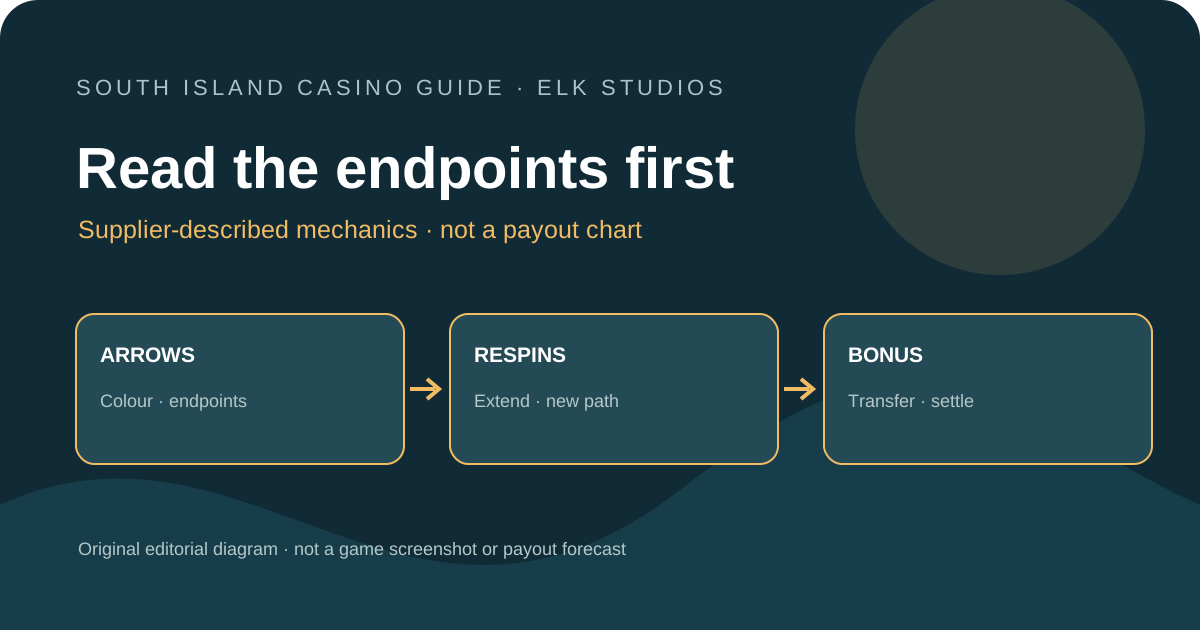
An official or operator demo, if offered where you are permitted to use it, can help you learn the endpoint rule. It cannot confirm a real-money RTP or New Zealand access. No demo is linked from this page. The illustration above is an original schematic and deliberately does not mimic the live board, so use the active paytable for exact positions and pathways.
Night Trax compared with conventional paylines
In a conventional slot, the paytable may show a set of straight paths across the reels. Night Trax asks the reader to follow coloured endpoints and allows diagonal connections, so simply counting horizontal lines can obscure how its special paths are formed. Use the word “payline” only as the provider uses it; explain the arrow-link condition whenever it matters.
Do not call the game “ways to win” unless the paytable uses that exact mechanism. A collection of arrows can form a route that resembles a ways system, but a connection path and a standard ways calculation are not the same thing. Secondary review tables sometimes use “ways”, “lines” and “tracks” casually. The live help should decide which term the guide uses and how a win is settled.
This page covers Night Trax only. Similar arrow-based games can have different numbers of reels, directions, split rules and respin triggers. Avoid combining a general strategy guide or another provider’s path puzzle here; the assigned intent is to understand Night Trax’s own rules and configuration boundary.
New Zealand availability and advertising context
This guide does not identify a casino or claim that Night Trax can be accessed from a New Zealand account. A foreign casino page or public game catalogue is not enough to establish local eligibility. Check current operator terms and authoritative local guidance before relying on an availability statement.
New Zealand’s Department of Internal Affairs currently says the online casino advertising prohibition is in effect and third parties that publish or arrange advertisements may be covered. The current advertiser page also describes affiliate-marketing restrictions in initial regulatory decisions. For that reason, this article does not contain a commercial in-text CPA button. See the official DIA advertiser guidance; this page is not legal advice.
No direct operator URL is included. The page links to the existing ELK catalogue and safer gambling information as editorial resources. A commercial placement needs a qualified compliance decision before it is added.
A step-by-step rules check
First verify the title, provider and board dimensions. In the help panel, find the definition of horizontal and diagonal arrow symbols, the matching-colour requirement, endpoint connection, minimum path and payout unit. Use a visual example to trace a route, then compare it with the written rule. Do not treat two touching arrows as a valid path until the endpoint condition is met.
Next, read Trax Respins. Record what triggers the feature, which symbols are kept, which positions respin, how an existing line extends, how a new line qualifies and what stops the sequence. Then read Splits: identify the trigger, the diagonal path scope, the multiplier arithmetic and whether it applies before or after ordinary settlement. Ask the help screen rather than assuming the multiplier covers the full spin total.
For the Bonus Game, note the Bonus-symbol entry rule, starting counter, reset condition, arrow connection and value-transfer sequence. Check whether multiple arrows resolve in a defined order and how the total is settled. Finally verify the RTP, volatility, maximum cap and stake range in the active operator configuration. If the client does not expose a field, mark it unknown and do not infer it from a review.
Frequently asked questions
What starts Trax Respins?
ELK says a payline triggers the feature. Non-winning symbols respin while an existing line extends or a new line appears. The operator help should define exactly which positions remain and what ends the sequence.
Do all arrow symbols connect diagonally?
No universal claim is supported by the public summary. It describes same-colour endpoint connections in multiple directions; use the game’s own diagram for valid colours, directions and endpoints.
What do Splits do?
The supplier says Splits add multipliers to wins on diagonal paylines. Which wins qualify and how a value is calculated must be verified in the active help.
What is Night Trax’s current RTP in New Zealand?
It was not verified. The official data sheet was inaccessible and no New Zealand operator help was provided. Do not apply a third-party review’s number to the local build.
Is there a free demo?
This guide does not confirm one for New Zealand. Demo availability depends on the operator and permitted access; a foreign page is not evidence of local access.
Sources and verification boundary
Checked 7 October 2026. Primary sources: ELK Studios, Night Trax and the ELK games catalogue. The linked Game Data Sheet returned HTTP 403; active operator help was unavailable, so RTP variants, volatility, hit frequency, cap, stake range and NZ access are unverified. Competitor sample: BigWinBoard, AboutSlots, Chipmonkz Slots, Casinos.com. Their quick specification tables differ in terminology and were not used to establish local settings. DIA, Online gambling for advertisers, checked the same date. No NZ search-volume data was supplied.
