ELK Studios game rules · South Island guide
Dreamzone review: cluster wins, Dream Features and Free Drops
 Best casinos available in New ZealandUpdated 7 November 2026

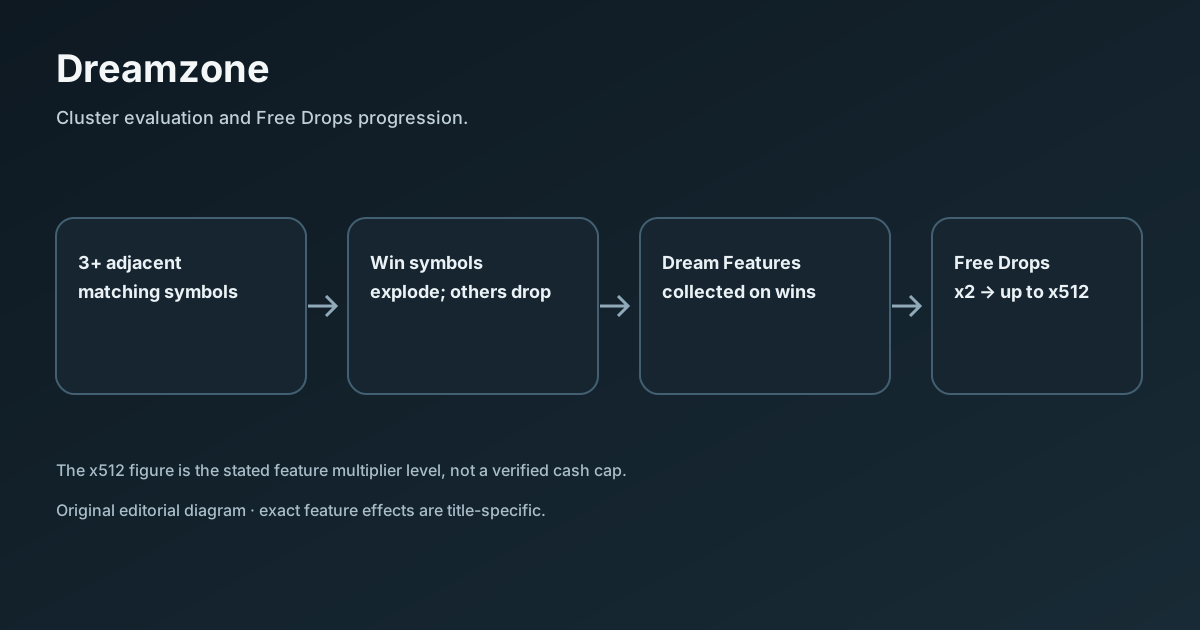
Dreamzone is ELK Studios’ cluster-based slot. Three or more matching symbols adjacent side by side can form a cluster; winning symbols explode and the remaining symbols drop. Its Free Drops bonus starts with three drops and an x2 win multiplier. Clearing the grid advances the level and doubles the multiplier up to x512. Dream Features collected on wins can be used on non-winning drops to keep the avalanche going. The x512 figure is a feature multiplier, not a verified maximum cash win or RTP.
The short answer
Dreamzone is a cluster-based ELK Studios slot in which matching symbols can form a win when at least three are adjacent side by side anywhere in the grid. Winning symbols explode; the remaining symbols drop, creating another chance for a qualifying cluster. In the Free Drops feature, ELK says the game begins with three free drops and an x2 win multiplier. Clearing the grid advances to the next level and doubles the multiplier, up to x512.
The feature also has Dream Features: Wilds, Symbol Explode, Symbol Upgrade and Symbol Scatter. ELK says up to five Dream Features can be collected per winning drop and then used on non-winning drops to keep the avalanche going. This is a conditional feature system, not a promise that a particular drop will produce another win. The rules for how a feature is selected and applied should be checked in the active game help.
One distinction prevents a common mistake: x512 is the supplier-stated top Win Multiplier level for the bonus. It is not, by itself, a maximum cash win, an RTP, or a promise that every win receives that multiplier. ELK’s accessible Dreamzone page explains the main mechanics but does not verify a casino’s active RTP, volatility, maximum win or New Zealand availability. Its linked Game Data Sheet returned 403 on 7 October 2026, so secondary numerical claims remain unconfirmed here.
What the official description confirms
ELK describes Dreamzone as an imaginary slot with cluster-based mechanics. It says that three or more matching symbols adjacent side by side anywhere in the grid create a cluster win. Winning symbols explode, and remaining symbols drop down for new win chances. The accessible summary does not state the exact grid dimensions or whether a particular configuration changes them; several competitor pages show a five-by-five grid, but that number is not repeated here as a supplier-confirmed field.
The Free Drops bonus starts with three free drops and an x2 Win Multiplier. Clear the grid to move to the next level, doubling the multiplier from x2 to x4, x8, x16 and onward up to x512. ELK describes Dream Features that can be collected on winning drops: Wilds, Symbol Explode, Symbol Upgrade and Symbol Scatter. It says up to five can be collected per winning drop and used on non-winning drops to keep the avalanche going.
These public rules are sufficient to explain the core loop but not every configuration detail. The accessible supplier page does not show an active operator RTP, stake range, win cap or volatility rating. It also does not provide the full probability or ordering rules for Dream Features. The linked Game Data Sheet was inaccessible during this review. A feature name and a multiplier ceiling do not fill in those missing mathematical fields.
What a cluster win means
A cluster is a group of matching symbols that satisfies the game’s adjacency condition. ELK says at least three matching symbols must be adjacent side by side and may appear anywhere in the grid. That differs from a fixed payline game, where symbols usually need to land along one of a predefined set of routes. A cluster can form in several positions, but it must still satisfy the exact adjacency and symbol rules shown by the game.
The phrase “side by side” should not be stretched into a rule that diagonals count. The accessible supplier description does not enumerate every geometric edge case. The in-game help should define which positions count as adjacent. When a cluster appears, use the paytable or rules panel to determine whether diagonal contact, gaps or special symbols have a role. If those details are not stated, leave them open instead of copying a generic cluster-game rule.
Once a winning cluster is evaluated, the winning symbols explode and the remaining symbols drop. That is the avalanche or cascade-style part of the flow: one outcome can be followed by a new arrangement without the player selecting another stake for each internal drop. Do not confuse those internal drops with separate paid spins. The history panel should show how the overall round or feature is accounted for.
The value of a cluster is not determined by its size alone unless the paytable says so. Symbol type, number of matching symbols, active multiplier and feature state can all matter. A screenshot of a large group does not reveal the credited amount or whether the symbols qualified. Read the final award in the round history and compare it with the paytable definitions for that symbol and state.
Explosions, drops and repeat chances
When winning symbols explode, the remaining symbols fall down. New arrangements can produce another qualifying cluster. The game therefore uses a sequence: evaluate the current grid, remove winning symbols, apply the drop, then evaluate the resulting state under the rules. The feature can produce more than one win in the same chain, but the existence of a cascade does not make the next win certain.
Keep the order clear when describing a round. The first cluster is not the same as a later cluster created after a drop. A symbol that remains on the grid may move into a new position; a new symbol may enter from above if the rules say it does. The supplier summary confirms that remaining symbols drop but does not spell out every refill animation in the available text. Let the current game help describe whether new symbols enter and which direction positions shift.
The distinction matters for collecting Dream Features. ELK says features are collected on winning drops and may be used on non-winning drops. A win can change the board and the feature inventory at the same time. Do not assume that a feature collected from one symbol automatically applies to the same symbol, to every following drop or to the whole bonus. The rules should state what is collected, when it is consumed and whether it persists.
If the interface displays a chain counter, feature icons or a multiplier, record what each indicator represents. A counter can describe the number of consecutive drops, the number of bonus levels or the inventory of collected effects. Those are different values. The rules panel is more reliable than interpreting an animation from memory, especially if several effects appear at once.
Free Drops and multiplier levels
The Free Drops feature begins with three free drops and an x2 win multiplier, according to ELK’s public summary. Clearing the grid moves the bonus to the next level, where the Win Multiplier doubles. The stated sequence includes x2, x4, x8 and x16, continuing to a top level of x512. That sequence describes bonus progression; it does not mean that a multiplier is added to the player’s balance or that an award is multiplied by x512 on every drop.
The level-up condition is described as clearing the grid. Readers should verify the exact definition in the live help: does the entire current grid need to clear, or does the game describe a particular bonus state? The public summary’s wording is brief. Do not substitute a competitor’s interpretation or claim that any cluster advances a level. A win can clear symbols without clearing the whole grid, so a win and a level change should be treated as distinct events unless the help equates them.
The Free Drops are not ordinary paid spins. They form part of a feature with its own state, starting drops and multiplier. The actual award still depends on the combination of qualifying symbols, feature effects and paytable. If the bonus ends with an accumulated amount, use the final history result rather than adding visible interim wins yourself. Some interfaces show a running total; others show individual drop awards and a final sum.
Do not read “up to x512” as “up to 512 times the stake” unless the game help explicitly connects the multiplier to the total stake that way. The phrase identifies a multiplier level. The overall max win could be constrained by a separate cap, symbol rules or configuration. The official page does not publish a maximum cash win in its accessible summary, so this guide leaves it unverified.
The four Dream Features
ELK names four Dream Features: Wilds, Symbol Explode, Symbol Upgrade and Symbol Scatter. They are collected on winning drops, up to five per winning drop according to the public description, and used on non-winning drops to keep the avalanche going. That says when the feature inventory may grow and the general role of the effects. It does not supply each feature’s exact target, selection chance or consumption rule.
A Wild can change how a symbol participates in combinations, but the title’s help must define which symbols it substitutes for and whether any symbols are excluded. Do not assume a Wild has the same rule across ELK games. Symbol Explode suggests a removal effect, but the exact positions and timing need the current help. Symbol Upgrade indicates a symbol-value or identity change, yet the official summary does not define which symbols can upgrade or how many steps are possible. Symbol Scatter may have a trigger or collection role that should not be inferred from its name alone.
Treat a Dream Feature like a stored instruction, not a guaranteed payout. It can alter the next non-winning drop, but an altered grid may still fail to create a qualifying cluster. The supplier says the purpose is to keep the avalanche going; that describes a possible continuation mechanic, not a guarantee that every feature produces a win. The result still depends on the new arrangement and game rules.
When reviewing a feature sequence, note the drop on which each icon was collected, whether the screen shows it as available or consumed, and which later drop it affected. If several features are collected together, do not attribute the next change to one specific icon unless the interface identifies that effect. This careful method is useful for understanding the sequence without overstating causation from a single animation.
RTP and the x512 multiplier are different questions
RTP is a theoretical return percentage for a defined game configuration, calculated across a very large number of rounds. It does not forecast the next spin, guarantee a session return or describe how likely a particular bonus sequence is. A multiplier level is a feature mechanic; RTP is a model statistic. They should never be used as substitutes for one another.
The accessible ELK Dreamzone page lists the x512 Win Multiplier, but it does not show an RTP number or volatility classification. ELK links a Game Data Sheet, which returned 403 during this research on 7 October 2026. Competitors report figures that differ: some list 96%, others 96.1%, while volatility descriptions range from medium to medium-high. These figures might relate to different versions or sources, but this review cannot establish the cause. None confirms the selected configuration at a specific New Zealand operator.
To check the active value, open the game’s paytable or information screen from the version you can actually access. Record the displayed RTP exactly, the title, operator and date. If the game lists several values, ask which one is active in your account. If no figure is available, mark it “not shown” and request written confirmation. Do not use an RTP from a competitor, community tracker, demo or another ELK title as though it applies here.
Maximum win and volatility require their own sources. A third-party maximum such as 2,500x may be correct for a version, but the supplier summary available here does not verify it. A volatility label is likewise absent from the accessible page. Do not derive volatility from the x512 multiplier: the feature level alone does not describe the distribution of all outcomes. If the operator’s current help shows either field, note its exact wording and unit.
What the competing pages contribute
The competitor sample checked on 7 October 2026 included All Slot Sites, Lady Luck Slots and SlotoTimes. These pages offer quick explanations of the cluster format and Free Drops, and can help a reader recognise terms used in slot reviews. They are not the controlling source for an operator’s live settings.
The numerical details diverge. All Slot Sites and Lady Luck show a five-by-five board and 96% RTP; SlotoTimes reports 96.10%. Secondary pages also label volatility differently and list a maximum-win amount not shown in ELK’s accessible summary. Those differences are precisely why the active game help matters. The official page confirms clusters, features and multiplier progression, but it does not verify a specific casino’s math configuration.
Competitor reviews sometimes describe the maximum multiplier as though it were the maximum payout. That is a category error unless the rules explicitly make the full win equal to the multiplier times the stake and no other limit applies. Another page may state a max win from a game sheet unavailable to the reader. Until the exact data sheet or active operator help is visible, keep the claim attributed and unverified rather than turning it into a headline fact.
A practical way to inspect a round
Before a session, open the rules and find the cluster definition, symbol paytable, bonus entry, Free Drops starting state, level-up condition and each Dream Feature. Record which grid dimensions and currency the actual game shows. Confirm whether the paytable expresses an award per symbol count, per cluster or as a stake multiple. If a help screen does not define diagonal adjacency, do not assume it counts.
During a feature, follow one event at a time: identify a qualifying cluster; observe the symbols that explode; note how remaining positions drop; check whether another cluster forms; and track any Dream Feature collected. In Free Drops, record the starting multiplier and the level change separately from the cash award. The visual sequence may move quickly, so use the completed-round history afterward to confirm the total.
For a comparison between operators, use the same fields on both sides: version or title name, grid, cluster rule, bet basis, RTP shown, volatility label, max-win wording, bonus rules and date. If the fields are absent from one side, write “not available” rather than substituting the other operator’s values. A feature demo may illustrate animation but not establish a particular account’s eligibility or configuration.
Questions readers ask
How many symbols are needed for a Dreamzone cluster?
ELK’s public description says three or more matching symbols adjacent side by side anywhere in the grid. The exact geometric edge cases should be checked in the active help. Do not assume diagonal contact counts unless the rules say so, and do not confuse the cluster condition with a fixed-payline route.
Does every winning cluster increase the Free Drops multiplier?
The supplier says clearing the grid advances the bonus to the next level and doubles the multiplier. That is more specific than simply landing a win. The accessible summary does not explain every edge case, so check whether the active game defines a full grid clear as the condition. Do not assume that any cluster automatically moves the multiplier up.
Is x512 the maximum win?
No. ELK describes x512 as the highest Win Multiplier level in the Free Drops feature. That is not a verified maximum cash payout or RTP. A maximum-win cap, if available, needs its own title-specific source and stated unit.
What are the Dream Features?
ELK names Wilds, Symbol Explode, Symbol Upgrade and Symbol Scatter. It says up to five can be collected per winning drop and used on non-winning drops to keep the avalanche going. The accessible summary does not give each feature’s full effect or probability, so consult the active help for exact targeting and consumption rules.
What RTP does Dreamzone use?
Competitor sites show 96% or 96.1%, but ELK’s accessible page did not show an RTP and the linked Game Data Sheet returned 403 during the check. Those secondary figures do not establish a particular operator’s setting. Read the value in the game’s current information panel or ask the operator.
Is Dreamzone a five-by-five slot?
Several competitor reviews describe a five-by-five grid, but the official summary accessed here did not state the dimensions. Verify the grid in the current game help and do not present the competitor layout as supplier-confirmed. A screenshot can show one configuration but may not establish whether a mode changes the grid.
Does the bonus always retrigger?
The accessible ELK description does not state a retrigger rule for Dreamzone. Check the bonus help in the active version for whether retriggers exist and which symbols or conditions qualify. Do not import a retrigger rule from another cluster slot.
Mobile, demo and New Zealand context
ELK recommends a 1600×900 desktop resolution and a 16:9 ratio if scaling is needed. This is a display recommendation, not a guarantee that every mobile browser or casino app supports the title. The grid and feature icons can require more vertical room than a standard reel layout. On a phone, confirm that the paytable and history remain reachable and that any tooltip does not cover the cluster you are trying to inspect.
Demo access can depend on the supplier showcase, operator and jurisdiction. A Play control on the provider page does not confirm that an operator makes the game available to New Zealand accounts. This article did not verify a specific local casino or demo. Check the operator’s current terms and game help if access matters to your decision.
See our ELK Studios catalogue guide for a broader explanation of supplier information and operator settings. For local support resources and ways to take a break, use the New Zealand safer gambling guide. The feature rules can be read without an affiliate link or a deposit.
Sources and verification boundaries
- ELK Studios: Dreamzone — official mechanics page checked 7 October 2026.
- ELK’s linked Product Sheet and Game Data Sheet — the Game Data Sheet returned 403 on 7 October 2026.
- All Slot Sites, Lady Luck Slots and SlotoTimes — competitor pages checked 7 October 2026 for coverage and conflicting secondary figures.
- DIA information for online casino customers — checked 7 October 2026; no specific operator access claim is made.
This guide does not claim a personal play test, an active casino RTP, a maximum payout, New Zealand availability or an expected result. Recheck the exact game help before relying on a numerical or configuration field.
