ELK Studios game rules · South Island guide
Io review: Gravity mechanics, Wild Forge and Free Drops
 Best casinos available in New ZealandUpdated 7 November 2026

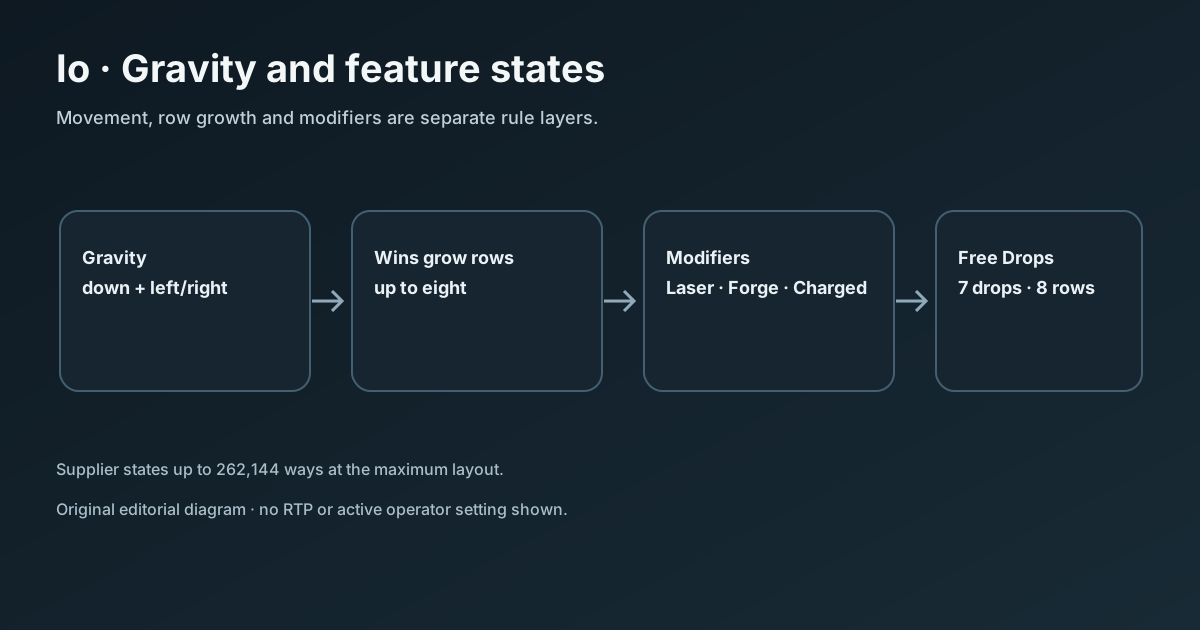
Io is an ELK Studios slot that uses a Gravity mechanic: symbols descend while sliding left or right, and rows are added after wins up to eight. ELK states that the game can reach 262,144 ways. Its Free Drops feature awards seven drops and uses the eight-row layout; Charged Wilds and Wild Forge symbols are collected at the bottom and the feature can retrigger. Laser clears symbols along its direction, crossing beams turn affected symbols into Wilds, and Wild Forge creates a multiplier Wild below an empty space. RTP and operator settings remain to be checked in the active help.
The short answer
Io is an ELK Studios slot whose central Gravity mechanic moves symbols downwards while they slide left or right, bringing additional symbols into play. ELK says rows are added for each win up to eight, and the game can reach 262,144 ways to win. Its Free Drops bonus awards seven drops and is played with eight rows. Between drops, Charged Wilds and Wild Forge symbols are collected at the bottom; the feature can retrigger.
The three named modifiers do different things. Laser clears symbols in the direction it points; if two beams cross, the symbols in their directions turn into Wilds. Wild Forge fills an empty space below with a multiplier Wild, and the multiplier grows each time the Wild Forge contributes to a win. Charged Wild has four extra lives and spends one whenever it contributes to a win. These mechanics interact with the grid but do not promise a particular cluster or award.
The official Io page confirms those features and the eight-row / 262,144-ways ceiling. It does not publish the active RTP, volatility, stake limits or maximum-win configuration in the readable summary. The linked Game Data Sheet returned 403 when checked on 7 October 2026. Competitor pages list numerical values, but those do not establish the current configuration at a specific operator or prove New Zealand access.
What the supplier says about Gravity
ELK calls Io a universal slot with Gravity mechanics. Its public explanation says symbols slide left and right while moving downwards, bringing more symbols into play. Rows are added for each win up to a maximum of eight, and the title can reach 262,144 ways to win. The summary does not state the exact starting row count or an intermediate ways ladder, so this guide does not fill those fields from a secondary source.
This is not a conventional fixed-reel animation in which each symbol only moves vertically in one column. The supplier describes both downward movement and lateral sliding. That description explains why a symbol can appear in a different horizontal position after a cascade. It does not mean the player chooses the direction or that each symbol follows a predictable path. The game’s rules determine the movement and award evaluation.
The row-growth rule is conditional on wins: ELK says rows are added for each win up to eight. A win can therefore change the visible play area, and the number of ways can increase as the layout grows. Eight rows and 262,144 ways are maximum-layout facts from the supplier summary, not a guarantee that a round reaches the full grid. A larger count of ways describes evaluated routes; it is not a payout, a probability or a count of guaranteed winning combinations.
When checking the rules panel, separate four fields: starting grid, how a win is evaluated, how the grid grows and the maximum layout. The active help should define matching symbols, adjacency or ways direction, and whether special symbols are evaluated differently. Do not assume that a “universal” format gives the same layout or starting way count in every jurisdiction. The supplier summary’s word choice does not replace the title-specific paytable.
Reading a Gravity sequence
To follow a single base-game result, start with the current grid and identify the symbols involved in the first win. Note how the win is evaluated according to the game’s rules, then observe which symbols are removed or retained and how the others descend and shift. If a row is added, check whether the new row appears at the top or another position; the short official summary says rows are added but does not fully describe every animation step.
After the grid changes, the game evaluates the new arrangement under its own rules. A further win can add another row, but growth stops at the eight-row maximum. The animation can include several internal results, which may all belong to one paid round. Do not place a new bet or count a cascade as a separate wager unless the history says it is a separate round.
A useful note for a disputed or confusing result includes the game title, round reference, starting stake, first visible grid, feature icons, row count after each win and final settlement shown by the history. A screenshot can help explain what appeared, but the account record is still needed to confirm the credited total. Do not try to calculate every intermediate award from a partial animation if the game already provides a final amount.
Movement and payout are separate. Gravity explains how the symbols can reposition; ways describe which combinations the game can evaluate; the paytable determines symbol values; and the account history shows the settled outcome. Mixing those layers can lead to claims such as “more rows mean more money” or “262,144 ways means a win is likely.” Neither statement follows from the mechanic summary alone.
Laser: clearing and crossing directions
ELK says the Laser symbol clears all symbols in the direction it is pointing. If two laser beams cross, all symbols in their directions are turned into Wilds. This makes direction important: a horizontal or vertical arrow may affect a path of positions, and a crossing creates a different effect from a single beam. The public summary does not specify every orientation, range or ordering detail, so use the active rules to interpret a particular grid.
Clearing symbols and converting symbols to Wilds are not the same event. A single Laser has a clearing effect in its direction. When two beams cross, symbols in their directions become Wilds. The second condition is explicit and should not be generalized to any two lasers on a board if they do not cross as defined by the game. The visual could show beams overlaid, but the help must determine which positions count as in the path.
A Wild can participate in a qualifying combination according to its substitution rules, but the public Io summary does not list every exclusion. The paytable should show what Wilds replace and whether they can stand in for scatters, feature symbols or other special icons. Do not assume that all Wilds are interchangeable across the title’s base game and Free Drops feature.
For a careful walkthrough, describe the state that triggered the effect, the Laser’s direction, whether another beam crossed it, which symbols were cleared or changed, and what the game evaluated afterward. Avoid claiming that the Laser “clears a win” or “guarantees a Wild line”; it modifies positions, and the final arrangement still has to meet the applicable rules.
Wild Forge: an increasing multiplier Wild
ELK says Wild Forge fills an empty space below with a multiplier Wild. Its multiplier increases every time Wild Forge contributes to a win. The empty-space condition is part of the description; it is not simply an upgrade of any symbol on the grid. The word “contributes” matters too: the value grows when the Wild Forge is involved in a win, not necessarily whenever it appears or moves.
The public page does not state the starting multiplier, exact increments, upper limit or whether the Wild Forge value persists across rounds. Those values should come from the active game help. Do not infer a multiplier ladder from a screenshot or from another ELK title. If a displayed value changes after a winning drop, record the old value, new value and whether Wild Forge was part of the scored combination.
The multiplier is attached to a game symbol and a rule state, not an automatic cash credit. To understand its effect, verify which combinations it multiplies, whether multiple Wild Forge symbols stack, and how the game resolves wins that include more than one multiplier. The accessible supplier summary does not answer all of those cases. The paytable or help panel should control.
When explaining the feature to someone new, use a sequence rather than a promotional phrase: an empty position below is filled by Wild Forge; the multiplier Wild can contribute to a later win; the displayed value increases when that contribution condition is met. This accurately conveys the mechanic without suggesting that the feature will appear often or produce a particular return.
Charged Wild: four extra lives
ELK describes a Charged Wild as having four extra lives. It spends a life when it contributes to a win. That is different from saying it disappears after any spin or loses a life merely by appearing. The stated condition is contribution to a win. A non-winning drop should not be described as consuming a life unless the active rules say otherwise.
The “extra lives” wording can be misread as four future winning spins. It is better understood as persistence: the symbol has a limited number of contributions under the supplier’s description. A life marker may change after a win, and the Wild can remain while any lives remain. The precise starting state, whether it can be recharged and what happens when the last life is used should be verified in the in-game rules.
Charged Wild is not the same thing as Wild Forge. One is a Wild with a life counter that decreases when it contributes; the other fills an empty space with a multiplier Wild whose value rises on contribution. They can both affect a winning arrangement, but the public description assigns them different state changes. Keep those effects separate when noting a result or describing a feature.
If the interface shows several Wild types at once, identify each by its label or icon, not just by colour. A feature screenshot from a review can omit the rules legend or use compressed art. The game’s information panel is the safest way to map an icon to its effect and to determine whether it was the Wild that contributed to the win.
Free Drops: seven drops at the full row layout
ELK says the Free Drops bonus awards seven free drops and is played with eight rows. Charged Wilds and Wild Forge symbols are collected at the bottom between Free Drops, and the feature can retrigger. This means the bonus combines the expanded layout with a collection area that can retain special symbols from one drop to another. It is distinct from the base-game row-growth sequence.
“Seven free drops” should not be confused with seven paid spins or a guaranteed seven winning results. A drop is a feature event; it can be a win or a non-win. The title-specific rules determine what continues the feature, whether any drop is added through a retrigger, and how collected symbols are used. The official summary confirms the number of drops and the collection behavior, but it does not list every retrigger trigger or exact persistence boundary.
The bottom collection area gives the player a state to follow between drops. Note which Charged Wilds and Wild Forge symbols are present before the next event and whether their values or life counters change after a win. Do not assume all collected symbols affect every position or all eight rows. The help should explain where a collected modifier is deployed and whether its effect ends at the end of the bonus.
Because the game can retrigger, a feature can continue beyond its starting allocation under the applicable rule. That does not mean it always will. Record the actual additional-drop message and new count if it appears. If the feature ends after seven, the initial award is not evidence that a retrigger was due; if it extends, the round history should show the final settled feature result.
RTP, volatility and maximum win
RTP is a theoretical statistic for a defined game configuration. It cannot predict a short session, identify the version loaded by an operator or guarantee that a particular feature will trigger. Volatility describes the distribution of results according to a particular model or rating system. A feature’s visual complexity does not provide either value.
The official Io summary checked on 7 October 2026 does not show an RTP, volatility or maximum-win figure. ELK links a Game Data Sheet, but that file returned 403 during this review. Competitor pages report around 96% RTP, high volatility, and a 5,000x maximum, but those claims are not verified by the accessible supplier page or tied to a specific New Zealand-facing casino. This guide does not repeat those numbers as active settings.
To find the current RTP, open the information screen inside the operator’s game and record the exact figure, title, operator and date. If more than one RTP variant is listed, ask which one the account uses. A value in a general review may refer to a different setting. If it is not shown, do not calculate a substitute from wins or a tracker sample.
Treat maximum win as a separate field from the 262,144 ways figure or any Wild multiplier. A cap should specify whether it applies to one spin, one paid round, the total bet or a currency amount. The accessible public summary does not provide that field. A competitor’s max-win number can be a useful question for support, but it is not sufficient evidence of the active configuration.
Competitor coverage and its limits
The sample reviewed on 7 October 2026 included AskGamblers, CasinoRange and Bigwinboard. A fourth result, SlotsReach, returned 410 Gone when opened, so its snippet was not treated as a verified page. These reviews help identify common reader questions about Gravity, Wild Forge and symbol movement.
The secondary pages generally report a 96% RTP, high volatility and a 5,000x maximum, while some describe a starting 4,096 ways. The accessible ELK page confirms a maximum of eight rows and 262,144 ways but does not state the starting way count, RTP, volatility or cap. This creates a clear evidence boundary: the mechanic flow can be explained from the supplier, while the math values need the actual data sheet or active operator help.
Competitors also use evaluative descriptions such as “medium-high,” “high” or “8/10.” A scale may be an editorial rating, a provider rating or a market-specific data sheet. Without the method and version, two labels cannot be compared directly. Their user-facing usefulness lies in showing what fields readers are looking for; it does not remove the need to verify what the current game actually displays.
How to inspect the game information panel
Open the title’s rules from the game itself and identify the title, version if shown, stake and currency. Confirm the starting grid and win condition; the gravity direction and lateral movement; the row-growth rule and maximum; how the game states the ways count; Laser direction and crossing behavior; the Wild Forge multiplier condition; and the Charged Wild life rule. Then read the Free Drops section for the starting drops, eight-row layout, collection area and retrigger rules.
Capture numerical fields separately from mechanic notes. Record RTP, volatility, hit-frequency definition, maximum win and min/max bet only when the active help explicitly supplies them. Mark each item as confirmed, not shown or requiring operator clarification. Do not merge a third-party value with a supplier rule without making the source and date clear.
For a completed round, compare the game history with the account transactions. A feature may show several drops and an accumulated total, but the operator ledger is what confirms the posted balance entry. If a result looks inconsistent, note the round reference and ask the operator to reconcile the game result, any feature state and the wallet settlement. Do not replay a disputed feature or make a new bet to test a screen.
Questions readers ask
What is the Gravity mechanic in Io?
ELK says symbols descend while sliding left or right, bringing more symbols into play. Rows are added for each win up to eight, and the game can reach 262,144 ways. The exact starting layout and intermediate ways count are not in the accessible summary, so use the current game help for those details.
How many rows can Io reach?
The official page says rows are added for each win up to a maximum of eight. The Free Drops bonus is played with eight rows. This does not mean every base-game round reaches the maximum. The game history or on-screen grid shows the state reached in a particular round.
How does the Laser work?
ELK says the Laser clears all symbols in its direction. If two laser beams cross, all symbols in their directions turn into Wilds. The active help should define the exact direction and affected positions; do not generalise the crossing effect to beams that do not meet as specified.
What does Wild Forge do?
Wild Forge fills an empty space below with a multiplier Wild. Its value increases every time it contributes to a win, according to ELK. The accessible summary does not list the starting value, increment size or cap. Check the active rules panel rather than borrowing a multiplier ladder from another title.
How many lives does a Charged Wild have?
ELK describes four extra lives and says one is spent whenever the Charged Wild contributes to a win. The public summary does not fully specify other state changes. Do not say it loses a life on every appearance or every drop unless the current rules explicitly say so.
Is x512 or 262,144 the maximum win?
Neither value is a verified maximum cash award in the accessible supplier summary. The 262,144 figure describes maximum ways, while the values in competitor pages about a cash cap are secondary. Confirm an actual cap and its unit in the active operator help.
Is the RTP 96%?
Competitor reviews report around 96%, but ELK’s readable page does not give an RTP and its linked Game Data Sheet returned 403 on 7 October 2026. A third-party number does not establish a casino’s setting. Check the value in the live information panel or request operator confirmation.
Mobile, demo and local availability
ELK recommends a desktop resolution of 1600×900 and a 16:9 ratio if scaling is needed. A full-height grid and a collection area can be harder to inspect on a narrow screen than a small fixed layout. Confirm that the game rules, history and controls remain accessible without obscuring the current row count or feature indicators. A landscape view may improve readability, but it does not change the rules.
An official supplier Play control or a third-party demo page does not confirm access through a particular casino. Demo settings can differ from a live operator configuration, and access can depend on jurisdiction. This research did not verify Io availability to New Zealand accounts. Check the operator’s current lobby and eligibility conditions rather than assuming the title is offered locally.
For the difference between an ELK catalogue description and a casino’s active setting, see our ELK Studios guide. New Zealand support resources and ways to step away are listed in our safer gambling guide. No affiliate link or offer is needed to understand the game mechanics.
Sources and verification boundaries
- ELK Studios: Io — official mechanics page checked 7 October 2026.
- ELK’s linked Product Sheet and Game Data Sheet — the Game Data Sheet returned 403 on 7 October 2026.
- AskGamblers, CasinoRange, Bigwinboard and SlotsReach — competitor sample checked 7 October 2026; SlotsReach returned 410 Gone.
- DIA information for online casino customers — checked 7 October 2026; no operator-specific eligibility claim is made.
No personal play test, active RTP, maximum win, New Zealand access or expected outcome is claimed. Use the current game help to verify settings for the exact operator version.
