ELK Studios game rules · South Island guide
Mine Defender: rules, features and settings to verify
 Best casinos available in New ZealandUpdated 7 November 2026

Mine Defender is an ELK Studios slot built around a defending board: symbols drop, scatter wins are described, and enemy appearances activate a Hero who attacks while collecting symbols and features. The supplier also describes a Mass Attack bonus and a later boss encounter. Those public mechanics explain the game’s theme and sequence, but they do not confirm the RTP, volatility, hit frequency, current cap or settings chosen by any operator.
The short answer
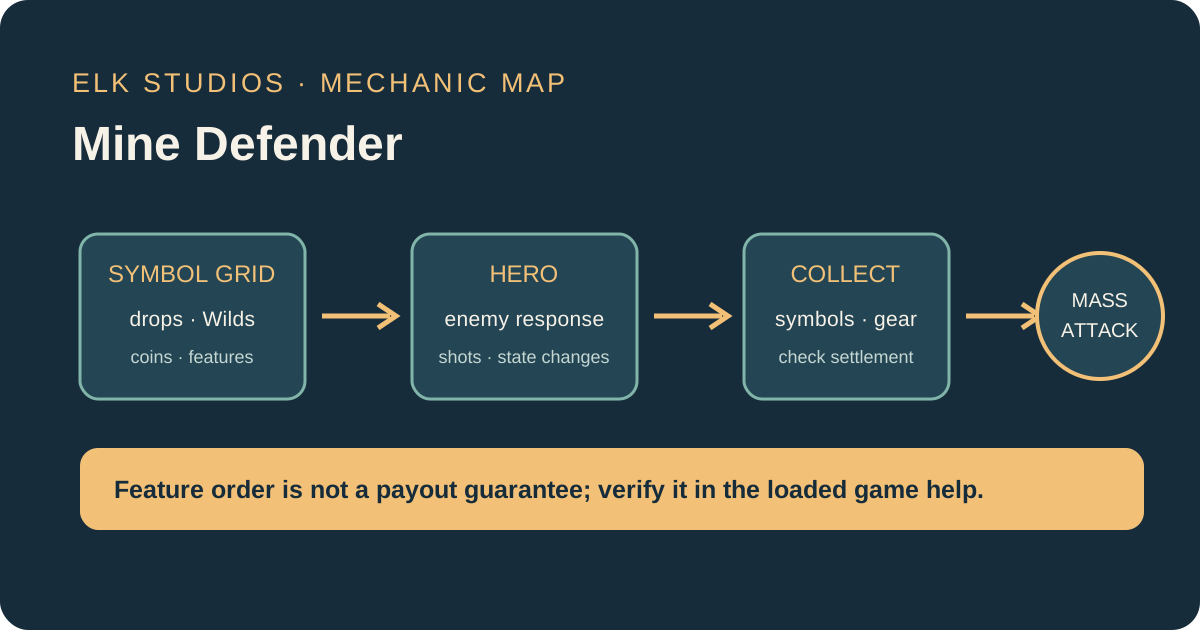
Mine Defender is a grid-based slot whose central idea is a miner holding a line against robots. ELK Studios describes dropping symbols and scatter wins, alongside Wilds, multipliers, coin wins, enemy encounters, a bonus and a super bonus. The Hero becomes active when enemies appear, fires at them and can collect equipment, feature symbols and paying symbols. A separate Mass Attack feature places the Hero in the centre of a circular field while enemies and symbols move inward; the supplier also describes a final boss battle after enough enemies have been defeated.
That gives a reader a useful way to follow the action: distinguish ordinary symbol drops from the Hero sequence, note what a feature changes, and then see whether the round has moved into the named bonus. It does not tell you the game’s current RTP, volatility label, hit frequency, exact wager range or operator-set cap. Those are configuration details that require the current game information panel at the casino where the title is loaded. A review page or a different demo build cannot establish them for your session.
This page keeps the title in one URL and separates the supplier’s public description from information still missing. It explains how to read the board, how the Hero and enemy rules fit together, what the Mass Attack and boss descriptions mean, and how to check an operator version without treating a dramatic animation as a payout rule. It does not claim that Mine Defender is offered in New Zealand, that a free demo is accessible from a New Zealand account, or that any optional mode is available to a particular player.
What the supplier description establishes
ELK Studios’ official page presents Mine Defender as a “defending slot” with dropping symbols and scatter wins. It names Wilds, multipliers, coin wins, boss battles, a bonus and a super bonus as part of the product. Its feature description says that the Hero is activated when enemies appear on the game grid. The Hero fires at them, with feature effects able to change shots, lives or projectiles. The game page also describes enemy robots as having different durability, moving toward the Hero and attacking when they reach the bottom row.
The official product text is strong evidence for the names and broad relationships of these features. It is not a complete mathematical specification. A short supplier synopsis does not show every symbol value, every trigger condition, the full sequence after an enemy is hit, or the exact way coin values and multipliers combine in the active game. The live help and paytable are where those operational rules should be verified. If a public synopsis and an in-game instruction use different language, the active help for the loaded build is the practical reference for that session.
An important editorial distinction is between the fictional story and a game rule. The setting describes a damaged world, a miner and incoming machines. The rules that affect a round are the symbol layout, win conditions, enemy movement, feature effects, bonus entry and settlement. The story can help a reader remember the feature names, but it does not prove that every enemy encounter pays, that the Hero always survives, or that defeating a boss always produces a large result.
ELK’s product page also describes an X-iter menu with different starting scenarios. That is a named supplier feature, not evidence that a particular operator enables it, that a New Zealand player may use it, or that its price and rules match another version. Treat the existence of the menu as a reason to inspect the active game help, not as an invitation to buy a feature. This guide does not link to or recommend an operator or purchase option.
A mental model for the base game
Start with the ordinary grid. Symbols land and can form the game’s published win patterns. The official description says the game uses dropping symbols and scatter wins, so a reader should distinguish a completed symbol result from what happens after symbols have cleared or moved. In a cascading or dropping system, one resolution may lead into another board state without a new paid spin. That is conceptually different from an extra spin purchased or started separately; the current rules must say exactly when a paid round ends.
The Hero is not simply a decorative character shown over the reels. The supplier says he activates when enemies appear and uses shots to attack them. During this action, the same encounter can be connected to equipment, features and paying symbols. A useful viewing habit is to pause mentally between events: identify what triggered the Hero, what the Hero action changed, which enemies or symbols remain, and whether the game has returned to ordinary resolution. This avoids treating the whole animation as one unexplained win.
The grid can hold several kinds of objects at once. Paying symbols contribute to ordinary results; Wilds may substitute if the game help says they do; multipliers modify eligible wins under their own conditions; coin symbols may carry a value or role; and feature symbols can activate a separate effect. A name such as “coin” or “multiplier” is not enough to know whether it applies to one symbol, an entire sequence, a bonus state or only a specific event. Look for the scope language in the paytable: per symbol, per win, global, attached, collected or retained are not interchangeable.
The Hero’s response is also a state change. ELK says Hero features can increase the number of shots, lives or projectiles. These terms describe different things. More shots can create additional attempts within an encounter; an added life can extend the state before the Hero is defeated; and a projectile effect can change how attacks reach enemies. The public page does not show every icon or order of precedence, so a player should use the game’s visual key and instructions rather than assume that all three effects are equivalent ways to add damage.
Enemy movement and the Hero’s condition
The enemy sequence gives Mine Defender an objective that differs from an ordinary static symbol grid. The official page says robots move toward the Hero when possible and attack at the bottom row, causing a loss of a Hero life. The exact path and exceptions should be read from the active rules, but the broad consequence is clear: an enemy is both a threat in the themed encounter and part of the feature flow. The Hero’s state is not the same as the player’s balance or the paid stake.
When watching a robot, separate its displayed durability from the number of Hero actions available. A tougher enemy may need more than one hit according to its rule, while a feature can affect shots or projectiles. That does not mean each shot is an independent bet or that a remaining enemy guarantees a loss of the round. The help panel should explain whether an attack happens before movement, whether multiple targets can be affected, and how the game selects a target when more than one is present.
If an enemy advances, note whether it moved one position, whether the Hero responded, and whether a feature altered the board. The interface may animate these transitions quickly. A round history or feature explanation, if available, is more reliable than trying to infer a hidden rule from the order of flashes. In particular, a player should not infer that an enemy reaching a boundary always ends a bonus; the supplier’s public text only identifies an attack and a lost Hero life, not every condition for terminating a state.
The Hero’s lives provide an internal game-state marker, but they are not a measure of the player’s remaining money. If a life is lost, it changes the feature state described by the game; it does not mean the game will return a stake or compensate a player. A visual meter can make the encounter feel like a separate action game, yet all wager settlement still follows the slot’s paytable and rules. Keep those two layers separate when reading the screen.
Hero features and collection
The official description groups Hero effects by what they influence: shots, lives or projectiles. It also says the Hero collects equipment, features and paying symbols while defending the grid. This suggests a relationship between the action sequence and symbol collection, but it does not disclose every transformation rule. A symbol collected during an encounter may have a different role from a symbol that simply lands on the base grid, so check whether the game calls it collected, replaced, upgraded or awarded.
An equipment icon can be a modifier rather than an immediate cash award. A feature symbol may change how the Hero acts; a paying symbol may contribute to a conventional win; and a coin may be settled under the multiplier rules. The paytable should specify which result is immediate and which changes future state. If the interface shows a feature banner before the round total appears, do not add its visual label to the payout yourself. Wait for the game to settle and inspect the ledger or history if the result is unclear.
The term “global multiplier” appears in the supplier’s final boss explanation. A global value may affect more than one eligible item, but the precise scope and timing need the game rules. Check when it is created, whether it carries between drops, whether it applies to a coin or trophy, and whether it resets at the end of a feature. Do not assume that a multiplier displayed on one screen is applied to every later event in every mode.
If the game offers a feature glossary, use it before play rather than during a timed animation. Make a short reference note for each symbol: how it appears, when it activates, what it changes, and when that effect stops. Mine Defender has enough overlapping nouns—Hero, equipment, shots, projectile, coin, multiplier, trophy, boss—that the same word can be mistaken for another. A glossary is more useful than trying to memorise every animation after a result has already been paid.
Mass Attack and the bonus sequence
ELK names the bonus “Mass Attack.” Its public page describes a circular grid with the Hero in the centre, while enemies and symbols move toward that centre from different directions. The circular layout changes how a reader should follow the screen: instead of looking only from top to bottom, watch the positions around the Hero, identify the direction of incoming objects, and note which event was resolved first. The bonus is a separate feature state, not merely a larger version of an ordinary spin.
The product page says that collecting bonus symbols triggers this game. It does not provide, in the short public copy, all conditions for collection, whether symbols must land together, what can retrigger the bonus, or the complete settlement procedure. Those are precisely the facts to obtain from the current help. Avoid copying a trigger count or free-round count from an unrelated review unless it demonstrably matches the same release and operator build. Our scope is the single title guide; there is no separate bonus-only URL.
Once the bonus begins, look for an explanation of what is retained from the base game and what is reset. Questions include whether the Hero’s condition carries over, whether a multiplier is shared across attacks, whether defeated enemies remain defeated, and what ends the sequence. The official summary supplies the central circular-board idea but not all of these details. The page therefore treats them as verification items rather than filling the gaps with plausible-sounding rules.
The phrase “super bonus” is also used in the supplier’s product description. It signals a named feature state, but a name alone does not establish its entry route or whether it is distinct from Mass Attack, a bonus extension or an X-iter starting mode. The active game help should explain the relationship. If it does not, an operator support answer or the game’s official rules document is needed before describing the sequence as definitive.
Boss encounters and the Trophy coin
The supplier describes a final boss battle after a threshold of defeated enemies. The boss occupies a larger pattern and has its own durability. If it is defeated, the page says its Trophy coin is multiplied by the global multiplier. This tells a reader that the boss is not merely a visual endpoint: its outcome links to a coin and a multiplier. But the words do not establish the probability of reaching the boss, expected value, whether every boss can be defeated, or the distribution of resulting payouts.
When a boss appears, first identify whether the feature has changed the grid or only overlaid a boss target. Then follow the game’s indicator for remaining boss durability, attack sequence and any life or shot effects. Watch for a separate trophy symbol and note exactly when the multiplier is applied. If the feature is resolved in several stages, use the history screen to see whether a displayed amount is an intermediate value or the final amount credited to the account.
A boss result is especially easy to overinterpret because a game can present it as a climax. “Defeated” is a condition, “Trophy coin” is an award type, and “global multiplier” is a calculation rule. They should be read as separate pieces of the final settlement. A boss can be a meaningful mechanic without implying that every session reaches it or that the displayed maximum potential is a realistic expectation for an individual spin.
Any maximum potential displayed on a marketing or supplier page should not be confused with a typical award or an operator’s current limit. This review deliberately does not state a maximum multiplier or coin value because the current operator help was not supplied. The actual client’s paytable, settings information and any published cap are required before a numeric claim is safe.
RTP, volatility and settings: what is still unknown
RTP is a theoretical long-run return percentage under a defined math configuration. It is not a promise about a session or a statement that a particular player will get back a fixed share of the amount spent. A slot’s supplier identity does not tell you which RTP configuration an operator has selected. Two versions of a title can use different settings while showing the same name and animations.
Volatility describes the distribution of results, not the direction or timing of the next spin. A high-volatility label, if present in a client, does not guarantee a large win; a low-volatility label does not mean that a loss cannot happen. The hit-frequency field, if provided, also has a defined scope: it may count any feature award, any non-zero win or another category. Without the game’s definition, the percentage is easy to misread.
For Mine Defender, no operator’s current game-help screen or paytable was supplied for this review. As a result, this article does not publish a numerical RTP, volatility rating, hit frequency, stake range, payout table, trigger probability, X-iter price or current max-win cap. The official supplier page names a maximum potential, but the assignment requires numeric settings to be checked against current game help; the number is intentionally not repeated as a verified operator setting. A competitor’s 2025 figure is not a substitute for that evidence.
To verify an actual build, open the game information before betting and save the exact title, game version if displayed, RTP field and paytable. Record the minimum and maximum stake in the displayed currency, bonus trigger wording, feature-buy price if enabled, and any cap or maximum-payout terms. If the screen has no RTP field, do not infer that the provider’s product page or a review has filled the gap. Ask the operator for the applicable specification and keep the answer tied to that named game build.
Optional modes and feature-start menus
X-iter is a supplier-named feature menu on the public Mine Defender page. Its description says that different modes can begin with a changed scenario or bonus state. That alters the starting conditions from an ordinary base spin. It should therefore be read as a separately priced feature choice with its own rules, not as a free preview or a guarantee of a result.
Before using any optional mode, the client should display its exact cost, what state starts, what remains random, which paytable applies and whether the cost counts as a single wager or a larger multiple of the usual stake. The public product synopsis is not enough to confirm an operator’s actual terms. This page does not reproduce feature-buy prices or recommend them. In New Zealand, advertising and availability also require a separate current assessment; no operator access is claimed.
If a menu offers a “bonus” or “super bonus” start, compare its starting state with the normal feature path. A mode can begin closer to an event while still leaving outcomes uncertain. Read whether the feature can end without a prize, how the final amount is calculated, and whether the displayed base bet is multiplied by the feature cost. A single decision can increase exposure much more than the spin control suggests, so the full currency amount matters.
Mobile display and practical readability
The supplier’s page recommends a landscape desktop proportion for the intended presentation. That is a product-design note, not a promise that every mobile browser will show the board clearly. On a phone, check whether the enemy positions, Hero state, feature icons and running total remain legible without hiding the bet controls. Use the game’s fullscreen or rotate option only if it is offered by the client and does not obscure the rules panel.
Before a session, open the paytable on the device you plan to use and check that it can be scrolled, closed and reopened. Confirm that an animated feature does not cover the current stake or action prompt. If a small screen makes it difficult to identify which feature changed, stop rather than tap through a decision. A touch interface can make a repeated spin button easy to hit accidentally; check that any repeat control does not preserve an unwanted side bet or optional mode.
Device performance can also affect the player’s ability to read the sequence. A lagging animation or dropped connection is not a game rule. The account history and operator terms should explain the resolution of a disconnected round. Do not infer a win or loss from a frozen frame; wait for the game state or obtain the round reference from the history before contacting support.
Demo access and release status
ELK’s public page displays a Play control and downloadable product materials. That establishes that the supplier presents a product page; it does not prove that a demo launches in every country, that the game is live with a New Zealand-facing operator, or that the user has permission to play it for money. Demo versions can omit account settlement, use a different math setting, or be disabled in some locations. Their results cannot establish the configuration of a real-money client.
This review has not launched the game or a demo. A current operator listing, New Zealand eligibility and in-client help were not provided or tested. Accordingly, the page describes the supplier-published mechanics, not release status in the New Zealand market. A public “Play” button on the supplier site should not be read as a local availability guarantee.
How to compare Mine Defender with another slot
Compare mechanics at the right level. Mine Defender’s unusual feature identity is a defending encounter where a Hero responds to enemy movement and can collect symbols and equipment. A game with a generic wild feature or a separate free-spin round is not necessarily similar. If you compare it with another grid slot, ask what causes a feature to begin, what persists between events, and how the game explains the result.
Then compare verified mathematical information only when the exact build is known. Record the RTP shown in each client, the same-currency stake range, how volatility is described, any published maximum cap, and whether optional modes change the wager. Do not compare a supplier’s broad maximum potential against another game’s current operator cap. Do not compare a UK stake range to a New Zealand account or use a review’s estimated volatility score as though it were an official field.
Finally, compare usability: whether the instructions name every symbol, whether the history explains coin and multiplier settlement, whether the touch controls are clear and whether a player can see the total amount wagered. A game may have an original mechanic but still be a poor fit for someone who finds fast feature sequences confusing. A calm rules check before play is more valuable than a star rating or a reviewer’s personal reaction.
A careful pre-play checklist
Use this checklist if an operator later makes the title available and provides the active help. Confirm the full game title and supplier; read the base win and scatter conditions; understand when the Hero activates; learn what enemies do and how lives change; distinguish shots, projectiles and equipment; read the Mass Attack entry and end conditions; check what “super bonus” means in that build; and confirm coin, Trophy and global-multiplier settlement.
After the feature rules, verify all account-facing settings: current RTP or an explicit statement that it is not displayed, any volatility label and definition, currency, stake limits, max-win wording, and optional-mode cost and restrictions. A missing value is not permission to borrow one from an older article. If two screens disagree, preserve the exact help screen and ask the operator which build and paytable govern the account.
Decide a spend and time limit before the first round. Include optional features and repeat controls in that limit. Stop if the game cannot explain what a button costs or what a feature does. The New Zealand safer gambling guide provides support information and practical ways to take a break; no game mechanic turns a wager into dependable income.
Frequently asked questions
What type of game is Mine Defender?
ELK Studios describes it as a defending slot with dropping symbols and scatter wins. The game also includes a Hero sequence, Wilds, multipliers, coin wins, boss encounters and named bonus states in the supplier’s public overview.
What does the Hero do?
The supplier says the Hero activates when enemies appear, fires at them and can collect equipment, features and paying symbols. The active game help is needed for the exact targeting, timing and symbol-effect rules.
How does the Mass Attack bonus work?
ELK describes a circular play area with the Hero in the centre and enemies and symbols moving inward. The current game help must be checked for the complete entry condition, what persists and how the feature ends.
Is Mine Defender’s RTP known for New Zealand?
No New Zealand operator build or current game-help screen was supplied. This guide does not state an RTP, volatility, hit frequency, stake range or operator cap, and does not claim New Zealand availability.
Does the supplier page confirm the maximum win?
It contains a supplier-published maximum-potential statement, but this article does not treat it as the active operator cap. The current client’s help and payout settings are required for a verified numeric claim.
Is the X-iter menu available to every player?
The supplier page names X-iter modes, but that does not establish that an operator enables them or that a specific account can access them. Check the exact client’s current instructions and cost before considering any optional mode.
Can I use a demo to verify the real-money RTP?
A demo does not establish the setting used in a separate operator build. It can be useful for learning visible controls only if access is lawful and available, but the active client help is needed for its own configuration.
Is Mine Defender confirmed to be available in New Zealand?
No. This review does not verify an operator listing or NZ account eligibility. Supplier information about a title is not proof that a casino offers it in a particular country.
Sources and verification boundary
Primary information checked 15 June 2026: ELK Studios’ Mine Defender page for supplier-published mechanics and the public product description; ELK Studios’ games catalogue for catalogue context; and DIA guidance for online-gambling advertisers for the current New Zealand advertising transition. Competitor examples checked 15 June 2026 include Casinos in Canada’s Mine Defender review and a Dutch operator’s game page; their regional figures were not adopted as New Zealand settings.
The source page supports the qualitative mechanics described above. It does not provide the current operator game-help panel used to verify the assignment’s requested RTP variants, volatility, stake range and cap. Numeric settings and New Zealand availability are therefore not stated. The competitor pages publish configuration claims tied to their own contexts; the review sample is a focused check, not a complete search-results study. No keyword-volume, ranking or traffic data was available. No game or demo was launched, no operator account was checked, no CPA destination was opened and no publication or legal conclusion about the exact affiliate route is made.
