ELK Studios game rules · South Island guide
Toro Shōgun ELK Studios slot review: rules and features
 Best casinos available in New ZealandUpdated 7 November 2026

Toro Shōgun combines a changing grid with walking Wilds, a Toro and Matador interaction, a Both Ways condition, and distinct bonus states. This review explains how to read those features without borrowing RTP or payout claims from another operator or Toro title.
The short answer
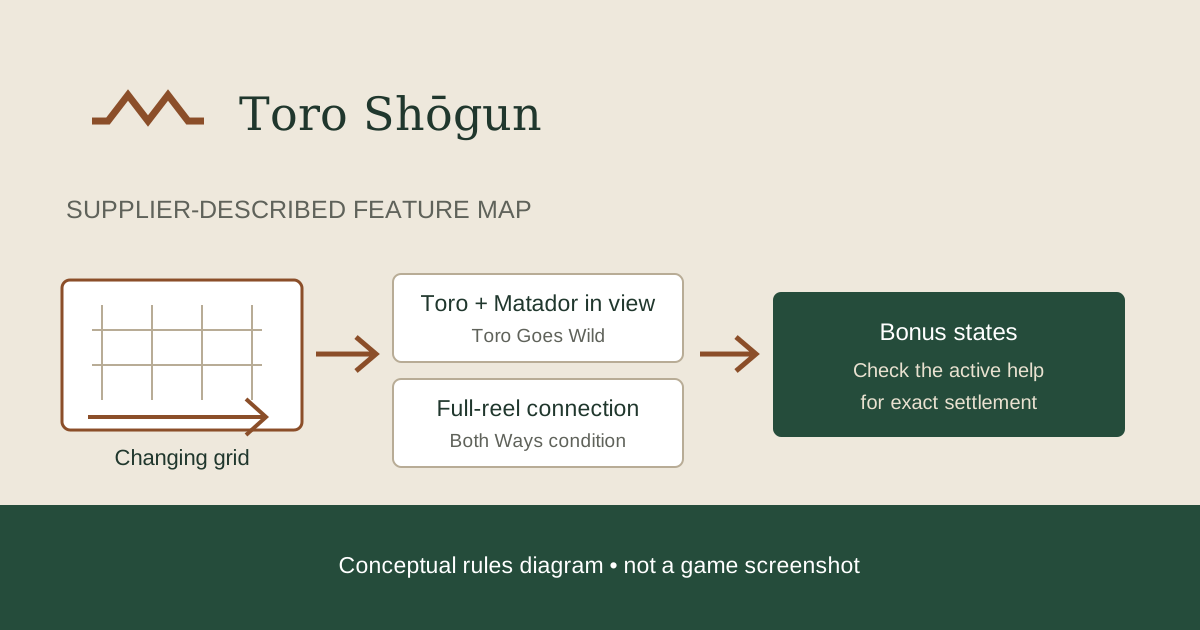
Toro Shōgun is an ELK Studios slot built around an expanding reel layout and several features that interact with named characters. The supplier’s public page describes walking and stacked Wilds, expanding rows, Both Ways, respins, a bonus game and a Super Bonus. It also says the Toro Goes Wild feature begins when Toro and the Matador appear together, and describes a Shōgun mode that follows full grid expansion. Those are useful signposts, but the exact trigger thresholds, wins, RTP variant and volatility for an operator’s client must come from that client’s current help.
This page helps a reader understand the difference between the visible animation and the settlement rule. We checked the ELK Studios Toro Shōgun page on 7 October 2026. The official summary supports the feature outline; a downloadable game-data sheet and a current New Zealand operator help panel were not available. For that reason, this review gives no percentage, stake range, win cap or claim of local access.
Make sure the game is Toro Shōgun
ELK has several games built around Toro and recurring characters. Toro Shōgun is a distinct title, not a new name for Toro 911 or Wild Toro 3. Those separate guides cover their own layouts and features. A reviewer should not combine their details just because a bull character returns or a game uses a similarly coloured Wild.
Confirm the exact title in the client’s information screen. Record the supplier, displayed title, game identifier if shown, configuration or build label if available, and date of inspection. A search result or casino category card may truncate the name. If the information panel uses a different spelling or omits the diacritic in Shōgun, check the accompanying provider field and help heading before assuming equivalence.
Supplier product pages are evidence that ELK describes the product and feature family. They do not prove which casino distributes the game, whether the title is enabled for New Zealand, or whether one operator’s configuration is used by another. These are separate questions. If a casino does not list the title in its own game lobby, an international review page cannot establish that it is available there.
How the changing grid affects play
The supplier describes a reel grid that can expand as part of Toro Shōgun’s feature design. The first thing to establish in the active help is what causes a row to appear. Then check whether the change happens after a qualifying win, a symbol event, a respin or a separate mode. Do not infer the trigger from a single animation; the same visual expansion can result from different rules in other games.
Next, find out when the added space is evaluated. Are the newly visible symbols part of the same win check, do they enter before a later evaluation, and does the layout remain expanded until the round ends? The client’s paytable should explain how a win is formed on the expanded grid. If it uses connected combinations, paylines, ways or a named Both Ways rule, each term should be read as written rather than translated into familiar terminology from another slot.
The expanded display can make the game look more active, but more positions do not guarantee that symbols will match. A larger visual board is a state change, not a promise of a winning outcome. Track the sequence in the round history: initial layout, trigger, newly available positions, eligible symbols, any respin, and final result. This method keeps each effect in its own place and makes the rules easier to explain.
An online review might list a maximum number of rows, ways or lines. Unless the value is shown by the current help or an applicable game-data sheet, treat it as unverified. This is especially important when the supplier has a family of Toro games with multiple layouts. The present article describes why expansion matters without importing a number from an old or market-specific review.
Ordinary Wilds, stacked Wilds and Toro’s movement
ELK’s public description separates walking Wilds and stacked Wilds. A stacked Wild is displayed across adjacent positions as one feature object or a set of linked symbols, depending on the game’s implementation. A walking Wild changes position across a reel or screen. These visual forms can have different substitution and movement rules, so the help should define them separately.
Check whether the Wild substitutes for every standard symbol or excludes bonus and character symbols. The product summary does not spell out all substitution exceptions. It also does not tell us whether a walking Wild moves before or after symbol evaluation, whether it leaves Wilds behind, or whether a stack pays as a single symbol or several positions. ELK’s named Toro Goes Wild description gives one specific interaction: when Toro and the Matador are both in view, Toro leaves Wilds as he chases the Matadors. Use that as the feature’s broad identity, then rely on client help for the exact step order.
There is a useful distinction between a symbol that moves and a symbol that remains. A trace left behind may participate in later evaluations, but that should not be assumed from the animation alone. Look for a sentence in the help that says whether the trail persists, how long it remains, and whether it is confined to the current spin. A still image of several Wilds cannot prove the order that created them.
If Toro and Matador appear on a screen, note whether the game announces the feature before the next symbols move. Then check the round record to see which resulting Wilds contribute to a paid combination. The feature name explains a theme; the paytable and game history explain the accounting.
Both Ways is a named rule, not a generic promise
ELK describes Both Ways as activating when a winning combination connects all reels from left to right. This supplier wording should be retained carefully. It does not mean that every symbol sequence pays in both directions at all times. The trigger is tied to the named feature and a condition involving the full reel set.
The active rules should explain whether a qualifying combination is identified before the feature changes direction, what symbols can form it, and whether a reverse-direction result is settled as an additional win or as a separate feature event. If the client presents a paytable diagram, read the starting point and connection requirement. Do not infer that a near-complete line qualifies, or that the same symbols can be counted twice, unless the text explicitly says so.
This matters because “pays both ways” is often compressed into short review tables. That phrase can hide the actual condition and cause a reader to expect routine reverse-direction payments. A better explanation names the supplier’s condition and leaves any operator-specific pay calculation to the current help. This review does not claim a precise payout or count of winning paths.
For an observed round, record the qualifying connection, direction shown by the game, symbols involved, any Wild substitutions and the balance change after settlement. If the game displays separate awards, keep them separate in your notes. A feature-trigger message is not itself proof of an extra payout; the transaction history is the place to confirm what the round actually settled.
Respins, feature sequencing and timing
The supplier lists respins among Toro Shōgun’s features. “Respin” can describe a new reel result under special conditions, a preserved set of symbols while some positions change, or a stage within another named feature. The product page alone does not define every trigger or whether a respin is available in the base game, a bonus or both. The live help should identify which positions remain fixed and what ends the sequence.
When one feature leads to another, record the handoff. For example, a round may first satisfy an expansion condition, then show Toro and the Matador, then enter a Both Ways resolution, or it may resolve only one of those events. The order affects which symbols are evaluated and which state persists. It is not safe to rearrange feature steps to make a simplified narrative.
The best way to learn the sequence is through the help screen’s feature diagrams, if present, and a complete round-history record. A short video clip can omit an earlier trigger or later settlement. If you are reviewing only the static supplier description, say that your explanation covers the named interaction at a high level rather than presenting an unobserved sequence as confirmed.
Avoid describing a respin as “another chance” in a way that implies value or a likely win. It is another rule-governed outcome, not a guarantee. A reader can understand what remains on screen and what may change without being told that a feature makes the game more favourable.
Base bonus and Shōgun Bonus
ELK’s public summary describes a bonus game and a Super Bonus. It says bonus symbols start the bonus, that bonus symbols during Shōgun mode lead to a Shōgun Bonus, and that additional bonus symbols during a bonus game increase a global bonus multiplier. The current client help should confirm the exact number required, what distinguishes each bonus version and when the multiplier is applied.
The “global” label matters because it suggests an effect wider than a single symbol, but the client must define its scope. Does it apply to every eligible award within a bonus, reset between drops, carry to a respin, or affect only a named award? Do not substitute an explanation from Toro 911 or another ELK game. Similar words such as “Super Bonus” can represent different rules across titles.
Look for the entry condition, the number of free rounds or drops awarded, any retrigger condition, which symbols are sticky, and the point when the total is credited. Because this data sheet could not be read, this review does not state a trigger count, spin quantity or multiplier value. Those are exactly the details a current game help panel should settle.
When comparing the base bonus with Shōgun Bonus, describe only documented differences. If Shōgun mode restricts the symbol set, name that as a change to the reel content, but do not claim it guarantees a better result. A bonus is a different game state; it is not evidence that a specific account receives higher returns.
Optional X-iter modes and additional cost
ELK presents X-iter as a group of optional modes that can move a player closer to a feature or directly into a bonus state. Its public product page describes several modes, including a route to a Shōgun super bonus. Availability depends on the client and jurisdiction, and the exact mode list should be confirmed in the game. This is not the same as the ordinary base game’s random feature trigger.
An optional feature entry should be understood as a purchase with its own displayed cost, not as a free shortcut. Before using one, if it is available, the user should read what the price includes, whether the stake is added or included, which RTP applies, which rewards are possible and whether any jurisdictional restrictions appear. This guide does not quote the option prices or recommend buying them.
Do not treat higher feature access as a sound way to manage play or get an expected prize. Paying to enter a bonus changes the immediate cost and can change the sequence experienced, but it does not turn an uncertain outcome into a guaranteed win. The current client help is the only appropriate place to confirm mode terms, and personal limits should be set independently of the feature menu.
If the option is missing from a casino version, do not assume something is broken. An operator may use a build or market configuration that omits it. The supplier page’s global catalogue does not prove that all listed modes are enabled everywhere.
RTP and variant settings: what we could not verify
RTP is a theoretical long-run return measure for a defined configuration. It is not a forecast for one session and does not promise that a portion of a stake will be returned on an individual spin. A short observation cannot calculate the game’s RTP. The correct figure for a person’s client should be shown in the current help or in a current title-specific operator document.
This article does not state a Toro Shōgun RTP or list alternative settings. Competitor pages checked for this review publish different summaries and may be based on different operators, dates or markets. The public ELK page gives features but its downloadable game-data sheet was unavailable in this research. No active New Zealand casino build was supplied for inspection. A percentage copied from another review would be more precise than the evidence allows.
To verify a setting, open the information menu before play and look for a field labelled RTP, theoretical return or equivalent. Note whether the value is a single default, whether variants appear and which one is active. Keep the game title and build identifier with the value. If the panel does not show an RTP, ask the operator for the applicable help material rather than applying a number from a different Toro game.
For a comparison across two casinos, check that both clients are the same game and that their displayed settings refer to the same calculation. Similar artwork does not prove identical mathematics. A title may have more than one configuration, but a list of generic variants is not a substitute for identifying the variant actually selected by an operator.
Volatility, max potential and payout cap
Volatility is a description of how variable outcomes can be; it is not the same as long-run RTP. A third-party label such as “medium”, “medium-high” or “high” may have no shared scale and should not be read as an objective measure unless the publisher explains its method. This page assigns no volatility rating because no current help or verified operator source was available.
Maximum potential, maximum win, a round cap and the amount shown by a particular feature are separate ideas. The official product page uses a maximum-potential description, while competitor tables repeat numerical caps. This review does not treat either as the operator’s exact round settlement rule. Find the current paytable field and read the terms around the cap: which stake unit applies, whether the value includes bonus purchases, and what happens if a calculation would exceed it.
If a jackpot, multiplier or bonus appears to exceed a normal win, do not decide from the animation which limit applies. The help should say whether a special award is within the cap or governed separately. A precise answer requires a current client and configuration. Until then, the cap is unverified.
These distinctions make a review more useful than a single headline number. A reader should be able to tell what the game’s public product description says, what the client help confirms, and what is simply not known.
Mobile controls, help and demo
A modern slot may scale to a phone, tablet or desktop, but visual scaling does not prove the game is available in a particular market or that each device shows the same settings. Check that the title, help icon, paytable, stake control, round history and exit action are reachable at the screen size in use. A feature animation should not hide a way to open rules or stop a session.
Read the game help before making assumptions about the bull, Wilds or grid. If symbol labels are hard to distinguish, check whether the rules provide names and descriptions in text rather than colour alone. A reader using a keyboard or assistive technology should be able to locate the controls; where that is not possible, request accessible information from the operator instead of guessing.
A demo may be a useful way to understand the interface if the operator offers it and local conditions permit. It may also be a different version or unavailable. A demo on a foreign affiliate site does not show that a New Zealand account can access the real-money title. Check the game identity and settings screen in any permitted demo, and do not confuse demonstration access with operator distribution.
The responsible review question is not “does the demo work somewhere?” but “what exact version is this, what does its help say, and can the intended reader access it under the relevant rules?” This article cannot answer the final access question from ELK’s catalogue alone.
A practical reading checklist
When inspecting Toro Shōgun, keep the evidence in a simple sequence. First write down the exact title and provider. Next note the starting grid as displayed, then the rule that changes the layout. Check how ordinary and stacked Wilds substitute, what “walking” means in this client, and whether the Toro/Matador interaction leaves any Wilds behind. Read the Both Ways condition exactly instead of paraphrasing it as a general reverse payout.
Then trace the bonus entry and any Shōgun-specific path. Record which parts of the symbol set change, what state persists, how a global bonus multiplier is applied, and where the total is settled. If X-iter appears, review its cost and conditions separately from the normal game. Keep screenshots of help text only where the operator permits it, and write down the inspection date.
Use “confirmed”, “supplier-described” and “unverified” consistently. A supplier page can confirm that ELK publicly describes a feature. The current help can confirm the client rule. A single observed round can show an example of that rule. None of those alone proves the long-run frequency or profitability of a feature.
The game’s story may connect Toro’s movement with samurai imagery, but the theme is not evidence about the probability model. Do not turn the narrative into claims about likely wins. A useful review is one that lets a reader understand the mechanics without overstating what they promise.
Responsible use and a balanced verdict
The feature set is layered: the grid can change, Wilds may move or appear in stacks, Both Ways has a specific condition, and Toro and the Matador can combine in a named feature. Bonus and Shōgun states add another layer. This makes the rule sequence worth reading rather than reducing the title to a single “high-win” tagline.
At the same time, there is no verified RTP, volatility label, operator cap, stake range, demo status or New Zealand access claim in this guide. A conclusion that rates the game as favourable or says it is worth playing would go beyond available evidence. The narrow, defensible verdict is that ELK’s public product page documents distinctive rule families, while the actual mathematical configuration must be checked in the current operator client.
If you choose to play any gambling game, decide in advance how much time and money you are willing to spend, and stop at those limits. Do not raise stakes to chase a feature or recover a loss. If gambling stops feeling manageable, leave the game and seek independent help. The site’s safer gambling guide provides New Zealand context and support routes.
Frequently asked questions
What is Both Ways in Toro Shōgun?
ELK’s description links the feature to winning combinations connecting all reels from left to right. That is a specific feature condition, not proof that every regular result pays in two directions. The operator help should explain its calculation and settlement.
How does Toro Goes Wild start?
The supplier says the feature is triggered when Toro and the Matador are both in view, after which Toro leaves Wilds as he chases the Matadors. Exact movement, persistence and substitution rules should be confirmed in the active client.
Does Shōgun Bonus have a different RTP?
This review cannot verify that. RTP and bonus rules are configuration-specific details. Check the current game help for the selected operator client; do not assume that a distinct bonus mode automatically has a separate return setting.
Is X-iter available everywhere?
No global supplier page proves universal availability. Optional modes may be omitted or restricted by a particular operator or jurisdiction. If a mode is shown, read its local cost and terms before deciding whether to use it.
Is Toro Shōgun available to New Zealand players?
This page does not verify access through a New Zealand operator. The supplier catalogue confirms the title’s public product information, not the distribution or eligibility of a specific account.
Sources and date checked
- ELK Studios Toro Shōgun product page and ELK catalogue — checked 7 October 2026; title and public feature outline.
- Competitor sample checked 7 October 2026: WhichBingo, Bigwinboard, FruitySlots, and Casinos.com. The last redirected to a general page; competitor figures were not used as operator facts.
- DIA guidance for online gambling advertisers and Online Casino Gambling Regulations 2026 — checked 7 October 2026. Promotional affiliate links remain withheld pending qualified compliance review.
