ELK Studios game rules · South Island guide
Ashoka ELK Studios slot review: rules and features
 Best casinos available in New ZealandUpdated 7 November 2026

Ashoka is a scatter-pay slot with large and stacked Wilds, a changing grid, multiplier effects and a free-drop bonus. This guide explains those mechanics while keeping the original Ashoka separate from Ashoka Eternal and leaving operator RTP, volatility and payout settings for current game help.
The short answer
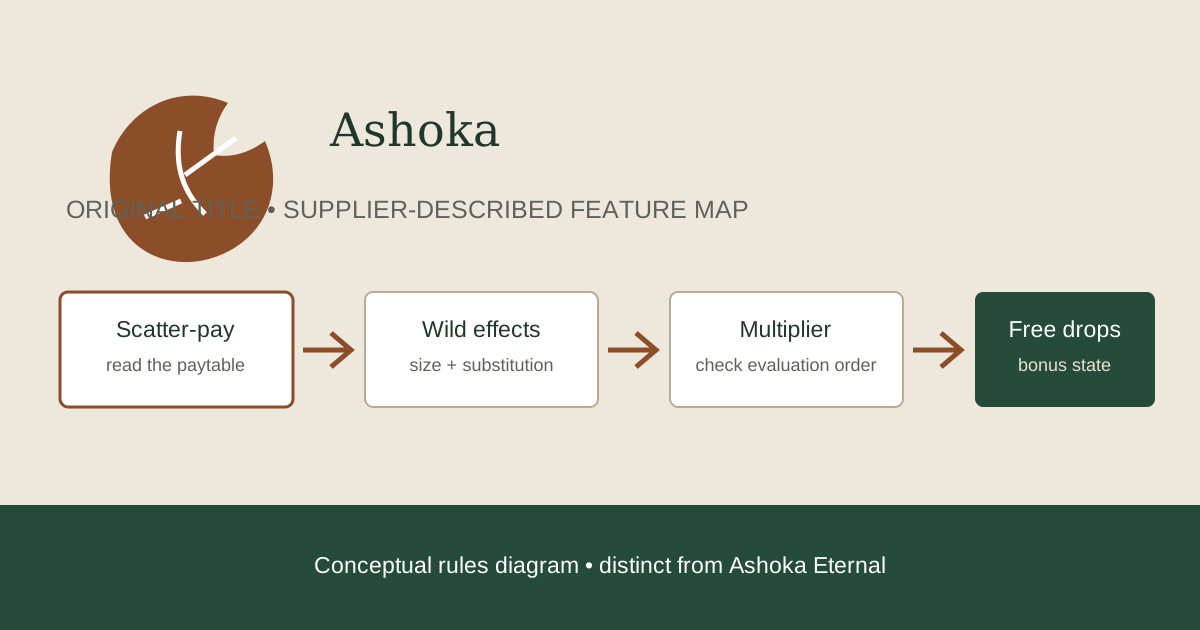
Ashoka is the original ELK Studios slot, not Ashoka Eternal. ELK describes it as a scatter-pay game with Big and stacked Wilds, an expanding grid, a multiplier feature, and a bonus and Super Bonus. The supplier says a multiplier activates the Win Multiplier when winning combinations are in view, while a Super Multiplier reactivates for each avalanche. Bonus symbols anywhere on the main grid can start a free-drop bonus, and the bonus may retrigger. Those terms sketch the main feature relationships; they do not verify an operator’s mathematical settings.
This guide focuses on what the rules mean and which items a reader must check in the client. The ELK Studios Ashoka product page and catalogue were checked on 7 October 2026. The public product page describes the broad mechanics, but its downloadable game-data sheet was inaccessible during research. No current operator help for a New Zealand account was provided. We therefore do not state an RTP, variant list, volatility label, exact payout cap or local availability.
Ashoka and Ashoka Eternal are different games
The first check is the exact title in the game information screen. ELK lists Ashoka and Ashoka Eternal as separate products. This site also has a dedicated Ashoka Eternal guide, with its own cluster-focused mechanics. That page is not a substitute for the original Ashoka rules. Similar names and related visual themes do not show that two versions share the same paytable.
Record the title as displayed, provider, game identifier if visible, build label if available and date. If a search result calls the game simply “Ashoka slot”, use the title in the actual client before deciding which page applies. If the lobby card and information panel differ, pause and check the game identifier. A promotional image can be reused across regions while the title or client settings vary.
The supplier’s product page establishes that ELK publicly documents the game. It does not establish distribution by a particular New Zealand casino. Nor does a foreign demo prove access for a local account. Treat title identity, current release status, operator distribution and account eligibility as separate facts.
What scatter-pay means
ELK labels Ashoka a scatter-pay slot. A scatter-pay format evaluates qualifying symbols across the grid according to its rules rather than assuming that every win follows a fixed line. That distinction can affect how a player reads the layout, but the term alone does not tell us the exact matching condition. The paytable must define which symbols qualify, how many are required, whether adjacency matters and how the game handles Wilds.
Find the symbol table first. It should show ordinary symbols, Wilds, bonus symbols, any multiplier symbols and any special objects. Read the payout explanation alongside the symbol picture: two symbols may look related while performing different roles. The client should also say whether wins are evaluated before or after a grid expansion or avalanche.
Do not turn “scatter-pay” into “everywhere on the board pays”. The word scatter is not a universal payout rule. Some games require symbols anywhere, others require a count or a state condition, and some reserve “scatter” for a bonus trigger. A review should use Ashoka’s own paytable definition rather than a generic slot glossary.
When a round resolves, note the symbol count, its positions, any substitutions, and the value the client records. If the game changes the grid and evaluates again, keep the two events separate. A visible symbol combination can be the input to a feature rather than an independently settled win. The history panel is useful for distinguishing these stages.
Big and stacked Wilds
ELK’s description names Big Wilds and stacked Wilds. A Big Wild covers a larger footprint than a single-position Wild; a stack spans multiple spaces. Both can change the set of symbols participating in a result, but their exact behaviour should be read from the current help. The supplier public summary does not provide every substitution exception or how the game handles a partial overlap.
Check whether a Wild replaces all regular symbols or excludes bonus, multiplier and other special symbols. Find out whether a Big Wild is treated as one object, several occupied positions or a single substitution across its whole footprint. A stacked Wild may also be evaluated differently from a large symbol. These distinctions determine whether the display is a visual effect, a substitute, a feature trigger or some combination.
The help should explain when Wilds are placed and whether they remain on the grid for later evaluations. If the game uses an avalanche, a symbol may persist only for the current evaluation or may be charged for a later win. ELK describes charged Wilds as lasting for a limited sequence of wins, but this guide does not give an unverified duration. The exact number and reset point must come from the current client help.
Avoid a blanket statement that Wilds “boost every spin”. A Wild can help only when its position and substitution role fit an eligible combination, and the paytable determines the effect. If a Wild is part of a win, that does not automatically mean its size or appearance changes the payout beyond the listed rules.
Expanding grid and avalanche order
The official page lists an expanding game grid and avalanches in the multiplier description. A changed grid affects what positions are available for later evaluation. To understand it, check the event that opens or adds space, whether symbols move into that space, and how the next pay check occurs. It is also important to know whether the expanded layout continues for one evaluation or remains through a feature state.
The word “avalanche” often describes symbols being removed and new ones falling into empty spaces, but implementations vary. Use the Ashoka help to establish exactly what happens after a qualifying result. Is the winning set removed? Do new symbols replace them? Does the game check the new board immediately? Are non-winning symbols retained? These are separate steps and should not be compressed into a single claim that the reels “cascade”.
An expanded grid can create more possible arrangements, but it does not guarantee that any of them will win. A larger number of positions is not a probability statement. The user can understand the feature by observing the board transition while keeping the event outcome separate from its mathematical chance.
If a review page lists an exact grid size, line count or number of possible ways, confirm the value in the active help. The source data sheet was unavailable during this review, so we avoid a precise layout cap. That boundary also prevents a number from a related title or older client from being passed off as current.
The Win Multiplier
ELK describes a multiplier symbol that activates the Win Multiplier and adds its value when winning combinations are in view. A practical reading is to separate the symbol’s appearance from the moment it affects a result. The symbol may be visible before a qualifying combination occurs; its presence alone should not be called a paid win.
The client should explain which values are added, when the resulting multiplier is applied, and whether it applies to a single combination or a broader total. If multiple winning combinations appear in one evaluation, find out whether each is calculated separately and then combined, or whether one multiplier modifies the overall result. A generic description like “all multipliers add together” can be wrong if the rules use a different order.
Write down the starting multiplier state, the triggering result, any values changed, and the round total after settlement. If the interface shows an intermediate total and then a final total, use history to determine whether the multiplier was applied once or at a later step. Do not add the displayed values manually unless the paytable instructs you to do so.
The supplier identifies the multiplier feature but does not provide an operator’s active settings in the public summary. A numerical multiplier value, maximum, frequency or expected return belongs in the live help or applicable data sheet. None should be inferred from a screenshot or third-party review.
Super Multiplier and repeated avalanches
The Super Multiplier is described as reactivating for each avalanche. This is a timing rule: the event that follows one result can change the multiplier state again. To review it accurately, first learn what the game calls an avalanche, then establish whether reactivation happens before or after the next board evaluation. The order determines which result is affected.
Do not assume that “reactivates” means a multiplier is guaranteed to grow on every avalanche. The supplier’s wording should be checked against the active help, which may define a trigger symbol, a specific state, a reset or a maximum. Reactivation can describe an effect becoming active again without proving that the next win increases by a predictable amount.
Track each board state in sequence: current symbols, qualifying result, removal, avalanche, multiplier event, next symbols, next evaluation and total settlement. If the interface displays a multiplier value after the spin, compare it with the event history. This approach reveals whether the feature affects the next result, a bonus total or a particular category of win.
The multiplier and an expanding grid can occur in the same game, but they answer different questions. Grid expansion changes the positions available for an evaluation; a multiplier changes how an eligible win is calculated. A review should explain both and then show where the help links them, rather than suggesting that one automatically causes the other.
Bonus and Super Bonus
ELK says active bonus symbols anywhere on the main grid can trigger the free-drop bonus and that the bonus can retrigger. The exact threshold, number of drops, retrigger condition and any difference between the bonus and Super Bonus should be read from the client. Because no current operator help was available, this article does not publish a symbol count or award quantity.
The phrase “anywhere on the main grid” describes a position condition in the supplier’s public outline. The live help should clarify whether the symbol must be active, whether any grid expansion changes the eligible area, and whether a symbol that appears during an avalanche can contribute. Do not assume that the same trigger rule applies during the bonus.
Find out which feature states carry into the free drops. Are Wilds sticky? Does the multiplier persist? Does the grid return to its starting layout? Can the bonus retrigger, and does that extend the same state or begin another? These questions are more informative than a generic label such as “free spins”.
If a Super Bonus is offered as an optional mode, its entry terms are separate from the randomly triggered bonus. Review its cost, included stake, starting state and applicable RTP in the game help. It is not a guaranteed win. This review does not list a price or recommend paying for a feature.
X-iter and optional modes
ELK lists X-iter as a set of optional game modes for Ashoka, including modes described as increasing the chance of a bonus or starting a Super Bonus. Availability and exact terms may vary by operator and location. A public supplier description cannot prove that a casino enables every option in its client.
If an X-iter menu appears, read what each mode changes. Determine whether the cost is an additional purchase, whether the base stake is included, what state begins, how the mode affects the theoretical return, and whether the option is permitted in the relevant jurisdiction. The active interface should display the amount and conditions before confirmation.
Treat optional feature access as a distinct decision from the base game. A paid route changes the cost and the starting conditions; it does not make the outcome predictable. Do not compare a purchased bonus to a normal spin without accounting for its separate cost and setup. This page does not quote X-iter prices because the current local help was unavailable.
When a mode is missing, it may have been disabled for that client. That is not enough evidence to claim the casino has an incomplete or broken release. Record the omission as an interface observation and ask the operator for clarification if the availability matters.
RTP: what a current check should show
RTP is a theoretical long-run return calculation for a specific mathematical configuration. It does not promise that any player will receive a set share of their stake, and it cannot be measured reliably from a short session. A single win, loss or bonus round says little about the long-run model.
This page does not state Ashoka’s RTP or list variants. Third-party search results publish percentages, but that does not establish which configuration they describe or whether it matches a live casino build. The supplier’s current public page does not provide an accessible game-data sheet from this research, and no current New Zealand operator help was supplied.
To verify the exact value, open the game’s information panel and locate the RTP or theoretical-return field. Note the title, operator, country or account region, displayed version and check date. If the panel lists alternatives, identify which one is active rather than repeating the full range as if every value applied. If the value is not shown, seek an operator answer instead of guessing.
Be careful with a related-game comparison. Ashoka Eternal has a separate page and separate rules; a percentage published for it cannot be applied to original Ashoka. The same caution applies to an older Ashoka screenshot or a demo client with no version details. Numerical precision is useful only when the source and build are precise too.
Volatility, maximum potential and cap
Volatility is not another name for RTP. It describes the variability of results, and labels such as low or high may not use a shared scale across review sites. No current client label was available for this guide, so we do not assign one. A short sample cannot establish it.
The supplier page publishes a maximum-potential description, while competitor pages may show an RTP, volatility label or win limit. These are not interchangeable facts. A maximum potential may refer to a theoretical feature outcome, while a payout cap may define what one client will credit for a round. The current game help should say which stake unit applies, whether the cap covers bonus play, and how a Super Bonus is treated.
If a multiplier seems to increase the round value dramatically, do not assume that the screen’s largest number is the final amount. Read the terms around maximum win and check the round history. Any cap or exception should be quoted only with a current, title-specific source. This page reports those values as unverified.
The useful conclusion is not that the game is “high risk” because of its theme or bonus animation. It is that a reader should see the actual RTP, volatility wording and cap before forming an opinion. If those details are missing, the review should say so plainly.
Mobile, demo and help-screen checklist
On a phone, confirm that the paytable, help icon, stake control, spin control, history and exit action can be reached without text being covered by the game frame. If the grid expands or an avalanche animates, wait for the motion to finish before reading the next screen. A responsive layout should keep labels legible at normal zoom.
Check whether the symbol guide includes text names, not only artwork. Big Wilds, stacked Wilds, bonus symbols and multiplier symbols need to be distinguishable. If the game uses colour to separate functions, look for an accompanying label or shape so the rule can be understood without relying on colour alone.
A demo is useful for learning interface controls when it is legitimately offered, but it may not match the real-money operator version. A demo page in another country is not evidence of New Zealand availability. Compare the displayed title and help panel, and record any difference in features or settings.
Before starting any session, locate the exit control and the responsible-gambling settings on the operator platform. If help cannot be opened, stop and contact support rather than guessing. The site’s safer gambling information gives New Zealand readers independent support options.
A fair way to write the verdict
The supplier information supports a clear mechanics summary: scatter-pay evaluation, larger and stacked Wilds, an expanding grid, a Win Multiplier that applies when eligible combinations are in view, a Super Multiplier tied to avalanches, and a retriggerable free-drop bonus. Those relationships are enough to help a reader orient themselves before opening a paytable.
It is not enough to rate the math or say whether the title is available locally. We cannot confirm RTP variants, a volatility category, an exact win cap, bet limits, demo access or a New Zealand operator listing. Avoid a score, a recommendation or a promise of suitability when the evidence does not support it.
If an operator provides current help in future, update the article with its exact title/build, check date, active RTP, any alternatives, volatility wording, win cap and availability evidence. Keep old claims traceable rather than silently replacing them. A review should show when its settings were checked and which client they apply to.
Gambling involves the risk of losing money. Decide on time and spending limits in advance, do not chase losses, and leave if you feel pressure to continue. A game guide describes rules; it does not make play risk-free or improve the chance of winning.
Frequently asked questions
What type of slot is Ashoka?
ELK describes the original Ashoka as a scatter-pay slot with Big and stacked Wilds, an expanding grid, multiplier features and a free-drop bonus. The exact win condition and symbol rules should be checked in the current help.
Is Ashoka the same as Ashoka Eternal?
No. ELK lists them as separate titles, and this site has a separate Ashoka Eternal guide. Do not transfer a paytable, trigger or RTP value from one to the other.
How does the Super Multiplier work?
The supplier says it reactivates for each avalanche. The active client help should explain the trigger timing, value, limits and which win it affects.
What is the verified Ashoka RTP?
No current operator help or accessible game-data sheet was available for this check. The exact value and any variants remain unverified; use the information panel in the specific client.
Can I access Ashoka in New Zealand?
This guide does not confirm local operator distribution or account eligibility. A supplier catalogue entry is not proof of access through a New Zealand casino.
Sources and date checked
- ELK Studios Ashoka product page and ELK games catalogue — checked 7 October 2026.
- Competitor sample checked 7 October 2026: FruitySlots, Online Slots Guru, Bigwinboard, and SlotsData. Some pages could not be fetched in the browser; competitor numerical claims were not used.
- DIA advertiser guidance and Online Casino Gambling Regulations 2026 — checked 7 October 2026; CPA promotion withheld pending qualified compliance review.
