ELK Studios game guide · South Island guide
Pirots 5: rules, CollectR features and settings to verify
 Best casinos available in New ZealandUpdated 7 November 2026

Pirots 5 is an ELK Studios 6-by-6 CollectR slot with an expanding grid, bird-led symbol collection, Catacombs, a rotating Secret Door and a conditional Cursed Temple Coin Game. This review separates the supplier’s published rules from RTP, stake and operator details that require current game help.
The short answer
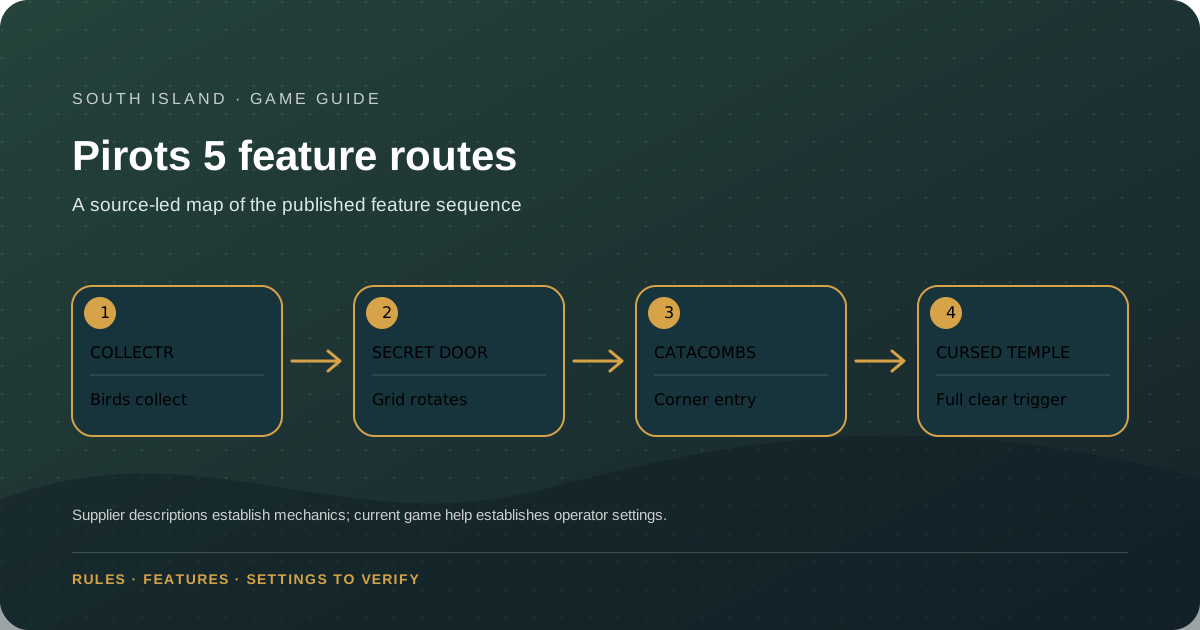
Pirots 5 is an ELK Studios adventure slot using a 6-by-6 CollectR grid. Its birds collect symbols, the grid can expand, and several feature paths change the board before the main bonus. The official product page describes Captain Blackfeather turning one to four birds into ghosts and their symbols into gems; a Secret Door that rotates the grid; Catacombs entered by collecting above a corner; and a Cursed Temple Coin Game that starts when the entire grid is cleared during the Secret Door feature. Three Bonus symbols collected by the birds trigger the Bonus Game, while a Super Bonus symbol changes that entry. Grid size, collection-meter progress and gem upgrades persist into the bonus.
ELK states a potential maximum of 10,000 times the bet and lists five X-iter modes, with an example ranging from a 3× bet option that has more than four times the bonus chance to a 250× Super Bonus option. The accessible page does not give RTP, volatility, hit frequency, a full paytable or stake limits. The linked product sheet returned 403. This guide explains what the official summary establishes, what to inspect in a live help screen, and why a supplier listing alone does not confirm availability in New Zealand.
Read the current title before relying on a series label
The primary reference is the ELK Studios Pirots 5 page, checked on 6 October 2026. The game title is written as “Pirots 5,” and the public listing identifies its theme, main mechanic and named feature set. Its page includes a Play control but no dated release line in the accessible text. The product-sheet links use several feature labels—Cursed Temple, The Kraken and City of Gold—so verify which sheet matches the exact Pirots 5 mode before using a downloadable file as evidence. The Cursed Temple sheet returned 403 in this check.
The product page’s presence in a supplier catalogue is evidence of a supplier listing, not proof that every operator carries the game or that it is live for every market. It also does not tell us which mathematical build, currency or interface a casino might use. A review should attribute the known feature description to ELK and keep operator-level claims separate.
This matters for a sequel within a named series. A familiar bird, gem colour or CollectR label can encourage readers to transfer rules from an earlier Pirots title. Avoid that shortcut. Record the exact displayed title and open its own help. A series name tells you that there may be a design family; it does not guarantee that grid dimensions, bonus costs or symbol behaviour are identical across releases.
How to think about the 6-by-6 CollectR board
ELK calls Pirots 5 a 6-by-6 adventure slot and says the grid can expand. The summary does not state the final grid dimensions. It does not publish every collection rule, every symbol value or the entire paytable. A reader should therefore treat the base dimensions as a confirmed starting point and inspect help for when and how the board changes.
CollectR is useful as a way to understand the board’s sequence: symbols are placed, birds interact with the symbols they can collect, progress indicators may change, and the resulting state can affect the next event. However, do not assume from the name alone whether collections are based on adjacency, colour, movement paths or another rule. The supplier’s summary specifically identifies collected symbols in several triggers, but does not define all ordinary win calculations. The exact help decides what counts as a completed collection or payout.
When the grid expands, distinguish a visual increase in available positions from a payout increase. More cells can mean more possible symbol positions, but that by itself says nothing about probability or value. Check whether the game describes expansion as part of a feature, a threshold event or persistent progress. Then note whether expansion is retained for a Bonus Game, resets when a round ends or has a separate maximum. The public page says grid size persists during the Bonus Game, which is more specific than a general claim that the expanded board lasts forever.
For a clear screen-by-screen record, write down the board size before a feature, the trigger that changed it and the board size after the transition. If a larger grid is shown in an animation, do not infer that every new cell is equally likely to contain a paying symbol. Layout and symbol distribution are separate fields.
Captain Blackfeather and the gem transformation
The official text says Captain Blackfeather turns one to four birds into ghosts and transforms their symbols into Blackfeather gems. That is the central identity of the antagonist feature and a specific transformation sequence. The page does not give an activation probability, whether the effect selects every bird equally, how gem values are assigned or whether a transformation can happen again within the same round.
To follow a Blackfeather activation, mark the birds and symbols that were present immediately before it. Then record which birds became ghosts and which symbols became gems. Finally, check where those gems appear in the paytable or collection rules. Do not call them prizes simply because their appearance follows a dramatic animation. Their contribution depends on what the game defines as a collection, upgrade or settlement event.
The phrase “one to four” describes a range of possible affected birds, not a predictable count. It does not establish that all four are likely to change or that an event affecting more birds is necessarily more valuable. One gem could have a special value or it could function within the same collection rules as another; the accessible summary does not state enough to calculate that. Use exact game help to identify the role of the gem symbol and any applicable upgrade condition.
If a casino’s rules use “Blackfeather gem” and the supplier overview says “their symbols,” retain both pieces of wording in notes. The first may name the new symbol type; the second explains what is transformed. If the operator uses another localised term, record it without silently changing the game’s rule description. Clear terminology is more useful than treating themed labels as interchangeable.
Catacombs: a corner collection opens another path
ELK says that collecting a symbol on top of a Catacombs corner enters the Catacombs. A mummy battle then rewards a feature symbol. This gives the feature a location-dependent entry rule: the place where a symbol is collected is part of the trigger. It is not simply “collect any symbol anywhere” and not the same as the Bonus-symbol trigger.
The public summary leaves several operational questions unanswered. It does not show a complete diagram identifying the corner cells, name the different feature symbols that can be won, describe the battle’s steps or publish the odds of each result. The game help should explain whether the corner remains fixed as the board expands and how it is recognised when the Secret Door rotates the grid. Do not infer that a corner moves with the original tile unless the help says so.
During a feature, note the board orientation before and after entry. If a corner tile changes location during a rotation, determine whether the “corner” is attached to the screen position or to the game element. That distinction changes how a player reads the trigger. A single animation could make the visual location appear intuitive while the formal rule uses a named grid position.
The reward is described as a feature symbol, which signals an outcome that can affect later play. It does not specify whether the symbol itself settles a win, starts a new feature or has a further collection condition. Those are materially different outcomes. Follow the new symbol into the subsequent board and confirm its definition in help rather than assuming it means an immediate prize.
The Secret Door rotates and repositions the board
ELK describes the Secret Door as rotating the grid, moving all symbols and birds. It also mentions crossover floor tiles that allow birds to cross positions they have already collected. The rotation therefore affects navigation through the board as well as symbol placement. Readers should follow the movement path rather than treating the board as static after a door event.
An efficient way to analyse this sequence is to separate three states: the board before rotation, the board immediately after it, and the bird movement that follows. Record which symbols moved, where each bird ended up and whether a crossover tile changed its possible route. This makes it easier to distinguish a grid-shuffle event from a bird’s collection action. It also avoids attributing a resulting collection to a symbol that did not stay in its former place.
The official summary does not state how many rotations can occur, whether rotation happens at a fixed point or how crossover tiles are selected. It also does not disclose an exact spatial algorithm. Avoid explaining an unseen algorithm as though it were a published rule. If a reader asks why a bird crossed a collected cell, the relevant answer is that ELK says crossover floor tiles permit such a crossing; the frequency and exact path logic remain questions for the game’s help.
The Secret Door also links to the Cursed Temple feature: the supplier says the Coin Game starts when the entire grid is cleared during the Secret Door feature. “Entire grid” is a high threshold description, but the public page does not give a probability, a number of moves or a guarantee of entry after a set number of rotations. Do not turn this conditional trigger into a progression promise.
Cursed Temple Coin Game and its condition
The Cursed Temple Coin Game is tied to a specific event: the whole grid must be cleared during the Secret Door feature. That makes it important to distinguish the state of a board from the number of symbols shown in a marketing graphic. The official text does not say that a partially cleared grid, a particular bird or a specific gem automatically starts the coin feature.
Once the condition is met, the feature name implies a coin-game stage, but the public summary does not supply a payout table, values, feature duration or exit condition. Check the specific help for how a coin value is determined and what can collect or multiply it. If the game shows a summary total, compare it with the underlying symbols and rules rather than treating a visual counter as a separate prize.
The feature’s conditional nature has a useful practical consequence: a player cannot judge its cost or availability simply by seeing the name on the title page. It might be an organic part of the game, but it still depends on a defined sequence. An X-iter mode that starts a bonus is also not proof that it can force the entire-grid-clear condition. Keep natural progression, bought feature entry and a special coin-game trigger as separate routes unless the rules explicitly connect them.
If the client shows a Cursed Temple Product Sheet, verify that the sheet’s version and game name are exactly Pirots 5. The official page lists several sheets with different labels. A file for another mode or product should not be used to fill gaps in this guide. The linked Cursed Temple sheet was inaccessible to the browser reader on 6 October 2026, so its contents have not been assumed.
Bonus and Super Bonus persistence
Three Bonus symbols collected by the birds trigger the Bonus Game. If one of those symbols is a Super Bonus symbol, the Super Bonus Game is triggered. ELK says the grid size, progress on the collection meter and gem upgrades persist during the Bonus Game. This is a particularly useful rule because it tells a reader which parts of the state carry into the feature.
Persistence is not a universal property. The source names three categories: grid size, collection-meter progress and gem upgrades. It does not state that every symbol, multiplier, bird position or other counter also carries over. When an operator screen shows additional indicators, check each one separately. “The state persists” is too broad unless the rules identify what that state includes.
Before entering the Bonus Game, a reader can note the current grid size and progress indicators. After entry, compare them with the starting feature board. This is a factual observation that can help explain the mechanic. It should not be recast as advice that waiting for a particular amount of progress guarantees a better return. A state can persist without implying any dependable cash value or event likelihood.
The difference between Bonus and Super Bonus also deserves exact treatment. The official page states the trigger distinction, but does not publicly detail how many drops, symbols or extra conditions differ. Do not claim that one is longer, more valuable or certain to produce a particular prize without the active help. The name “Super” signals a mode distinction; only the rules tell the reader what changes.
X-iter: modes and arithmetic before selection
The supplier says X-iter offers five modes. Its public summary names a 3× bet option with more than four times the chance to trigger the bonus and a 250× bet Super Bonus option. Intermediate menu prices and all start conditions are not shown in the accessible page text. The mode range should therefore be checked in the current game instead of reconstructed from a review published for a different market.
If a menu states that the price is a multiple of the selected wager, multiply only after reading that wording. For illustration, a 3× entry against a hypothetical NZ$1 base bet would total NZ$3. That example is just arithmetic: it does not establish an NZ$1 minimum, a permitted game version or a New Zealand-facing operator. A 250× mode under the same hypothetical stake would be NZ$250, before any other terms the operator might show.
“More than four times the chance” compares the mode with a baseline not given in the public summary. It does not state the natural trigger probability or say a Bonus will happen in the selected round. A Super Bonus entry sets the starting state; it does not guarantee that the ending result will exceed the purchase price. A reader deciding whether the price is within a limit should treat the entire amount as money at risk.
Before using any X-iter option, check whether it is enabled, its exact total cost, which rules version applies and how the mode changes the round. If the menu is absent, do not seek a workaround. Availability can depend on an operator or market setting. The article does not say the modes are available in New Zealand.
Interpreting the 10,000× potential and unknown settings
ELK’s stated potential maximum is 10,000× the bet. A maximum describes an upper bound within a game’s mathematics; it does not tell a reader how frequently the result happens, how much a typical round returns or whether a particular operator configuration retains that maximum. This review uses the figure as an attributed supplier statement, not a prediction.
The public page does not show numerical RTP, volatility, hit frequency, a complete paytable or currency-specific stake limits. The linked Cursed Temple sheet returned 403 on the date checked. Several comparison pages publish their own RTP and stake fields, but they do not establish the exact version that an operator would provide. Where such numbers differ between pages, that is a reason to verify, not to select whichever figure appears most favourable.
RTP is a theoretical long-run metric for a defined configuration. It is not the percentage of a personal balance that should return in a session. Volatility concerns the distribution of results, not whether the game is “due.” A win cap, RTP, hit frequency and stake range each answer different questions. Record them as distinct fields and attach the exact source and date to each one.
For a compact audit note, use: “Pirots 5; operator and market; rules/version date; currency; min/max stake; displayed RTP; volatility label and scale; max win; X-iter prices; and source URL.” Mark any absent field “not shown in the source checked.” That simple note prevents a Canadian, British or euro-based review from becoming a supposed New Zealand operator setting.
Screen layout, mobile help and practical checks
ELK recommends a 1600×900 desktop window or 16:9 scaling. The public page describes a grid that expands and multiple features involving symbol movement, so a small screen should be checked for legibility before play. A responsive screen that fits a viewport does not prove that text, multipliers or feature prompts remain readable.
On mobile, find the game-help control, the paytable, the bet selector and the round history. Check whether the expanded board can be read without clipping, whether the controls remain visible in landscape and whether an optional X-iter price is shown before confirmation. If a critical condition is only visible after a tap, read it before making a stake. Do not use a game animation as a replacement for its written rules.
No demo was launched for this article, and no mobile device or casino client was tested. The official title page has a Play control, but the text reviewed does not establish an openly accessible demo or market eligibility. It is reasonable to use a demo only when an operator or supplier makes one lawfully available in the reader’s jurisdiction, and to treat it as a way to learn the interface rather than as evidence of future outcomes.
A state-by-state review worksheet
An independent reviewer can use a small table or notes to keep every mechanic tied to its source:
| State to inspect | Evidence to record | Do not infer |
|---|---|---|
| Initial board | Title, size and help version | Win method from the square grid alone |
| Bird collection | Triggered symbol and resulting meter/gem change | Collection probability |
| Captain Blackfeather | Number of birds and transformation shown | Value of a gem without help |
| Catacombs | Corner position, entry event and reward symbol | A cash payout from the feature label |
| Secret Door | Before/after orientation and bird route | The complete movement algorithm |
| Cursed Temple | Full-clear condition and feature rules | Guaranteed entry after a fixed number of turns |
| Bonus | Trigger and state carried into the feature | Persistence of fields the supplier does not name |
| X-iter | Price, start condition and restrictions | A positive return from bonus entry |
| Settings | Currency, stake, RTP and maximum shown | That another market uses the same build |
This table is designed to answer the review task without pretending to know a hidden mathematical parameter. A public overview can support an accurate mechanic map, while the operator’s help can fill in current settings. If the two do not agree, record the discrepancy and ask the operator which rules version applies. Do not edit one source to make it resemble another.
New Zealand access and responsible-play limits
An official ELK page does not prove that Pirots 5 is available from a New Zealand operator. A supplier listing, a casino’s product catalogue, an account holder’s eligibility and applicable regulatory requirements are separate facts. This guide has not tested an operator or followed the user-supplied CPA route.
The Department of Internal Affairs says online casino advertising is prohibited during the current transition. Its advertiser guidance includes third parties that publish or arrange advertisements, while the 2026 regulations identify ads involving an affiliate arrangement as a prohibited form. Since the requested CPA route is an affiliate route, no promotional buttons are included pending owner/compliance review. This is a conservative editorial blocker based on public guidance, not personal legal advice. See DIA advertiser guidance and the Online Casino Gambling Regulations 2026.
Treat any stake as entertainment expenditure that can be lost. Set a total spend and stopping point before starting, and do not add funds to chase a feature or recover a previous result. If gambling is causing harm, the DIA player guidance lists New Zealand support contacts.
Questions readers commonly ask
Does Pirots 5 use CollectR?
Yes. ELK describes Pirots 5 as a CollectR adventure slot. The accessible overview does not give the complete collection and paytable rules, so use the exact game help for how the symbols settle.
What does Captain Blackfeather do?
The supplier says the feature turns one to four birds into ghosts and transforms their symbols into Blackfeather gems. It does not publish a probability or gem-value table in the accessible summary.
What starts the Cursed Temple Coin Game?
ELK says the entire grid must be cleared during the Secret Door feature. The public page does not provide odds or a guaranteed number of moves to reach that state.
What persists in the Bonus Game?
The supplier specifically names grid size, collection-meter progress and gem upgrades. Do not assume unlisted fields persist unless current help confirms them.
Is the RTP 96%?
That figure appears on third-party pages, but it is not in the accessible ELK text inspected here. The official product sheet was inaccessible. Check the exact operator help before quoting a configured RTP.
What is the maximum win?
ELK’s public page states a potential of 10,000 times the bet. This is an attributed ceiling, not a typical result or a guarantee.
Is it available to New Zealand players?
The supplier’s catalogue does not confirm an operator’s NZ availability or a customer’s eligibility. This guide makes no access claim.
Does the 250× Super Bonus option guarantee a win?
No. It describes an entry cost and starting mode. A bonus outcome can still return less than the entry price or no positive result.
For independent help, visit the site’s New Zealand safer gambling guide. This article contains no casino offer.
Sources and verification boundary
- ELK Studios Pirots 5 product page and official games catalogue — mechanics, grid and persistence summary; checked 6 October 2026.
- Cursed Temple Product Sheet linked from the official title page — returned HTTP 403 on 6 October 2026; not used.
- Competitor pages opened 6 October 2026: CanadaCasino, SlotsGamblers, CasinoWizard and OLBG. They provide fuller feature explanations but apply market-specific settings and sometimes disagree; numerical settings were not imported as New Zealand operator facts.
- DIA advertiser guidance, DIA player guidance, and Online Casino Gambling Regulations 2026 — checked 6 October 2026.
