ELK Studios game guide · South Island guide
Wild Toro 3: rules, modes and feature guide
 Best casinos available in New ZealandUpdated 7 November 2026

Wild Toro 3 is an ELK Studios slot that pairs Toro’s moving Wild with Toritos, Matadors, selectable modes and a Golden Rose feature. This guide explains the feature sequence and marks the settings an operator’s game help must confirm.
The short answer
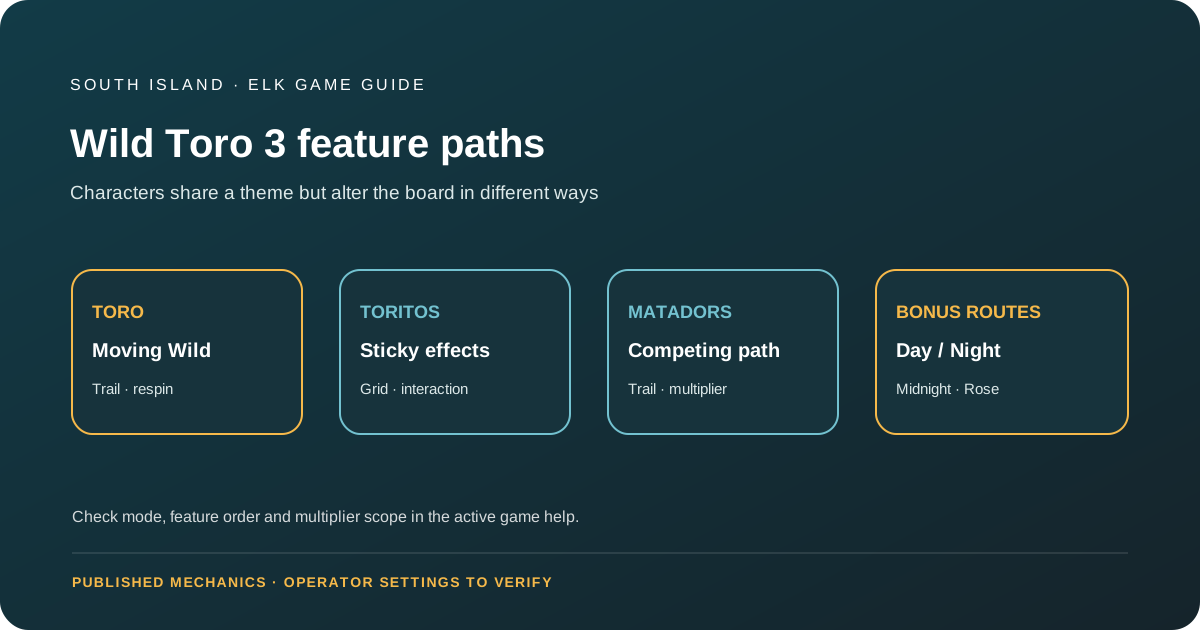
Wild Toro 3 is an ELK Studios slot built around a moving Toro Wild and several character features that can change the reel grid. Toro travels across the reels and can leave Wild positions behind; Toritos can add sticky Wild effects and change reel height; Matadors create a separate moving obstacle and multiplier path. The game also presents Day and Night modes and a Golden Rose bonus route. These features share a bullfight theme but do different jobs, so the clearest way to learn the game is to follow the trigger and resulting state for each character separately.
ELK’s public catalogue confirms the title and outlines those named mechanics. It is not the same thing as the operator’s in-game help. The supplier page does not establish which RTP, stake range, volatility configuration, paytable or feature menu a specific casino build uses. Check the active help before relying on any numeric setting, and do not infer that the slot is available in New Zealand because it appears in the supplier catalogue.
Identify the exact game and version
Begin at the official Wild Toro 3 product page, which is the primary source for the title name and feature terminology used in this guide. Then compare the title shown in an operator lobby and the name on the loading screen. Similar artwork or a shared series name is not enough to confirm that the game is the same version.
The product page presents Wild Toro 3 as part of a series built around Toro and highlights the new character roles and the Golden Rose path. It does not provide a dated operator configuration. If the live game help offers a version number or rules revision date, capture that value with the operator name and the date you checked it. A search result or review for another market may describe a different build.
The game’s high-level description is useful for orientation, but not for resolving a disputed rule. If the help panel and the supplier summary differ, prefer the active client for what that operator has enabled and preserve the discrepancy in your notes. Do not silently merge the two descriptions or treat a third-party demo as proof about a New Zealand casino.
Read the base game as a sequence
The most useful way to follow a Wild Toro 3 round is to separate a normal spin from a feature sequence. A normal spin produces a reel result under the selected mode. A special character can then change the board or add a follow-on action. The visual result may include a Wild, a multiplier, a taller reel, a respin or a new feature state. Each of these is part of the game’s rules only when the active help confirms it.
Toro’s role is easiest to understand as movement. The supplier description identifies him as a walking Wild that enters from one side and travels left across the reels. His movement can award respins, and the multiplier associated with the feature increases as he continues. That description explains the broad logic, but it does not tell a reader the exact starting position, whether every step always causes the same board change or how the final win is settled. Read the game help for those details.
During a sample, note where Toro begins, where the Wild trail appears and what triggers the next action. A record of one animation can explain the interface, but it cannot measure the frequency of Toro appearing or predict whether the trail will form a winning combination. The route is random; a player does not steer Toro by changing bet timing or tapping the screen.
Toro’s walking Wild and respins
The central feature gives the game its visual identity. Toro moves from a starting reel toward the other side of the grid, with each movement connected to a respin and a growing multiplier as described by the supplier. If Toro passes over a position, the screen can show Wild marks or a multiplier trail, depending on the exact state. The help must explain how those marks interact with ordinary symbols and whether any trail persists after the character leaves.
When reading the rules, keep the character’s position distinct from the positions that count as Wilds. Some games evaluate a Wild at the current character location; others leave a trail or a tall symbol behind. The supplier’s public overview is not detailed enough to settle every edge case. Check the game’s paytable for substitution rules and inspect the history panel if the client provides a round record.
A respin is another game action, not a guaranteed payout. The round can continue and still end with no qualifying win. A multiplier can affect only the win defined by the rules; it does not mean every visible symbol or the entire player balance is multiplied. Do not explain a feature by pointing at a large number or animation without stating what the actual help says it applies to.
Toritos: sticky effects and changing reel space
The Toritos are a group of sticky Wild characters associated with the centre reels. The official product page describes them as capable of expanding the grid by adding reel height and awarding a respin. It also explains that their presence can interact with Toro by adding Wilds or increasing the Toro multiplier. This is a layered interaction: one character changes the space available on the grid, while another can move through that space.
The first question to answer is what “sticky” means in the particular state. Does a Torito remain fixed for one respin, for a whole feature or until a defined event ends? The supplier overview uses the character label but does not spell out every duration. The live help should supply the exact persistence rule. If it does not, describe only the animation that is visible and leave the duration unconfirmed.
Grid expansion also has practical consequences for reading wins. A taller reel can create more positions, but it does not tell you how many ways or lines are active, how symbol values are determined or whether every added cell is equally eligible. The paytable and feature help should identify those rules. Do not copy a maximum row count or ways count from a review written for a different version.
When Toritos and Toro appear in the same sequence, describe each action in order. Identify the Torito’s position, record whether the grid changes, then see what Toro does on the next action. The official overview signals that their effects can combine, but the operator’s help is still needed to explain exact priority and payout calculation.
Matadors: a competing movement path
Matadors provide a counterpoint to Toro. The supplier describes them as moving Wild characters on the middle reels that can continue left through respins. Their movement can leave Wild or tall multiplier trails. This is a separate named character system, and it should not be described as another Toro unless the game help explicitly connects the two.
The practical questions are about where Matadors appear, what causes them to move and which positions are altered. A short sequence might show a Matador moving one step, the game granting another action and the trail changing. That sequence helps a reader recognise what is on screen. It does not confirm how often the effect occurs, what the highest multiplier can be or what happens if a Matador and Toro occupy related positions.
Check whether the help explains conflicts between characters. If multiple movement effects are triggered together, does the client resolve them in a fixed order or as a combined board update? If the rules are silent, avoid writing an exact priority rule. A transparent guide can say what the supplier does publish and which interaction remains unverified.
Matadors may affect the visual busyness of a round. On a phone, a reader should check whether the information panel identifies each character with a consistent symbol and whether the action history makes the sequence readable. A crowded animation is not a reason to guess at the settlement; open the rules or round history instead.
Day and Night are separate play modes
The game offers Day and Night modes. ELK describes them as different volatility choices, with Night associated with a special Midnight Bullfight feature. The mode selection changes the feature profile, so a guide should not flatten the two into one universal “Wild Toro 3 rules” paragraph. Record which mode is selected whenever you compare the help or describe a sample round.
The modes are not a forecast of a result. A higher-volatility option, if that is how the active help labels it, means the game’s distribution can be more uneven. It does not make an individual spin more likely to win or guarantee that a larger feature will appear. Use the help’s exact label and avoid turning a design choice into a strategy claim.
Before a round begins, check whether the interface makes the selected mode visible and whether the rules say that both modes share the same base game. The public supplier summary calls out their difference but does not publish a complete mode-by-mode paytable. If the operator help lists different RTP or other numerical settings by mode, record those figures exactly for that build; if not, do not import them from a review site.
Midnight Bullfight
Midnight Bullfight is the distinctive Night-mode feature named by the supplier. ELK says it can be triggered by the Moon and includes random tall multiplier Wilds. The product page also describes the feature as a bullfight-style state with Wilds that may cover several reels. The exact trigger, eligible mode and settlement conditions belong to the current game help.
To explain the feature accurately, identify what the help calls the trigger symbol and what state begins after it appears. Then distinguish the random placement of tall Wilds from the multiplier value displayed on them. If the game explains whether symbols are replaced, covered or otherwise transformed, use that wording. Do not assume that a tall Wild substitutes on every position or that a displayed multiplier applies to every win in the feature.
The word “random” means the player cannot choose the positions or set the value through timing. Do not suggest that a particular bet size, spin pace or previous outcome increases the chance of the feature unless the game’s official help explicitly states that relationship. A feature showcase video can illustrate the display but not establish the trigger probability.
Golden Rose bonus path
The Golden Rose feature is a separate bonus route. ELK describes a Golden Rose collectible that, when collected by Toro, triggers a bonus on a new grid with a larger Toro character. Toro follows a route, gathers roses and confronts Matadors. This gives the feature a distinct objective from the ordinary walking-Wild sequence: the board becomes a route through a bonus environment rather than simply continuing the base reels.
Use the bonus help to confirm how the Golden Rose appears, what counts as being collected and whether the feature begins immediately or after another selection. The public product description explains the theme and broad sequence, but not all entry conditions, route choices or payout rules. Avoid filling those gaps with instructions copied from a different Toro title.
During a bonus walkthrough, state what the display shows at each stage: the board transition, Toro’s starting point, rose collection, any Matador interaction and the final settlement. If the route is random, say that the player observes it rather than controls it. Do not call a path “better” or tell someone to choose a route unless the active game actually presents a choice and states its consequences.
What the official page establishes, and what it does not
The accessible ELK product page supports the title, the character names, the broad movement features, the two named modes, the Midnight Bullfight and the Golden Rose concept. It does not provide an operator-specific help file, complete symbol paytable or a New Zealand distribution list. This guide therefore uses it for the mechanics overview but does not publish a numeric RTP or stake range.
Third-party reviews may show RTP variants, maximum-win figures, volatility labels, hit rates, bet limits or mode tables. Those can be useful clues about what to check in the live panel. They are not interchangeable with a New Zealand casino build. When those pages disagree, a source hierarchy resolves the editorial question: the exact operator’s game help is needed for its setting, and the supplier’s official material is evidence for supplier-level feature design.
Do not infer that the game is “live in NZ” from the fact that a reviewer could open a demo elsewhere. Product availability is set by operator and jurisdiction. No operator account or demo was used for this page, and no direct game client was tested.
How to verify RTP, volatility and the paytable
Open the information icon inside the exact game client. Record the title, any version or help revision, the displayed configuration and the date. Capture the RTP figure only if the help itself shows one. If the help offers more than one RTP setting, list each setting and make clear that the operator’s selected version must be checked separately.
For volatility, copy the exact label and any note about Day and Night. Do not combine a mode-level description with a title-level label if the help distinguishes them. For the paytable, identify symbol values, win requirements, Wild substitution exceptions and how feature wins are settled. The main screen may show a mode but still hide the details needed to report an accurate payout table.
Treat maximum win and feature-buy prices with the same discipline. Check whether a stated ceiling is a cap in the active build and whether it applies to the stake, the total round or a particular feature. For an optional mode, note the exact cost, what it guarantees and what it merely makes more likely. A menu label does not prove a result or positive expected return.
Demo access and learning the controls
If a legitimate operator or supplier offers a demo in the reader’s location, it can help them learn the controls and recognise the character icons. It cannot prove the operator’s actual RTP, eligibility, cashier conditions or real-money limits. The demo may use a different version or omit account-specific settings. No demo link is included here because local access was not verified.
A useful learning session focuses on comprehension, not simulated winnings. Identify the mode selector, paytable, character symbols, help panel, history and stop controls. Watch one feature sequence and explain it back in plain language. If a named mechanic remains unclear, return to the rules instead of repeating rounds in the hope of learning from a random result.
The screen can be busy, particularly when characters, respins and multipliers appear together. On mobile, test whether the mode label and multiplier remain readable without covering important controls. If information is clipped or the history is inaccessible, ask the operator for the full rules text or use another permitted display size. Do not use a VPN to evade a regional restriction.
New Zealand availability and advertising boundary
An official supplier page confirms a product description; it does not confirm that a specific online casino offers Wild Toro 3 to a New Zealand account. Check the operator’s legal name and current terms independently. The nationality of a domain, a supplier’s corporate permissions and another market’s casino list are not proof of local consumer access.
New Zealand’s Online Casino Gambling Regulations 2026 came into force on 3 July 2026. Regulation 3 defines an affiliate arrangement by reference to facilitating a referral and receiving a benefit contingent on a later outcome. Regulation 40(c) prohibits advertisements involving such arrangements. The Department of Internal Affairs says the advertising framework applies to operators and third parties that publish or arrange advertisements. This site’s assigned route is a CPA route and no compliance approval was provided, so the article contains no affiliate CTA. The placement remains blocked pending a qualified compliance review.
If gambling is affecting your time, finances or relationships, step back and use the site’s New Zealand safer gambling guide for independent support information. Set limits before play, never chase a loss and do not treat a slot as income.
A reader’s verification checklist
Before relying on a Wild Toro 3 description, check each item against a named source:
- Exact game title and provider credit match the official page and game loading screen.
- The selected Day or Night mode is visible before the round.
- The in-game help explains Toro’s trail and how its multiplier is applied.
- Toritos’ sticky duration and any expanded-grid rule are stated.
- Matador movement and its relation to Toro are explained or labelled unresolved.
- The Midnight Bullfight trigger and multiplier Wild rules are confirmed.
- The Golden Rose entry condition, bonus board and route resolution are clear.
- The RTP, volatility, stake range and cap come from the active help, not a different market review.
- Any demo is actually available in the reader’s location and is not confused with real-money play.
- Operator eligibility and local legal terms are verified independently.
If one item is not visible, write “not published in the source checked.” This does not make the guide less useful. It tells readers exactly which part is a supplier description and which part remains a live-configuration question.
How to compare this game with another Toro title
Series familiarity can make a new slot easier to approach, but it can also encourage inaccurate assumptions. A previous game might have the same character, reel layout or visual language while changing how the Wild trail works. Compare titles only on like-for-like fields: base layout, active modes, trigger conditions, feature persistence, mode-specific help, operator build and dated RTP information.
Do not assume that a feature carried over unchanged because a reviewer calls this a sequel. Use the older game only as a navigation aid: it may help a returning reader recognise Toro or the bullfight setting. The Wild Toro 3 page and help remain the authority for this title’s own rules.
A simple comparison table can keep the distinction clear. Put each title in a separate column and use rows for verified mechanics, unresolved questions and the source date. Do not fill cells with another game’s multipliers, feature price or volatility. If a value is unavailable, mark it as unavailable instead of guessing from the series.
Questions readers commonly ask
What does Toro do in Wild Toro 3?
ELK describes Toro as a walking Wild that moves across the reels, can award respins and is associated with an increasing multiplier. The active game help is needed for the exact positions and settlement rules.
What is the difference between Day and Night?
The supplier presents them as separate modes and associates Midnight Bullfight with Night. The exact mode settings, RTP and volatility labels must be read in the operator’s current help.
What starts the Golden Rose feature?
The official description says Toro collecting a Golden Rose triggers the bonus route. It does not publish every operator rule or route detail, so confirm the specific help panel before describing all entry conditions.
Is Wild Toro 3 available to play in New Zealand?
The supplier catalogue alone cannot answer that. Availability depends on the operator and local eligibility. This guide has not tested an operator account or demo.
Why are there no casino links in the article?
The current New Zealand regulations prohibit advertisements involving defined outcome-based affiliate arrangements, and no compliance approval was supplied for this CPA route. The page is informational while that placement is under review.
Sources and verification boundary
Primary source checked 6 October 2026: ELK Studios Wild Toro 3 product page; ELK Studios official game catalogue; DIA advertising guidance; Online Casino Gambling Regulations 2026, regulations 3 and 40.
Competitor pages opened 6 October 2026: OLBG, FruitySlots, iGamingToday, SlotGods, and Bonkku. These pages show different market-specific numeric settings and presentation choices. Their numbers were not treated as proof of a New Zealand operator build. One search result returned a cache miss and is not counted as reviewed.
The official accessible product page confirms feature names and high-level descriptions, not an active game-help revision or the requested numeric configuration. No RTP, stake limit, payout table or win cap is stated here. Search-volume data was not supplied. Source-word count is recorded in the batch report; rendered count and performance remain unverified because production build could not complete in this archived environment.
