ELK Studios game guide · South Island guide
Spark of Creation: rules, creature features and settings
 Best casinos available in New ZealandUpdated 7 November 2026

Spark of Creation is an ELK Studios 6-by-7 CollectR slot built around four creatures, an Evolution Meter and multipliers that develop on grid positions. This guide traces the official feature sequence and separates confirmed mechanics from RTP, volatility and operator settings that need current help.
The short answer
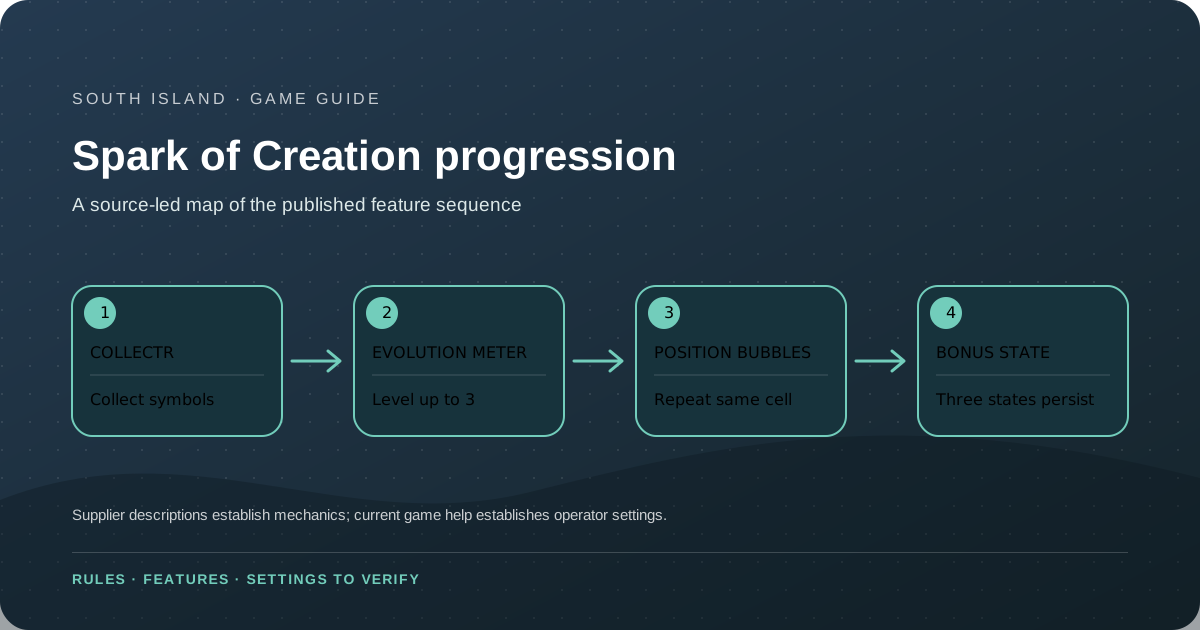
Spark of Creation is an ELK Studios 6-column, 7-row elemental slot using the CollectR mechanic. The supplier’s page describes four creatures, each with an ability that can upgrade multipliers, add feature or payout symbols, or remove symbols; a creature’s level affects the strength of its ability. The Evolution Meter fills when symbols are collected and, when full, upgrades a creature up to level 3 while its ability is pending. The first collection on a position creates a Multiplier Bubble; later collections at that position increase its value. A Multiplier Strike can occur before a drop and raise multipliers on the grid. Three Bonus symbols collected by creatures trigger the Bonus Game, while a Super Bonus symbol starts the Super Bonus. ELK states that meter progress, creature levels and bubble values persist during the bonus, and gives a potential maximum of 10,000× the bet.
The public summary does not list RTP, volatility, hit frequency, stake limits or a complete paytable. It also does not give a dated release-status line. The linked product sheet returned HTTP 403 on 6 October 2026. Several competitor pages provide extra numbers, but their descriptions disagree about board dimensions and other settings, so those claims are not used as New Zealand operator facts. The exact game help remains necessary for current configuration and settlement.
Check the title and source wording
The primary reference is ELK’s Spark of Creation product page, checked on 6 October 2026. The heading and URL use the singular title “Spark of Creation.” In the descriptive paragraph, the accessible page once says “Sparks of Creation.” This appears to be a wording inconsistency in the public text; the catalogue title and product page heading are used here as the product name. The page has a Play control but no dated release line in the text reviewed.
The official page establishes the high-level features. It does not establish that a particular operator has the game, that a demo is available in New Zealand, or that the provider’s maximum appears in every market. The linked product sheet returned HTTP 403 through the available reader, and no live casino client was accessed. Thus this article can map supplier-published mechanics but cannot claim a tested version or market-specific build.
The distinction between a game family and a specific title also matters. CollectR appears in other ELK products, but the creatures, upgrade path and bubble rules described here belong to Spark of Creation. Do not fill missing details by transferring a rule from Pirots, Oxygen or another studio game. Similar movement or collection language is not proof of identical timing, payouts or feature costs.
The 6-by-7 grid and collection sequence
ELK describes six columns and seven rows, with four creatures that interact with the game’s symbols. A board dimension tells us how many visible positions are available; it does not state how a win is evaluated. The accessible product text does not include a complete paytable or say whether ordinary payouts use fixed lines, ways, clusters or another method. Consult the active help before describing exactly which symbols form a payout.
CollectR is the game’s named central mechanic. In this title, creatures collect symbols and that action can feed the Evolution Meter, create or increase a multiplier bubble, and trigger creature-specific effects. Think of the round as a state sequence: symbols appear; a creature has an opportunity to collect according to its rule; the meter and any bubble may change; the game evaluates the new board; and any resulting drop continues under the rules. The supplier overview names several of these state changes, but it does not publish every move rule or the full order of all simultaneous effects.
For a careful reader, position history is more informative than a single screenshot. Mark where a bubble first appears, which symbol is later collected on that position and whether the displayed value changes. In parallel, note the level of each creature and the meter’s progress. These are separate counters. A multiplier bubble can grow while a creature’s level remains unchanged, or the meter can progress without a particular bubble being affected.
Do not infer a probability from repeated collections in a short sample. A limited observation can show that a mechanic occurred; it cannot establish how often a bubble grows or a creature levels up. Those are mathematical questions that a product summary or a handful of demo rounds may not answer. The active game’s published help should define the relevant condition, and any numerical chance should be omitted if it is not stated.
Four creatures and level-dependent abilities
ELK says there are four creatures with individual abilities. Their abilities can upgrade multipliers, add feature symbols or payout symbols, or remove symbols. The level of a creature changes the strength of its ability. The accessible public description does not name each creature’s specific ability, the exact level effect or how frequently a creature acts.
When a creature activates, identify the change before judging the result. An ability that upgrades a multiplier is not the same as one that adds a payout symbol; removing symbols can change the board without creating an immediate prize. The next game evaluation determines whether the changed grid satisfies its win rule. A feature animation or level-up display is not itself proof that a cash amount was paid.
The level information should be read with the Evolution Meter. ELK says a full meter upgrades a creature to a higher level, up to level 3, while its ability is pending. This implies that the meter event and the ability event can occur in sequence rather than being a single effect. The public text does not give a required number of collections or explain whether partial progress carries over after each round. Check the active help for the meter’s reset boundary and the precise meaning of “pending.”
To compare a level 1 creature with a level 3 creature, read the effect description for each level rather than assuming a simple multiplier increase. The strength could mean a quantity, a wider effect area or a different outcome. The supplier says the strength changes but does not define the exact scaling in its public summary. Do not extrapolate a formula such as “three times stronger” without a source.
The four-creature setup can create overlapping activity. If two abilities are pending at once, write down the order shown by the help or feature history. The summary does not publish a priority table for simultaneous creature abilities. If the client resolves them sequentially, note the intermediate grid after each step. If the help does not explain the sequence, describe only the observable change and keep the interaction unresolved.
The Evolution Meter and what “level 3” means
The Evolution Meter fills when symbols are collected. Once full, it upgrades a creature to a higher level, with level 3 as the maximum stated in the supplier summary, while its ability is pending. This is a trackable progression feature with a stated upper level. It is not a promise that every session reaches level 3 or that a higher level guarantees a payout.
Separate the meter’s current fill from the creature’s current level. A display might show progress toward an upgrade while the creature is still on its existing level. After the meter completes, a level indicator may change and an ability may be pending. These should be recorded as distinct states, because the feature’s effect might resolve after the meter event rather than at the exact moment it fills.
ELK’s text does not state how many symbols fill the meter, whether all collections contribute equally, whether the meter can fill more than once for a creature, or what happens when a creature reaches level 3. It also does not say whether an ability pending at the end of a round is guaranteed to resolve later. Read the exact help for those boundary cases. A full meter picture does not supply the missing rule by itself.
During the Bonus Game, the supplier says the progress on the Evolution Meter and the creature levels are persistent. That means the Bonus can begin with progression accumulated before entry. However, the page does not say that the meter keeps filling within the Bonus, whether a level-up at level 3 is converted into another benefit or whether an ability pending before entry resolves under the same conditions. Keep these questions open until the active version’s help answers them.
Multiplier Bubbles: local values and repeat collections
The first time a symbol is collected on a position, a Multiplier Bubble is created there. Each subsequent collection on that position increases the multiplier value, according to ELK’s summary. The mechanic is local: a bubble belongs to a specific position rather than automatically applying to the entire grid. That makes the coordinate of a collection important.
For a simple hypothetical example, imagine a symbol is collected from a position with no bubble, so a bubble appears. A later collection at that same position raises its value. If another creature collects a symbol on a different cell, the first bubble does not necessarily change. This illustrates the location logic only; it does not assert the starting value, amount of each increase or whether every later collection is eligible.
The public page does not state the initial bubble multiplier, the exact increment, a cap, whether collection of different symbol types counts equally or what happens if an ability moves or removes a symbol from a bubbled position. Those details define the feature’s practical effect. Do not state a maximum bubble value unless the current official help shows it. A visible large number on one screen is not necessarily a universal limit.
The supplier explicitly says bubble values persist in the Bonus Game. This is one of three listed carry-over states. A reviewer should note the position and value at entry, then compare the same position after each bonus drop. If a bubble moves or vanishes, check whether the rules say the cell changed, the feature reset or the display changed coordinate systems. Do not treat persistence as permanence beyond the boundary ELK names.
Multiplier and symbol settlement are related but not interchangeable. A bubble’s value may influence a result according to the game’s pay rules, but the accessible summary does not explain the exact multiplier target. The help should state whether it applies to a collected symbol, a winning combination, a feature total or another amount. Without that target, the article can explain growth but not calculate a payout.
Multiplier Strike before a drop
ELK says Multiplier Strike can trigger before any drop and increase the multipliers on the grid. This gives it a timing role: it can alter the multiplier state before the next board drop is resolved. The summary does not state whether it affects every multiplier, how much each value rises, whether the event can occur more than once in a feature or whether it applies to bubbles only.
If the Strike appears, record the values before and after it and the positions that changed. That makes it easier to tell whether the effect was global to all multipliers or limited to a subset. The wording “on the grid” suggests a board-level effect, but without a full rules panel it is not enough to calculate exactly which values are included or their increment.
Do not merge the Strike with the Evolution Meter. One feature changes multipliers before a drop; the other changes creature level when its progress fills. The resulting screen may show both a larger bubble and an evolved creature, but those are separate sources of change. In the log, attribute each transition to the mechanic that caused it.
The supplier summary does not identify a Strike probability or indicate that a Strike always precedes a payout. A trigger before a drop may raise multiplier values and still be followed by a non-winning board. The presence of a more valuable state does not ensure that a qualifying result reaches it.
Bonus and Super Bonus: three carry-over states
Three Bonus symbols collected by the creatures trigger the Bonus Game. If one of those symbols is a Super Bonus symbol, the Super Bonus Game is triggered. ELK says the following all persist during the Bonus: progress on the Evolution Meter, creature levels, and multiplier bubbles and their values. These are three distinct state groups, so “the game state persists” would be too imprecise.
Before the trigger, note the meter’s state, each creature’s level and the position/value of every bubble. During the Bonus, compare those fields with the starting display. This tells a reader which progress carried over. It does not prove that the same progression will produce the same amount on another round, because the later symbol layout and feature events can differ.
The public summary does not state the number of bonus drops, whether drops retrigger, what the Super Bonus changes beyond its trigger condition, or how a bonus ends. It also does not say whether a pending ability resolves before or after bonus entry. These are exact rules questions that belong in the operator’s current help. Avoid substituting the mechanics from another CollectR title or a previous version.
Persistence is a state rule, not a forecast. A game entering a Bonus with more developed creatures or bubbles may look different from one entering at the initial level, but the official page does not say that more progress ensures a positive return. Present the carry-over as a feature and avoid claims that encourage a reader to keep staking for a “better” bonus state.
X-iter and the price of a chosen start
ELK lists five X-iter modes. Its public description identifies a 2.5× bet mode said to offer more than four times the chance to trigger the Bonus and a 250× bet Super Bonus at the far end. It does not give every mode’s price or exact starting condition in the text reviewed. Confirm the current menu rather than building a list from a screenshot captured at another casino.
“More than four times the chance” is relative to an unspecified baseline. The supplier’s summary does not state that baseline or the natural Bonus probability. It therefore cannot be turned into an exact chance or promise. A mode that guarantees entry to a feature, if the help says it does, still cannot guarantee the feature’s final value.
For scale only, a 2.5× mode against a hypothetical NZ$1 base stake would cost NZ$2.50 if the screen defines the multiple against the normal stake. A 250× option against that same hypothetical bet would be NZ$250. These are arithmetic examples, not New Zealand stake limits or proof of local availability. Always read the amount displayed by the game before confirming.
When checking X-iter, note whether each option starts the Bonus, Super Bonus or a different state; whether the Evolution Meter and bubbles begin at a specified value; and whether the operator disallows purchases in that market. Treat every price as money at risk. If the game does not display the total clearly, do not select the mode until the rule is clear.
Maximum, RTP and how to record settings
ELK states a potential maximum of 10,000 times the bet. This is an attributed ceiling from the supplier summary checked on 6 October 2026. It is not the typical result, a session forecast or a guarantee that an operator build pays the same cap. A maximum does not tell us the theoretical long-run return.
No numerical RTP, volatility label, hit frequency, paytable or stake range appeared in the accessible official Spark of Creation page. The product-sheet link returned 403. Several third-party pages give additional figures, but competitor reviews also contradict one another about grid dimensions and volatility. We have not used those as verified settings for a New Zealand operator. If the client’s information menu states a value, capture that value alongside the title, version and operator.
RTP describes a long-run theoretical return for a defined model. Volatility describes the distribution of results; it does not make a feature overdue. The maximum payout is an upper bound, and a stake range is an operator setting. They answer different questions and should not be collapsed into one “game quality” number.
An auditable settings record should include: title as shown; supplier; date/version of the rules; market; currency; smallest and largest permitted stake; RTP; volatility label and scale; maximum payout; X-iter prices; and the URL or help panel where each field appeared. Mark missing values as “not published in the source checked.” This wording tells readers what the research supports without hiding uncertainty.
Mobile display and demo boundaries
The supplier recommends a 1600×900 desktop display or a 16:9 scaled ratio. The 6-by-7 grid has many locations, and the features rely on remembering which creature, bubble or meter belongs to which part of the screen. On a phone, a cropped board or small counter can make it hard to tell whether a value changed.
Before a round, locate the game help, paytable, history and stake controls. Check whether a user can zoom the rule text, rotate the board or review a completed sequence. Confirm that a feature price remains visible before selection. If the board or help is obscured by a fixed interface panel, stop and switch to a readable layout rather than infer the rule.
The official page has a Play control, but its accessible text does not establish a public demo or which jurisdictions can use one. No demo or mobile session was launched for this review. A demo can help a reader learn interface labels where it is lawfully available; it does not verify an operator’s cash-mode settings or predict a real-money result.
A position-state checklist
Use the following checks to trace one normal sequence and a Bonus entry:
- Write down the initial board size and the win-evaluation rule from help.
- Record the position of each creature and its level.
- Note which collection fills the Evolution Meter and when an upgrade becomes pending.
- Mark the first bubble on each position and its shown value.
- Track repeat collections to that same position separately from other cells.
- Record a Multiplier Strike before the next drop and identify which values changed.
- Note whether the creature ability upgrades a multiplier, adds symbols or removes symbols.
- At Bonus entry, copy the meter, creature levels and bubble values.
- Compare the same fields during later drops to confirm the persistence rule.
- Record the reset point, feature end and any title/version shown in help.
- Keep RTP, volatility, stake and maximum as separate operator-specific fields.
This checklist is a way to make a review reproducible, not a system for finding a profitable pattern. The board’s visible history does not guarantee what the next symbols will be. If the game’s help does not say how two effects combine, state that limit directly instead of describing an invented formula.
New Zealand availability and responsible play
An official ELK product listing does not confirm that Spark of Creation is available at a New Zealand-facing casino. Supplier catalogue, operator inventory, account eligibility and country-specific requirements are separate checks. This guide has not tested an operator or followed the supplied CPA route.
The Department of Internal Affairs says online casino advertising is prohibited during the current transition; it also states that advertising rules apply to third parties that publish or arrange an advertisement. The 2026 regulations list ads involving an affiliate arrangement as prohibited. Because /go/south/south-cashdesk-8a14.php is a CPA affiliate route, this package does not add promotional buttons pending owner/compliance review. This is a conservative editorial blocker based on public guidance, not individualized legal advice. See DIA advertiser guidance and the Online Casino Gambling Regulations 2026.
Set a fixed spend and time limit before starting and treat the stake as entertainment money that can be lost. Do not extend a session to wait for an Evolution Meter or recover a loss. For New Zealand support options, see the DIA player information and the site’s safer gambling guide.
Questions readers commonly ask
Is the game on a 6-by-7 grid?
Yes. ELK’s public page describes six columns and seven rows. Some opened competitors give conflicting layouts; the official product page is the source used here.
How do the creatures level up?
The Evolution Meter fills through collected symbols. When full, it upgrades a creature to the next level up to level 3 while its ability is pending. The summary does not publish the exact meter thresholds.
What happens to a Multiplier Bubble?
ELK says the first collection on a position creates a bubble, and every later collection at that position increases its value. The page does not list the starting value, increment or cap.
What persists during a Bonus?
The source names Evolution Meter progress, creature levels and Multiplier Bubbles and their values. Other state is not confirmed in the accessible summary.
What is the RTP?
No numeric RTP appeared in the accessible official text checked on 6 October 2026. Check the exact version shown by an operator’s help panel.
Does the official page confirm release or demo status?
The accessible text has a Play control but no dated release line or explicit demo statement. No demo was launched for this review.
Is it available in New Zealand?
The supplier page does not establish operator availability or customer eligibility in New Zealand. This guide makes no such claim.
Is the 10,000× maximum a likely result?
No. It is the potential ceiling stated by ELK, not a typical outcome, prediction or guarantee.
For independent support, read the site’s New Zealand safer gambling guide. This article contains no casino offer.
Sources and verification boundary
- ELK Studios Spark of Creation product page and official games catalogue — title wording, grid, creature and meter features, multipliers, Bonus persistence, maximum and display guidance; checked 6 October 2026.
- Product Sheet linked from the official title page — returned HTTP 403 on 6 October 2026; not used.
- Competitor pages opened 6 October 2026: SlotArk, FruitySlots, Bonkku, AboutSlots, and Chase the Scatter. They disagree on some board details and provide market-specific figures; none was used as the active NZ operator configuration.
- DIA advertiser guidance, DIA player guidance, and Online Casino Gambling Regulations 2026 — checked 6 October 2026.
