Live game rules · South Island guide
Super Speed Dragon Tiger: rules, bets and settings
 Best casinos available in New ZealandUpdated 7 November 2026

Super Speed Dragon Tiger is Evolution’s fast variant of a two-card comparison game. Evolution says players can select Dragon, Tiger, Tie or Suited Tie, then a dealer draws one card for each side and the higher card wins. The public overview confirms shorter betting time and swift dealing, but does not publish a universal payout table, stake limits, RTP or New Zealand availability.
The short answer
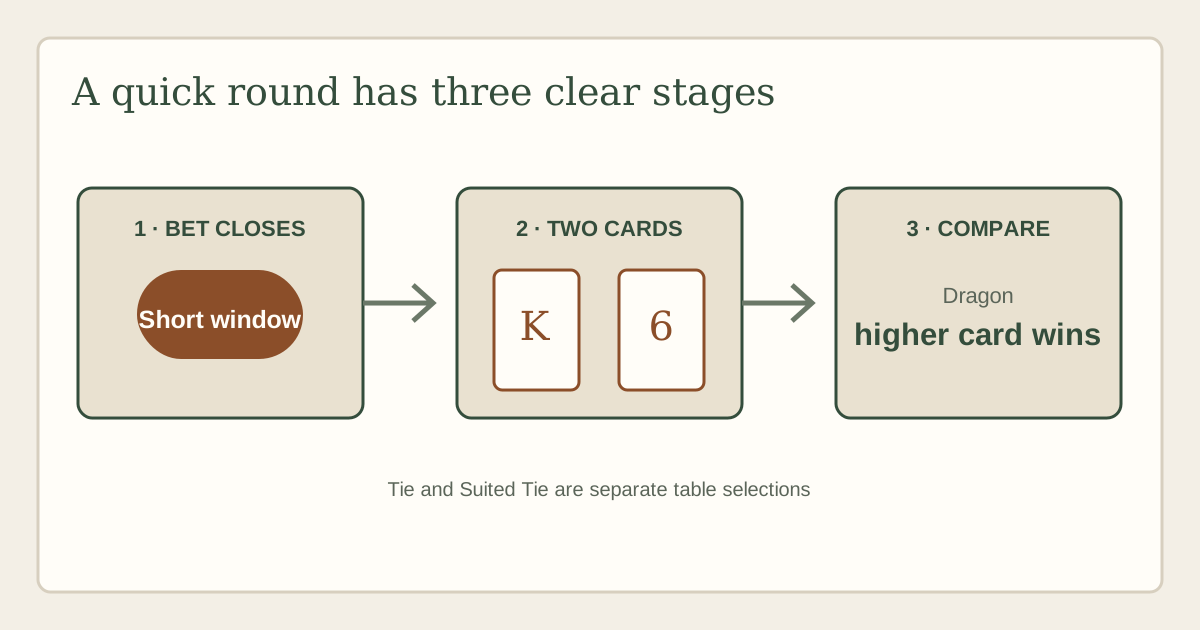
Super Speed Dragon Tiger is Evolution’s quicker presentation of a simple two-card comparison. Evolution’s official overview says the betting period is shorter and the cards are dealt swiftly, while the familiar market choices remain Dragon, Tiger, Tie and Suited Tie. Once betting closes, the dealer draws one card for Dragon and one for Tiger; the higher card wins. If the values match, the result is a Tie. The supplier says a winning chip is paid according to the table’s payout table.
That summary explains the core task, but not every setting. Evolution’s public page does not set out a complete universal paytable, specific minimum and maximum stakes, a theoretical return, a precise timer for every table or New Zealand operator availability. Check the actual game help before relying on a tie ratio, a suited-tie ratio, a card-ranking detail or a stake limit. Do not transfer figures from another Dragon Tiger product just because the bet names look familiar.
The “speed” part describes the round’s pace. It does not mean a player can influence the cards, that results are more predictable, or that a faster decision is better. A useful approach is to understand the bet before the short betting window starts, choose a stake only if it fits a pre-set limit, and skip the round when the interface is unclear.
What Evolution says makes this variant faster
Evolution describes Super Speed Dragon Tiger as its quickest Dragon Tiger game and identifies shorter betting time and swift dealing as the product distinction. The core comparison remains familiar: one Dragon card is compared with one Tiger card. The supplier page does not state a single number of seconds that applies to every operator interface, so this guide avoids specifying a fixed countdown.
Shorter decision time changes the practical experience even if the market labels appear familiar. A player has less time to move a chip, reconsider a selection or open a rules panel after the round has begun. That makes preparation more useful than last-second reaction. Read the table information before betting opens, locate the bet spots and controls, and decide in advance whether you intend to select Dragon, Tiger, Tie or Suited Tie.
Speed also creates a risk of interface mistakes. On a phone, the betting grid can be compact; on a desktop, other controls or a history panel may compete for attention. A quick round can make it tempting to add a chip without checking the total. If the bet slip does not clearly show the market and stake, wait for a later round. The game does not require participation in every deal.
The pace is not itself evidence about mathematical advantage. A shorter timer changes how quickly the outcome arrives, not the meaning of a winning bet. The product overview gives no basis for claiming that a fast format has a different card distribution from another version. If a table publishes its own rule variation, use that table’s documentation rather than assuming pace and probability are linked.
The four market labels in plain language
Dragon is the selection that the Dragon-side card will be higher under the game’s ranking rule. Tiger is the corresponding selection for the other card. These are the two main sides. The official page says the side receiving the higher card wins; it does not publish every detail of the rank ordering in the overview checked for this article.
Tie is the selection for equal card values. Evolution says that if both cards have the same value, the game ends in a Tie. The payout associated with that selection is a separate table setting. The fact that a tie can pay more than a main outcome, if shown on a given table, does not show how likely it is or whether the exact ratio includes the original stake.
Suited Tie is a more specific named selection in the official product description: both cards must have the same value and suit. It is not the same as an ordinary value tie. Whether a particular table pays a Suited Tie as its own market, whether it shares settlement with another position and what ratio applies need to be confirmed in that table’s help. The Evolution overview names it but does not supply a full payout schedule.
The labels are bets on conditions, not predictions based on character, colour or a streak. Do not assume an icon means a market has already been selected; check the bet slip. A chip placed on Dragon does not become a Tie bet if the cards match. The settlement is controlled by the rules attached to the selected position.
How a round proceeds
Before the deal, look at the displayed markets and choose a chip value only after reading the help. Place a chip on the intended position. If more than one position is allowed, each selection contributes to the total stake. Review the accepted bet indicator before the betting period closes. Evolution’s page confirms the broad order—betting time ends, then one card is drawn for each side—but the exact screen transitions and operator controls are implementation details.
After betting closes, the dealer draws a Dragon card and a Tiger card. The side with the higher card wins. When the values match, the result is a Tie. If the suits also match, the Suited Tie condition described by Evolution is met. Wait for the game to mark the outcome settled and then read the applicable payout line. The animation may display the cards before all account settlement is final, so use the round result/history for a completed record.
Once a round has settled, review what happened to each active position. If you selected Dragon and Dragon wins, check the stake and the table’s published payment convention. If the result is a Tie, look at whether a separate Tie bet was placed and how the main positions are settled on ties. Those settlement rules are not fully described on the supplier’s overview page, so do not assume the losing side’s stake is returned or forfeited without checking.
The next deal should be treated as a new decision. A previous Tie does not establish that a Dragon or Tiger win is now more likely. A run of Dragon outcomes does not create a rule that favours Tiger. The history panel is a record of previous rounds, not a prediction feature identified in the product page.
Understanding the payout table without importing another variant
The official page says that a chip on a winning bet is paid according to the payout table, but it does not display all rows in its public overview. For the precise rules, open the game information panel for the table you can actually access. Find one row for each market you intend to understand. Note the payout for Dragon, Tiger, Tie and Suited Tie separately, as well as what happens when a main bet meets a tied result.
Check whether the table prints odds as a net win ratio or a total return. In a hypothetical example, a one-unit stake at a 1:1 net ratio could mean the player receives one unit of winnings plus the one-unit stake back, while a table that labels total return might show the combined two-unit credit differently. This is only an arithmetic illustration; it is not an Evolution Super Speed payout claim. Terms like “pays 1:1” should be interpreted using the help panel’s definition.
Do not use a standard Dragon Tiger table found online as a substitute. Search results frequently combine game suppliers and table versions. A payout schedule may come from a land-based casino, a different live provider or a regular-speed game. The name Super Speed does not verify that all other variants share exactly the same settings. Verify the supplier, full title and actual rules source before comparing numbers.
If you want to compare the markets mathematically, you need more than the visible payout. You need the event definition, card ranks, deck composition or randomisation model and all settlement exceptions. Without these inputs, a claimed return percentage or “best bet” calculation is incomplete. The supplier’s public overview does not provide a universal RTP figure for Super Speed Dragon Tiger, so this guide does not invent one.
Tie and Suited Tie: questions to settle in the help panel
The official description defines an ordinary Tie by equal values and a Suited Tie by equal values and equal suits. It does not show every possible card combination or describe every relationship between the markets. Before placing either selection, look for answers to four questions: does a Suited Tie also meet the ordinary Tie condition; which position or positions are paid; what happens to the Dragon and Tiger main bets; and what exact payout appears for the suited condition?
The order in which a help page lists the bets does not necessarily tell you how simultaneous selections interact. If the table permits both Tie and Suited Tie bets in one round, confirm whether both can win on the same result and whether the settlement rules treat one as a subset of the other. The product overview’s short description does not answer all these questions.
A tied outcome can be defined by rank while suit adds an extra qualification. That conceptual distinction helps read the labels, but it is not enough to calculate the event probability. A calculation requires the deck and dealing model. Do not assume a standard deck count, that cards are drawn without replacement across a shoe, or that a shuffle happens at a particular point unless the official rules say so.
If the help page shows a high payout for Suited Tie, do not read the larger number as a hint that it is more attractive. A larger ratio may accompany a narrower event. To estimate expected return, a player would need the exact probability and settlement model; a headline ratio alone is not evidence of value. The safer editorial choice is to report the verified figure with its source and limits, not to create a strategy from incomplete inputs.
Faster play and decision quality
A short betting window places a premium on knowing the controls before the countdown. It is not necessary to decide at the last moment. If you need more time, use the pause between rounds, reopen the help or leave the table. Missing one round has no cost. This is a practical response to pace, not a method for changing the result. The site’s game guide index separates this title from other supplier products that use related card themes. If faster rounds are making it difficult to keep a boundary, see the New Zealand safer-gambling resources and pause before continuing.
For an error-resistant routine, first select the chip size, then identify the bet spot, then check the displayed stake and total, and finally confirm the bet was accepted. Avoid switching rapidly between multiple positions because of a just-seen result. Do not chase a losing outcome by raising the next stake. The round timer is part of the game experience, but urgency is not a reason to spend more than planned.
The term “speed” can also be misread as a promise about time to payment. The supplier uses it to describe the game variant’s betting and dealing pace. It does not establish how an operator processes deposits, withdrawals, disputes or account checks. Those are separate operator processes and should not be inferred from a game title.
Likewise, seeing a fast stream does not prove that the outcome was generated in a specific way. The official page states how the cards determine the result, but the short overview does not publish a complete technical specification. Avoid claims that the stream, host or pace makes the outcome more transparent or more predictable unless there is direct evidence for that statement.
Main bets, risk and simple arithmetic
The Dragon and Tiger selections map to opposing higher-card outcomes. If the cards do not tie, one side is the winner under the overview’s rule. That intuitive structure may make the main markets easier to understand than the Tie markets, but ease of understanding does not establish the highest expected return. A main bet can still lose, and its result depends on the rule-defined card deal.
If you consider covering both sides in one round, add the chip amounts first. Suppose, purely as an example, a player places NZ$1 on Dragon and NZ$1 on Tiger. The total amount exposed is NZ$2, not NZ$1. Whether one side’s win offsets the other stake depends on the exact payouts and tie treatment; without the table, it is not possible to call the combination a hedge. Covering both sides can still produce a net loss.
For Tie or Suited Tie, the key issue is the event condition, not only the advertised ratio. A higher possible return may be associated with a less frequent outcome. The official product overview does not provide the full probability data needed for a verified return calculation. Any numerical advice based on an unrelated table should be labelled as a different product and not presented as this game’s rule.
Keep stake decisions separate from prediction. Choose a maximum session amount before starting, do not use borrowed funds and do not increase a stake in order to recover a prior loss. If the table provides spend or time limits, learn how to set them before a round begins. These steps cannot make a random result favourable, but they can prevent the fast interface from driving an unplanned decision.
What to verify on desktop and mobile
On a desktop, locate the timer, the four market labels, the chip selector, the bet slip and the result-history area. The table may keep help in a separate icon. Check the amount shown for each active market rather than relying on memory. If a table uses a compact layout or hides one of the positions behind a tab, verify that it is visible before selecting it.
On a phone, confirm that the touch target belongs to the intended market. A narrow screen may place Tie close to Dragon or Tiger, and a thumb can cover the selection while you tap. Look for a clear accepted-bet marker and check total exposure before betting closes. Use the help panel in landscape or zoomed text if the rules are hard to read; do not place a wager while the important labels are obscured.
If the stream freezes or the connection drops, do not assume that a tap reached the table. Restore the page and inspect the accepted bet and settled history. If a round is disputed, preserve the round ID, time, position and stake and ask the operator to review the account record. The supplier’s public product page cannot confirm what happened to a particular account request.
Accessibility also matters in a fast interface. Check whether labels are text rather than colour alone, whether keyboard controls are announced, and whether the page zoom preserves the bet slip and confirmation state. If you cannot reliably identify a market or amount, do not use that interface until the controls are clear. A quicker game is not a reason to accept a harder-to-read display.
Demo mode and New Zealand access
Evolution’s game catalogue identifies its site as a freeplay demo environment and says demo access and features depend on jurisdiction. This wording does not guarantee that Super Speed Dragon Tiger is present in a demo, that a demo uses the same table rules as a live operator, or that a specific New Zealand visitor can access a casino table. Check the operator’s current eligibility information and New Zealand regulatory guidance independently.
The Department of Internal Affairs says that online casino providers must not advertise to people in New Zealand during the transition. The current law also identifies affiliate arrangements as a prohibited form of online casino advertisement. Rules and official guidance may be updated, so review the DIA material before a public release. This guide does not say that the game is available in New Zealand and contains no operator referral button.
A supplier demo is best read as a way to become familiar with labels and round sequence where access is permitted. It cannot verify the live operator’s stake limits, account conditions or table-specific payout settings. If the demo does not expose an information panel, do not use it as evidence for a missing rule.
Frequent mistakes when searching for rules
Reading a regular Dragon Tiger page as the Super Speed rulebook. The core comparison is similar, but exact payouts and settings may differ. Look for the full product title and supplier.
Assuming that a fast game has a fixed universal timer. The official overview says shorter betting time, but it does not establish one time value for every operator table. The displayed timer and help are the appropriate source.
Treating Tie and Suited Tie as identical. Evolution distinguishes a value match from a value-and-suit match. Check the table’s separate lines and settlement rules.
Assuming a payout ratio proves a bet is favourable. It does not show the event probability, model assumptions or return. Avoid “best bet” claims without complete math.
Using an old outcome sequence as a signal. A history panel reports earlier results. It is not described by the supplier as a forecast for the next deal.
Confusing the game’s pace with operator payment speed. Game rounds and account withdrawals are separate processes. One does not verify the other.
Before you place or assess a bet
Confirm the exact title and read the current help. Identify the rank rule, how ordinary ties settle, what qualifies as a suited tie and whether the table allows more than one selection. Find each payout ratio and determine whether it includes the stake. Check the actual minimum and maximum rather than borrowing values from another casino or a review of a different variant.
Before a round, decide the stake and selection away from the last seconds of the timer. After adding the chip, verify the market label, amount and accepted status. Add up every active position to understand the total exposure. If you cannot check these details in time, skip the round.
After the cards are shown, wait for the settlement, then compare the table result with your bet slip and history. Save the round reference and contact operator support if the record appears inconsistent. Avoid repeat bets made as an informal test. For a session, set time and spend limits before starting and stop when either is reached.
The supplier page describes a simple comparison delivered at a faster pace. That is enough to understand the broad idea; it is not a substitute for the table’s full help. A careful reader can identify what is confirmed, what remains table-specific and what should not be inferred. That distinction is more useful than importing a payout number from a similar title.
Questions readers commonly ask
How does Super Speed Dragon Tiger work?
Evolution says players choose Dragon, Tiger, Tie or Suited Tie. After betting closes, one card is drawn for each side, and the higher card wins. Equal values produce a Tie. The table payout panel sets the actual payment for a winning bet.
What is “super speed” about it?
The official overview describes shorter betting time and swift dealing compared with the familiar format. It does not publish a single timer value that is guaranteed across operator tables.
What is the difference between Tie and Suited Tie?
Evolution’s public description defines Tie as equal card values, and Suited Tie as equal values and equal suits. Check the current table help for payout, bet interaction and settlement details.
Does the supplier publish a universal RTP or stake range?
The product overview checked for this guide does not provide a complete payout table, universal RTP or stake limits. Those values should not be guessed from a standard Dragon Tiger game.
Does a faster round make Dragon or Tiger more likely?
The official description links speed to shorter betting time and swift dealing. It does not say the pace changes the card comparison or predicts an outcome.
Can I infer the next card from previous results?
The supplier does not describe the history panel as a prediction tool. Previous settled results are records, not a verified signal for the next deal.
Is the game available to New Zealand residents?
Evolution’s catalogue does not prove a particular operator offers the product or that a person in New Zealand can access it. Check the operator’s terms and the current DIA guidance; this guide makes no availability claim.
Sources and verification boundary
Evolution’s official Super Speed Dragon Tiger page was checked on 6 October 2026. It confirms the faster variant description, shorter betting time, swift dealing, Dragon and Tiger selections, Tie and Suited Tie, and the broad card-comparison sequence. It does not provide a full public payout table or universal limits in the overview used here. DIA advertiser guidance and the New Zealand regulations were also checked on that date. No search-volume or ranking data were available in the supplied project.
