Live game rules · South Island guide
Ice Fishing: rules, wheel bets and bonus settings
 Best casinos available in New ZealandUpdated 7 November 2026

Ice Fishing is Evolution’s speed game show built around a virtual 53-segment money wheel. The public rules describe two instant-payout Leaf positions, three fish bonus positions and an All Bonuses selection. Random multipliers can be assigned after betting closes. Evolution publishes bonus ranges for each fish type, but a table’s own help remains necessary for complete payouts, stakes and availability.
The short answer
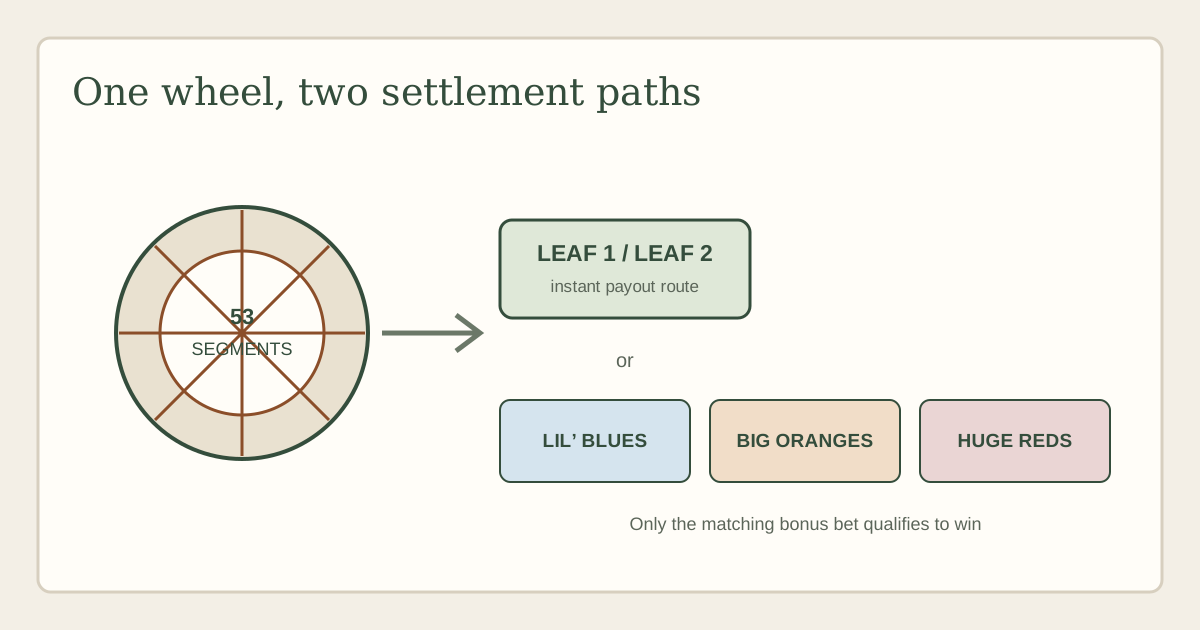
Ice Fishing is Evolution’s fast game show built around a virtual money wheel with 53 segments. A player can select Leaf 1 or Leaf 2 for an instant wheel payout, or choose one or more fish bonus positions: Lil’ Blues, Big Oranges or Huge Reds. Evolution also describes an All Bonuses position that covers the bonus segments. After betting closes, random multipliers may be assigned to wheel segments. The wheel then stops on a segment; a Leaf result settles immediately, while a fish segment opens its corresponding bonus game.
The supplier’s public page lists base multiplier ranges for the fish games: 3× to 100× for Lil’ Blues, 4× to 200× for Big Oranges, and 10× to 500× for Huge Reds. It says a multiplier assigned to a bonus segment increases all fish values for that game before the fishing sequence begins. These are supplier-published feature ranges, not a complete table-specific payout schedule. The table help still controls the accepted stake, exact payout convention, eligibility, any caps and other settlement details.
One rule is particularly easy to miss: everyone can watch a bonus animation, but Evolution says only players who placed a bet on the corresponding bonus spot can participate and win. Seeing a fish caught does not mean every person at the table receives a payout. A player should match the winning wheel segment to the bet slip and then confirm the qualifying position in the settled round history.
The structure: one wheel and two kinds of outcome
The main round uses a virtual wheel divided into 53 segments. The public overview groups those segments into Leaf positions and fish bonus categories. Leaf 1 and Leaf 2 are described as instant-payout spots. Lil’ Blues, Big Oranges and Huge Reds are entry points to distinct bonus games. All Bonuses is an additional choice to cover the bonus-game segments rather than a separate kind of fish.
This creates two broad settlement paths. A Leaf result is handled as an instant wheel payout according to the applicable table rules. A fish result first determines whether the matching bonus market was backed; if it was, the game displays the corresponding fishing sequence and the final fish multiplier. The wheel result and the bonus result are related stages, but they are not the same event. A bonus screen is not itself proof that a particular bet won.
The 53-segment description is useful for understanding the format, but the public summary does not list every segment count by category or give a complete probability table. Do not use a fan-made count, a screenshot or another site’s table as an official probability. To calculate chances, the exact segment distribution and the payout rules need to be in the table’s rules or information panel.
The main distinction is between selecting a destination on the wheel and participating in the bonus after that destination is reached. A player who wants to understand a potential result should ask: Which position did I cover? Did the wheel land on it? Is that position eligible for an instant payout or a bonus? Did the bonus qualify my specific bet? What multiplier and payout convention apply? Reading the round as a sequence helps prevent the animation from obscuring the actual bet condition.
Step by step: how a main round is described
Choose the positions before betting closes. The table displays the available bet spots and the current betting window. Select Leaf 1, Leaf 2, one of the fish categories, All Bonuses or a combination only after reading the help. If several chips are permitted, the total stake is the sum of every selected position.
The betting period ends. Evolution says multipliers may be assigned to random wheel segments after the betting time is over. A player cannot use a multiplier that has not yet appeared to make an informed pre-round prediction. The appearance of a multiplier is part of the post-betting feature sequence, not a signal about the next selection.
The wheel spins and identifies a segment. The flapper indicates where the virtual wheel stops. If the result is a Leaf, the rules say the instant payout is handled by the Payouts section. If the result is one of the three fish segments, the corresponding bonus game follows.
Eligibility is checked for the bonus. All players may observe the bonus game. Evolution’s page says only a person who bet on the corresponding bonus spot can participate and win. If the player selected a different fish category, a Leaf or no qualifying position, the animation may still be visible, but the supplier overview does not award that person the corresponding bonus win.
The fish multiplier is revealed. The host reels in the fish and the final multiplier is shown when the catch is out of the water. If the bonus segment received a multiplier during the wheel stage, Evolution says all fish values for that bonus game are increased accordingly before the fishing begins. The accepted bet and current table paytable determine the final credited amount.
After the sequence completes, read the settlement record. The visual result can be compelling, but the account history should show which selected position was paid, which stake applied and what return was credited. If the animation and history seem inconsistent, record the round information and ask the operator to review it.
Leaf 1 and Leaf 2: instant wheel positions
Evolution describes Leaf 1 and Leaf 2 as instant payout bet spots. One random wheel segment may be assigned a multiplier from the supplier’s listed Leaf set: 3×, 4×, 5×, 7× or 10×. The multiplier is assigned after betting closes. The public overview does not give all ordinary Leaf base payout rows, exact probabilities, stake limits or how a specific table displays net profit versus gross return.
Keep the two Leaf labels distinct. The game page treats them as separate positions. Do not assume that a bet on Leaf 1 also covers Leaf 2, or that they have identical settlement terms simply because both are instant payouts. Check the current paytable for each spot and note how the multiplier feature is applied if a particular segment receives one.
An “instant” payout describes a path that ends at the wheel result rather than opening a fishing bonus. It does not mean the casino processes account withdrawals instantly. It also does not imply that a Leaf selection wins often enough to be low-risk. Frequency and expected return require a complete probability model; the public supplier summary is not enough to calculate them.
If a multiplier appears on one Leaf segment, read the interface to see exactly which labelled segment it covers. The post-bet timing matters: it can be easy to remember the multiplier but forget whether it was assigned to the segment your bet selected. After settlement, compare the wheel result, the marked segment, the selected position and the paytable line. A multiplier that appears elsewhere on the wheel does not change the result of a different segment.
The three fish bonus games
Evolution lists three bonus types with different fish multiplier ranges. Lil’ Blues has a listed range from 3× to 100×. Big Oranges runs from 4× to 200×. Huge Reds runs from 10× to 500×. These ranges describe the multiplier assigned to fish in each bonus game according to the public supplier overview. They do not give the probability of catching each value or the chance that the wheel lands on that bonus category.
The category names are labels for distinct bet spots and bonus sequences. They should not be read as a player’s choice of which fish will appear after a wheel result. The wheel first identifies which bonus type is entered. A player who selected the relevant bet spot may then be eligible for that bonus outcome. The “fish” animation reveals a multiplier, but the visual story does not let a player influence the result.
If a bonus segment was assigned a multiplier during the wheel stage, Evolution says every fish value in that bonus game is increased by it. The effect applies to the bonus values for that game before fishing begins; it is not a general boost to every player or every later round. A multiplier assigned to a different wheel segment should not be assumed to apply to the game now being shown.
The maximum listed base range is not a typical outcome. A range says which values can be displayed under the described rules, not how often each value occurs. Avoid statements such as “usually pays” or “one in a certain number of rounds” unless a current primary source publishes that distribution. The supplier’s product page gives the feature description and ranges, not a public empirical dataset.
All Bonuses: what the label means
Evolution says a player can bet on All Bonuses to cover all bonus game segments. That makes it a distinct market on the main layout, but the supplier summary does not supply a complete payout row or explain every version of how the stake is divided among the bonus categories. Use the active table’s help to verify what one chip on All Bonuses covers, how much of the stake applies to each segment and what happens to the bet when any one of the bonus types lands.
Do not assume All Bonuses is a separate wheel outcome. The wheel still lands on a labelled segment. The selection is described as covering the bonus segments, while Lil’ Blues, Big Oranges and Huge Reds remain the actual categories. It is the relationship between the selection and those underlying outcomes that the table’s terms should clarify.
If the interface allows a player to place All Bonuses alongside one specific fish bet, add both stakes into the total exposure and check whether the rules permit both positions to settle on the same wheel result. Avoid calling the combination a hedge or a guaranteed feature. The exact returns matter, and a broad selection may involve different payments depending on which fish category appears.
When reading the paytable, look for a separate All Bonuses row and note any category-specific payout. If no such row is visible, open the game’s full help rather than infer an amount by averaging the three published fish ranges. The ranges are not probabilities and cannot be averaged into a return figure without distribution data.
Multipliers: timing and interpretation
The timing of the multiplier assignment is central to Ice Fishing. Evolution says multipliers are applied after betting time ends. Up to 10× may be assigned. For Leaf positions, the supplier lists possible assignments of 3×, 4×, 5×, 7× or 10× on one random wheel segment. For a bonus game type, the supplier lists possible segment multipliers from 2× through 10×. These details belong to the rule description, but the actual paytable should explain how the values affect a winning stake.
A multiplier is a factor in payout calculation, not a guarantee that a selected bet wins. If a multiplier is assigned to a bonus segment that does not become the wheel result, a player cannot assume the bonus game happened. If the segment does land, only qualifying bets are relevant. The wheel result, selected position and multiplier assignment all have to align under the rules.
For arithmetic clarity, suppose a hypothetical table defines a one-unit fish stake and a winning fish value of 12×. Multiplying one by 12 gives a gross factor illustration of 12 units. This is not a claim about Ice Fishing’s account credit, because the exact rule may state a net amount, total return, original stake treatment or cap differently. It is a teaching example, not a payout quote.
Avoid adding multipliers mentally before checking the rule. The supplier says a segment multiplier increases the fish values for the relevant bonus game. That is different from assuming every multiplier in the display multiplies the original amount in a simple way. Use the table help to understand whether the segment factor is combined with the fish factor, whether the game states a maximum and how rounding works.
The largest possible combined amount is not the expected return. Even if a player could calculate a theoretical maximum from the published factors, that ceiling says nothing about its likelihood. The maximum should not be used as a session target or to justify a larger stake.
What the public page does not settle
The supplier overview provides useful mechanics but not every detail a player may want. It does not present a full universal paytable with all base returns. It does not publish a complete probability distribution for each wheel segment, a universal theoretical RTP for every position, or operator-specific minimum and maximum stakes. It does not establish that one particular New Zealand casino offers the product or that every customer can access a table.
These missing values are not a defect to fill with guesses. Live products can be presented through tables in different currencies, languages or operator interfaces. Where a rule or stake is not in the official overview, the live table’s game information is the correct place to verify it. If the table information is unavailable or contradicts a third-party guide, rely on the official rule set provided at that table or ask the operator for the applicable version.
Third-party pages surfaced in search use differing claims about segment counts, timer lengths, RTP percentages, stake limits and maximums. Some show a game overview, others mix estimated odds with a specific operator’s rule PDF, and some present tracking data. Those may answer different versions or use a source not visible on Evolution’s public page. Do not combine their numbers into a universal Ice Fishing specification. The scope and date of each source matter.
A practical evidence hierarchy is: current game help attached to the exact table; official supplier documentation for the product-level features; operator terms for account and stake settings; and third-party explanations only as context. If two sources disagree, record the exact title, language, date and table configuration. Do not settle a conflict by choosing the more attractive number.
Reading a payout row carefully
Start by finding the exact outcome label in the help. Confirm whether the row is for Leaf 1, Leaf 2, Lil’ Blues, Big Oranges, Huge Reds or All Bonuses. A general row for a game category may not describe the same settlement as the individual bet spot. Make a note of whether the amount is written as “pays,” “odds,” “multiplier” or “return,” because those words can be used differently.
Next identify the role of any pre-spin multiplier. Does the number multiply the base bonus value, the stake, or a displayed payout? Does it affect only the segment where it appears? Evolution’s overview says segment multipliers increase the Leaf payouts or fish multiplier values in the corresponding bonus feature, but the table rules must explain the operational calculation and the maximum.
Then inspect limits. A minimum stake and a maximum stake can differ by bet type, currency or table. A maximum payout may cap a calculation even if the feature multiplier appears larger. The official product overview checked here does not provide a universal stake range. Do not insert a figure from a casino review into a guide for all operators.
Finally, consider what happens on a connection problem, rejected chip or interrupted result. A good table help or operator terms should identify how accepted bets and results are recorded. If the screen freezes, use round history and the operator’s support process instead of interpreting an unfinished animation.
Mobile, pace and interface checks
The speed-game label suggests that the betting stage is short, but the supplier overview does not state a single timer that applies to every user interface. On mobile, open the information panel before the round and learn where the five main groups of bet spots appear. Verify that the chip size is visible and that the total stake includes every selected position.
A phone screen can make neighbouring spots difficult to distinguish. Check whether Leaf 1, Leaf 2 and All Bonuses have readable text in addition to colour or artwork. Do not rely on the visual position of a button alone if the layout changes when the screen rotates. After placing a selection, confirm that the bet slip names it correctly before betting closes.
During the bonus sequence, keep the main round result separate from the animation. The host’s presentation may draw attention to the fish, but eligibility came from the bet placed before the wheel spin. If a bonus appears for a category you did not select, watching it does not convert another bet into a winning one. Wait for the settlement and check the history.
If a stream or connection stops, avoid tapping multiple positions to compensate. Reconnect and check whether the table accepted the original bet. Save the round ID, timestamp, selected category and stake if there is a dispute. The operator can examine the account record; the public supplier overview cannot verify a particular click.
New Zealand context and demo claims
Evolution identifies its game catalogue as a freeplay demo site and notes that demos and features are subject to jurisdiction. That statement is not proof that Ice Fishing is offered in every demo, that the demo has the same terms as an operator table, or that a New Zealand customer can access a real-money game. Operator availability and legal permission are separate questions.
The Department of Internal Affairs says online casino providers must not advertise to people in New Zealand during the current transition. The current regulatory instrument defines an affiliate arrangement and prohibits advertisements involving such an arrangement. The relevant rules can be updated; review the current DIA guidance before making public claims or distributing this guide. No New Zealand availability is asserted here, and this draft has no operator referral button. Use the site’s game guide index to distinguish other supplier titles from this wheel format. For New Zealand help contacts and non-commercial support information, use the safer-gambling page.
If a demo is available, use it only to understand the display and sequence described by that version. It may not show live limits, the exact table’s currency, operator terms or account-settlement information. A demo’s play-money display should not be treated as evidence of a real-money payout or as a forecast of any future result.
Common mistakes when interpreting Ice Fishing
Assuming everyone who watches a bonus can win it. Evolution says all players may observe, but only those who bet on the corresponding bonus spot can participate and win.
Treating a fish multiplier range as the chance of catching a value. The range lists possible multipliers. It does not publish the distribution across values or the probability of reaching a particular outcome.
Thinking a post-betting multiplier can be anticipated. The official page says multipliers may be assigned after betting time ends. That sequence does not provide a pre-round prediction signal.
Confusing All Bonuses with a fourth fish type. The supplier describes it as a bet that covers all bonus-game segments. It is not listed as an additional fish bonus game.
Using an operator-specific RTP as universal. Third-party pages may quote different table rules or jurisdiction versions. Record which ruleset a number belongs to and check the live table before using it.
Equating a large maximum with a likely return. A ceiling is not an expected payout, and it gives no frequency information by itself.
Assuming online availability from the provider catalogue. A supplier listing does not show that a particular casino carries the game or that a New Zealand visitor is eligible.
A practical pre-round checklist
Read the exact game title and confirm that you are viewing Ice Fishing rather than a different wheel game. Find the layout and identify Leaf 1, Leaf 2, each fish category and All Bonuses. Read the individual payout rows and note how multipliers apply. Confirm which selection qualifies for each bonus and whether the table displays a maximum payout or stake restriction.
Set the amount before the countdown, then review every chip. Add the positions to find the total exposure for the round. Check that the bet slip shows the intended bet and the correct amount. If you need to guess what All Bonuses covers, do not select it until the help explains it. If the short window makes a decision uncomfortable, skip the round.
After the wheel result, match the stopped segment to your bet. For a fish outcome, confirm whether your selection qualifies before interpreting the bonus screen. After settlement, compare the credited amount to the rule’s payout convention. Keep the round information for a support request if something is unclear.
Use a fixed time and spend boundary. A game with quick rounds can make elapsed time harder to notice, so a timer can help. Do not raise a stake to recover a prior loss, and do not treat a displayed multiplier as a reason to continue. If gambling causes stress or affects essential spending, stop and use New Zealand support services rather than continuing to look for a better bet.
Questions readers commonly ask
What is the Ice Fishing wheel?
Evolution describes a virtual 53-segment money wheel with Leaf positions and fish bonus categories. The public overview does not list a complete universal segment probability table.
What are the three bonus games?
They are Lil’ Blues, Big Oranges and Huge Reds. Evolution’s public page lists their base fish multiplier ranges as 3×–100×, 4×–200× and 10×–500× respectively.
Can everyone win when a fish bonus is shown?
No. The supplier says everyone can observe a bonus game, but only a player who bet on the corresponding bonus spot can participate and win.
How do the random multipliers work?
Evolution says they may be assigned after betting closes. Leaf segment multipliers can be 3×, 4×, 5×, 7× or 10×; a bonus game segment may receive a factor from 2× to 10×. The table help explains the precise payout calculation.
Does the public game page give an RTP or stake range?
The product overview used here does not publish a complete universal RTP and stake range. Check the exact table help and do not import a third-party value without confirming its ruleset.
Does the 500× Huge Reds value mean a player will receive 500 times the stake?
It is the upper value in the supplier’s listed base fish range, not a guarantee. A bonus segment multiplier may affect the feature, while the exact amount and any cap depend on the table’s payout rules.
Is Ice Fishing available in New Zealand?
Evolution’s catalogue does not establish operator availability or local eligibility. Check current New Zealand guidance and the specific operator’s terms; this guide makes no access claim.
Sources and verification boundary
Evolution’s official Ice Fishing page was checked on 6 October 2026. It confirms the virtual 53-segment wheel, Leaf and bonus positions, All Bonuses, multipliers assigned after betting closes, the three fish multiplier ranges and the rule that only a player who backed the corresponding bonus spot can win. It does not publish a complete universal stake range or probability distribution in the overview reviewed. DIA advertiser guidance and the New Zealand regulations were checked on the same date. Search results contain conflicting secondary claims; no third-party numerical estimate is presented as a universal official setting.
