Live game rules · South Island guide
Marble Race: Rules, Betting Grid and Table Settings
 Best casinos available in New ZealandUpdated 7 November 2026

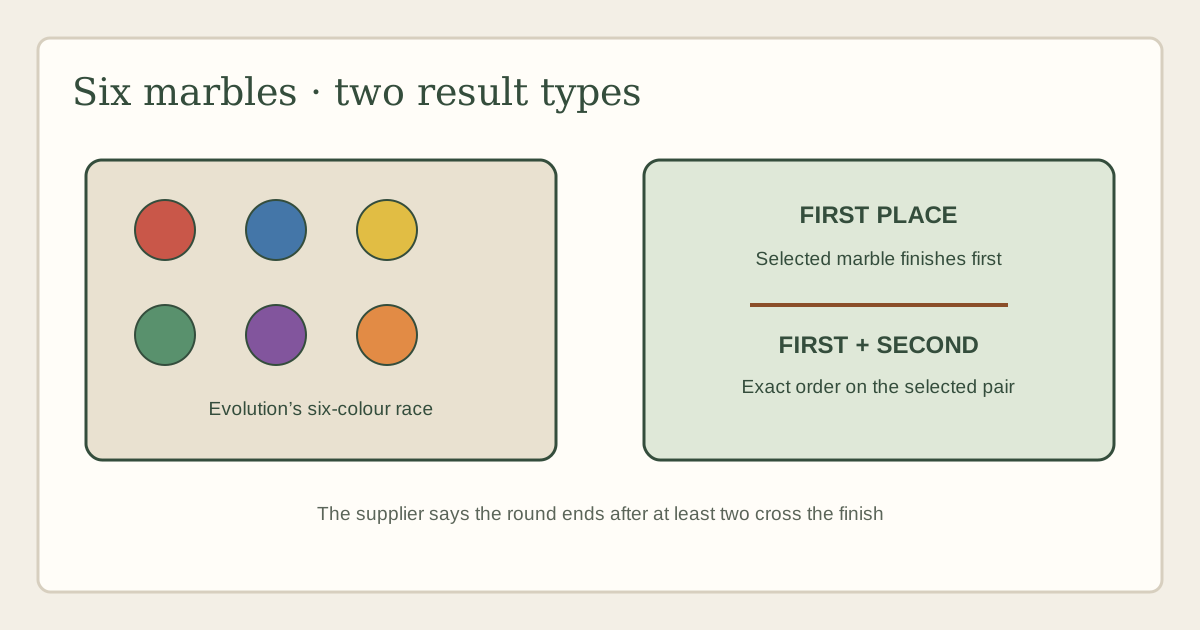
Evolution Marble Race is a six-colour game show with a first-place market and a market that requires the exact first-and-second order. The round settles once at least two marbles cross the finish line. The supplier’s public page does not provide one universal payout table, RTP or New Zealand operator setting.
The short answer
Evolution’s Marble Race is a game show in which six coloured marbles race down a track. The supplier describes two relevant selection types: a first-place bet, where the chosen marble must finish first, and a compound first-and-second bet, where the selected pair must finish in the exact order shown on the chosen spot. The round ends when at least two marbles cross the finish line. The final order displayed by the game is what matters for those markets; choosing the correct two colours in reverse order is not the same as choosing the displayed ordered pair.
That summary explains the public rules, but it is not a full paytable. Evolution’s public product page does not give one universal RTP, stake range, New Zealand operator list, demo entitlement or complete payout schedule. Those details must be read in the help attached to the specific table. Do not copy a value from a third-party guide and present it as a setting shared by every operator. This is also the Evolution-branded game, not Ezugi’s separately described EZ Marble Race Las Vegas, which the supplier describes as a five-marble product with unique pre-recorded races.
Which Marble Race is this?
The name appears on more than one supplier product, so verify the brand before reading a guide. This page covers Evolution’s game called Marble Race. The supplier page describes six uniquely coloured marbles, a custom-built track and bet choices for first place or an ordered first-and-second result. Ezugi’s page uses the distinct name EZ Marble Race Las Vegas and describes five marbles. Shared imagery or the general racing theme does not make these the same game.
The distinction changes what source should control the answer. A review of the Ezugi product may describe a different number of competitors, a different visual sequence or another grid. An Evolution guide can only use the Evolution page and the exact Evolution table help. If an operator lobby shows a shortened name, check the supplier logo, game help heading and product identity before relying on any rule. If the brand cannot be established from what is visible, record the title as ambiguous rather than assuming.
Evolution’s public game page presents Marble Race under its game-show catalogue. That confirms how the supplier categorises the product, but it does not establish which casino operator has integrated it or whether a New Zealand account can open a particular table. A public supplier page and an operator lobby answer different questions. Keep the supplier identity separate from the account and local-market question.
The six marbles and the race result
The Evolution page says that six uniquely coloured marbles compete on a track with obstacles. The colour functions as a visual identifier for a competitor. When a player reads a bet spot, the selected colour or pair must be matched against the official result shown for that round. Do not rely on a cropped animation, a commentator’s emphasis or the order in which the marbles enter the frame. The settlement panel and completed result screen should show the game’s recorded order.
The game page says a round ends when at least two marbles cross the finish line. That is important because the compound bet is defined around first and second place, and the game must establish those positions. The supplier’s wording does not require all six marbles to finish before the result is available. An unfinished visual sequence after the first two finishers should not cause a player to invent additional market outcomes. Use the table’s final result and history record.
“At least two finish” describes the supplier’s stated endpoint, not a promise that the two initially leading marbles can never be overtaken before the finish. A race continues through its track sequence until the finish condition has been reached. The official page calls every race unpredictable and refers to randomised starting positions after betting time. It does not publish a deterministic movement model or say that previous results forecast the next result.
The two market types in the supplier overview
First place
Evolution says the regular grid permits a first-place selection. You choose a marble colour, and the bet wins if that marble crosses the finish line first. The condition is singular: selecting the eventual second-place marble does not satisfy a first-place selection. The table’s bet spot should make clear which colour corresponds to each choice. Before the selection period closes, verify the chip and amount appear on the intended colour.
The public product page does not supply the return for each colour, the exact grid layout, whether every operator displays the same betting options or the stake range. It also does not specify whether a particular table presents extra markets beyond the two named examples. Read the operator instance’s rules rather than treating a general video or third-party screenshot as universal. If a return ratio appears, check whether it is net winnings or includes the original stake.
First and second in exact order
Evolution also describes a compound betting grid for first and second place. The bet spot uses a pair of coloured numbers to identify an ordered result. The supplier’s example states that a black first-place marble with a white second-place marble is one particular ordered pair. To win that selection, both finishing positions must match in the order shown. White first and black second would be a different outcome.
The term “compound” is a label for the grid described by Evolution; it should not be expanded into assumptions about multiple separate tickets, a system bet or a payout boost. The exact interface should show how one selection is made and what stake is associated with it. Check the grid legend for the first-position and second-position cues. Some screens rely on coloured number chips, so read the help and accessible labels rather than guessing based on a small graphic.
The supplier summary does not provide the complete list of pairs, each payout or whether the current operator lets a player combine first-place and compound selections in the same round. Do not assume the two grid types can be combined or that a single stake covers both. Read the exact table and confirmation slip. If the table displays both, understand each accepted selection and total stake independently.
Round sequence: from open betting to settlement
The public description supports a simple sequence. First, a betting period opens and the available grid is presented. A player may use the market or markets shown by that table. Next, betting time ends. Evolution says the marbles are gathered into randomised starting positions. A host starts the round and opens the gates. The six marbles race over the track and obstacles. Once at least two cross the finish line, the game ends and the result is displayed.
This order matters when interpreting what can and cannot be known at the time of selection. The supplier says the starting positions are randomised after betting closes. That timing means an animation or starting arrangement not yet shown during the selection period cannot serve as information a player had when placing the bet. The public overview does not state a method for predicting the final order, and a historical list is not described as a forecast model.
For a careful read, compare three screens or moments: the market before closure, the accepted bet record immediately after placement, and the settled result after the finish condition. If there is a disagreement, note the round identifier and preserve the account record. An animation replay can be useful context, but the accepted wager and the official settlement history answer different questions. Do not assume a bet was accepted merely because a chip appeared momentarily on screen.
Reading a bet grid without misreading the result
The first task is to identify whether the active grid means first place alone or ordered first and second. A player should not have to infer that from colour alone. Read the grid title or help label, then follow the visual key. If a compound spot shows two numbers or colours, identify which marker denotes first and which denotes second. The Evolution overview gives an ordered example, but it does not reproduce every operator’s interface.
The second task is to confirm the colour mapping. A colour is a label, not a guarantee that the same shade is easy to distinguish on every display. On a small screen, two saturated colours can look similar or appear differently because of brightness settings. Use any text labels, number labels or accessible descriptions that accompany the selection. Confirm the exact bet summary before closure rather than trusting a tiny visual token.
The third task is to read the amount and market in the bet slip. If more than one spot is selected, add the stakes to understand the total exposure for the round. The bet slip should make it possible to tell whether a selection was recorded and what it cost. If the amount is not clear, do not assume that a tap was undone or that a prior stake was replaced. Use the interface controls and table help while betting remains open, and stop if the summary cannot be reconciled.
Finally, after settlement, compare the displayed order to the exact spot selected. For a first-place ticket, check position one. For a compound ticket, check both positions in order. A near match is a losing result if the stated condition requires exact order. That is a rule interpretation, not a judgment about which marble looked most impressive during the animation.
Payouts, odds and what the public page leaves open
The official product summary explains what selected outcomes mean but does not provide a complete payout table. It therefore cannot support a verified statement that a particular first-place colour pays a certain amount, that an ordered pair has a particular ratio, or that every operator configures identical values. Several third-party pages publish numbers, but the pages checked for this guide did not provide a supplier-wide basis that could be applied to every table; they varied in how they presented payout, limits and demo access.
For a table-specific figure, locate the rules or paytable from inside the game instance. Copy the row name exactly, including market and grid, and note the currency, table identifier and date. Check whether the figure is written as a multiplier, a payout ratio, a net win or a total return. If it is a total return, the stake treatment differs from a net-win convention. Do not perform an arithmetic conversion until the source defines that convention.
RTP is a separate kind of number from an individual winning payout. A table may disclose theoretical return in its rules or approved information, but a payout ratio for one selection alone does not reveal the expected return. Nor does a large possible result prove a high average return. A valid calculation needs the full outcome probabilities and settlement schedule that apply to the particular market. The public supplier summary does not provide those inputs, so this guide does not quote a universal RTP.
“Odds” can refer to displayed payouts, the likelihood of an outcome, or a conversion from one to the other. A page may use the word loosely. If a source gives only a payout, do not call it the chance of winning. If an operator panel shows an RTP, retain the exact table and market context. If neither is available, a concise unknown is more accurate than importing numbers from a review page with no version information.
How to check a table before using its settings
Open help before the first round and look for the title, supplier, version or table label. Confirm the available grid types, colour key, how a pair is ordered, the point at which bets close, the result condition and how void or interrupted rounds are handled. Then find the displayed stake range, currency, payout table and any return information. If a panel contains multiple sections, move through all of them; the first instruction screen may only explain the broad mechanic.
Make a short record instead of relying on memory: table name, operator, date, jurisdiction, selected grid, rule version if shown, lower and upper stakes, payout wording and the specific source panel. This is especially important for an operator-specific setting that may later change. Avoid saving only an isolated payout image without its table heading or date. Without context, a figure can easily be misattributed to another game version.
Check the same terms in the operator’s general rules when they concern account access, currency, settlement time or disconnection handling. Game help governs game mechanics; operator terms may govern the relationship between player and account. If those sources appear to conflict, record the inconsistency and seek clarification before relying on a rule. Do not resolve it by choosing whichever value is more favourable.
The public Evolution page says freeplay demonstrations and individual game features are subject to jurisdiction. If a demo is linked, verify that it is an official supplier demo and understand that it may omit operator-specific cashier terms and stake limits. A demo screen is not evidence that a real-money table is available to an account or that the local market permits it.
Randomisation and historical results
Evolution describes the starting positions as randomised after the betting time and calls the race unpredictable. That is the extent of the mechanism that the public summary establishes. It does not publish the exact randomisation algorithm, a calibrated probability for every marble, a certified distribution or a method by which past outcomes can forecast the next race. Do not claim to know those internal details from an animation or a list of previous results.
A history panel, when supplied by an operator, can show previous completed outcomes. It can help identify what happened in a past round or resolve a record question. It does not necessarily show every input required to calculate future odds. A streak of one colour finishing first is a description of a sample. It is not proof that the colour is more likely next time, less likely next time or due to regress. A short sample can fluctuate by chance.
The same caution applies to apparent lane positions. If the marbles are positioned only after the betting period, a spectator cannot use that later display as pre-bet information. If a table shows a persistent lane colour or historical speed label, read the game help to learn what the display means before attaching a prediction to it. This public guide does not present a betting system, staking method or “best colour.” No selection method can be inferred from the supplier overview.
Visual accessibility and mobile reading
The game relies on coloured marble identities and a dynamic track. A usable interface should provide a way to connect the visual result to the selected bet, ideally through clear labels, a text summary or history. If the only available result is a fast animation, pause and inspect the final result panel. On a phone, check whether the six colours and the ordered pair grid are readable without zooming into controls. A colourful presentation is not a substitute for a legible bet confirmation.
Before selecting a market, confirm the control is keyboard or touch accessible in the operator’s interface and that focus does not disappear behind a video panel. If a result history can be opened, make sure its close or back control is visible and does not overlap a key bet selection. Interface details vary across operators, so this is a practical checklist rather than a claim about every Evolution implementation.
If an audio announcement is available, treat it as a secondary cue. The official settled result should remain accessible visually or in the recorded history. Similarly, do not rely on a colour alone where labels are available. A player should be able to tell exactly which first-place or compound position has been selected, especially if the screen is reduced to a narrow portrait view.
Similar names and adjacent products
This package includes separate provider and game pages because a reader can encounter overlapping terms. The Ezugi guide describes the Ezugi supplier catalogue, including its own EZ Marble Race Las Vegas product. The Evolution game described here has six marbles, according to the official Evolution page. The Ezugi description says five vibrant marbles and calls its footage pre-recorded yet unique. Do not combine the two descriptions, numbers or features into one hybrid game.
The Evolution provider guide navigates Evolution’s broader catalogue and links to game-specific pages. It does not replace this page’s single-title explanation. Likewise, this page is not a review of all Evolution game shows. If a user asks for another named title, use its own supplier source rather than extrapolating from the Marble Race layout.
The separation also helps when using a search result. A search snippet that drops the brand prefix may show “Marble Race” for multiple products. The destination page and supplier branding should resolve the identity. If they do not, avoid quoting a rule until the exact title is clear. A short identifier check prevents the most consequential error in a product guide: applying the correct-looking rule to the wrong product.
What is not established for New Zealand
Nothing on the supplier page establishes that a particular New Zealand operator currently offers Evolution Marble Race or that it is available to every local account. The supplier also says freeplay mode and individual game features are jurisdiction-dependent. This guide therefore makes no market-availability or demo-access promise and does not identify an operator as approved or licensed. Check current New Zealand government information and the relevant operator’s own terms separately.
The Department of Internal Affairs says online casino providers must not advertise to people in New Zealand during the current transition. Its advertiser guidance says the advertising prohibition is in effect and applies to a third party that publishes or arranges an advertisement. For that reason, this page is informational and contains no operator offer, sponsored CPA button or referral route. An internal rules guide should not be mistaken for an invitation to open an account.
If a reader is making a market or eligibility decision, use the current Department guidance rather than a historical review, search snippet or game catalogue. Regulatory arrangements can change; a page written earlier may no longer match the current transition. The relevant official sources are dated in the source section, and readers should check them again at the time they need a decision.
Questions readers commonly ask
How many marbles take part in Evolution Marble Race?
Evolution’s public page describes six uniquely coloured marbles. This is one way to distinguish it from Ezugi’s separately described EZ Marble Race Las Vegas, which the supplier page describes with five marbles.
What does a first-place bet require?
The chosen marble must cross the finish line first. The supplier says the regular grid lets a player select a colour for first place. The active table’s help supplies the exact grid and payout information.
Does the first-and-second bet accept the pair in either order?
Evolution describes ordered pairs and gives an example with one colour first and another second. A reversed finish is a different order. Check the active grid’s labels to confirm which displayed element represents first and second place.
Does every marble need to finish before the round settles?
Evolution says the round ends when at least two marbles cross the finish line. The final result panel and history should be used to confirm the official order.
What are the game’s RTP and stake limits?
The public product summary reviewed for this guide does not provide one universal RTP or stake range. Check the help attached to the exact operator table and retain its date and market context.
Is Evolution Marble Race available in New Zealand?
The supplier catalogue does not establish local operator availability or account eligibility. This guide does not make that claim. Consult current DIA information and the operator’s current terms.
Can past race results predict the next marble order?
Evolution describes the starting positions as randomised after betting closes and calls the race unpredictable. The public page does not say its history is a forecast tool. Previous outcomes should not be treated as a prediction.
Does a supplier demo prove a real-money game is accessible?
No. Evolution says freeplay demo mode and some game features are subject to jurisdiction. Demo access does not establish operator account access, payment terms or local legal status.
Sources and verification boundary
Evolution’s official Marble Race page was checked on 6 October 2026. It confirms six uniquely coloured marbles, first-place and ordered first-and-second markets, randomised starting positions after betting closes, and a result when at least two marbles finish. It does not provide a complete universal paytable, RTP, stake limits or New Zealand operator availability in the public description reviewed. The official Ezugi page was checked the same day and describes EZ Marble Race Las Vegas as a distinct five-marble product. Several secondary reviews reviewed on 6 October 2026 published conflicting payout and limit values; none are repeated here as universal settings. DIA guidance was checked on 6 October 2026.
