Live game rules · South Island guide
Super Color Game: rules, colour bets and multipliers
 Best casinos available in New ZealandUpdated 7 November 2026

Super Color Game is Evolution’s live game show with three coloured dice. Players can choose from six colours—yellow, white, pink, blue, red or green—and use Single, Double or Triple markets. Evolution says up to 18 random multipliers may be assigned after betting closes; exact odds, stake limits and settlement remain matters for the current table help.
The short answer
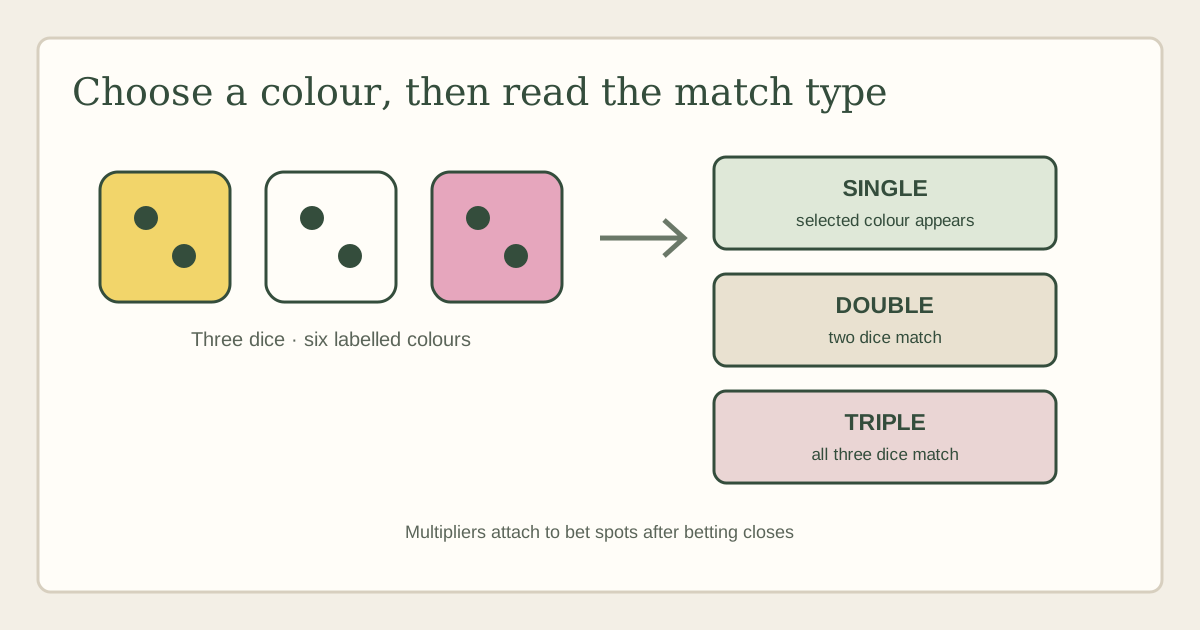
Super Color Game is an Evolution live game show built around three coloured dice. The supplier lists six colours: yellow, white, pink, blue, red and green. For a chosen colour, the table offers Single, Double and Triple bet types. In broad terms, those labels refer to how many dice must show the selected colour for the corresponding outcome to qualify. After betting closes, Evolution says up to 18 random multipliers may be assigned to different bet positions; the dice are then released and the face-up colours determine the result.
Evolution’s public page gives selected multiplier descriptions: a Single bet can have a two-exact-match multiplier from 4× to 10× or a three-exact-match multiplier up to 100×; Double positions can receive multipliers from 15× to 100× when two dice match the chosen colour; and a Triple bet can reach up to 1,000× when all three dice match. These are supplier-level feature statements, not a full universal payout table or a probability schedule.
The complete paytable, minimum and maximum stakes, settlement wording, RTP and availability through a New Zealand operator are not established by that overview. Check the rules panel on the precise table before relying on a number. A headline multiplier is a possible upper factor, not a promise, a typical return or evidence about how often a winning combination occurs.
The three dice and six colour choices
The game presents three dice, each showing one of six named colours. A player’s selection concerns a chosen colour and a bet type. The dice are then released by the host, and their visible faces establish how many times that colour appeared. The table’s rules map the result to a winning or losing condition and, when applicable, to a multiplier.
The six supplier-listed colours are yellow, white, pink, blue, red and green. The labels matter because each bet position refers to one of them. A colour graphic alone should not be the only cue: check the text label next to the bet spot, especially on a mobile screen where the layout may be condensed or the colours may appear similar in a small chip area.
The words Single, Double and Triple are not a ranking of colours. They describe different match conditions. A Single is associated with the selected colour appearing; Double refers to a two-dice match; Triple refers to all three dice matching the selected colour, according to the table’s bet description. Exact payout bands and how a result with more matches is settled should be confirmed in the help panel.
Do not assume that selecting a colour gives the player a choice over how the dice land. The product overview describes the host releasing the dice and the colours showing the result. It does not describe a player-controlled roll, a skill-based manipulation or a method to influence the faces. A colour’s previous frequency in the history is not identified as a signal for the next roll.
What Single, Double and Triple mean
Single is the broadest match label. Evolution says a Single selection may receive a “Two Exact Matches” multiplier of 4× to 10× or a “Three Exact Matches” multiplier up to 100×. The chosen colour must appear on the corresponding number of dice for those named conditions to apply. The overview does not supply a complete base payout row for every Single result, so read the table help for a result with one, two or three matches.
Double focuses on a result in which two dice match the chosen colour. Evolution says Double bets can carry multipliers from 15× to 100× when two dice show that colour. The public page does not enumerate every payout for a Double position or explain all interactions when all three dice show the chosen colour. A player should check the rules to see whether a three-match result also qualifies for a Double position and which multiplier row applies.
Triple is the narrowest named match: all three dice show the chosen colour. Evolution says a Triple selection can have a multiplier up to 1,000× if all three dice match. This is a maximum feature description, not a statement that the outcome occurs frequently or that every triple is multiplied by the maximum.
These categories make the table easier to read, but they do not tell the full financial result. The payout table should specify whether a winning position pays a fixed ratio, a multiplier, a base return plus multiplier or some other combination. It should also show whether the original stake is included in the displayed amount. Do not calculate a cash return from a marketing headline alone.
How a round works from bet placement to settlement
Before the betting period closes, identify the colour and the bet type. If you choose more than one position, each chip is a separate stake unless the help says otherwise. Confirm the bet slip lists the intended colour and Single, Double or Triple condition, and add the stakes to understand the total amount exposed in the round.
When betting closes, Evolution says random multipliers may be assigned to different bet spots, up to 18. Because this assignment occurs after the betting period, it is not a factor a player can use to predict the next result before placing the wager. The public summary does not say that every position receives a multiplier; “up to 18” describes a maximum count of assigned multipliers, not a guarantee that the chosen spot will be boosted.
The host then releases the dice down a chute onto a platform. Their visible faces show the resulting colours. Count how many dice display the colour attached to each active bet. Apply the table’s rules to determine whether Single, Double or Triple conditions are satisfied and whether a multiplier has been assigned to that position. Wait until the interface marks the round settled before reading a final return.
After the result, compare the accepted bet with the official history. Make sure the colour is correct, the bet type is correct, the amount is the accepted amount and the multiplier belongs to the active bet spot. A multiplier shown on another colour or bet type is not automatically applied to your selection. A winning condition and a multiplier are separate checks in the settlement process.
If the interface only shows a dramatic dice animation and no clear payout, open the round history or game help. A visual highlight might mark an outcome without explaining how the stake was settled. The account record is the place to verify what was credited, while the current rules explain why.
Reading the multiplier features carefully
The product’s multipliers are assigned to bet spots, rather than being a general multiplier applied to every stake on the table. Evolution says up to 18 random multipliers can be assigned after betting closes. This timing means that a player’s selection is placed before seeing those multipliers. A multiplier later displayed for a different colour or match condition does not alter the bet a player chose.
For Single, the official overview distinguishes two exact matches and three exact matches. It gives 4× to 10× for the former and up to 100× for the latter. For Double, it lists 15× to 100× when two dice match the selected colour. For Triple, the headline ceiling is 1,000× for three matching dice. The exact payout amounts or the range of possible multiplier values within each category need to be read in the current table help.
“Up to” describes a ceiling in the public overview. It does not state the chance that a position receives a multiplier, the chance that the dice satisfy the condition, or the chance that both occur together. These are different probabilities. A high possible value can coexist with a narrow win condition. Without the full distributions, a return calculation is not verified.
A multiplier is a factor, not necessarily the complete amount that appears in a player’s account. The table should clarify how the factor combines with the base result and whether the displayed amount includes the stake. As a purely hypothetical arithmetic illustration, a two-unit stake multiplied by a factor of 5 gives a factor calculation of 10 units. That is not a Super Color Game payout quote: the actual rules may define the credit differently and may have a cap or rounding convention.
Do not multiply a displayed factor twice. If the table’s payout panel already shows a final amount, applying another multiplication manually could misstate the return. Read whether the multiplier is a line-specific add-on, a replacement for a base pay or a value already included in the result display. If the help does not explain it, ask the operator before wagering.
What can and cannot be inferred from three dice
Three dice and six colours may invite a quick probability calculation. A simple mathematical model could count combinations, but it would rely on assumptions about the dice being equivalent, each face being equally likely, the physical or randomisation process and any game-specific rules. The public overview gives the visual format and named features; it does not provide the full certified probability table or all return assumptions needed for a verified game-specific calculation.
Do not state an exact chance for Single, Double or Triple using a generic six-sided dice formula unless the current official help confirms that model. In particular, the multiplier assignment adds a second condition for some enhanced outcomes. The chance of three matching colours is not automatically the chance of receiving a 1,000× return. A position has to qualify, the multiplier has to apply and the payout rules must allow the maximum.
The game history can show previous rolls, but a short sequence does not reveal a stable pattern. A colour that has appeared often recently is not thereby due to stop appearing. A colour that has not appeared for several rounds is not thereby “owed.” The supplier overview does not describe the history as predictive.
If a table publishes a theoretical return percentage, record the exact table, market and date alongside it. Return figures can differ by position and ruleset. A number copied from another provider, operator or jurisdiction may not apply. This guide does not report an RTP because the Evolution public overview reviewed here does not give a complete universal value for every Super Color Game table.
Comparing the bet types without claiming a best bet
The simplest comparison is the number of matches required. A Single market may have more ways to meet its basic condition than a Triple market, while the Triple feature has the highest supplier-listed multiplier ceiling. That describes breadth of condition and possible ceiling; it does not say which position has better expected value or suits a particular person.
Next compare the payout rows. The paytable should show the base return for each match count and how a spot-specific multiplier changes it. A Double position may settle differently from a Single position even when the same number of dice show a colour. Do not assume that a two-match result pays both bets identically, or that placing the same amount on Single, Double and Triple creates a balanced position.
Then compare the total stake, not only the possible headline. If a player places one unit on each of three positions, the total exposure is three units for that round. A larger multiplier on one position does not remove the losses on the others. A winning line may not offset all losing stakes, depending on the table’s payout and settlement rules.
Finally consider how easy the interface is to read. A player who cannot tell whether a chip is on Double or Triple should not guess. The table labels and help are more important than selecting a particular colour. There is no need to fill all available positions or bet on a round; skipping is always a valid choice.
The practical pre-round checklist
Read the title and verify that the game is Super Color Game. Identify the six colour labels and the Single, Double and Triple positions. Open the rules and write down the exact match condition for each market. Find the payout rows for one, two and three matching dice and note how a multiplier applies to each. Check whether a three-match result can settle both a Double and Triple position if you have selected both.
Look for minimum and maximum stake values and for any maximum payout. Evolution’s public page does not establish a universal stake range. Limits may be shown by the operator’s table or depend on its configuration. Do not import an amount from a screenshot or a third-party game review.
Before the timer runs down, select only the bet spots you understand. Confirm the colour text, market type and chip amount. Add every active chip to see the total exposure. A second check matters when multiple positions are selected: the aggregate is more than any single bet line. If the bet slip does not make the selections clear, wait for another round or leave.
After the dice stop, count the relevant colour appearances and check the table’s multiplier marker. Wait for settlement, then compare the account history with the rule. If something is unclear, keep a private record of the round number and ask the operator for an explanation rather than placing a test bet.
Mobile and accessibility considerations
On a mobile screen, the six colours may be displayed as small circles or chips. Verify the written label as well as the colour, especially if your screen has low brightness or a colour-vision difference. The bet type can be positioned beside the colour rather than underneath it. Zooming or rotating the screen may move controls, so check the bet slip again after any layout change.
The short betting stage leaves less room to read a hidden help panel. Open the rules before participating and become familiar with the table. Do not make a choice while a tooltip covers the bet grid or when the accepted stake is partly hidden. A keyboard or screen-reader user should be able to identify a market by a text label rather than colour alone; if the interface does not expose that information clearly, stop using it.
During the dice animation, distinguish the three individual faces. If the platform is buffering, wait for the final state and consult history. A frozen frame is not a settled result. If the connection drops after a bet, re-open the table and check whether the wager was accepted before attempting another action.
Save the title, round identifier, time, chosen colour, bet type and stake for a support request about a disputed result. Do not post account details or payment information in public. The operator can examine the settlement record; the game’s product overview cannot answer an account-specific question.
Demo mode, New Zealand availability and advertising context
Evolution’s official catalogue describes a freeplay demo environment and says demos and features depend on jurisdiction. This does not establish that Super Color Game is included in every demo, that the exact live table will match the demo or that a New Zealand customer can access an operator’s game. Supplier availability, operator selection and local eligibility are distinct questions.
The Department of Internal Affairs says online casino providers must not advertise to people in New Zealand during the current transition. The regulations in force also prohibit advertisements that involve an affiliate arrangement. This guide therefore does not link to an operator or claim that the game is available in New Zealand. Check the current DIA information and the specific operator’s terms before relying on any access statement. The game guide index groups this title with the site’s other selected supplier references. The New Zealand safer-gambling page is available for local support information if a game session is no longer feeling manageable.
A demo, where offered, can help a person recognise the layout and the order of events. It cannot show the exact monetary terms of every live table. Practice results are not a prediction about a later real-money round. If a demo does not include the table help, it cannot fill a gap in the published payout information.
Mistakes to avoid
Treating 1,000× as a usual Triple payout. It is the supplier’s upper feature description, not a typical outcome or a frequency claim.
Assuming any multiplier helps every bet. Evolution describes multipliers on different bet spots. Check that the multiplier is attached to the market and colour you selected.
Counting the same dice result twice without checking the rules. A result may interact with multiple positions, but the paytable determines what settles. Do not infer that every selected line wins in the same way.
Using generic dice odds as official Super Color Game probabilities. A calculation requires verified assumptions and the game’s multiplier rules. A simple six-sided-dice model is not automatically the supplier’s complete payout model.
Confusing possible multiplier with probability. The size of a possible factor gives no information about how likely the selected bet and factor combination is.
Assuming a recent colour sequence predicts the next round. History is a record, not a signal described by Evolution.
Claiming NZ access from the supplier page. The catalogue does not prove which operator offers the title or that local access is available.
Questions readers commonly ask
How many dice are used?
Evolution describes three coloured dice and six colour choices: yellow, white, pink, blue, red and green.
What is the difference between Single, Double and Triple?
They are different match conditions for a selected colour. The supplier describes Single multipliers for two and three exact matches, Double multipliers when two dice match, and Triple multipliers when all three match. The table’s help specifies the full base payout and settlement.
How many multipliers are assigned?
Evolution says up to 18 random multipliers may be assigned to different bet spots after betting closes. That does not mean every spot receives one or that the multiplier is known before betting closes.
What is the highest multiplier Evolution mentions?
Its public overview says a Triple bet can reach up to 1,000× if all three dice match the chosen colour. That is a maximum feature statement, not a probability or expected return.
Does the public page give an RTP or table limits?
The overview reviewed here does not publish a complete universal RTP and stake range. Use the rules and payout panel on the actual table.
Can a multiplier on another colour affect my bet?
Do not assume that it can. Evolution describes multipliers applied to different bet spots. Check the marker and the specific rules for the position you selected.
Is Super Color Game available in New Zealand?
The supplier listing does not establish that. Check the operator and current New Zealand guidance; this guide makes no local availability claim.
Sources and verification boundary
Evolution’s official Super Color Game page was checked on 6 October 2026. It confirms three dice, six named colours, Single/Double/Triple bet types, up to 18 random multipliers assigned after betting closes, and the multiplier descriptions stated above. The public overview does not provide a complete table-specific paytable, stake limits or universal RTP in the material reviewed. Competing search results disagree on some detailed payout and RTP figures, so they are not repeated here as verified settings. DIA advertiser guidance and the New Zealand regulations were checked on the same date.
