Game supplier catalogue · South Island guide
NetEnt games guide: catalogue, formats and settings
 Best casinos available in New ZealandUpdated 7 November 2026

This NetEnt games guide explains how to use the current supplier catalogue, recognise common slot formats and check a title’s paytable without treating a brand page as proof of New Zealand availability or an operator’s exact settings.
The short answer
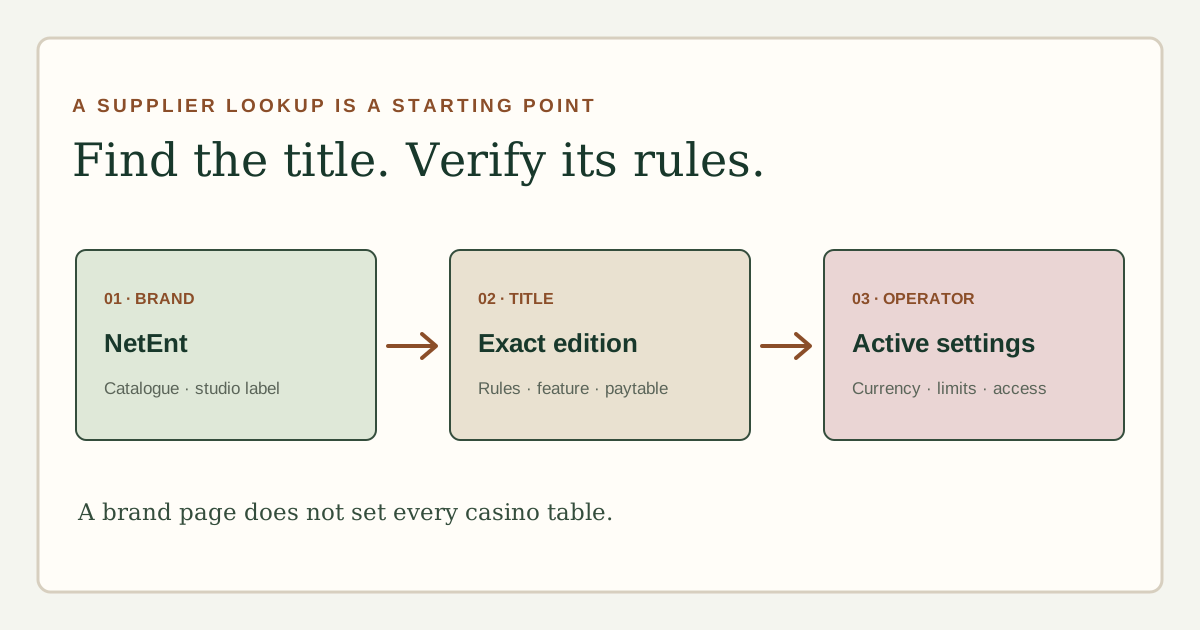
A NetEnt games guide should help you find the exact title, understand the kind of slot mechanics it uses, and work out which settings still need checking in the casino interface. The official Evolution Group slot catalogue currently identifies NetEnt as one of its slot brands and presents NetEnt titles beside games from other group studios. The NetEnt-branded games page also has a search field and catalogue navigation. Those pages are useful discovery tools, but they are not a universal New Zealand casino lobby and do not prove that every title is available to every account.
Start with the exact game name, then compare the supplier description with the title and rules shown by the operator. Check the paytable, return information, bet range, bonus conditions and any applicable feature cost on the active game screen. If an official public page does not state a figure, leave it unverified rather than borrowing a number from an unrelated casino, currency, edition or country.
What this NetEnt hub covers
This page is the site’s single NetEnt provider hub. It covers the supplier catalogue, the broad ways a reader can sort and interpret the titles, and a practical method for checking each game’s published settings. It does not attempt to review every NetEnt slot, create separate return-percentage pages, or rank casinos. A provider guide answers “what belongs to this studio and how do I inspect it?” A game review would answer a narrower question about one named title. That second task belongs on a separate title page only when the site actually commissions one.
NetEnt is a brand within Evolution Group’s wider portfolio. The group also presents other studios and formats, including live casino and game-show products. That corporate relationship is useful for finding the catalogue, but it does not make every Evolution or Ezugi title a NetEnt game. A game should be attributed to the studio named on its own product page or in the supplier’s current catalogue. Familiar visual style, a shared website footer, or a parent-company relationship is not sufficient evidence of brand ownership.
The guide focuses on NetEnt’s slot catalogue because that is how the current official group catalogue introduces the brand. NetEnt’s older history, former corporate structure and well-known titles can provide context, but they should not be used to infer the current size of the library, a launch schedule, local licences or the game mix an operator has integrated. Catalogues move: a game can be featured, archived, relabelled or absent from a particular market without the supplier page being an operator promise.
How to use the official catalogue
The supplier catalogue is best treated as an index. Search for the full title, open the matching card and confirm that the heading, image, studio attribution and rules refer to the same game you intend to research. Similar titles can differ by sequel, edition, feature-buy suffix or jurisdictional release. A search result that shows only part of a title is not enough to resolve those differences.
A reliable lookup can be done in a few deliberate passes:
- Write down the full title as it appears in the operator’s game lobby, including any edition marker or suffix.
- Search that exact wording in the official catalogue. If the result is missing, try the brand’s own games page, but record that the group catalogue did not surface it.
- Open the title page and note the product’s own name, studio label, broad format and the date you checked it.
- Look for the rule or help control in the operator’s actual game client. That is where the active table configuration and settlement explanation may appear.
- Compare the operator’s displayed rules with the supplier description. If the wording differs, record the difference instead of silently choosing the value that seems more convenient.
- Repeat the check after an edition change, a rules update or a new account jurisdiction. A saved screenshot without a title and date is weak evidence.
This process is useful when a name appears in several places. The supplier catalogue can confirm which studio markets the title; the casino lobby can confirm that the operator has placed a title in its own catalogue; and the game’s help panel can explain how a wager is settled. Those are three separate claims. One does not automatically establish the next.
Common slot formats and what their labels mean
A standard video slot usually presents a set of reels, a symbol grid and one or more ways for a result to qualify as a win. The visible layout is only the start of the rules. A payline game asks whether matching symbols land along one of the defined lines. A ways-to-win title counts qualifying adjacent symbols across reels. A cluster-pay game can instead look for groups of connected matching symbols. Before comparing games, identify how the win is formed and which direction or positions count.
A title with expanding wilds, sticky wilds or respins may alter the way a feature round works without changing the base game’s underlying stake. The word “wild” commonly signals a symbol that can stand in for other symbols, but the title’s paytable defines any exclusions. An expanding wild may occupy a full reel or a defined area only after a trigger. A respin is another spin granted or activated under a stated condition; it is not necessarily free in every feature. Read the rule rather than inferring the outcome from the animation.
Free spins are usually a feature state in which a defined number of further spins is played under specified conditions. The title’s help should explain whether extra spins can be awarded, whether a multiplier changes during the feature, and whether the stake is fixed from the triggering round. “Free” describes the feature’s relationship to the initial wager; it does not mean a casino promotion has credited cash or spins to an account. Promotional free spins have separate terms, eligibility conditions and expiry rules.
Megaways is a proprietary reel modifier associated with Big Time Gaming, another Evolution Group brand. NetEnt has released titles that use the Megaways mechanic, but a shared group umbrella does not change the origin of the mechanic. In a Megaways title, the number of visible symbols can change from spin to spin and affect the possible ways to win. The exact range, pay structure and feature interactions belong to the specific title’s rules. Do not assume that every game with changing reels uses Megaways or offers the same maximum number of ways.
Jackpot language also needs care. A fixed jackpot has a defined prize schedule. A progressive jackpot can grow according to a linked contribution or other configured arrangement. A title may have a jackpot-style bonus without a progressive pool, and a game page that uses the word “jackpot” does not reveal whether a casino has connected the title to a local prize network. Check the current game help and operator rules for how the feature is funded, triggered, displayed and paid.
The catalogue may also display labels such as “new”, a featured carousel, promotional artwork or a studio collection. These are navigation and merchandising signals, not a technical classification. A featured position does not mean a title has a better return, a smaller variance, or a greater chance of being available in New Zealand. Treat labels as shortcuts to a product page, not as evidence about its mathematics.
Recognisable titles are examples, not a complete review list
Starburst is one of the titles the official slot catalogue associates with NetEnt. Evolution’s public slot overview uses it as an example when explaining return-to-player terminology and shows a sample published figure in a particular presentation. That example is useful for learning where the supplier places return information. It should not be copied into a statement about every casino version, every stake or every market. A title page can be updated, and an operator’s game client may show a distinct configuration or currency-specific rule panel.
Gonzo’s Quest is another recognisable NetEnt title that appears in the official catalogue. Its name can also appear in more than one edition or with an additional feature label. If you are looking at an enhanced edition, make sure its name and rules match the base title before using an older guide. A familiar character or logo does not make two versions mechanically identical.
Divine Fortune and other branded entries show why a catalogue can be useful even when you are not seeking a specific mechanic. A title can contain a jackpot presentation, a story theme or a reel feature that has its own rules. The point of this provider hub is to help you navigate from brand to title, not to make a promise about which game is most likely to pay or most suitable for a particular person.
These examples are deliberately brief. They identify familiar catalogue entries but do not replace full game-specific reviews. For a detailed decision about one slot, the relevant questions are the actual paytable, the displayed return value, how bonus rounds are triggered, what controls the stake and whether any optional feature costs extra. Those checks are more important than a studio-wide ranking.
Verify RTP and payout settings without overreading them
Return to player, commonly shortened to RTP, is a theoretical long-run measure. It is not a forecast for one session and does not tell you what a particular person will receive after a set number of spins. A displayed percentage describes a mathematical model under stated assumptions. In a single short session, results can differ widely from that long-run average.
First, check whether the number is tied to the exact game version. Providers sometimes publish figures for a title or one mode, while the operator may surface additional information for the version it has integrated. If a named feature or alternate mode has its own mathematical profile, do not substitute the base-game value for it. The label beside the number should say what it applies to.
Second, check who published the figure and what configuration it describes. A studio catalogue is a useful primary source for a supplier’s public product information. An operator’s help screen may be the more relevant source for an account-facing configuration. A review page can point you to an interesting question, but its value should not override the current primary rule text. If two sources differ, record both and state which one is authoritative for the active game you are describing.
Third, read the whole paytable entry. A payout can be expressed as a multiplier, odds ratio, total return including the stake, or net winnings. Those formats are not interchangeable. A feature can also require a separate wager, a minimum stake or an optional purchase. If the interface does not make the cost clear, do not assume that pressing the feature button uses the same stake as a normal spin.
Finally, note the display’s currency and jurisdiction. A number shown in a UK catalogue example is not automatically a New Zealand operator value. Bet limits can vary by table, currency, account status, operator and local configuration. Record the exact screen, date and title. If the relevant field is absent, say that it was not present in the source checked.
How to compare two NetEnt games fairly
Start by identifying the decision you are trying to make. If you want to understand game pace, look at the spin and feature sequence. If you want to understand wager exposure, compare the cost of an ordinary spin with any optional feature or bonus-buy controls. If you want to compare pay structures, use the same kind of figure from each title and make sure the version and currency are visible.
A useful comparison table should keep unlike things separate. These fields are good candidates:
| Check | What to record | Why it matters |
|---|---|---|
| Exact title | Full title and edition label | Avoids mixing a sequel or feature variant with the base game. |
| Win formation | Paylines, ways, clusters or other stated rule | Explains what pattern has to appear. |
| Feature trigger | Symbols, event or condition shown in help | Prevents a theme or animation being mistaken for a rule. |
| Return information | Figure, source, mode and date | Keeps a long-run value attached to its scope. |
| Stake details | Per-spin cost and optional extra costs | Makes the total wager visible before play. |
| Availability | Operator and jurisdiction checked | Separates a supplier listing from a local casino offer. |
A comparison becomes misleading if it combines one game’s RTP from an operator’s help with another game’s figure from an undated review. It is also misleading to rank a “high-volatility” title above a “low-volatility” title as if volatility were a quality score. Volatility is a description of how results are distributed, not a statement that a game is safer or more generous.
For an editorial comparison, keep the underlying evidence next to the summary. A reader should be able to see whether a fact came from the supplier page, the active operator’s help or a third-party article. If the evidence is incomplete, preserve the gap. This is more useful than presenting a confident-looking table that joins incompatible settings.
Mobile, demo and catalogue access
A title being listed in a supplier’s catalogue does not guarantee that a free-play mode will load in every country or on every device. The official Evolution slot page says demo access and individual features can depend on jurisdiction. A branded video or walkthrough may still be available when the playable demo is not. Confirm what the official page actually offers in the region you are checking rather than promising a working demo.
A mobile-friendly slot should keep its rules, help and controls usable at a smaller screen width. That is a practical interface check, not a claim that every operator has tested every handset. In a browser or app, make sure the title is readable, the stake is clear, the paytable can be opened and the menu can be reached without covering essential information. If a help panel is too small or clipped, use the operator’s accessible support route before making assumptions about the game.
Mobile performance and account support belong to the casino operator as well as the game supplier. A provider may optimise game content for different screens, but it does not control a casino’s sign-in process, payment systems, regional account checks or customer service. A slow loading screen is not evidence that the slot is fraudulent; equally, a polished animation is not proof that the operator is authorised for a New Zealand customer.
What a supplier page cannot tell you about New Zealand
The official catalogue describes a group portfolio and may show demos or examples. It does not establish that a specific New Zealand casino offers a given title, that a particular account can open it, or that a particular operator has selected the same settings shown elsewhere. Availability needs to be checked at the operator and in the relevant jurisdiction.
New Zealand’s online-casino rules are changing during 2026. This article is an informational supplier guide, not a casino recommendation or an offer. DIA’s current advertiser and customer pages should be checked before relying on any claim about advertising, provider access or operator status. If a title appears in a worldwide catalogue, do not infer local availability from that fact alone.
The most accurate local statement is often limited: “the supplier lists this title” or “the operator’s game help displayed this rule when checked.” Include the date and source. Avoid broader claims such as “all NetEnt games are available here,” “the same return applies everywhere,” or “this title is approved for every New Zealand account.” Those claims require evidence that a group-wide catalogue does not provide.
A repeatable fact-check before relying on a game description
Before using a provider guide to make a choice, compare its summary with the active product screen. Confirm the exact title, the game’s current version if one is displayed, the bet size and whether a separate feature stake has been selected. Check that the described bonus appears under the same name in the current help panel. If an operator has multiple lobby entries for similar versions, take care not to move facts from one listing to another.
The paytable is the place to look for combinations, symbol values and feature outcomes. A rules panel explains how the round proceeds. The operator’s terms explain account-facing matters such as access, settlement disputes and complaint routes. A casino’s game lobby helps you locate a title. These resources serve different jobs, and the responsible guide links or names them separately rather than treating one screenshot as proof of everything.
If the supplier page is inaccessible, record what happened and what material remains available. A search snippet can help locate a product page, but it is not a complete rules document. An archived page may show an older title state. A third-party guide can help explain a concept, but a specific payout or stake range should still be verified against a current primary source. The correct conclusion may be that the exact value is not verified.
A useful note for your own comparison does not need to be elaborate. Write the full game name, operator, source screen, currency, date and the rule you checked. If the value changes later, you can see whether it is a new configuration or an old comparison. If the value is still unclear, you have avoided turning uncertainty into a fact.
Questions readers commonly ask
Is NetEnt a separate studio from Evolution?
NetEnt is a distinct game brand within Evolution Group’s broader portfolio. The official Evolution catalogue places NetEnt alongside other slot brands, while its wider showcase also contains live dealer and game-show categories. For an individual title, use the studio or brand attribution on that title’s own page. Do not call every game in the parent group a NetEnt product.
Does the NetEnt catalogue show every game available in New Zealand?
No. A supplier catalogue is a discovery tool, not a list of titles enabled by every operator in every country. An individual casino may have a smaller catalogue or a different regional configuration. Verify the exact game in the operator’s lobby and its own help panel, and avoid inferring New Zealand availability from a global product page.
Does one RTP percentage apply to all NetEnt slots?
No. Return information belongs to a specific game, edition, mode and sometimes configuration. A single example on a supplier page cannot be turned into a studio-wide average. RTP is a long-run mathematical measure rather than a promise for one session; compare values only when they describe the same kind of setting and have a clear source.
What is the quickest way to identify a slot’s format?
Read the game help for how a win is formed, then identify its reels, payline or ways rule, feature trigger and any special symbols. The artwork and title may point toward a theme, but the help panel explains whether the game uses a line, adjacent ways, a cluster or another condition. Check the exact edition before applying a rule from another version.
Does a demo prove the casino operator is suitable?
No. A demo can help explain a game’s interface and mechanics, where that demo is offered. It does not verify the operator’s account services, payment terms, local status or the active real-money paytable. Check the real operator’s information separately and do not assume a demo is available in every jurisdiction.
Why might the game lobby and provider catalogue differ?
They are different catalogues serving different purposes. The provider page presents the supplier’s portfolio, while a casino lobby lists the games integrated and enabled by that operator. Names can also change as titles are updated or grouped into a different category. If you cannot match an entry exactly, keep the discrepancy visible and avoid merging the two listings.
Sources and verification boundary
Primary supplier sources checked 6 October 2026: Evolution Group slots catalogue; NetEnt games page. The official catalogue identifies NetEnt among Evolution Group’s slot brands and displays catalogue navigation and NetEnt examples. The NetEnt-branded page was inspected for brand navigation; its accessible text did not expose a complete static game list. No New Zealand casino-specific game lobby or operator paytable was verified. Search-volume data was not supplied.
