Game supplier catalogue · South Island guide
Nolimit City games guide: catalogue and xMechanics
 Best casinos available in New ZealandUpdated 7 November 2026

This guide explains how to navigate Nolimit City’s official game catalogue and interpret named mechanics without treating studio-wide labels as the complete rules for a specific slot. It is a supplier index, not a casino directory or ranking.
The short answer: follow the title, then the title’s own help
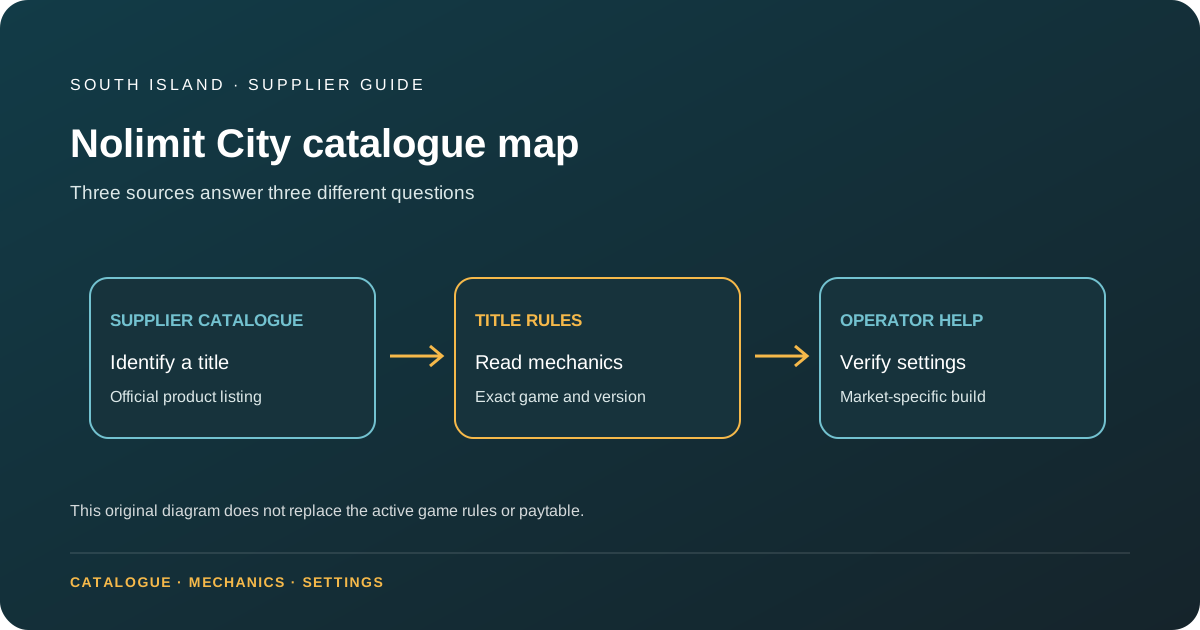
Use Nolimit City’s official catalogue to identify a game and open its title-specific information. The catalogue is a useful index; it is not a single rules document for every product. A named mechanic such as xWays, xNudge, xBomb or xSplit signals a particular family of effects, but its position, trigger, cost, interaction and payout handling still depend on the game in which it appears. For an accurate reading, keep three sources separate: the supplier catalogue, the product page or game sheet for the exact title, and the current in-game help shown by the casino version under consideration.
This distinction is especially important when comparing a dramatic feature description with mathematical fields. A feature name does not establish a fixed return to player (RTP), volatility rating, minimum stake, maximum stake or maximum payout for the whole studio. Nor does a public supplier page establish that a particular operator carries the game or makes it available in New Zealand. The page below is a navigation guide and a reading framework, not a recommendation to play.
What the official catalogue is for
Nolimit City’s official games catalogue is the primary starting point for its own product listings. The visible site uses a dynamic catalogue, so the set of cards and the order in which they appear can change. It includes product names, editorial descriptions and links to individual titles. A dated catalogue check is more useful than a remembered title count: note the date and the exact product URL, then reopen it when the question concerns a later release or a changing listing.
The catalogue helps answer a narrow identity question: does the studio currently present a product under this name? It can also guide a reader towards a game’s official feature summary. It does not by itself answer where the product is distributed, which software build an operator runs, what its current setting is, or whether a game opens for someone using a particular account. Those are different facts with different sources.
At the time checked for this guide, the official catalogue was the authoritative index for Nolimit City titles, but its text-only retrieval did not expose every card in a stable, complete inventory. For that reason this hub does not quote a definitive catalogue size or say that a sampled set is exhaustive. If a game matters to a decision, follow the current catalogue link to the exact product instead of relying on an old list copied into an article.
Find the exact game before comparing mechanics
Search by the full displayed title, including numerals, punctuation, and sequel words. A sequel can preserve a mechanic’s name while changing the board, trigger, feature duration, or maximum win. A spin-off can share characters or visual motifs while using different game rules. A close match in an operator’s lobby is not enough to identify the version.
When two results look similar, compare the supplier’s own page address, the title shown in the loading screen and the heading inside the information menu. If a game sheet is available, check whether it names the same game and a version or build. Save the exact URL alongside any number transcribed from the sheet. This makes it possible to revisit the evidence if the catalogue changes or a search engine keeps surfacing a cached page.
The South Island site already has a title-specific Ding Dong Death guide. That page addresses one game’s mechanics. It is linked here as an example of the difference between a provider hub and an individual review; the present guide does not duplicate its walkthrough or claim that Ding Dong Death is offered by a New Zealand casino.
Treat a game format as a way to read the screen
The word “format” is a practical description of how a round is organised, not a guarantee about the mathematics. A conventional reel layout can combine with ways-to-win, clusters, falling symbols, expanding reels, feature symbols, or several of those systems. Some Nolimit City games use multi-stage bonus rounds, while others make a symbol or board change the centre of the feature. The title page and its help determine which of those concepts actually apply.
Start with the base-game screen. Identify the playable area, the symbol positions, any payline or cluster rule, and what counts as a completed result. Then identify any additional row, reel, cell, marker, or feature display. A grid that looks wider during a bonus may use a different win calculation from the base game. A symbol that changes another symbol can be a transformation, a multiplier change, a movement effect, or a trigger; visual animation alone does not tell you which calculation is used.
Write down the sequence as discrete events. For example: a feature symbol lands; the game checks an eligibility condition; one or more symbols change; the win is calculated; a counter resets or moves; then the round ends or continues. If the help describes only the visual effect, do not invent the omitted ordering. Ask the operator for the actual rule text if the missing step changes whether a win qualifies.
Read xMechanics as named components, not universal rules
Nolimit City’s public material describes proprietary mechanics and its individual game sheets attach mechanics to particular titles. The names make products easier to recognise, but they are not interchangeable. One title may use one named component; another may combine several. The exact interaction should be learned from that game’s help.
xWays is commonly used for a mystery-style symbol that can reveal or expand into symbol positions. The useful questions are: what symbols may it reveal, how many positions can it cover, which reels can be affected, and does the change alter the ways count for that title? An answer from another game does not establish the same limits here.
xNudge refers to a nudging or moving Wild-style effect in the supplier’s documented examples. Check where the symbol starts, which direction it can move, whether it gains a multiplier on each move, what stops it, and whether the multiplier applies to one win or more than one. A phrase such as “growing Wild” is not enough to reconstruct the settlement rule.
xBomb appears in some game sheets as an explosive Wild or transformation event associated with removals or cascades. The reader should look for what can be removed, which symbols are exempt, whether the next cascade receives a multiplier and when the sequence stops. The exclusions matter as much as the animation.
xSplit is another named effect used in some Nolimit City products. Its actual description should be checked on the relevant title page: do not infer from the word “split” whether a symbol divides, a payout is multiplied, or an additional calculation takes place. Similarly, xBet is a title-specific optional stake mode in some supplier sheets. A mode price or feature-entry effect must be recorded from the exact game; no studio-wide cost should be assumed.
This mini-glossary is a map for questions to ask, not a catalogue-wide promise that each item appears in every game. The supplier’s game sheet and the casino’s active help override a general explanation whenever they describe a title-specific exception.
Build a mechanic map before reading a bonus
A bonus can combine a trigger, a starting resource, repeat conditions and a final conversion. Separate each step before evaluating the feature. First ask what opens the bonus: a symbol count, a meter, a gamble, a feature mode or another explicit condition. Then identify how many initial actions the feature awards, if the help says so. Next, note what can add actions, what can reset a counter, and whether a round can move into a second phase.
For a cascade feature, record whether a win removes only the winning symbols or a larger area, how new symbols enter the grid, and whether multipliers reset or persist. If a growing multiplier appears, determine whether it applies to the next win, the whole feature, one symbol, or the total round. These are not interchangeable descriptions. A screen can display multiple counters whose roles differ.
For a collection feature, write down what object is collected, how the collector qualifies, whether it can move, and when its stored value is paid. A symbol that gathers prizes might also trigger the next stage, but that does not mean every gathered icon is a cash value. If the help uses words such as “collector”, “meter”, “charge”, or “level”, look for the exact definition rather than importing a familiar rule from a different studio.
Finally, identify the end condition. A feature may end when its counter reaches zero, when no eligible symbols remain, after a fixed sequence, or when the last stage resolves. If the ending rule is unclear in the publicly visible summary, mark it unknown. Do not fill the gap with a reviewer’s description of a similar title.
The supplier and the operator answer different questions
The supplier designs and documents a game. An operator selects which titles to distribute and provides the customer-facing product, account, cashier, device experience, and market-specific settings. In some releases the public supplier material gives a maximum-win potential, while other settings are only visible in the operator’s game help or configuration. A provider profile cannot bridge that evidence gap.
Use a small source ledger. For every factual field, note its value, source type, checked date and confidence. “Supplier’s product page says…” is different from “the operator help panel displays…”. “A third-party review lists…” is a secondary report and may refer to a specific foreign operator or to a stale build. “Not shown in the public source checked” is a valid result; it is better than filling an empty cell with a figure that merely looks plausible.
The same rule applies to access. Supplier presence in a catalogue does not prove operator distribution. An operator’s general supplier list does not prove that every game from that studio is live. A demo page does not prove that a real-money version is available in a country. The reader should identify the legal operator and consult its current terms and game screen for the jurisdiction and account in question.
What the familiar numbers mean—and what they do not
RTP is a theoretical return for a defined game configuration over a very large number of rounds. It is not a forecast for a session, a guarantee for an account, or a schedule of when a return will occur. If a supplier does not publish a title’s RTP in the accessible primary material, this guide does not convert a number from a casino review into a universal supplier setting.
Volatility is a shorthand label for the distribution of outcomes, but labels such as low, medium, or high are not always measured on the same scale by different publishers. If a game’s own help does not provide a volatility classification, treat external ratings as editorial assessments, not official settings. A large maximum-win ceiling is not itself a volatility score, and it does not mean the ceiling is likely to occur.
Maximum payout is a ceiling described by a game’s rules, not an expected win. Check whether it is expressed as a multiplier of the total bet, whether the title’s help imposes a separate cap by mode, and what happens when a round would exceed it. Stake limits require the active operator display and currency. Never convert a supplier’s “times bet” figure into NZD without a current local stake value from the operator.
If a game offers a priced mode, compare the mode cost with its entry rule and its separately displayed return information. The guarantee may concern the start of a feature, not the result or recovery of the cost. A useful page explains this distinction plainly rather than calling a purchase a shortcut to profit.
How to check game help without losing the version
Open the title first, then use the information or rules control inside the game. Confirm the title name before copying anything. If the help includes a version date, build identifier, jurisdiction note, or RTP table, record it. Keep the image or text of the relevant page with the checked date if editorial records permit. A screenshot should not replace the underlying source URL, and it should never be presented as current after a later operator update without a new check.
Read the paytable from the top down. Determine the winning symbol combinations, whether a win must begin on a particular reel, whether scatters pay independently, and whether the display shows gross returns or amounts including the stake. Then open each feature section separately. A general game description often describes the theme and headline feature, but the help text is more likely to specify trigger conditions, repeat rules, exclusions and settlement.
For a game with several modes, repeat that process for each mode. Record mode cost, what changes, and whether its RTP or cap differs, but only when the operator actually shows those values. If the interface hides a field behind a click, do not infer it from the promotional card. If no operator build is available for a public check, say that the setting could not be verified.
Mobile display and accessibility checks
The catalogue is a separate interface from the game. On a small screen, a title card may fit while the underlying help table still requires scrolling or zoom. Before relying on a number, check that the entire label and value are visible. If a number is clipped, use a text version of the rules or ask the operator for clarification instead of guessing the missing digit.
Within a game, find the rules, paytable, sound and history controls before any round. Check whether landscape orientation is needed to read a chart and whether the game frame obscures the controls. These steps describe what a reader can inspect; they are not a claim that this editorial team tested a live game on every device. No account, deposit, real-money session or mobile operator product was used to prepare this guide.
A demonstration can show the order of a sample interaction. It cannot establish a live operator’s paytable, stake range, RTP build, account eligibility or cashier conditions. A video is even narrower: it shows a recorded path, not a reproducible probability sample. If a demo is not offered in the relevant place, do not use a workaround to bypass a location restriction. Public supplier rules are enough for a mechanics overview when an operator build cannot be inspected.
Compare titles without turning the hub into a ranking
This hub helps readers navigate the supplier’s catalogue; it does not rank games or recommend a “best” title. A practical comparison should start with the reader’s question: do they need to understand a particular symbol interaction, distinguish a sequel, or check which settings remain unpublished? Pick one comparison dimension at a time. For example, two games can both feature expanding reels while differing in how symbols enter, what triggers a cascade, and whether the expansion exists only in a bonus.
Do not compare a headline multiplier from one title with an RTP from another as if they measured the same thing. RTP addresses a theoretical long-run return; a cap addresses the maximum allowed settlement; volatility describes an outcome distribution. They answer different questions. A title with a larger cap is not automatically more suitable, and an additional feature does not automatically make a round more favourable.
When comparing sequels, write what changed using documented evidence: reel layout, feature trigger, additional mode, or changed bonus structure. If a product page does not explain the change, keep the comparison at the level that is actually supported. Do not claim that a game is improved, easier, more rewarding or more entertaining merely because its page uses stronger promotional language.
A concise catalogue workflow
- Start on the official Nolimit City games page and identify the exact product spelling.
- Open that game’s supplier page or product sheet; record the page and the date checked.
- Identify the round structure and each named mechanic from that title’s own help.
- Separate base-game rules, bonus rules and optional priced modes.
- Record numerical settings only when their source names the applicable version and configuration.
- Check the operator’s own game help for local stake, currency, RTP and cap fields, if a lawful and available operator version is being reviewed.
- Keep catalogue status, game distribution and customer eligibility as separate statements.
- If evidence is missing, label the field “not confirmed in the source checked” and explain what would settle it.
The method may feel more cautious than a quick list of numbers, but it protects readers from a real source problem: a supplier’s game concept, a secondary database’s default setting and one operator’s live configuration can all differ. Recording the source beside every field makes an update straightforward and keeps a future editor from copying an old value without context.
New Zealand scope and advertising boundary
This is a New Zealand-facing editorial guide. It does not say that a particular Nolimit City game can be opened through a local account, that any offshore operator is eligible, or that a supplier catalogue is a local availability list. Readers should distinguish a supplier’s software catalogue from consumer permissions and operator terms.
The Department of Internal Affairs (DIA) currently says online casino advertising is prohibited and that enforcement can apply to anyone who publishes an unlawful advertisement or arranges publication on behalf of a provider. The DIA also says advertising and marketing regulations apply to operators and third parties, and cites prohibition of affiliate marketing among the initial regulatory decisions; its licensing timeline anticipates a later, restricted advertising regime. This guide therefore contains no partner button or operator referral. The existing site route is intentionally not used in an editorial game explanation while this compliance point remains unresolved. The current guidance should be checked again before public distribution because the framework is being implemented in stages.
Questions readers commonly ask
Does the supplier catalogue list every game available in New Zealand?
No. It lists the supplier’s games. An operator may carry some, all, or none of them, and access can vary by location, account and product configuration. A catalogue entry is not proof of local availability. Check the current operator lobby, terms and the specific game screen where legally appropriate.
Does every Nolimit City game use xWays or xNudge?
No catalogue-wide assumption is safe. The supplier uses named mechanics across its products, but the mechanic list varies by title. Open the exact game’s product page and help, then record only the effects named there. The presence of one mechanic does not imply the rest of the suite.
Is a game’s maximum win a likely result?
No. A maximum-win figure is a rules ceiling. It does not state the probability of reaching the ceiling or predict what a session returns. A probability claim needs a specific source and configuration; this guide does not infer one from the ceiling.
Can I use one RTP number for the entire studio?
No. RTP relates to a game and mathematical configuration. Some products or operators may use different settings. If the exact current value is absent from the source being reviewed, leave it unverified instead of reusing another title’s number.
Does xBet or another priced mode guarantee a positive return?
No. A mode description can say that it guarantees entry to a feature or changes the chance of a trigger. That is not the same as a guaranteed winning outcome, and it does not promise to return the mode’s cost. Read the specific mode rules and price first.
Are third-party slot ratings official volatility settings?
No. Ratings from review sites are editorial labels and may use different scales. Use the exact game help for official rules and describe an external volatility score as a secondary publisher’s assessment, if it is needed at all.
Does a supplier page prove an operator is licensed or allowed to accept a New Zealand customer?
No. The supplier and the operator have separate roles. A product listing says nothing about a customer account’s eligibility or an operator’s consumer permissions. The local regulator and operator terms are the appropriate sources for those separate questions.
Can a demo confirm the real-money version’s settings?
Not by itself. A demo can illustrate an interface or mechanic, but the real-money operator version may have separate limits or configuration. Use the active game help for its settings and do not treat a short sample as evidence of long-run return.
Where can I read an individual Nolimit City game guide on this site?
The site has a separate Ding Dong Death guide, which covers that title’s specific mechanics. Browse the selected game guide index for other published references. Each page should be read as its own title guide, not as a universal rule for the provider.
Selected game reference
- Ding Dong Death rules and feature guide — one title’s documented meter, symbols, bonus states and settings questions.
- All selected game guides — supplier hubs and individual game pages already present in the site.
- New Zealand safer gambling support — local support and break information.
Sources and verification boundary
Sources checked on 6 October 2026: Nolimit City official game catalogue; the supplier’s The Crypt game sheet and The Border game sheet as title-specific examples of mechanic wording; and the site’s existing Ding Dong Death guide. A former test-domain registered-mechanics URL redirected to Playin and was not relied on. The catalogue is dynamic and its complete contents were not reliably available in a text snapshot. No market-wide catalogue count, full title taxonomy, local operator availability, current RTP, volatility, stake range or New Zealand game access is claimed.
New Zealand advertising context checked on 6 October 2026: DIA online gambling guidance for advertisers and Online Casino Gambling Regulations 2026. This editorial restriction is cautious pending compliance review and is not legal advice. No demo, operator account, deposit, withdrawal, live play or affiliate route was accessed. Search demand data was not supplied; no volume, trend, ranking or competition metric is claimed.
