Game supplier catalogue · South Island guide
Red Tiger games guide: catalogue, formats and settings
 Best casinos available in New ZealandUpdated 7 November 2026

A dated guide to Red Tiger’s official catalogue, documented slot formats and Daily Drop network. It shows how to distinguish a studio feature from an optional jackpot overlay, and why RTP, limits, demos and New Zealand access must be checked title by title.
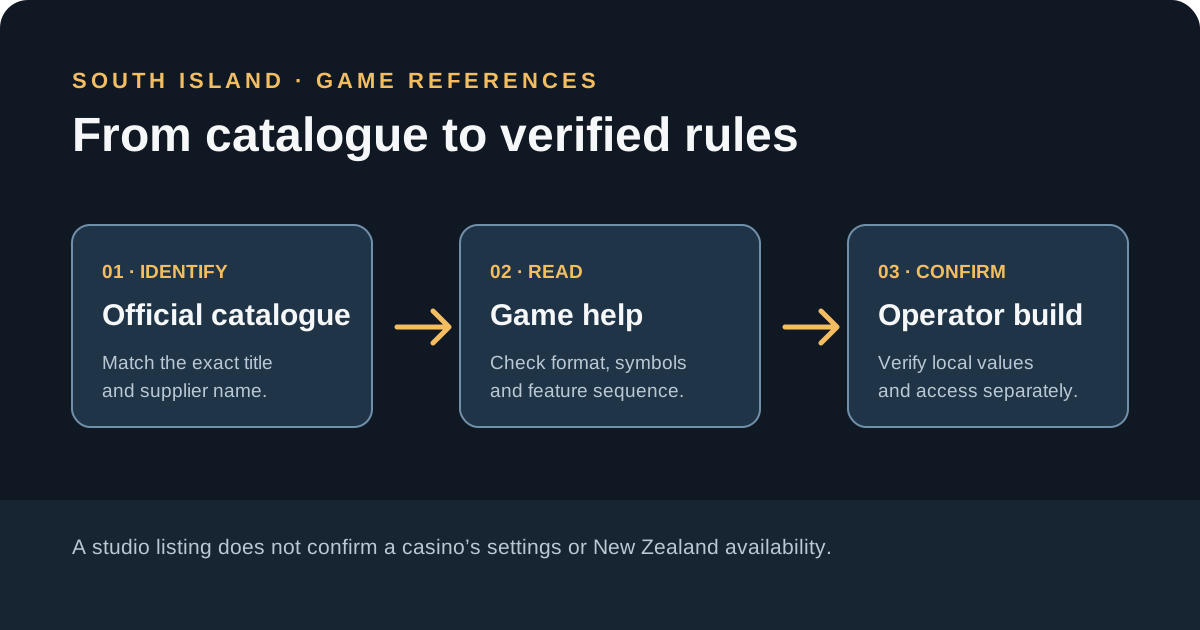
The short answer: use the catalogue to identify a title, then verify its own rules
Red Tiger’s games guide is most useful as a way to navigate one supplier’s slot catalogue. Start on the official Red Tiger games page, match the exact title and its current product card, and then open that title’s own help or information screen at the operator you are checking. Those records answer different questions. A catalogue can show that Red Tiger publishes a game and describe a broad mechanic. A product page can explain that title’s format. The operator’s game help and information panel determine the version, paytable, RTP display, stake limits and availability that apply to the actual game opened there.
This page is a provider hub, not a casino recommendation or a review of every Red Tiger slot. It explains how to recognise a few documented catalogue formats, how to read a jackpot network listing, and how to keep supplier facts separate from operator settings. It does not claim that a title is available to every casino, player or country. The only title-specific guide currently linked from this site is Stormfire’s Red Tiger rules reference; its feature explanation remains on that separate URL.
What the official catalogue shows, and what it does not
The Red Tiger catalogue at redtiger.com/games provides a game search field and an area for upcoming games. The page is catalogue navigation, not a permanent downloadable ledger. When checked on 6 October 2026, its accessible page text exposed the search control and the upcoming-games heading, but not a complete, stable list of every title. That limitation matters: a reader should not turn a dynamic, partially rendered page into a claim about catalogue size or current distribution.
Evolution’s official slots catalogue separately describes Evolution Group’s slot brands, including Red Tiger, and lists selected games. It can help identify a title or its supplier attribution, but it also changes as items are promoted or added. A featured card is not a promise that the whole catalogue is visible, and a game visible on either supplier page is not proof that a New Zealand operator carries it. If two pages show a different title spelling, use the exact game title and the information panel on the operator’s game screen to resolve the version before describing it.
The practical record for a catalogue check is modest: save the official URL, the title spelling, any release wording shown, and the date you looked. Then treat the listing as a dated snapshot. If a later editor needs the same fact, they can re-open the supplier page instead of treating last month’s featured carousel or search result as an evergreen inventory.
Red Tiger is a distinct studio brand inside a wider group
Red Tiger is the subject of this hub. Evolution’s corporate and group pages mention several slot brands, but their shared ownership does not make their games one interchangeable catalogue. A Red Tiger title should be attributed to Red Tiger when the official product page says so. It should not be re-labelled as a NetEnt, Nolimit City, Big Time Gaming or general Evolution game simply because it appears on an Evolution Group site.
This distinction also protects readers from transferring a feature between similarly named brands. A group site may display several suppliers on one screen, while the game’s own product page identifies a particular provider. When checking a game, record both the group website that hosts the page and the supplier attribution displayed in the title information. The site host tells you where the page lives; the product attribution tells you which studio is credited for that game.
The boundary here is deliberately narrow. It covers Red Tiger’s own catalogue and high-level formats. It does not attempt a second “Evolution Group casino” guide, a universal list of all group brands, or a complete technical guide to each Red Tiger title. Where one title has its own route, that page owns the rules task for the title. A provider hub should direct readers toward those individual references, not reprint them in full.
A useful format map: ordinary reels, expanding families and overlays
“Red Tiger slot” is not one game format. The catalogue contains games built around different board sizes and ways of resolving a round. The most reliable classification comes from the individual product’s help, but the official catalogue provides examples that make a reader’s first navigation step easier.
A conventional reel slot may use fixed reels and win lines. A feature-led game may add wilds, cascades, expanding symbols or a separate bonus state. An EveryWay product uses a distinct rule about matching symbols anywhere on the reels and may use cascades. A Clusterbuster title places a locked feature area among a wider grid and ties its progression to nearby wins. Power Reels can expand or alter a reel area in the specific game that carries the label. Megaways is a separate licensed reel modifier developed by Big Time Gaming, and Evolution’s catalogue says Red Tiger is among the group brands with Megaways titles.
These terms are navigation clues, not a full rules engine. Two titles can share a family label and still have different symbols, triggers, multipliers or bonus rounds. The operator help remains the place to verify how the active version settles a particular spin. A reader who begins with a format label should still move on to the exact title name and version before relying on any number.
Clusterbuster: a family label for a particular board interaction
The official Evolution listing for Egypt Clusterbuster identifies Red Tiger as the game provider and shows one example of the Clusterbuster format. Its published overview describes a locked 3-by-3 central area and a sequence of feature effects associated with coloured elements. That example tells a reader what to look for: an arrangement on the board, a condition that affects the locked area, and a change in the game state when a stage is completed.
It does not give every Clusterbuster title the same board dimensions, values, bonus trigger or RTP. The word “Clusterbuster” should prompt a reader to open the product’s own explanation. It is not a guarantee that every adjacent win breaks the same number of tiles, that the board resets in the same way, or that a bonus has the same number of spins. Use the family label to organise the catalogue, then copy the exact mechanics only from the help for the game being discussed.
When documenting this family, note the board size if the official page states it, the condition that affects the locked area, whether progress persists or resets, and what event follows a completed feature. If one of those fields is absent from the public summary, mark it as unconfirmed rather than filling the gap from another Clusterbuster title. That makes the guide useful without turning a family name into a false universal rule.
EveryWay and Megaways are not synonyms
The official Evolution page for Viking’s Legacy EveryWay describes a Red Tiger game where eight matching symbols anywhere on the reels can start cascades. That is an example of an EveryWay-style ruleset: the help explains a qualifying symbol count and what happens after a win. It should not be confused with a Megaways title, where reel heights can vary and the number of ways changes as a result.
Evolution’s catalogue describes Megaways as a random reel modifier originally developed by Big Time Gaming and notes that Red Tiger also has titles using it. That attribution matters. “Megaways” identifies a licensed mechanic, not a claim that every Red Tiger game uses changing reel heights. Similarly, an EveryWay title can be recognised by its own match condition; the label should not be casually substituted for “ways to win” in a generic description.
A title page or in-game help should answer the operational questions: how many symbols qualify, whether wilds substitute, whether winning symbols disappear, whether new symbols fall into place, whether a multiplier carries into later cascades, and when the chain ends. The supplier catalogue may summarise only a few of those points. Do not publish a total number of combinations, a cap or a probability unless the exact product source makes it explicit.
Power Reels and the limits of family comparisons
The official product page for Majestic Mysteries Power Reels lists Red Tiger as provider and explains that Mystery Chests may reveal a random paying symbol. The page’s title also identifies Power Reels, giving the reader a concrete catalogue example of a branded reel feature. That helps with product recognition, but the name alone does not reveal how the feature triggers or which reels expand in another title.
For a Power Reels product, check the base grid before describing the special area. Record which symbol initiates the feature, the condition for expansion, whether the expanded reel changes ways or win lines, whether an extra spin is awarded, and how the game settles a win that overlaps the feature. Those are title-level questions. A catalogue tile rarely contains enough detail to answer them all.
Avoid presenting the feature family as a ranking. “Bigger grid” does not automatically mean larger expected returns, a more frequent bonus or a better experience. It only describes part of the game structure. RTP, volatility, max-win potential and stake range are independent fields; each needs its own source for the exact version. If a supplier summary does not list one of those fields, the accurate hub wording is that the field must be checked in game help.
Daily Drop is a network feature, not one universal game paytable
Red Tiger’s official Daily Drop network page describes a network of Daily Drop jackpots, including daily, hourly and progressive Super Drop tiers. It says the network is available with all slots as an operator option and offers an animated jackpot ticker. This is different from the base rules of a particular slot. A network jackpot can be an added engagement feature around a game; it does not rewrite the base reel rules or prove that a particular casino has enabled every tier.
The word “progressive” also needs care. A progressive prize changes as eligible contributions or the network’s rules change. The amount displayed at one moment is not a permanent setting. If an operator shows a jackpot ticker, inspect the game’s own prize terms: which games are eligible, how a prize is won, whether the displayed amount is shared or local, and what eligibility conditions apply. Do not imply that a jackpot is available just because Red Tiger offers the network to operators.
Keep jackpot data separate from ordinary game settings. A record might have fields for the base-game RTP, the jackpot contribution or terms, the displayed pool, and the eligibility rule. If a supplier or casino does not make a field available, leave it unverified. A reader should be able to distinguish a game’s expected return from a separate prize feature rather than assuming that one displayed percentage already answers every question.
How to read catalogue settings without transferring one game’s numbers
A useful settings table is title-specific. It can include the exact game name, provider label, release status as shown, game type, RTP if published, volatility if published, max-win wording, minimum and maximum stake, currency, feature-buy availability, jackpot eligibility and the date the help was checked. Keep blanks for fields that were not visible. This is more honest than inventing a single Red Tiger specification.
Official catalogue examples demonstrate why the distinction matters. Evolution’s page for Egypt Clusterbuster lists one pair of RTP values. Viking’s Legacy EveryWay displays another pair. Majestic Mysteries Power Reels displays one percentage. Those are figures attached to separate product pages, and they may reflect supplier-published configurations rather than the exact version a specific casino has installed. None of them is a studio-wide Red Tiger return rate. Do not take an old catalogue number and use it to describe another title or an operator’s local instance.
If an RTP is visible, record the whole display exactly and note whether the game help associates it with a mode or version. If two values appear, do not select the higher number as the “real” one. Ask which build the operator has enabled or inspect its information panel. RTP is a theoretical long-run property of a defined configuration; it does not predict the result of a single spin or a short session.
Volatility is similarly title-specific. Some catalogue pages show a label; others may omit it. A third-party reviewer’s qualitative score is not automatically the supplier’s official classification. If the operator help does not provide a volatility label, say that no such label was verified in the source checked rather than assigning “high” based on a maximum win or one observed session.
A repeatable way to inspect one title
Use this sequence when the official catalogue returns a title:
- Match the complete title spelling, sequel number and branded suffix. Avoid merging the base title with its sequel or a different family member.
- Record the supplier page and check whether it says released, upcoming or something more limited. Treat a future date as a notice, not proof of current casino access.
- Open the individual product page and identify the format, core round sequence and named feature conditions.
- Look for the game’s rules or information sheet. If the download is unavailable, write down the failure and do not reconstruct its contents from search snippets.
- Separate base-game values from feature-buy modes or jackpot overlays. The price and rules for an optional feature are not the same as a base spin.
- At the operator, confirm the exact version, help date, currency and stake limits before using any settings as local facts.
- Record whether a demo actually loads and which jurisdiction or operator serves it. A supplier page that offers a demo button is not proof that a New Zealand casino will show it.
- Recheck every changing field immediately before publication and include the date in the editorial record.
This workflow is intentionally modest. It gives the reader a clear route to a verifiable answer without claiming access to a casino account or pretending to have tested a live game. If a field remains unavailable, the guide can still be useful by saying exactly what the catalogue confirms and what the operator must supply.
Release status, distribution and New Zealand access are separate
A game can appear on a supplier’s page before a casino adds it. A supplier can call a title live while one operator has not enabled it. A title may be available in one regulated market and unavailable in another. These are distinct stages: the studio can publish product material, a casino can integrate a build, and the casino can decide which customers may access it under its own terms.
That distinction applies to the titles in this site’s archive. The Stormfire guide explains the supplier-published Wild features and the source limits for its own game; it does not make a universal distribution claim. A Red Tiger logo on a game screen identifies the supplier, but it does not establish the operator’s legal eligibility in New Zealand or that the game appears in every local lobby.
New Zealand information also needs a date. The Department of Internal Affairs says online casino gambling advertising is prohibited during the current transition and that third parties which publish or arrange advertising are within the relevant marketing framework. This provider guide therefore contains no operator offer or affiliate link. It does not advise readers to use a workaround to reach a title that is unavailable or restricted. Check official regulator information and operator terms for any current consumer-facing status.
Mobile presentation and help panels
A supplier catalogue page may load differently from the game itself. On a phone, the search field, product cards and help icon can be separate interfaces. A card fitting a mobile screen says nothing about whether the game’s paytable is readable or whether a specific operator supports the device. If a game opens, use its own rules icon and confirm that the title and version match what you intended to inspect.
For a narrow screen, check whether long tables scroll within the game frame or become truncated, whether any settings drawer hides part of the help, and whether the game can rotate to landscape. These are interface checks, not claims that a certain phone or app has been tested. If a number is clipped, do not guess the missing digits. Use an accessible text rule sheet or ask the operator to identify the version and its published settings.
A demo can help someone learn what a button or feature looks like, but it cannot establish the real-money operator’s stake range, RTP version, jurisdictional access or cashier terms. No demo was launched while preparing this page. No deposit, live game, or personal account was used. The useful next step is to read the exact rule panel, not to treat a sample animation as a test of payout behaviour.
What this guide deliberately does not infer
The official Red Tiger catalogue does not, in its accessible text, provide a single fixed count of all titles. It does not prove that every listed game is distributed to every operator or market. Red Tiger’s jackpot network page does not prove that every operator enables the network. The existence of formats such as Clusterbuster, EveryWay, Power Reels or Megaways does not establish that all formats are present in every release. Those statements would require current title-level evidence.
The accessible supplier pages also do not provide a catalogue-wide RTP, an across-the-board volatility label, a universal stake range, a single maximum win, or a New Zealand operator list. Third-party databases may publish such fields, but those values can belong to a particular casino build or a different market. A useful guide labels the source and date for a field rather than copying a convenient value into a provider profile.
The same restraint applies to player reports. A forum post about a jackpot, a screenshot of a big win or a short demo session cannot establish the probability of an outcome. A studio description of a maximum win is a ceiling in the rules, not an expected result. It does not mean the ceiling is common, attainable on every mode, or enabled by every operator.
Questions readers commonly ask
Does Red Tiger’s catalogue list every game the studio has ever made?
The official games page is a changing supplier catalogue with a search control and upcoming-game area. It is a useful place to find current product information, but its accessible page does not expose a permanent exhaustive ledger. A title can be promoted, moved, retired or presented through a dynamic interface. Save the checked date and title URL rather than reporting an unverified lifetime catalogue total.
Is Daily Drop part of every Red Tiger game’s base rules?
No. Red Tiger describes Daily Drop as a jackpot network that operators can add to some or all of their Red Tiger slots. The network page describes jackpot tiers and a ticker; the game’s own rules and the operator’s prize terms must establish whether a particular version participates and what conditions apply. Do not treat the network as a feature guaranteed to be enabled on every casino screen.
Are Megaways and EveryWay the same mechanic?
No. Evolution describes Megaways as a random reel modifier developed by Big Time Gaming and also identifies Red Tiger games in that catalogue family. The official Viking’s Legacy EveryWay page describes a different qualifying match rule. The title’s own help should establish symbol count, reel behaviour, cascades and settlement; the labels should not be swapped as generic synonyms.
Can I use the RTP from one Red Tiger title for another?
No. RTP belongs to a defined game and configuration, not to the whole supplier brand. The official catalogued examples show distinct values on different title pages. Check the exact operator’s displayed information for the version in question. If that field is not visible, say it was not confirmed in the source checked.
Does an upcoming-game card mean I can open the title at a casino now?
No. A future supplier listing is an announcement about a planned release, not evidence of casino integration or local eligibility. Even an official “live” notice does not prove that a particular operator has enabled the game for a New Zealand account. Check the operator’s current catalogue and help without bypassing a regional restriction.
Is Red Tiger a separate provider from Evolution?
Red Tiger is a distinct supplier brand within a wider corporate group. Group ownership and the host domain of a product page do not change the provider attribution shown on an individual title. Keep the studio named on the game page separate from the company or platform that distributes it.
Can I use a demo to confirm the payout settings at an operator?
A demo can show an interface or illustrative sequence, but it does not establish the operator’s real-money configuration, customer eligibility or local settings. Open the exact game help at the operator if it is lawfully available, and compare the title/version fields before relying on a number.
For a New Zealand consumer guide to safer play and support, use the site’s safer gambling information. This provider page is informational and contains no casino offer.
Sources and verification boundary
- Red Tiger official games catalogue — catalogue search and upcoming-games area; checked 6 October 2026. The full dynamic title list was not available in the accessible text.
- Evolution official slots catalogue — group slot brands and catalogue navigation; checked 6 October 2026.
- Red Tiger Daily Drop network — network description; checked 6 October 2026.
- Egypt Clusterbuster official product page — example Red Tiger catalogue metadata; checked 6 October 2026.
- Viking’s Legacy EveryWay official product page — format example; checked 6 October 2026.
- Majestic Mysteries Power Reels official product page — format example; checked 6 October 2026.
- Department of Internal Affairs advertiser guidance and customer guidance — checked 6 October 2026.
