Game supplier catalogue · South Island guide
Ezugi Games Guide: Catalogue, Formats and Verification
 Best casinos available in New ZealandUpdated 7 November 2026

Use this Ezugi games guide to navigate the supplier’s catalogue, distinguish table formats and identify what remains to be checked in a specific game. The guide covers Ezugi as a supplier brand in Evolution’s catalogue, not every Evolution Group title and not New Zealand operator availability.
The short answer
An Ezugi games guide should help a reader identify an Ezugi title in the supplier catalogue, understand its broad format, and move to the exact product page or game help without treating a promotional description as a complete rules document. Ezugi’s public supplier page presents it as a live casino portfolio and currently highlights examples such as New Speed Roulette, Ride Free Blackjack, Ultimate Flip, Ultimate Roulette, Casino Hold’em, EZ Marble Race Las Vegas, Sic Bo, EZ Baccarat and other named products. The list is a navigation aid that can change; it is not a promise that every operator carries every title or that every displayed feature is enabled in every market.
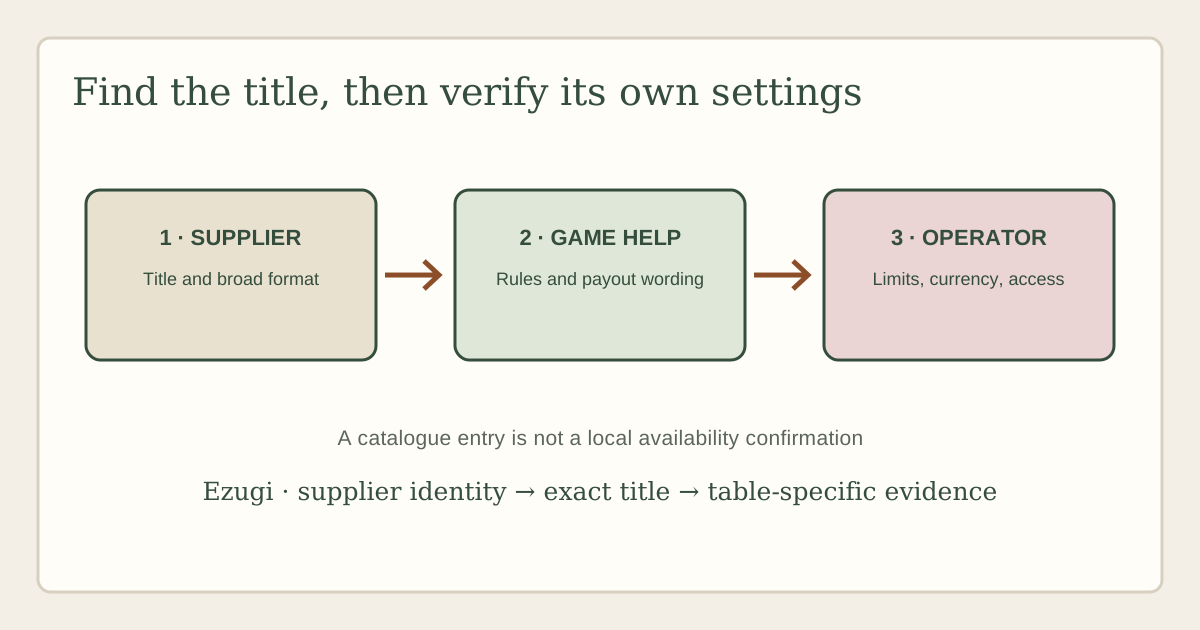
Use three separate records when researching a game: the supplier’s title page for product identity and described mechanics; the help panel attached to the precise game table for its visible rules and payout notation; and the operator’s own terms or account interface for currency, eligibility, location access and account conditions. If one of those layers does not publish a requested figure, mark it as unverified instead of borrowing a value from a similarly named title, a third-party review or a different jurisdiction. This page is the site’s Ezugi provider hub. It is not an operator list, casino recommendation, or complete review of each Ezugi game.
What Ezugi means in this guide
Ezugi is the entity being navigated here: the supplier brand and its own published catalogue. Evolution’s corporate brands page lists Ezugi alongside Evolution, while the Ezugi product showcase has its own portfolio and product descriptions. A shared corporate portfolio does not erase the product-brand distinction. When the question is about an Ezugi title, start with the Ezugi catalogue and the exact title page, even if corporate material is hosted on an Evolution domain.
The catalogue description says Ezugi’s offer includes live dealer games and supporting distribution, back-office, support and player-retention products for licensees. Those are supplier-side service descriptions, not information about the terms of an individual casino account. They do not tell a player which cashier methods, identity checks, table limits, language options or responsible-gambling controls a particular operator supplies. This page therefore keeps the user-facing task narrow: identify the supplier title, understand what the public description actually establishes, and note what still requires a table-specific check.
The word “portfolio” also does not mean every possible product can be found in a single public carousel. A page may feature selected games, use a See All link, and then present a subset of product tiles. Tiles can rotate or move. A missing title may be absent from that page’s featured row without proving the game was discontinued. Conversely, a visible tile does not prove a title is enabled at a New Zealand-facing operator. Treat inclusion as evidence of a supplier listing at the time you checked it, no more.
Start with the supplier’s own catalogue
Open the official Ezugi page and search the exact spelling of the title you want. Check the page heading, the product’s own card and the destination URL. The title should match across those three places. Similar names are common in live casino products: a “roulette” label may indicate a standard live table, a speed variant, a themed multiplier product or an automatic-wheel format. A title such as EZ Baccarat is not interchangeable with every baccarat game, and EZ Marble Race Las Vegas is not the same game as Evolution’s Marble Race.
Record the supplier page URL and the date you inspected it. If the page shows an announcement date, keep that separate from the date you checked it. A current catalogue appearance does not tell you the product’s original release date. If the page’s title, images or game description contradict the operator’s lobby, do not silently choose one. Record the mismatch and check whether the operator offers another version with a similar name.
The Ezugi supplier showcase reviewed for this guide included a set of featured products and brief descriptions. It describes Ultimate Roulette as a roulette variant with randomly selected number multipliers and an option to purchase additional multipliers. It describes Casino Hold’em as a live dealer poker game where a player’s two cards and five community cards are used to make the best five-card hand against the house. It describes EZ Marble Race Las Vegas as a five-marble race using pre-recorded but unique races. Those examples show why the page is a starting point: each tells a reader how to recognise a product family, but not every settlement detail or table configuration.
Read format labels without over-interpreting them
Live dealer tables
A live dealer format normally presents a game through a streamed studio environment with an interface for selecting markets or actions. The supplier page may mention dealers, cameras, chat, multiple games or mobile support. Such a broad description does not establish that every table has the same camera layout, chat availability, language, seat capacity or action timer. These are session-level interface details. A reader evaluating an actual table should look at that table’s help panel and the controls visible before any action is taken.
Live table products can also be variants of familiar games. A variant may add a side market, a multiplier feature, an altered round pace or a distinctive dealing sequence. The familiar game name is not enough to infer rules. For example, a classic roulette table and an Ezugi roulette variant may share a wheel vocabulary but differ in how bonus multipliers enter a round. Read the product-specific page rather than applying a remembered rule from another supplier’s game.
Game-show and event-style formats
Some live products are presented as a staged event: a host, track, wheel, draw, or other visual sequence determines what happens after the selection period. The animation makes the order of the steps especially important. A useful product guide should distinguish what the player selects before the event, what the supplier says happens after selection closes, what is revealed, and which condition settles a selection. The visual story is not a substitute for the market’s formal rules.
For a game-show format, look for the point at which selection closes, whether a random assignment or draw occurs after that point, and what event ends the round. Ask whether the interface shows a final result, a provisional result or a continuing bonus stage. If the public product page only describes the broad sequence, do not invent additional stages or assume an outcome is final before the displayed settlement is complete.
Themed or enhanced variants
Words such as Ultimate, Speed, EZ, Auto or Las Vegas are part of product identity, but a label alone is not a technical rule. “Ultimate” may be attached to a variant with multipliers; “Speed” may refer to a shorter table cycle; “EZ” appears in multiple Ezugi product names. Do not infer the exact feature from the label. Open the associated product page and confirm its descriptive text. Then check the table help to learn how the operator presents the feature and which choices actually exist.
The same caution applies to themed graphics. A city theme, sports motif or branded presentation can make products easy to recognise, but it does not determine the return schedule, the allowed stake range or the local legal status. Use the theme only for identification. Use the product rules for mechanics and operator terms for account conditions.
A practical catalogue map
This table is deliberately a map rather than a ranking. It records example Ezugi products the official showcase displayed when checked on 6 October 2026 and the next question to answer on their own page. The examples are not a complete catalogue and are not New Zealand availability confirmations.
| Example title | Supplier-page cue | What the public cue does not settle |
|---|---|---|
| New Speed Roulette | A roulette product listed among featured Ezugi games | Exact timer, full bet grid, table limits, and any operator-specific configuration |
| Ride Free Blackjack | A named blackjack product on the Ezugi showcase | Whether a given operator instance uses the same rules as a similarly named product from another brand |
| Ultimate Flip | A distinct Ezugi title in the featured row | The exact choice set, settlement table, version and limits unless the product help says so |
| Ultimate Roulette | Roulette with randomly assigned number multipliers described by the supplier | A full probability schedule, purchase terms, operator setting or any result frequency |
| Casino Hold’em | Live poker format using a player hand and community cards to form a five-card hand against the house | Complete qualifying rules, tie settlement, commission, side-bet paytable or table limits |
| EZ Marble Race Las Vegas | Five marbles and unique pre-recorded race footage in the supplier description | Exact wager grid, payout values, current table access or how this differs from other marble products beyond the official description |
| Sic Bo | Dice-game title displayed in the Ezugi showcase | The exact available markets and payout schedule for a specific table |
| EZ Baccarat | Ezugi baccarat title listed among featured games | Commission, side bets, tie rules or any operator-specific variation |
| EZ Dealer Roulette Hindi | A language-qualified roulette title | Whether the interface or dealer language is selectable for a particular account and session |
| American Football Auto Roulette | A sports-themed automatic roulette title | Whether its wheel, betting window, interface or rules match a different auto-roulette game |
The map helps a reader formulate the right follow-up question. It intentionally leaves blank anything the public page does not establish. If the operator’s lobby calls a game by a shortened title, use the supplier page and table help to compare it before treating it as the same product. If the operator’s version label is hidden, do not claim that a supplier page proves a full match.
A three-layer verification method
Layer one: confirm product identity
At the supplier layer, capture the exact title, page heading, product URL and broad format. Note the named supplier brand as well as any corporate footer. If there is a release note, write down its wording and date. Keep these fields separate: a corporate brand relationship is not a title-level release statement, and a feature card is not a complete product specification.
Check identity before looking up rules. It prevents errors caused by similar names, catalogue changes and third-party review pages that group products by theme. If the supplier’s product page points to another title or a particular variant, use that path. Do not use a search snippet as a substitute for opening the actual destination page. If the page cannot be accessed in the reader’s region or browser, mark the verification limitation rather than claiming the information was unavailable everywhere.
Layer two: read the exact game help
At the game layer, open help from the table instance you are considering, before taking any action. Look for the game title, version or table name, rules, bet type definitions, winning condition, payout notation, tie rules, side-bet terms and stake limits. For a product with multiple stages, read every relevant panel, not just the first pop-up. Save the source path and date if the rule is likely to change.
Check whether the help calls a displayed figure a payout, multiplier, win, return or net profit. Those terms may not mean the same thing. If a ratio is shown, ask whether the original stake is returned in addition to the stated amount. If a feature can alter a result, look for the sequence and any conditions that apply. If the help is silent, the answer is “not stated in the help checked,” not a guess based on standard roulette or blackjack rules.
Layer three: confirm the operator context
The operator layer answers questions the supplier cannot answer about a player’s account. Check the operator’s own terms for location eligibility, age, identity verification, currency, payment conditions, account restrictions and responsible-gambling controls. The currency shown at one operator is not a universal Ezugi setting. A game tile appearing in a lobby is also not enough to establish that every account or location can open it.
Keep the country and jurisdiction attached to any settings you record. “This table displayed a NZD minimum of X on date Y” is more precise than “Ezugi has a minimum of X.” If an operator changes its configuration, the supplier’s general page may remain unchanged. If an offer or access condition is involved, only the current operator document can establish it; this guide does not carry an offer or affiliate link.
What to do when sources disagree
First check whether the sources describe the same exact product. A named side bet, variant suffix, language label or “infinite” qualifier may distinguish two versions. Next compare the source dates. A review written several years ago may accurately describe a prior interface while no longer matching the current game help. Then check jurisdiction and operator: identical titles can be configured differently or offered under market-specific rules.
If a third-party guide says a particular RTP, paytable, table range or title count and the official supplier page does not, do not automatically copy that figure into a general Ezugi guide. Determine whether the third party names an operator, market, version and date. Without those details, the number may have no reliable scope. If the official page also omits it, mark it as unknown. A useful guide can explain how to verify a value without supplying a fabricated value.
If an official product page and a game help panel conflict, prioritize the help attached to the precise active table for how that table is displayed, while recording the supplier-page discrepancy. The operator’s own terms may introduce another layer. Do not silently resolve a conflict in favour of the value that sounds most attractive. A reviewer should be able to reproduce the verification from the links and date in the article.
Release status and catalogue freshness
A catalogue card proves a page was in view at the time of checking; it does not necessarily prove a particular commercial launch date. Distinguish four states: a supplier page exists; an announcement was published; a product is visible in an operator lobby; and an account can actually open the product. Each state needs its own evidence. A freeplay button can also be subject to jurisdiction, and it is not proof that real-money play is permitted in any location.
The official Ezugi showcase reviewed here presented its featured row on 6 October 2026. That is a checked date for the source, not the release date of every featured title. The page includes language about freeplay being subject to jurisdiction. Therefore this guide does not say that any Ezugi game is available through a New Zealand operator, that a demo will load for a local reader, or that a specific account is eligible.
When refreshing this page, compare the catalogue directly rather than merely updating the date in the footer. Remove titles no longer visible only after checking whether a product has moved or its URL has changed. Add new examples only after opening their supplier pages. Keep a note of the comparison date and preserve the title spellings. This makes an editorial update traceable and avoids quietly treating the old featured carousel as a permanent catalogue.
Mobile, language and interface checks
Evolution’s Ezugi page describes broad support for multiple devices and languages, and mentions interactive live features. A general statement is useful context, but it does not certify the exact operator interface on a particular handset. A mobile test should ask whether the table name remains readable, all bet labels are visible, controls stay distinct, history can be opened, and the help panel scrolls without covering its close button. If the session uses a portrait layout, confirm that the outcome and bet selections remain understandable without rotating the device.
Do not infer that every game is available in every language just because the provider says it supports multiple languages. A language might apply to menus, dealer audio, written help or only certain products. Look at the actual table’s language control and read the displayed terms in the selected language. An auto-translated page may help navigation but should not be treated as an authoritative translation of a payout rule.
On a smaller screen, compare icons with their text names. A colour, card, marble or roulette graphic may be compact and easy to misread. Before a choice is committed, the interface should make the selected bet type and amount clear. If the summary is ambiguous, do not proceed based on the animation. Reopen the selection or the game help and verify the entry. Accessibility and legibility are part of understanding the rules, not a cosmetic extra.
New Zealand context and responsible use
The guide is written in en-NZ for readers researching supplier material, but local language does not imply local game access. The Department of Internal Affairs states that online casino providers must not advertise to people in New Zealand during the present transition. Its advertiser guidance says the advertising prohibition is in effect and notes that advertising and marketing rules apply to providers that publish or arrange for publication, including third parties. This site therefore carries no Ezugi operator offer, CPA button or referral link.
The distinction matters when a reader encounters an external page, a freeplay demonstration or an operator lobby. The supplier itself says demo mode and individual game features are subject to jurisdiction. Do not treat a playable video as proof of local eligibility, legal status, or a real-money product. For current rules about the market, consult the Department’s current guidance and do not infer eligibility from the studio’s international catalogue.
Game descriptions explain product mechanics; they do not predict personal outcomes. A past result, a streak, an animation or a “hot” label does not establish what will happen in a later round. If gambling stops being entertainment or affects money needed for essentials, pause and use New Zealand support services. Help details are available through the site’s safer gambling information. No article should encourage chasing a loss, borrowing, or treating a game as income.
From the provider hub to a specific game guide
The most efficient path is to identify the format first and then open a title-specific guide. This site’s selected game guide index is not an Ezugi catalogue mirror: it lists the game pages actually maintained here. In this package, the new individual-game pages concern Evolution-branded Marble Race, War, Race Track and Bet Stacker Blackjack. They are separate title guides, and none of them should be relabelled as an Ezugi product merely because Evolution’s site also hosts the Ezugi supplier page.
Before clicking an internal guide, compare the exact title and brand. If the question is about the supplier’s EZ Marble Race Las Vegas, the relevant source is the Ezugi/Evolution page naming that product. The site’s Evolution Marble Race page explains the Evolution-branded product with six marbles, a different product description from the five-marble Ezugi listing. The matching internal Evolution Marble Race guide exists to prevent a same-theme search from blending two distinct games. It does not purport to review the Ezugi race.
For another Ezugi title, use the supplier page’s destination and seek an exact game help panel. This site does not create a separate full review simply because a title is on a featured carousel. The practical benefit is a clear ownership boundary: this page navigates the Ezugi catalogue; a single-game guide answers one named product’s rules; and the operator remains responsible for account-specific access and settings.
A reusable verification worksheet
For each title, copy a compact set of fields into your notes. The first group establishes identity: displayed title, supplier brand, supplier URL, broad format and date checked. The next group captures mechanics: round order, available markets, winning condition, tie or void handling, feature triggers and any player decisions after the initial selection. The final group captures configuration: displayed currency, lower and upper stake values, payout notation, side-bet tables, return percentage if explicitly shown, operator name, jurisdiction and rules version.
Use a blank value when information is not visible. A blank is more precise than a number collected from another site without its scope. You can label each field “supplier-confirmed,” “table-help confirmed,” “operator-term confirmed,” or “not found.” This simple provenance scheme is especially helpful if a game has a main bet plus several extras. It tells a reader which parts of the explanation are product-level facts and which parts depend on the current operator.
Do not record a partial screenshot without the surrounding context. Keep the title and route visible, or note them alongside the image. If the help panel names a version or table, include it. If settings can vary, say that your observation applies to that table and date only. If it cannot be independently checked, do not claim that it was tested. This page is based on published supplier material and does not claim a personal play session.
Common mistakes when using provider guides
One frequent mistake is to treat a provider profile as a review of every product in its portfolio. A provider hub can explain how to navigate titles and identify broad formats, but the detailed rule question belongs on a product page. Another mistake is to conflate a product tile with local availability. A catalogue can be international and jurisdiction-qualified. A third is to copy the first payout number found in search without checking whether it is a maximum, a multiplier, a net payout, or a specific market’s table.
People can also mix up suppliers within a corporate family. Evolution and Ezugi can be related in corporate material while retaining their own branded game portfolios. Use the supplier name attached to the title, not only the domain that hosts the page. Product pages hosted on the same domain may represent different brands. That is exactly why the brand label, official page path and title need to be recorded together.
Finally, do not mistake dramatic presentation for a rule. A dealer’s narration, a themed track or a multiplier animation can make the sequence intuitive but may omit an important settlement condition. The help panel governs the formal market. If its terminology conflicts with a summary, prefer the current specific rule text and report the discrepancy. Do not invent a cleaner explanation than the source supports.
Questions readers commonly ask
Is Ezugi a game or a supplier?
Ezugi is the supplier brand whose live game catalogue is the subject of this page. It contains multiple distinct products, so the brand name alone does not tell you which rules apply. Start with the exact title page, then read the specific table help.
Is Ezugi part of Evolution?
Evolution’s corporate brands page lists Ezugi alongside Evolution, and the official Ezugi product showcase is hosted on Evolution’s games site. That corporate context does not make every Ezugi-branded product an Evolution-branded game. Use the exact brand and title stated on the product page.
Does the catalogue list every current Ezugi product?
The page reviewed displays featured products and a See All navigation option. The featured carousel is not documented as a permanent complete inventory. Record what the page showed on the date you checked it and follow the official catalogue destination for any additional title.
Does an Ezugi catalogue page prove a game is available in New Zealand?
No. A supplier page establishes supplier-published information about a product, not that an operator offers it to a particular person or account in New Zealand. Check current official market guidance and operator terms separately.
Where do exact limits and payouts come from?
Use the rules/help attached to the exact table for its payout and limit information, and the operator’s terms for account and jurisdiction conditions. If a number is missing or its settlement meaning is unclear, treat it as unverified rather than copying a figure for a different table.
Is EZ Marble Race Las Vegas the same as Evolution Marble Race?
The official Ezugi description identifies EZ Marble Race Las Vegas as a five-marble product with unique pre-recorded races. Evolution’s separate Marble Race page describes six coloured marbles and first-place or ordered first-and-second markets. The names and themes overlap, but these are distinct product descriptions.
Can I rely on a demo to prove local availability?
No. Evolution’s games site says freeplay demo mode and individual features are subject to jurisdiction. A demo loading in a browser would not establish a real-money operator’s eligibility terms or local regulatory status.
Does this guide recommend an Ezugi operator?
No. It is a supplier-catalogue navigation guide. It has no operator ranking, offer, referral link or affiliate call to action. The user should rely on current official sources for access and rules.
Sources and verification boundary
The official Ezugi catalogue and Evolution corporate brands page were checked on 6 October 2026. The catalogue confirmed the displayed featured titles and the product-level descriptions for Ultimate Roulette, Casino Hold’em and EZ Marble Race Las Vegas described above. Evolution’s separate Marble Race page was checked on the same date. Secondary provider directories reviewed on 6 October 2026 varied in product categorisation and included older or unsupported figures; those figures are not repeated as universal facts. This guide does not provide an Ezugi RTP, complete game count, stake range, full payout tables, operator availability or New Zealand access claim. The New Zealand DIA advertiser and customer guidance was also checked on 6 October 2026.
